
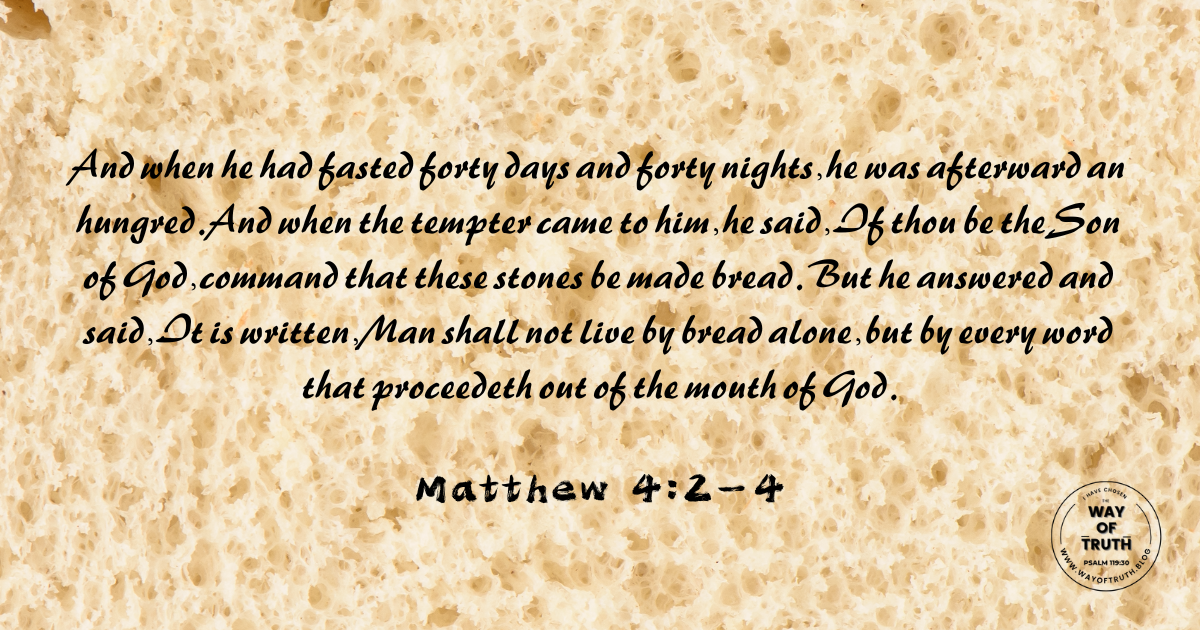
Matthew doesn’t rush past the hardship. “When he had fasted forty days and forty nights, he was afterward an hungred.” That’s not a casual remark. Forty days of fasting means real physical weakness. The Son of God enters temptation not at His strongest but at the edge of exhaustion.
This detail matters because it shows that Jesus experienced genuine human limitation. He’s not pretending to be hungry. He is hungry. The incarnation isn’t theatrical. The eternal Son truly took on human nature.
The number forty echoes familiar biblical patterns. Moses fasted forty days on Sinai. Israel wandered forty years in the wilderness. Elijah traveled forty days to Horeb. Scripture repeatedly uses wilderness seasons to mark preparation, testing, and revelation.
Jesus stands at the intersection of those stories. He’s the true Israel who will succeed where Israel failed.
Then the tempter arrives.
The devil doesn’t begin with a blatant command to worship evil. He begins with a suggestion that seems reasonable. “If thou be the Son of God, command that these stones be made bread.”
The temptation is subtle. Jesus is hungry. Bread would solve the problem instantly. And the power to do it exists.
But the challenge is deeper than hunger. “If thou be the Son of God.” The devil is pressing on identity. The voice from heaven declared Christ’s sonship just one chapter earlier. Now the adversary invites Him to prove it.
Temptation often works the same way. It disguises rebellion as practicality.
The Battle Over Trust and Provision
At first glance, turning stones into bread may not appear sinful. Jesus will later multiply bread for crowds. Why not now?
The issue isn’t the miracle itself. The issue is obedience. The Spirit led Him into the wilderness. The Father’s will governs the timing of His power.
To create bread here would mean stepping outside that dependence. It would mean using divine authority to satisfy personal need rather than to fulfill the Father’s mission.
That is why Jesus responds with Scripture: “It is written.”
He quotes Deuteronomy 8:3, where Moses reminds Israel that God allowed them to hunger in the wilderness so they would learn a deeper truth: life is sustained not merely by physical provision but by God’s word.
Israel failed that lesson repeatedly. When hungry, they complained and distrusted God’s care. Jesus succeeds where they failed.
“Man shall not live by bread alone.”
Bread is necessary. Scripture never denies physical needs. But bread isn’t ultimate. Life is anchored in something deeper: “every word that proceedeth out of the mouth of God.”
Christ refuses to treat God’s will as negotiable even under pressure.
Skeptics sometimes treat the devil in this passage as symbolic. Yet the narrative presents a real dialogue with a personal adversary. Jesus answers him directly. Later New Testament writers treat Satan the same way. The Bible’s worldview includes both spiritual opposition and divine authority over it.
The key point is clear: temptation is defeated not by clever reasoning but by trust in God’s word.
Feeding the Soul in a Hungry World
This passage presses on a question many of us rarely ask: what truly sustains life?
Modern culture assumes the answer is obvious. Security, income, comfort, and opportunity. In other words, bread.
Jesus doesn’t deny the importance of provision. But He refuses to treat it as ultimate. Life can’t be reduced to material survival.
We live in a time that constantly encourages us to chase the next form of bread. More convenience. More entertainment. More control over our circumstances. None of these things are evil by themselves. But they become dangerous when they replace dependence on God.
The wilderness exposes priorities. When comfort disappears, the heart reveals what it truly trusts.
The church also needs this reminder. It’s easy to believe that ministry success depends on resources, influence, or visibility. Yet the life of God’s people has always been sustained primarily by His word.
Programs don’t create spiritual life. God’s word does.
Individually, this passage invites a simple question: what feeds your soul?
Many believers are spiritually undernourished not because Scripture is unavailable but because it’s neglected. We snack constantly on news, opinions, and entertainment, yet treat God’s word as an occasional supplement.
Jesus shows a different posture. In the moment of testing, Scripture was already within Him. He didn’t scramble to find it. He spoke it.
The wilderness didn’t produce His trust in God’s word but revealed it.
If You Are Trying to Live on Bread Alone
There’s a deeper issue behind this passage.
Most people spend their lives chasing forms of bread. Success, approval, pleasure, and security. These things promise satisfaction but can’t sustain the soul.
The reason is simple. Human beings were created for more than survival. We were created for fellowship with God.
Sin broke that fellowship. Our rebellion separated us from the God whose word gives life. The result is spiritual hunger that nothing in this world can fully satisfy.
Jesus entered the wilderness and faced temptation not only as an example but as a substitute. He obeyed where humanity failed. Later He would go to the cross and bear the judgment our sin deserves. He rose again, opening the way back to God.
The One who refused to turn stones into bread later called Himself the Bread of Life.
If you’ve never trusted Him, the hunger you feel can’t be solved by more achievements or experiences. It can only be satisfied by reconciliation with God.
Turn from sin. Trust in Christ alone. Believe that His death and resurrection provide the forgiveness and new life you need.
You can’t live on bread alone. But in Christ, you can truly live.
Reflection and Response
- What does Jesus’ response teach me about the role of Scripture in resisting temptation?
- In what ways do I try to satisfy deeper spiritual needs with “bread alone”?
- How does Christ’s victory in the wilderness encourage me in my own struggles?
- What practical steps can help me feed my life more consistently on God’s word?
- Have I personally trusted in Christ, the true Bread of Life, for salvation?
Good post
Thank you, Brandon! God bless you, Brother!