
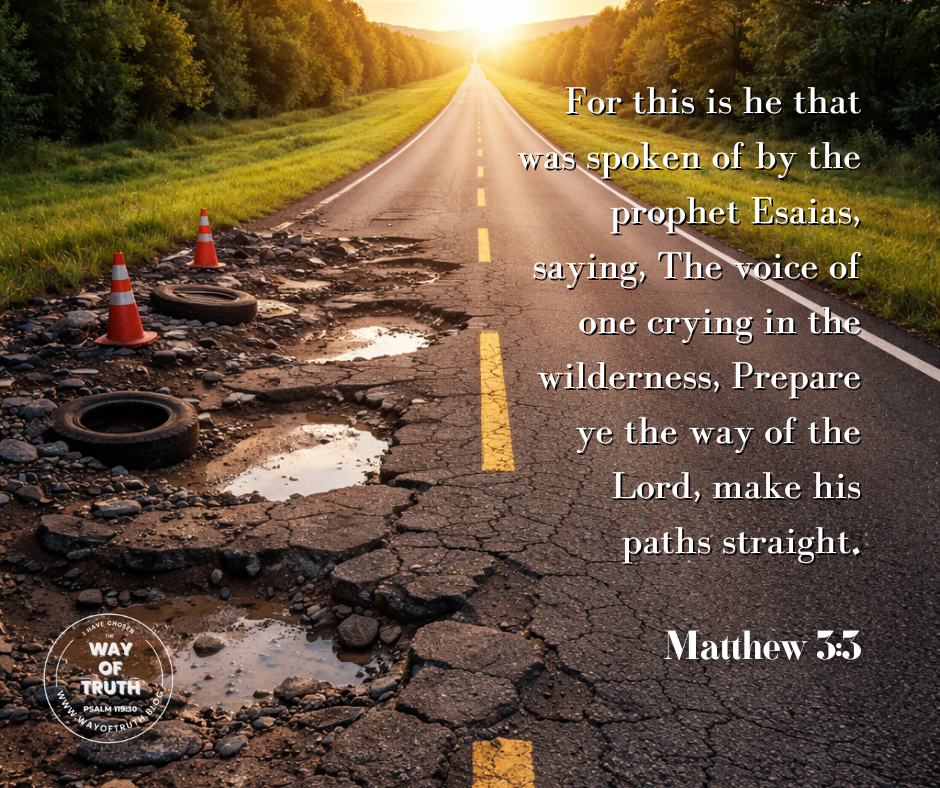
Matthew anchors John the Baptist in prophecy. John is not self-appointed. He’s the fulfillment of what “was spoken of by the prophet Esaias.”
Matthew quotes Isaiah 40:3, a passage originally addressed to Israel in exile. In Isaiah’s context, the voice announced comfort and the coming of God’s saving presence. The wilderness imagery signified both judgment and renewal. Now, centuries later, that prophetic voice finds concrete embodiment in John.
Notice the emphasis: “The voice of one crying.” John is described not first as a personality, but as a voice. His identity is secondary to his message. That alone confronts modern instincts. We’re tempted to build ministries around charisma. Scripture builds them around proclamation.
The location remains significant. “In the wilderness.” This isn’t accidental staging. The wilderness had been the place of Israel’s testing, wandering, and dependence. It was also the place where God formed them as a people. The fact that the preparatory voice sounds there signals both continuity and correction. Israel must be spiritually re-formed before receiving her King.
“Prepare ye the way of the Lord.” In ancient times, roads were cleared and leveled for royal processions. Obstacles were removed. Paths were straightened. Matthew applies that imagery to hearts. The Lord Himself is coming, and preparation is required.
This isn’t preparation by works that earn salvation. It’s preparation by repentance that acknowledges need. The command assumes that something is misaligned. Paths are not naturally straight.
Apologetically, the text strengthens confidence in Scripture’s unity. Isaiah’s prophecy wasn’t an abstract poetic flourish. It anticipated a real historical forerunner. Matthew’s citation isn’t forced; it’s contextual. Isaiah spoke of God’s coming deliverance. Matthew identifies that deliverance in the arrival of Christ.
Some critics argue that the Gospel writers retrofitted Old Testament passages to fit Jesus. But this verse doesn’t stretch Isaiah beyond recognition. It draws out what Isaiah explicitly declared: God Himself would come, and a voice would prepare the way. John fits that description with remarkable precision.
Matthew 3:3 announces that the coming of Jesus is not a religious innovation. It’s the unfolding of a long-promised plan.
Straight Paths for a Holy King
The imagery of road construction may not seem applicable to our faith, but the spiritual meaning is immediate. Preparing the way of the Lord means removing what obstructs His rightful rule.
John’s ministry didn’t involve bulldozers. It involved truth. The crookedness he addressed was moral and spiritual. Pride, hypocrisy, complacency, and self-righteousness. These were the rocks and ruts in the road.
For believers today, the call remains relevant. Christ has come, yet we still prepare our hearts daily for His reign. Sanctification is, in part, the ongoing straightening of paths. Not because we earn His presence, but because we desire unhindered fellowship with Him.
The Church must also hear this corporately. When a congregation tolerates unconfessed sin, cultivates division, or prioritizes appearance over holiness, it creates crooked paths. We can’t claim to welcome the King while resisting His authority.
At the same time, there’s encouragement here. The command to prepare assumes that God intends to come near. He’s not distant and disinterested. The very reason preparation is meaningful is because His arrival is certain.
On a personal level, consider what obstacles you quietly defend. We often know where the path bends. We rationalize attitudes or habits that dull our sensitivity to God. John’s message is not cruel; it’s clarifying. Straight paths are freer paths.
There’s also a lesson in John’s self-understanding. He’s a voice, not the destination. That humility should shape Christian witness. Our task is not to draw attention to ourselves but to direct attention to Christ. If people leave impressed with us but unchanged before Him, the road remains crooked.
Finally, preparing the way isn’t a grim, joyless exercise. In Isaiah, the announcement of the voice precedes comfort and glory. The leveling of the road leads to the revelation of the Lord. Repentance clears the way for joy.
We prepare because the King is worthy. We straighten paths because His reign is good. Our obedience glorifies God and testifies to a watching world that His kingdom is real.
The King Who Walked the Straightened Road
The command to prepare the way ultimately points beyond John to Jesus.
We prepare because we’re not ready on our own. Sin bends the road of our lives away from God. Scripture is clear: all have sinned. The penalty for sin is death. No amount of self-improvement can level the terrain enough to make us worthy of a holy King.
Yet the Lord didn’t wait for perfect roads.
Jesus walked into our wilderness. He lived without sin, perfectly aligned with the Father’s will. He then went to the cross, taking upon Himself the judgment that crooked lives deserve. His death satisfied divine justice. His resurrection declared victory over sin and death.
Repentance prepares the way, but Christ accomplishes the rescue. Faith rests not in our straightened paths but in His finished work.
If you’ve never turned to Him, hear the invitation. The King has come. Confess your sin. Stop defending what separates you from God. Trust in Jesus Christ alone, believing that His death and resurrection are sufficient to save you.
He doesn’t demand polished perfection. He calls for honest repentance and genuine faith. In Him there’s forgiveness, new life, and the promise of eternal fellowship with God.
And if you already belong to Him, continue preparing the way in your own heart and in your witness. Let your life point clearly to the Lord whose paths are straight and whose kingdom cannot be shaken.
Reflection and Response
- What “crooked paths” in my life need to be straightened in light of Christ’s reign?
- Do I see repentance as preparation for deeper joy in the Lord?
- In what ways can my words and actions function as a clear voice pointing to Christ?
- How does the unity between Isaiah’s prophecy and John’s ministry strengthen my trust in Scripture?
- Am I preparing daily for the Lord’s rule in my life, or resisting it quietly?