
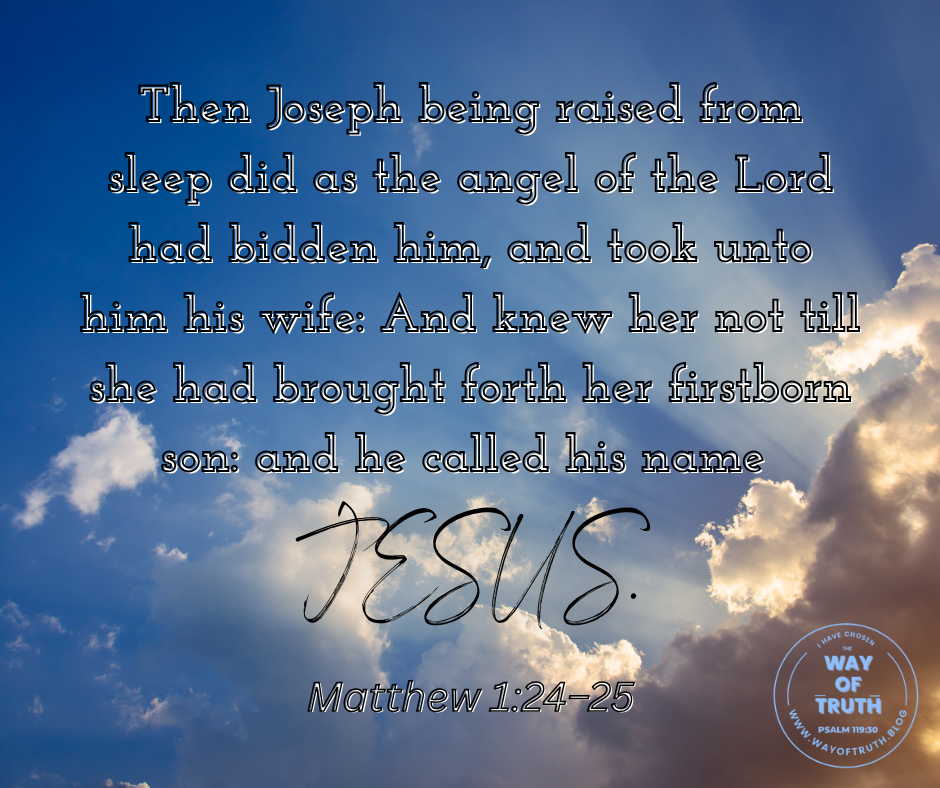
Matthew closes chapter one with remarkable simplicity. After dreams, angels, prophecy, fear, and confusion, the story settles into action. “Then Joseph being raised from sleep did.” That’s it. No speech. No argument. No delay. Joseph wakes up and obeys.
The verse draws a straight line between God’s word and Joseph’s response. There’s no gap filled with negotiation or half-measures. Joseph does exactly what he was told. He takes Mary as his wife, publicly aligning himself with a situation that will almost certainly invite suspicion and misunderstanding. Obedience here isn’t safe or reputation-preserving. It’s costly.
Verse 25 adds a detail Matthew clearly wants us to notice. Joseph “knew her not till she had brought forth her firstborn son.” This is not prudishness or unnecessary detail. It safeguards the truth Matthew has been careful to establish all along. Jesus’ birth is holy, intentional, and untouched by human origin. Joseph’s restraint isn’t accidental; it’s obedience shaped by reverence.
Finally, Joseph names the child. “He called his name JESUS.” This matters more than it may seem. By naming the child, Joseph legally claims Him as his own. He steps fully into the role God has given him. He doesn’t hover at a distance. He commits.
These verses quietly dismantle the idea that obedience must be loud or dramatic to be real. Joseph doesn’t preach a sermon. He doesn’t defend himself. He simply does what God says. Scripture doesn’t rush past this moment because it shows what genuine faith looks like when revelation ends and responsibility begins.
Faith That Acts Without Needing Validation
Matthew 1:24–25 speaks powerfully to believers who are tempted to overcomplicate obedience.
Joseph’s response shows us that faith isn’t proven by intensity of feeling, but by follow-through. He doesn’t wake up energized by certainty or shielded from consequence. He wakes up to the same world he fell asleep in, but now with clarity from God. And that clarity demands action.
Many believers wait for obedience to feel easier, safer, or more socially acceptable. Joseph never gets that luxury. His obedience places him under suspicion. It costs him control over how his story will be told. That’s often the case. Obedience rarely comes with a guarantee of understanding from others.
This passage also speaks to integrity in private decisions. Joseph’s restraint in verse 25 is unseen by the world, but not by God. Faithfulness often shows itself in choices no one applauds or even notices. That kind of obedience forms character. It trains the heart to honor God for who He is, not for the recognition obedience might bring.
For the Church, these verses are a reminder that belief must be matched by obedience. We’re not called only to affirm doctrines about Christ, but to live in ways that reflect trust in Him. When the Church confesses Christ but hesitates to obey Him, it sends mixed signals to the world.
Joseph’s example also encourages believers who feel their role is small or overlooked. Joseph doesn’t preach, heal, or perform miracles. He protects, provides, obeys, and names the Savior. That’s enough. God uses ordinary obedience to accomplish extraordinary purposes.
There’s a quiet challenge here, too. Joseph doesn’t ask for further explanation. He doesn’t request a second sign. He doesn’t ask God to soften the consequences. He trusts that obedience is enough.
Faith that waits for applause is fragile. Faith that obeys because God has spoken is strong. Joseph models the latter.
The Obedience That Led to the Savior
Joseph’s obedience clears the final human obstacle to the arrival of the Savior. But the gospel doesn’t rest on Joseph’s faithfulness. It rests on Christ’s.
The name Joseph gives the child tells us why Jesus came. He came to save His people from their sins. Sin isn’t a small problem. It separates us from God, corrupts our hearts, and carries a real penalty. No amount of effort or sincerity can undo that damage.
God’s answer was not instruction alone, but incarnation. Jesus entered the world through obedience like Joseph’s, but He would live a life of perfect obedience Himself. Where we fail, He succeeded. Where we disobey, He remained faithful.
On the cross, Jesus took the judgment sin deserves. He didn’t avoid the cost of obedience; He embraced it fully. And when He rose from the dead, He proved that sin and death had been defeated.
The gospel calls for a response. Not admiration. Not vague belief. Repentance and faith. Turning from sin and trusting in Jesus Christ alone for salvation.
If you don’t already know Jesus Christ as your Lord and Savior, this passage invites you to consider the Savior whose name was spoken in obedience long before He spoke a word Himself. God has acted. Salvation is offered. You’re invited to trust Him.
And if you belong to Christ, let Joseph’s example shape your walk. Obedience doesn’t save you, but it reveals trust in the One who does. Follow Him. Honor Him. Live for His glory.
Reflection and Response
- What stands out to you about Joseph’s immediate response to God’s command?
- Where are you tempted to delay obedience until conditions feel safer or clearer?
- How does private faithfulness shape long-term trust in God?
- In what ways does Joseph’s example challenge how you view significance and success?
- What step of obedience might God be calling you to take right now without waiting for approval?