
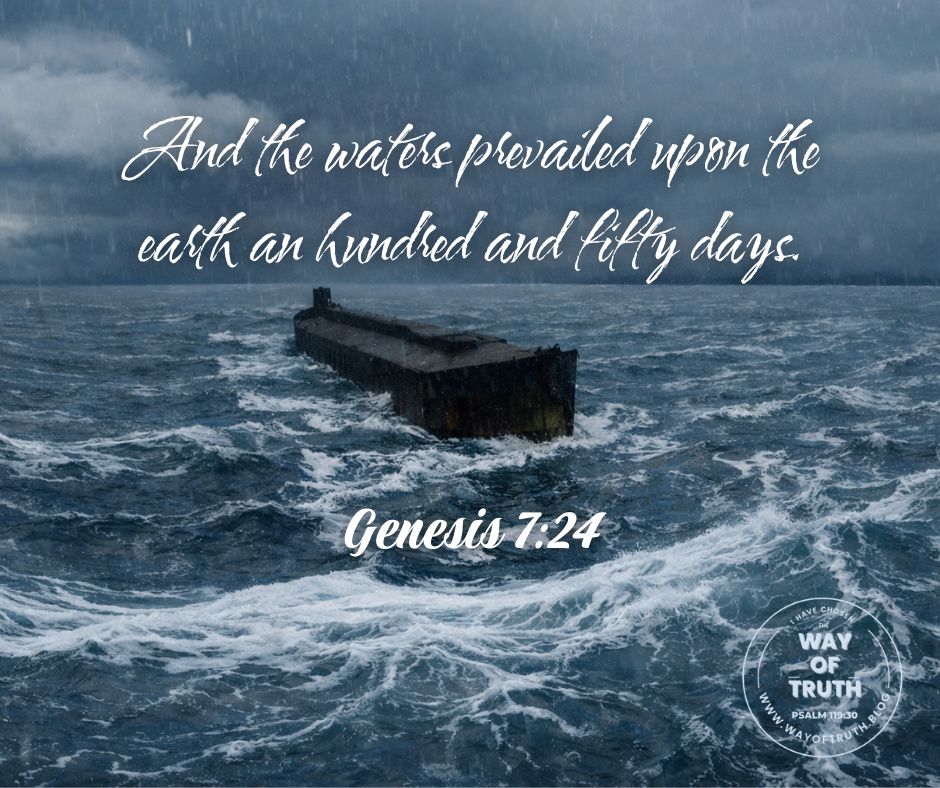
“And the waters prevailed upon the earth an hundred and fifty days” (Genesis 7:24).
Genesis 7:24 is easily passed over as a simple chronological marker. Yet its stillness carries weight. The verse doesn’t describe rising waters or falling rain. It describes time. The waters prevailed—not for a moment, not in a sudden burst of chaos—but for one hundred and fifty days. Judgment endured. Nothing visibly changed. The earth remained submerged, and those inside the ark waited.
For the believer today, this verse speaks into seasons that feel long, unresolved, and heavy. It reminds us that God’s work often unfolds slowly, deliberately, and beyond our preferred timelines.
Noah had already obeyed. The ark had already proven effective. Judgment had already begun. And yet the waters continued to prevail. Deliverance was real, but completion was delayed. Faith, in that season, was not about dramatic action but about endurance, continuing to trust God when the scene outside the ark remained unchanged day after day.
Many of us know that experience well. We obey, pray, repent, and trust, and still find ourselves waiting. Genesis 7:24 assures us that waiting does not mean abandonment. God was no less sovereign on the hundredth day than on the first. The same God who brought judgment also governed its duration.
One of the most striking features of this verse is its precision. The waters prevailed for exactly one hundred and fifty days, not fewer, and not more. Scripture does not present this number casually. It tells us something important about God’s character. Judgment is not impulsive or uncontrolled. It’s measured, purposeful, and bounded by God’s will.
That truth matters when life feels overwhelming. There are times when circumstances press down so steadily that relief seems distant. Genesis 7:24 reminds us that even overwhelming seasons have limits known to God, even if unknown to us. The waters were not permanent. They were permitted, but only for a time.
This verse also corrects a common misunderstanding about faith. Faith does not always bring immediate resolution. Sometimes faith means trusting God while nothing visibly improves. Noah could not hasten the retreat of the waters. He couldn’t see the land reemerging. He could only remain where God had placed him and trust that God would act in His time.
That kind of faith is quiet and often unnoticed. It doesn’t make headlines. Yet Scripture consistently honors it. Waiting faithfully is not spiritual weakness, but spiritual maturity. It acknowledges that God’s purposes are larger than our comfort and wiser than our urgency.
Genesis 7:24 also reminds us that judgment itself is not God’s final word. The verse marks the height of judgment, not the end of the story. The next movement of the narrative begins with a profound phrase: “And God remembered Noah” (Genesis 8:1). That remembrance did not arise because Noah endured well enough, but because God is faithful to His promises.
For believers, this points beyond the Flood to the broader pattern of Scripture. God judges sin seriously, but He never abandons His redemptive purposes. Judgment clears the ground; mercy rebuilds. The prevailing waters prepare the way for renewal.
This truth invites humility. It reminds us that God’s timing is not negotiable and not mistaken. We live in a culture that expects immediate results and quick solutions. Scripture invites us into a different posture: patient trust shaped by reverence for God’s wisdom.
Genesis 7:24 also challenges us to think carefully about how we view God’s judgment. It’s easy to imagine judgment as reckless or excessive. This verse presents something far more sobering and reassuring. God’s judgment is thorough, but it’s not careless. It lasts exactly as long as necessary to accomplish His holy purposes.
For the church, this fosters a balanced witness. We’re called to speak honestly about sin and judgment without exaggeration or fear-driven rhetoric. God doesn’t need embellishment. His Word is sufficient. At the same time, we hold fast to hope, knowing that judgment never stands alone in God’s plan.
On a personal level, Genesis 7:24 invites reflection. Are there areas of life where we’re tempted to interpret delay as absence? Are there seasons where obedience feels quiet and unseen? This verse encourages us to remain faithful where God has placed us. The waters may prevail for a time, but they don’t prevail forever.
And if you don’t already know Jesus Christ as your Lord and Savior, this verse carries a deeper invitation. The Flood reminds us that judgment is real and serious. Sin has consequences that can’t be ignored or outrun. Yet the same God who brought judgment also provided an ark. Salvation wasn’t achieved by escaping the waters, but by entering the refuge God supplied.
That refuge finds its fulfillment in Jesus Christ. At the cross, Christ bore the full weight of God’s righteous judgment against sin so that sinners could be forgiven, restored, and given new life. Salvation is not found in endurance alone, but in trusting the Savior God has provided.
If you have trusted Christ, Genesis 7:24 calls you to live with patient faith and reverent hope. If you have not, it invites you to turn to Him while the door of grace remains open. God’s judgment is measured, but His mercy is rich.
To explore this passage more deeply, including its theological and redemptive context, you’re warmly invited to read the full Bible study here: The Measure of Judgment: A Study of Genesis 7:24.