
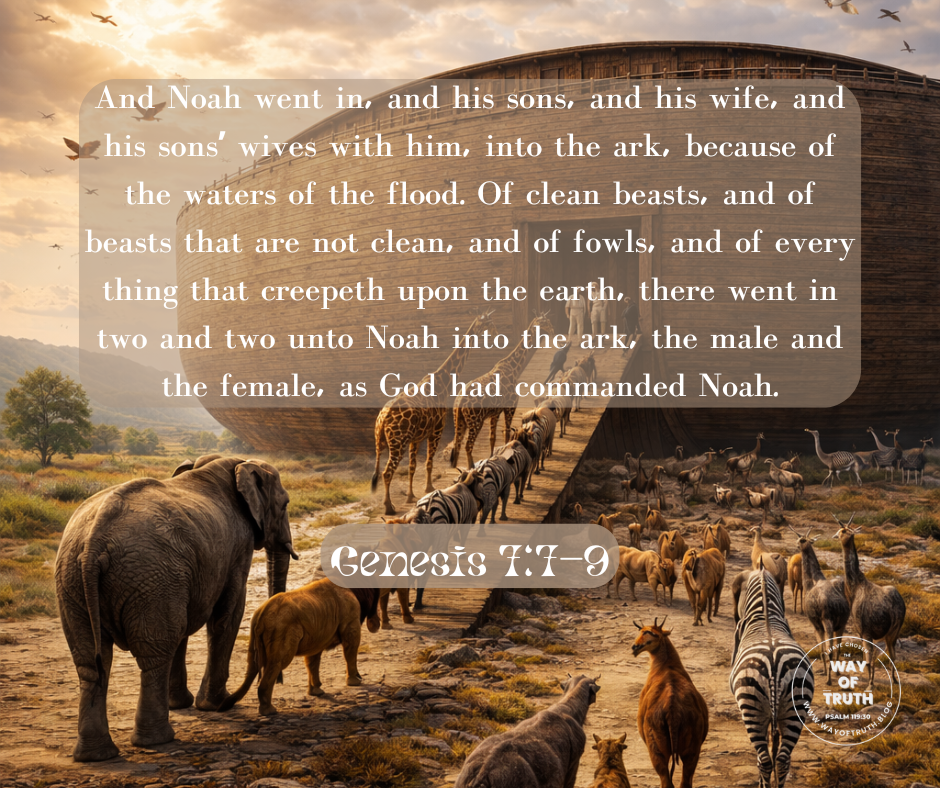
Genesis 7:7–9 captures a moment that’s quiet, deliberate, and profoundly revealing. No thunder is recorded. No rain has begun. Yet Noah and his household step into the ark because God has spoken. The text does not dramatize their emotions or speculate about their thoughts. Scripture simply tells us that they went in. Faith, in this moment, is simply obedient.
One of the most striking features of this passage is its timing. Noah enters the ark before there’s visible proof that judgment is imminent. This is the essence of biblical faith: trusting God’s word when circumstances still appear unchanged. Obedience that waits for confirmation is not really obedience at all.
There is also something deeply searching about the act of entering. The ark had been built for years. It was familiar, visible, and accessible. Yet none of that mattered until Noah and his family actually stepped inside. Preparation without participation would have left them just as exposed as everyone else. In the same way, it’s possible to live near the truth, to know the language of faith, and to admire God’s promises, while still remaining outside of full obedience. Salvation, in Scripture, is never merely observed. It’s entered.
The passage also emphasizes order and intention. The animals come ‘two and two,’ male and female, exactly as God commanded. Nothing is rushed or chaotic. Even on the brink of judgment, God isn’t frantic. His purposes unfold with precision. That truth does not promise an easy path for the obedient, but it does offer assurance that obedience is never wasted. Faithfulness to God’s word may lead through suffering rather than around it, yet it places the believer firmly within God’s will, where even hardship is neither random nor meaningless.
Devotionally, Genesis 7:7–9 invites reflection on delayed obedience. Are there areas where God has spoken clearly, yet we hesitate to step fully inside what He has commanded? Perhaps it’s an unresolved sin, a call to forgive, a step of faith that feels risky, or a truth we know but haven’t yet embraced in practice. Noah’s story reminds us that faith often requires movement before clarity.
Finally, this passage gently points us forward. The ark is not only a place of survival; it’s a place of trust. Those inside are carried through judgment by God Himself. For believers, this anticipates the greater refuge found in Christ, where salvation is not earned by effort but received by faith.
If you would like to explore these themes more deeply, you’re invited to read the full Bible study here: Entering the Ark: A Study of Genesis 7:7–9.
Genesis 7:7–9 leaves us with a simple but searching question: when God speaks, do we merely agree or do we step inside?