
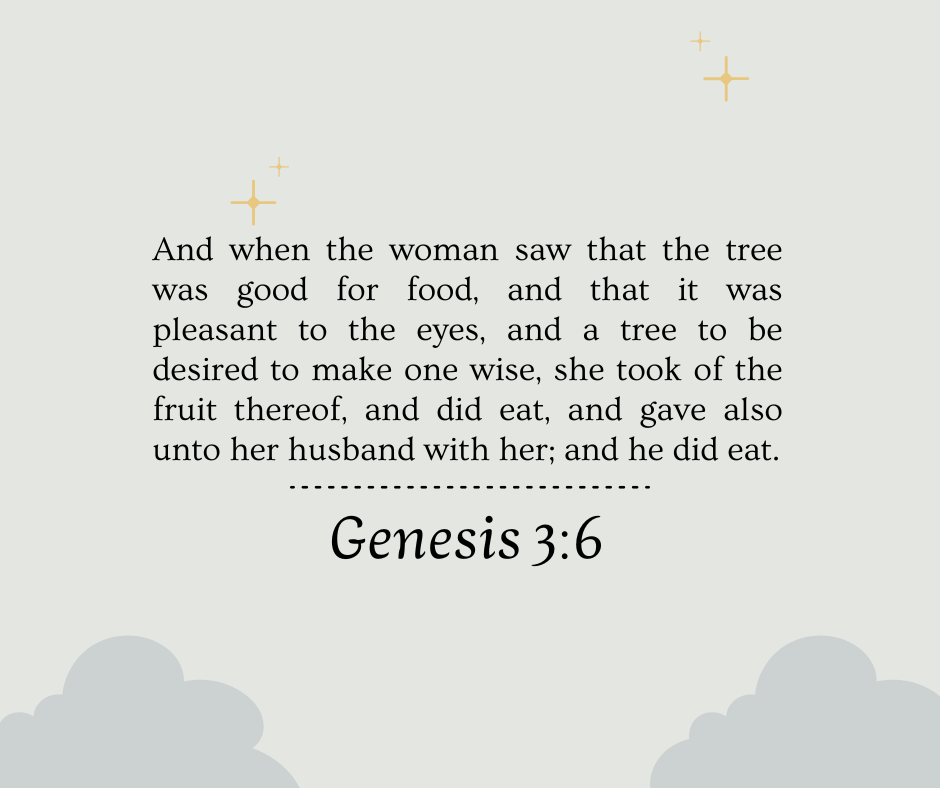
Genesis 3:6 touches nearly every major doctrine concerning sin, free will, temptation, and moral corruption. In one verse, the unity of creation collapses, the innocence of humanity is lost, and the foundations of redemption begin to stir. Here, in compact form, theologians have long recognized the genesis of hamartiology, the doctrine of sin. The verse explains how a perfect human nature became fallen, how moral autonomy supplanted divine dependence, and how this rupture extended to all creation. Each clause is like a window into a theological reality still shaping human experience.
The Nature of Sin: Rebellion Against Revelation
At its core, sin is rebellion. In Genesis 3:6, Eve’s transgression is not the product of confusion or lack of information. God’s command was simple, explicit, and clear. The sin begins not with the eating of fruit, but with a shift in trust: she ceases to view God’s Word as the measure of truth and begins to rely on her own perception. What was once revelation becomes subject to her evaluation. When Scripture later says, “Whatsoever is not of faith is sin” (Romans 14:23), it describes precisely what happens here: sin originates in unbelief. It is an epistemological crisis before it is an ethical one.1 Humanity no longer trusts the truthfulness of God’s Word, and from that distrust, every moral failure flows.
Sin thus emerges not as mere moral weakness but as cosmic treason, a deliberate dethronement of God in the human heart. Eve’s act redefines what is “good” apart from divine decree. The moral order that once radiated outward from God’s will now bends inward around human desire. In this sense, the Fall is not only the first sin but the archetype of all sin: the will’s insistence that it can determine right and wrong without reference to the Creator. Isaiah would later describe this very inversion: “Woe unto them that call evil good, and good evil” (Isaiah 5:20). What begins with the fruit ends with the fragmentation of reality.
The rebellion against revelation also reorients how humanity perceives wisdom, morality, and beauty. Sin blinds as much as it corrupts. Once the authority of God’s Word is questioned, every perception becomes suspect and every moral instinct unreliable. This is why Scripture consistently presents faith as the foundation of righteousness, not merely faith in the abstract but faith that God is true and His Word trustworthy. To sin, then, is to exchange divine truth for human opinion, which is a trade that always ends in bondage.
The Anatomy of Temptation and the Allure of the Forbidden
Genesis 3:6 also lays bare the anatomy of temptation, revealing that sin rarely begins with what is evil in itself. Each appeal targets a good gift of God: bodily appetite (“good for food”), aesthetic appreciation (“pleasant to the eyes”), and intellectual pursuit (“to make one wise), but twists it toward an illegitimate end. Appetite becomes gluttony, admiration becomes covetousness, and ambition becomes pride. The temptation is powerful precisely because it is parasitic on what is good. As James writes, “Every man is tempted, when he is drawn away of his own lust, and enticed. Then when lust hath conceived, it bringeth forth sin: and sin, when it is finished, bringeth forth death” (James 1:14–15).
Temptation, therefore, does not create new desires; it distorts existing ones. Eve’s longing for food and wisdom was not wrong in itself. God had provided abundance and knowledge in fellowship with Him. The deceit lay in pursuing those blessings apart from obedience. Sin always promises fulfillment while cutting itself off from the very Source of fulfillment. This is why temptation feels reasonable: it offers the appearance of good while severing it from God’s will. The heart whispers, why would God forbid something so good? But the moment that question becomes justification, the heart has already begun to drift from faith.
Understanding this anatomy of temptation is crucial for the believer. The enemy still employs the same tactics: appealing to physical need, emotional longing, and intellectual pride. Yet God provides the same defense He offered in Eden: His Word. Jesus resisted temptation in the wilderness by quoting Scripture, not by reasoning with the deceiver. He demonstrates that victory over temptation lies not in debating sin but in submitting to truth. The battle begins and ends with whether we will trust what God has said.
Human Freedom and the Illusion of Autonomy
Eve’s choice—and Adam’s silent consent—also reveal the paradox of human freedom. They were not coerced, manipulated, or predestined to fail. Both possessed genuine moral freedom: the ability to obey or disobey, to trust or reject God’s Word. That freedom, however, was always relational, not autonomous. It existed within the boundary of God’s moral law and flourished under His lordship. When they redefined freedom as self-rule, they destroyed the very condition that made freedom possible. The Fall therefore shows that liberty without obedience is not freedom but slavery in disguise.
Before sin, the will of humanity was perfectly inclined toward God’s goodness; afterward, it became enslaved to self. What had been a choice between obedience and disobedience became a condition of inability. Humanity remains free in the sense of acting according to its desires, but those desires are now corrupted. Paul captures this paradox when he writes, “When ye were the servants of sin, ye were free from righteousness” (Romans 6:20). The will is not annihilated by the Fall, but it’s bound by it. Only grace can restore the capacity to love and choose God rightly.
This truth carries profound moral responsibility. The Fall does not absolve humanity of accountability; it defines it. Eve’s freedom was real, and so was her guilt. Adam’s freedom was real, and so was his culpability. Every human being since has inherited both the moral awareness of choice and the inability to choose righteousness apart from grace. This is why salvation must be a work of God, not of willpower. The cross restores what Eden lost: the freedom to love and obey God from a renewed heart (Romans 6:17–18).
Headship, Guilt, and the Legacy of Original Sin
The final clause of the verse—“and gave also unto her husband with her; and he did eat”—anchors one of Scripture’s most far-reaching doctrines: federal headship. Though Eve sinned first chronologically, Adam bore covenantal responsibility. He had received the divine command directly (Genesis 2:16–17) and stood as the representative head of the human race. When he sinned, the consequences of his disobedience were imputed to all his descendants. Paul articulates this clearly: “By one man sin entered into the world, and death by sin; and so death passed upon all men” (Romans 5:12). Humanity fell in Adam, not merely after him.
This principle is not arbitrary; it reflects God’s design for covenantal representation. Adam’s headship anticipates Christ’s. Both stand as representatives of their people. Through Adam’s sin came condemnation; through Christ’s obedience comes justification (Romans 5:18–19). The first Adam brings death; the second Adam brings life. The fairness of this system is often questioned, but it is precisely this structure that makes salvation possible. If Adam’s guilt could be imputed to us, then Christ’s righteousness can be imputed as well. Grace operates through the same covenantal logic as judgment.
The doctrine of original sin, therefore, describes more than inherited guilt; it describes inherited corruption. As David confessed, “Behold, I was shapen in iniquity; and in sin did my mother conceive me” (Psalm 51:5). Every human heart bears the stain of Adam’s rebellion: an innate inclination toward sin. This corruption affects every faculty of the soul: the mind darkened, the affections disordered, the will weakened. Humanity’s problem is not merely what we do but what we are. The Fall did not destroy the image of God but defaced it, requiring the renewing work of the Holy Spirit to restore what was lost.
The Heart’s Disordered Longings
At the heart of Genesis 3:6 lies the deeper issue of the heart itself. Eve’s hand only carried out what her heart had already decided. Temptation did not enter from outside alone. It resonated with something within. Scripture consistently teaches that sin begins internally: “For from within, out of the heart of men, proceed evil thoughts… all these evil things come from within, and defile the man” (Mark 7:21–23). The Fall reveals the heart as the epicenter of moral life. When the heart desires what God forbids, sin has already begun its work.
This inner corruption explains why moral reform alone cannot save. Eve’s desire was not evil because it was desire; it was evil because it was misdirected. Desire detached from trust becomes idolatry, the worship of the created rather than the Creator (Romans 1:25). Every human being since has faced the same internal warfare: the battle between godly longing and self-centered craving. The heart’s orientation determines the outcome. That’s why the prophets cry out for a “new heart” (Ezekiel 36:26) and why Christ blesses the “pure in heart” (Matthew 5:8). Redemption begins when God reclaims the seat of our affections.
This doctrine also explains the persistence of temptation even in redeemed lives. Though believers are justified by faith, sanctification involves the gradual reordering of desire. The Christian life is the slow undoing of Genesis 3:6 within the soul. The Holy Spirit reshapes our loves, teaching us to find beauty in obedience and satisfaction in God alone. Where Eve’s gaze lingered on the forbidden, the redeemed heart learns to gaze upon “the beauty of the Lord” (Psalm 27:4).
The Redemptive Counterpart and the Second Adam
Even in judgment, God was already writing redemption into the story. The same verse that unveils humanity’s fall foreshadows the structure of salvation. If sin began with a woman offering forbidden fruit to a man, redemption will culminate with a woman’s seed defeating the serpent (Genesis 3:15). The forbidden meal that brought death will be answered by a redemptive meal that brings life: the bread and cup of Christ’s body and blood. The same verbs reappear in reverse: she took and ate becomes take, eat; this is My body. Grace mirrors the shape of sin but moves in the opposite direction.
The redemptive counterpart also restores every aspect that the Fall corrupted. Adam and Eve’s rebellion severed fellowship between God and man; Christ’s obedience restores it. The act that brought shame through eating is redeemed by an act that brings remembrance through eating. Where the first meal brought death to all, the second meal offers life to all who believe. Each time believers partake of communion, they testify that the curse has been answered and that the hand which once grasped now receives in faith.
This is the gospel encoded in Genesis 3:6: what was lost through disobedience is regained through perfect obedience. The second Adam resists the same threefold temptation that overcame the first: He refuses to turn stones to bread, to worship the tempter, or to test God’s faithfulness (Luke 4:1–13). And having triumphed, He invites all who fell in Adam to rise in Him. The story that began with taking ends with giving, and the tragedy of Eden becomes the triumph of Calvary.
In summary, Genesis 3:6 is not merely the story of the first sin but the foundation of the gospel itself. It exposes the failure of human wisdom, the fragility of moral freedom, the corruption of desire, and the necessity of divine grace. Every doctrine of salvation casts its shadow here: justification because of guilt, regeneration because of death, sanctification because of corruption, and glorification because of loss. The Fall is not only humanity’s tragedy; it’s God’s stage for revealing the riches of His mercy. Where humanity reached upward in pride, God stooped downward in love, and through that condescension, the world that died in Adam begins to live again in Christ.
- E. E. Zinke, “Faith–Science Issues: An Epistemological Perspective,” Journal of the Adventist Theological Society 15, no. 1 (Autumn 2004): 4–20, https://digitalcommons.andrews.edu/cgi/viewcontent.cgi?article=1228&context=jats. ↩︎