
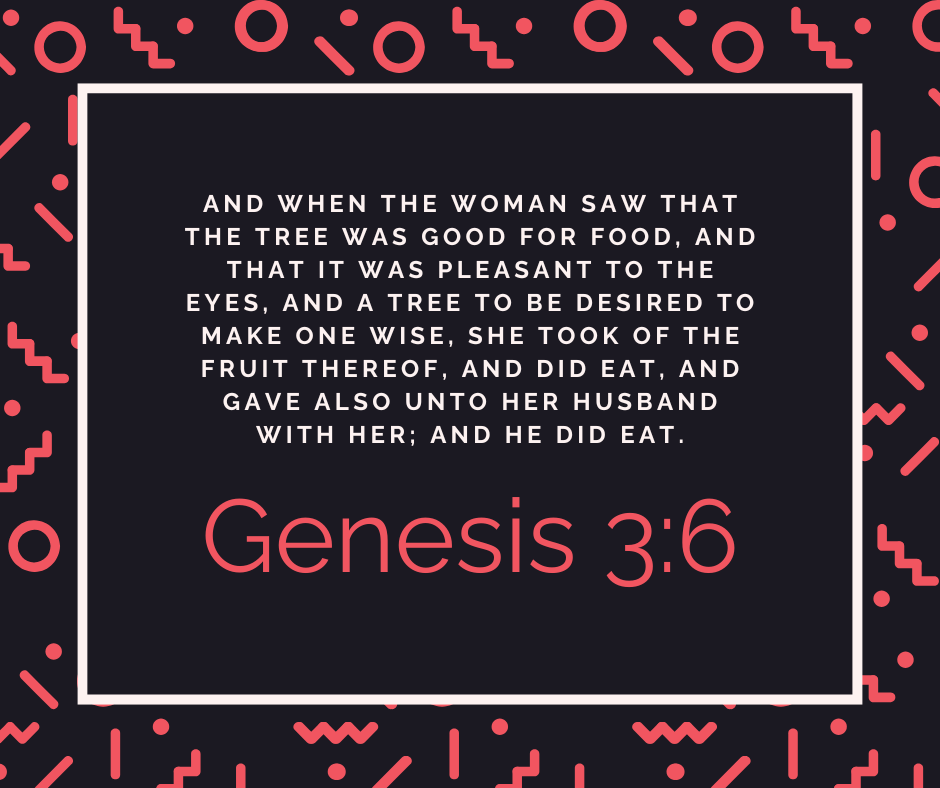
The final clause completes the descent. What began as Eve’s inward temptation now becomes humanity’s shared rebellion. Until this moment, the focus has been on the woman’s perception and choice, but the narrative subtly widens to include the man: “and gave also unto her husband with her; and he did eat.” The words are quiet, almost understated, yet they signal the full collapse of the created order.
The little phrase “with her” carries immense weight. As John Walton and Kenneth Mathews both observe, the Hebrew grammar implies that Adam was present during the encounter, a silent witness to the serpent’s lies and his wife’s growing enticement.1,2 The serpent’s plural “you” in verse 1 and the woman’s inclusive “we” confirm that this was not merely Eve’s test but theirs together. Adam stood beside her, not absent but inactive. The tragedy is not his distance but his silence.
That silence is the echoing void at the heart of the Fall. Adam, who had received the divine command firsthand (Genesis 2:16–17), should have spoken truth into the serpent’s deceit. He should have guarded his wife, reaffirmed the Word of the Lord, and rebuked the intruder. But he does none of these things. The man who once named the creatures now says nothing to the one defying his Creator. His silence is not neutrality; it’s abdication. He relinquishes his spiritual headship, not by violent rebellion, but by passive complicity. In that moment, leadership gives way to appeasement, and love detaches from truth.
The verb “gave” carries deep irony. Only a chapter earlier, Adam had received his bride as a gracious gift from God: “This is now bone of my bones, and flesh of my flesh” (Genesis 2:23). That sacred giving, born of love and unity, now becomes a vehicle of death. The joy of mutual sharing turns to the sorrow of shared ruin. Sin spreads relationally: the gift once given for life becomes the instrument of death. As Matthew Henry notes, “Those who have done ill are willing to draw in others to do the same.”3 In this sense, Eve now mirrors the serpent’s pattern. Having been deceived, she becomes a tempter herself, extending to her husband the same invitation that destroyed her.
Some interpreters have suggested that Adam’s choice was motivated by affection: that he ate out of love for Eve, unwilling to lose her to judgment. Henry Morris acknowledges that such a reading might appear consistent with the later typology of Christ’s self-sacrificial love for the Church (Ephesians 5:25).4 Yet Scripture gives no hint that Adam’s decision was noble. His act was not redemptive but reckless, not sacrificial but sinful. Eve fell through deception; Adam fell with eyes wide open. His was deliberate disobedience, a choice made in full awareness of the command he violated.
Thus, the first couple’s unity, which had been their glory, now becomes their downfall. Together they had walked with God in perfect fellowship; now they will walk in shame. Together they had shared joy; now they share guilt. The bond that once reflected divine love now mirrors rebellion. Adam’s participation closes the circle of the Fall: the serpent deceives, the woman desires, the man decides, and the world dies.
- John H. Walton, The NIV Application Commentary: Genesis (Grand Rapids: Zondervan, 2001), 206. ↩︎
- Kenneth A. Mathews, Genesis 1–11:26, NAC Vol. 1A (Nashville: Broadman & Holman, 1996), 238. ↩︎
- Matthew Henry, Concise Commentary on the Whole Bible (Grand Rapids: Christian Classics Ethereal Library, 1997), 6. ↩︎
- Henry M. Morris, The Genesis Record (Grand Rapids: Baker, 1976), 114–115. ↩︎