
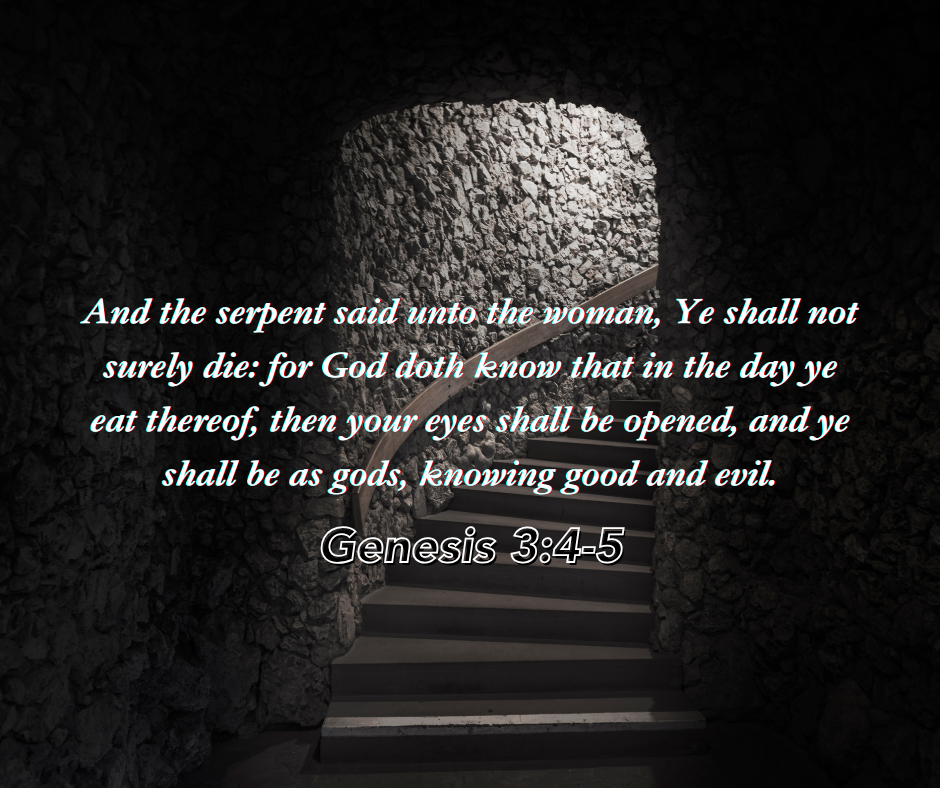
When ancient Gnostic sects turned to Genesis 3:4-5, they interpreted the serpent’s promise—“Your eyes shall be opened, and ye shall be as gods”— as a revelatory gift rather than a temptation. In Gnostic retellings such as The Hypostasis of the Archons or On the Origin of the World (from the Nag Hammadi corpus), Eve is not deceived by a lying spirit but awakened by a messenger of gnōsis, who helps her perceive the falsity of the Demiurge’s prohibition. The “opening of eyes” becomes an ascent from ignorance to self-knowledge; “ye shall be as gods” points toward reunion with the divine fullness (Pleroma). Even the serpent’s “Ye shall not surely die” is re-coded as spiritual truth: death, for the Gnostic, belongs to matter and illusion, not to the enlightened self who knows its divine origin.1,2
This interpretive reversal has powerful mythic appeal. It offers what might be called a theology of inversion, in which every element of biblical revelation is turned inside out. The serpent is wise, God is insecure, and sin is misunderstood illumination. By transforming disobedience into awakening, the Gnostic myth relieves humanity of moral guilt and replaces repentance with self-recognition. Salvation becomes the recovery of hidden knowledge, discovering that one has always been divine, trapped only by ignorance. The Gnostic impulse is not mere rebellion against the church’s authority; it is a radical re-imagining of creation, evil, and redemption. Evil becomes ignorance, salvation becomes knowledge, and the cross itself becomes unnecessary. The tragic irony, of course, is that the serpent’s original lie—“Ye shall not surely die”—becomes the creed of this entire system: death and judgment are illusions, and humanity’s problem is not sin but forgetfulness.
Biblical Christianity, from the second century onward, recognized this as a complete inversion of revelation. Irenaeus of Lyons, in Against Heresies, refuted Gnosticism precisely by appealing to the moral and historical realism of Genesis. The Creator, he insisted, is not a jealous tyrant but the loving Father who made all things good (Genesis 1:31). The serpent’s word is not enlightenment but contradiction; the “opening of eyes” reveals shame, not transcendence; and “ye shall be as gods” is the very lie that precipitates death, not deliverance. The difference between Genesis and Gnosticism is not simply moral; it’s ontological. The Gnostic god cannot love or redeem; he can only instruct. The biblical God enters the world He made and suffers to save it. In this contrast, the entire difference between revelation and speculation, between redemption and self-realization, comes into view. Where Gnosticism promises escape from creation, Christianity promises renewal of creation; where Gnosticism crowns the serpent, the gospel crushes his head.
Thus, the Gnostic reading of Genesis 3:4–5 stands as the first and most transparent form of what Scripture itself calls “calling evil good, and good evil” (Isaiah 5:20). Its spirit still breathes in modern “Gnostic Christianities” that celebrate inner divinity and spiritual awakening apart from repentance and faith. Whether ancient or new, the pattern remains the same: a rival revelation, a redefinition of death, and a blurred boundary between Creator and creature. It is the serpent’s logic systematized, a mythic theology built on a single syllable of denial: “Not.”
- Elaine H. Pagels, The Gnostic Gospels (New York: Vintage Books, 1979). ↩︎
- Eduard Iricinschi, Lance Jenott, Nicola Denzey Lewis, and Philippa Townsend, eds., Beyond the Gnostic Gospels: Studies Building on the Work of Elaine Pagels (Tübingen: Mohr Siebeck, 2013), accessed via Mohr Siebeck PDF, https://cdn.mohrsiebeck.com/e1%2C7a040b1a3a4e2a809afc2b18a38c54.pdf. ↩︎