
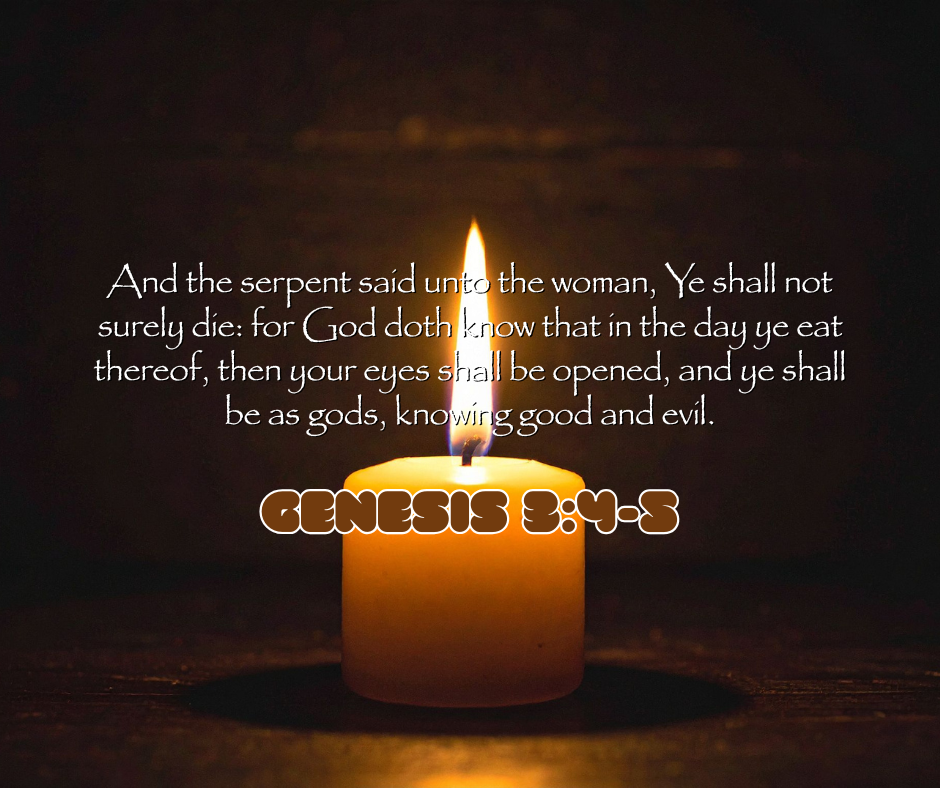
Across the centuries and traditions of Christian thought, Genesis 3:4–5 has been seen not merely as a narrative about humanity’s first sin but as a revelation of sin’s inner logic: the denial of God’s truth, the suspicion of His goodness, and the lust to transcend creaturely dependence. From the very beginning, the church has consistently discerned here the pattern of all heresy and the prelude to all redemption. Though the accents differ among traditions, the central melody remains: the serpent’s word opposes God’s Word; the promise of “opened eyes” is a half-truth; the lure to be “as gods” is pride’s oldest dream; and death, in every dimension, is its just and certain end.
Early Church Consensus: Pride, Deception, and the Reversal in Christ
Early Church theologians read Genesis 3:4–5 as a microcosm of the human condition: the fall from truth into falsehood, and from dependence into pride. Irenaeus of Lyons emphasizes that Eve’s deception by the serpent’s subtilty displays the devil’s pedagogy of inversion: the twisting of revelation into its opposite. Yet he also insists that the Second Adam, Christ, would recapitulate and reverse this deception through obedience.1 In Irenaeus’s view, every false word finds its correction in the true Word made flesh.
Augustine delves deeper into the moral psychology of sin, calling pride (superbia) “the craving for undue exaltation.” Through that craving, the soul ceases to cleave to God and seeks to be its own end.2 For him, “Ye shall not surely die” is not merely false information; it’s a metaphysical rebellion. The lie severs the creature from the Creator by promising life without obedience, autonomy without grace. Chrysostom, ever the pastor, observes the sobering realism of the fall: Eve was indeed deceived, yet still accountable; Adam was not deceived in the same way, yet willfully transgressed.3 Thus, for early church theologians, these verses unveil the anatomy of sin: a counterfeit word, a distorted worship, and a tragic fall that only Christ, the obedient Word, can undo.
Roman Catholic Teaching: The Death of Trust and the Sin of Pride
Catholic theology has long read Genesis 3:4–5 as the moment when faith dies and pride is born. The Catechism explains that humanity “let his trust in his Creator die in his heart” by believing a lie about God’s intention.4 “For God doth know…” is thus read as the first catechism in unbelief, an insinuation that God’s command was not love but envy. The temptation promised a godlikeness “without God,” and man, abusing his freedom, lost both innocence and life.
Aquinas refines this into a moral analysis: the first sin was pride, the desire for a greatness unfitting to a creature: to be as God in status or self-sufficiency.5 He notes that curiosity also played a role: the craving to grasp knowledge beyond the bounds of divine measure. The Catholic tradition therefore sees this passage as unveiling three truths: the integrity of God’s command, the distortion of His goodness, and the catastrophic misuse of freedom. Spiritual death came that day; physical death followed; and humanity’s redemption would require a new act of humble obedience: the obedience of Christ.
Eastern Orthodox Teaching: Communion Lost and the Healing of Humility
In the East, Orthodox theologians hear in the serpent’s voice the rupture of communion, a distortion of the humble phronema, the mind of worship that keeps creature and Creator rightly aligned. Chrysostom’s homilies emphasize the serpent’s mêtis (craftiness), noting that deception does not cancel moral responsibility but reveals the danger of curiosity beyond the limits of revelation.6
Later catechesis, such as that of St. Philaret of Moscow, describes the fall as the abuse of freedom: man aspired to independence from God and thus fell into corruption and death.7 For John of Damascus, the sin lies in overreaching the mystery: seeking to know what belongs only to God.8 “For God doth know…” becomes, in the Orthodox reading, an invitation to gnosis without grace. The result is not enlightenment but corruption: the divine image fractured, communion broken, and mortality unleashed. Redemption, then, is understood as theosis rightly restored, not becoming God by grasping, but by grace, through participation in the humility of the New Adam.
The Reformation Traditions: The Word Contradicted and the Heart Corrupted
Lutheran Perspective. Luther regarded the serpent’s denial—non moriemini, “You will not surely die”—as the beginning of all false theology: a lie that distorts God’s Word and undermines trust in His justice. For Luther, this deception was not merely about death, but about the very nature of sin and its consequences. The serpent’s promise of “opened eyes” led not to divine enlightenment but to shame, hiding, and blame, hallmarks of alienation from God. In slandering God’s character, the serpent portrayed the loving Father as a restrictive tyrant, thus sowing the seeds of prideful rebellion.9
Reformed Perspective. Calvin’s exposition underscores the deliberate inversion of God’s emphatic phrase mot tamut (“you shall surely die”). The fall, he says, is not merely moral but epistemic, a failure of faith that redefines truth. For Calvin, “ye shall be as gods” captures sin’s essence: humanity’s refusal to stay within its creaturely limits, aspiring to autonomy rather than communion.10
Wesleyan and Evangelical Anglican Perspective. John Wesley, reading the same verses devotionally, highlights the moral tragedy beneath the intellectual deception. The serpent’s offer of “knowing good and evil” becomes, for him, the exchange of holy wisdom for experiential guilt. “The eyes of them both were opened,” not to light, but to loss.11 Wesley and the Anglican reformers saw in this passage a pastoral warning: every doctrine that questions God’s goodness or downplays His judgment reenacts Eden’s fall.
Shared Doctrinal Threads: A United Witness Against the Lie
When these diverse streams of orthodoxy are woven together, a single theological tapestry emerges.
- Revelation and Truth. The serpent introduces a rival word, establishing the prototype for every counterfeit revelation. Faith begins with “It is written”; unbelief begins with “Hath God said?”
- Theology Proper. “For God doth know…” slanders divine goodness, recasting law as oppression and holiness as jealousy. True theology begins in trust, not suspicion.
- Anthropology. “Ye shall be as gods” tempts the creature to erase its dependence. The image-bearer becomes an idol-maker. Pride replaces humility; autonomy supplants worship.
- Hamartiology and Death. “Ye shall not surely die” denies judgment and redefines sin as harmless. Yet death—spiritual, physical, and eternal—remains sin’s fixed wage.
- Soteriology in Seed. All traditions glimpse in these verses the shadow of Christ, the Second Adam, whose obedience and truth-speaking heal the rupture: “It is written” answers “Hath God said?” and undoes the serpent’s theology of self.
In the end, Genesis 3:4–5 is not merely a story about two people and a tree; it’s the blueprint of all spiritual conflict. Across the ages, faithful Christians have seen in it the anatomy of deception and the promise of restoration. The lie that birthed death still echoes, but every orthodox tradition replies in harmony with the same confession: Life is found only in the Word of God, and that Word has become flesh to make us sons and daughters again.
- Irenaeus, Against Heresies 5.21, in Nicene and Post-Nicene Fathers, accessed October 5, 2025, https://www.newadvent.org/fathers/0103521.htm. ↩︎
- Augustine, City of God 14.13, in NPNF, accessed October 5, 2025, https://www.logoslibrary.org/augustine/city/1413.html. ↩︎
- John Chrysostom, Homilies on 1 Timothy, Homily 9, in Catena Bible, accessed October 7, 2025, https://catenabible.com/com/575f0fd63c6effa740ddddf7. ↩︎
- Catechism of the Catholic Church, 2nd ed. (Vatican City: Libreria Editrice Vaticana, 1997), §397, accessed October 7, 2025, https://www.vatican.va/content/catechism/en/part_one/section_two/chapter_one/article_1/paragraph_7_the_fall.html. ↩︎
- Thomas Aquinas, Summa Theologiae I–II, q.163 (“The first man’s sin”), accessed October 5, 2025, https://www.newadvent.org/summa/3163.htm. ↩︎
- John Chrysostom, Homilies on Genesis (English resources and index), accessed October 5, 2025, https://www2.iath.virginia.edu/anderson/commentaries/ChrGen.html#glossGen3:4,Gen3:5. ↩︎
- St. Philaret of Moscow, The Longer Catechism of the Orthodox, Catholic, Eastern Church, trans. R. W. Blackmore (Moscow: Synod of the Russian Orthodox Church, 1839), Part I, Qs. 23–25, accessed October 7, 2025, https://www.pravoslavieto.com/docs/eng/Orthodox_Catechism_of_Philaret.htm. ↩︎
- John of Damascus, An Exact Exposition of the Orthodox Faith 1.1, in NPNF, accessed October 5, 2025, https://www.newadvent.org/fathers/33041.htm. ↩︎
- Bible Study with Luther: Genesis 3:7–15, LutheranReformation.org, accessed October 7, 2025, https://lutheranreformation.org/get-involved/bible-study-luther-genesis-37-15/. ↩︎
- John Calvin, Commentary on Genesis (on Gen 3:4–5), accessed October 5, 2025, https://biblehub.com/commentaries/calvin/genesis/3.htm. ↩︎
- John Wesley, Explanatory Notes on the Bible (on Gen 3), accessed October 5, 2025, https://www.christianity.com/bible/commentary/john-wesley/genesis/3. ↩︎