
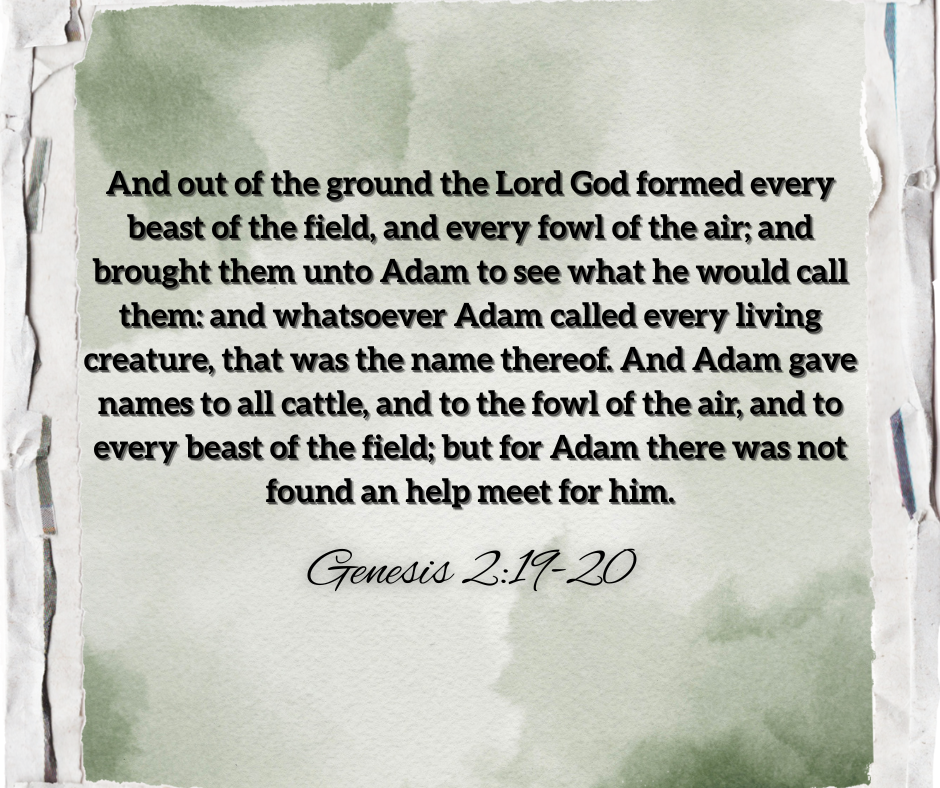
Genesis 2:19–20 is not a narrative aside but a carefully constructed interlude that performs both a literary and theological function within the flow of Genesis 2. Following God’s pronouncement in verse 18 that “it is not good that the man should be alone,” one might expect the immediate creation of the woman. Instead, the text introduces a delay: God forms animals and brings them to Adam for naming. This sequence is not a detour, but a divinely orchestrated act of instruction.
Theologically, this naming event serves to reveal Adam’s unique status within creation while simultaneously exposing his incompleteness. While verse 18 announces man’s need, verses 19–20 allow Adam to perceive that need for himself. God, in His wisdom, does not merely declare man’s insufficiency, He leads Adam through an experience that deepens his understanding of it. The parade of animals and the act of naming reinforce the point: Adam is intellectually and spiritually distinct from the animal world, yet he remains alone.
From a narrative standpoint, these verses create a rising tension that heightens the impact of the woman’s eventual creation. The structure is chiastic in its effect: divine assessment (v.18), process of discovery (vv.19–20), and divine provision (vv.21–22). This structure mirrors a broader biblical pattern in which God reveals truth progressively and relationally, not merely propositionally. The narrative invites the reader to experience Adam’s journey, one that moves from dominion to longing, from authority to the aching recognition of solitude.
Moreover, this passage exemplifies God’s pedagogical method. Just as later He will use the wilderness to teach Israel dependence (Deut. 8:2–3), here He uses the act of naming to teach Adam that no creature can be his equal. The naming process thus has dual significance: it affirms Adam’s rulership (cf. Gen. 1:28) and uncovers his relational deficiency. These dual truths prepare the way for the woman’s creation not as a generic helper, but as a deliberate and dignified counterpart.
In sum, Genesis 2:19–20 functions as a theological hinge, deepening the problem of man’s aloneness while simultaneously preparing the reader for the grandeur of God’s solution in the creation of woman. The delay is purposeful, the process is revelatory, and the narrative arc is designed to magnify the importance of what follows.