
The opening chapters of Genesis establish God as the sovereign Creator who brings all things into being by His word. Genesis 1 unfolds the six days of creation, revealing a purposeful and ordered cosmos, culminating in the formation of man and woman in God’s image, with dominion over the earth. On the seventh day, God rests, sanctifying it as holy. Genesis 2 zooms in on the sixth day, offering a more intimate account of Adam’s creation, his placement in the Garden of Eden, the divine command concerning the tree of the knowledge of good and evil, and God’s declaration that it is “not good” for man to be alone. This sets the stage for the introduction of woman as a divinely crafted companion suited to him, affirming God’s design for relational and covenantal human life.
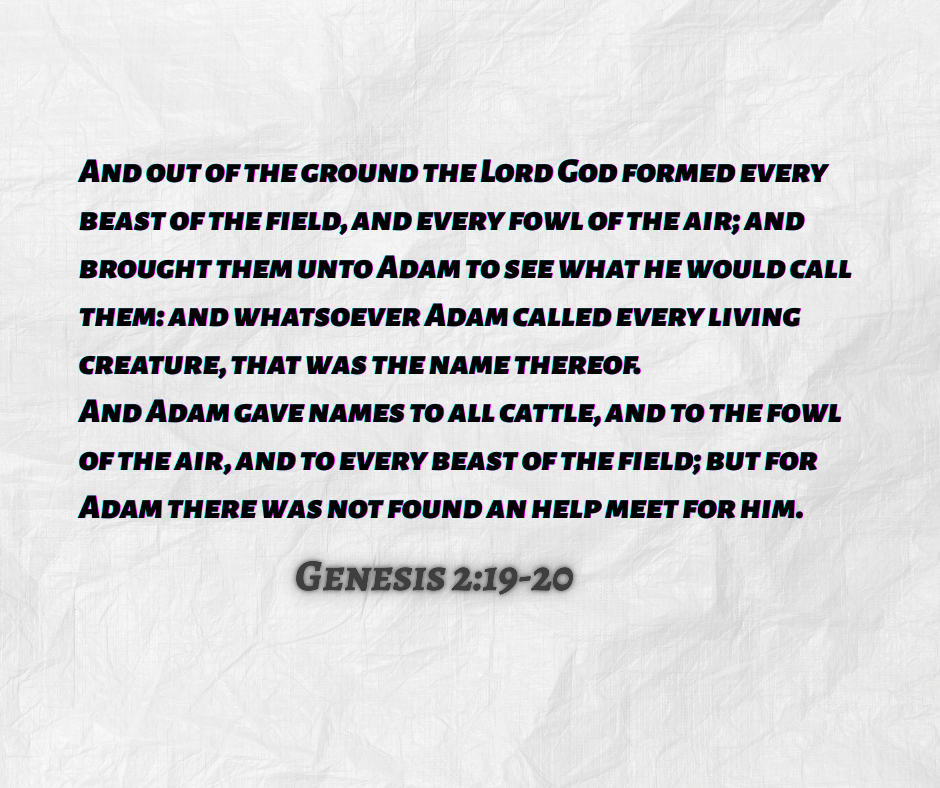
Genesis 2:19–20 serves as a pivotal narrative bridge between the divine pronouncement that man’s solitude is “not good” (v.18) and God’s creation of the woman (v.21–22). These verses recount God bringing every living creature before Adam “to see what he would call them,” and whatever Adam named each, “that was the name thereof.” While seemingly a zoological exercise, this event carries profound theological and anthropological significance.
First, the act of naming demonstrates Adam’s unique role as image-bearer and vice-regent of God’s creation. In biblical thought, naming is not arbitrary; it is an act of authority and discernment. By naming the animals, Adam exercises dominion (cf. Genesis 1:28), showing his intelligence, capacity for language, and the divinely given authority to govern. Yet as the animals pass before him—each with its pair—none is found to be “an help meet for him.” This process highlighted the fundamental contrast between Adam and the rest of creation, underscoring that he stands categorically apart as a unique bearer of God’s image. He is without a counterpart.
This parade of creatures thus serves a pedagogical function. God is not discovering Adam’s loneliness—He already declared it—but is helping Adam discover it himself. Through this process, Adam comes to perceive what God had already known: that no other creature corresponds to him in kind, purpose, or dignity. The scene underscores both the insufficiency of the animal kingdom to provide true companionship and the uniqueness of woman’s creation that is to follow.
Theologically, these verses also guard against pagan notions that reduce humanity to part of the animal continuum. Genesis elevates human beings above the animal world, affirming their unique status as bearers of the divine image. Adam’s inability to find a suitable companion among the animals reaffirms the relational and spiritual depth of human nature, which finds its fulfillment not in the created order broadly, but in a fellow image-bearer crafted by God’s own hand.
Thus, Genesis 2:19–20 functions as both contrast and anticipation. It reveals the inadequacy of all that came before to meet man’s relational need, heightens the dramatic tension in the narrative, and prepares the reader for the glorious creation of woman, not from the dust, but from Adam’s own side. The stage is set for a creation that is not a repetition, but a completion; not a utility, but a counterpart; not a mere addition, but a fulfillment of God’s creational wisdom.