
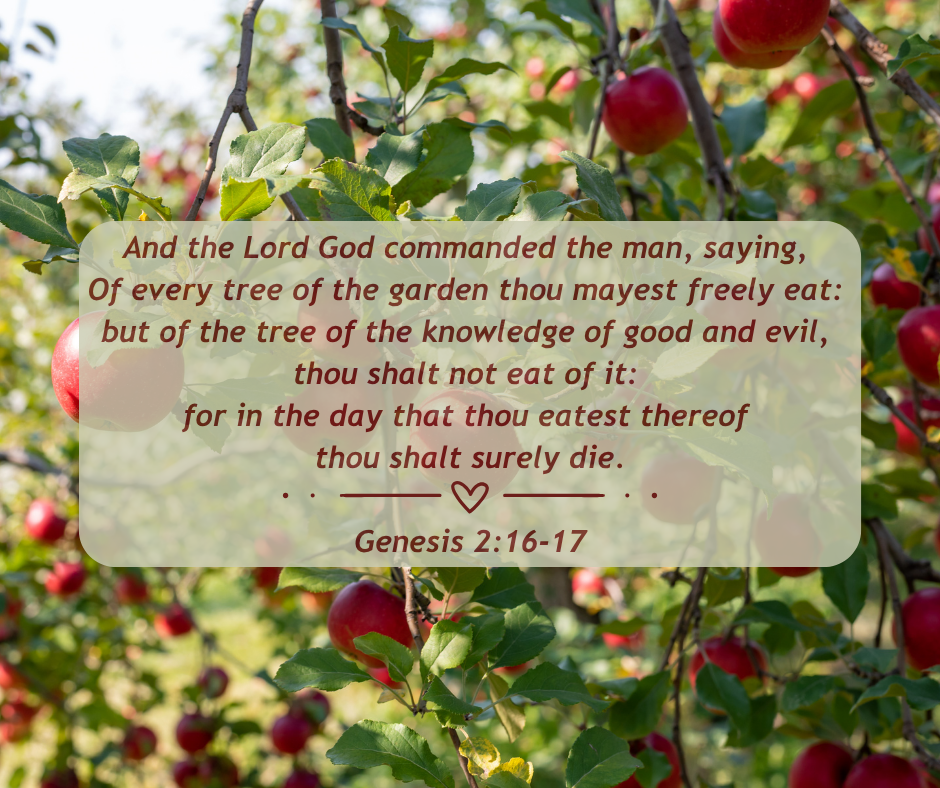
From the first breath in Eden to the final trumpet of glory, the story of Scripture hinges on the words spoken in Genesis 2:16–17. A command was given. A boundary was drawn. A death was pronounced. Yet hidden within that solemn warning was a promise: that through another Tree and a greater Man, life would one day be restored. The Fall was real, but so is the Redeemer. The curse was just, but the cross was triumphant. What began as divine law in a garden became the seed of the Gospel that would blossom on Calvary and bear fruit for eternity.
This first command was not the end of the story; it was the beginning of redemption. In Adam, we died; in Christ, we are made alive. What was lost through rebellion is regained by grace. The way to the Tree of Life, once barred by judgment, now stands open, cleared by the Savior who fulfilled the command we broke, and bore the death we deserved.
Living as Children of a Better Eden
Delight in God’s Generous Provision
God’s first word to mankind was not a prohibition, but a permission: “Of every tree of the garden thou mayest freely eat.” Before man heard a single “thou shalt not,” he was overwhelmed with divine generosity. This is the true heart of our Creator, overflowing with goodness, giving “us richly all things to enjoy” (1 Timothy 6:17). He is not a miser guarding treasure, but a Father who delights in blessing His children.
In a world that constantly tempts us to see God as restrictive or withholding, believers must intentionally cultivate a theology of abundance rooted in Eden. God’s provision was not merely sufficient; it was lavish. The trees of Eden were “pleasant to the sight, and good for food” (Genesis 2:9), revealing that God’s gifts are both beautiful and bountiful. This same God has not changed. As James affirms, “Every good gift and every perfect gift is from above, and cometh down from the Father of lights” (James 1:17).
Therefore, let us live with hearts tuned to gratitude, not grumbling. Let us see each sunrise, each meal, each moment of joy, and each page of Scripture as fruit from Eden’s orchard, blessings granted by a generous Lord. The Christian life is not one of fearful rule-keeping, but of joyful trust in the Giver of all good. Live each day not with a clenched fist of anxiety, but with open hands and thankful hearts, rejoicing in the freedom God gives within the safe and satisfying boundaries of His will.
Embrace the Blessing of God’s Boundaries
In a garden filled with abundance, God placed one tree that was off-limits, not to withhold joy, but to protect it. The command concerning the tree of the knowledge of good and evil was not a denial of something necessary, but the preservation of something sacred: the bond of trust between Creator and creature. The boundary was not cruel; it was a signpost of divine wisdom, calling man to live under God’s authority and not above it.
This reveals a timeless truth: God’s boundaries are not barriers to flourishing, but the very means by which we are kept in His blessing. In a fallen world that confuses freedom with lawlessness and views constraint as oppression, we must recover Eden’s perspective. True liberty is not the right to define good and evil for ourselves, but the joy of living under the care of the One who already knows what is best.
To embrace God’s commands is to walk the path of peace. “Great peace have they which love thy law: and nothing shall offend them” (Psalm 119:165). When we submit to the Lord’s boundaries—in our morality, our relationships, our affections—we are not forfeiting joy but finding it where it was always meant to be: in obedience to the God who made us, loves us, and knows our frame.
Let us therefore welcome God’s boundaries with humility, not resistance. They are not fences to keep us from good things, but walls to keep the good in and the destructive out. Obedience is not a burden; it is our blessing. And as Eden teaches, it is in trusting submission that true joy, safety, and fellowship with God are preserved.
Resist the Serpent’s Lie with the Truth of God’s Word
The first sin did not begin with an action; it began with a question: “Yea, hath God said?” (Genesis 3:1). With subtlety and craft, the serpent twisted God’s generous command into a restrictive burden, casting suspicion on the goodness of the Giver. Eve’s fall began not when she reached for the fruit, but when she began to doubt the character of God. The same lie echoes today: God is holding out on you; freedom lies outside His will.
Resisting temptation, then, is not merely about willpower, it’s about worship. It’s about believing, deep in our bones, that God is good, His Word is true, and His will is best. Every moral crisis is, at its core, a crisis of trust. Do we believe that God’s Word leads to life? Or will we redefine good and evil for ourselves?
The only way to silence the serpent’s voice is to fill our hearts with the voice of God. When Jesus, the Second Adam, was tempted in the wilderness, He did not reason or argue. He answered with Scripture. “It is written…” was His weapon, and it must be ours. “Thy word have I hid in mine heart, that I might not sin against thee” (Psalm 119:11).
In a culture saturated with lies, we must become saturated with truth. Let the Word of God dwell in you richly (Colossians 3:16). Meditate on it. Trust it. Speak it. Use it as your shield when the enemy tempts you to doubt God’s goodness, twist His commands, or take sin lightly. Resist the serpent not by debating with him, but by submitting to God and clinging to the truth that never changes.
Live as One Who Has Access to the Tree of Life
The tragedy of Eden was not only the fall, but the expulsion, the severing of man’s access to the Tree of Life. Cherubim and a flaming sword barred the way, symbolizing that sin had erected a barrier no man could pass. But through the cross of Christ, that sword has been sheathed, and the way once closed has been opened forever. “Blessed are they that do his commandments, that they may have right to the tree of life…” (Revelation 22:14).
We now live not under the curse, but under grace. In Christ, we are no longer wandering east of Eden. We are citizens of the New Jerusalem, already partakers of eternal life. Jesus declared, “I am the way, the truth, and the life” (John 14:6), and by His blood we are reconciled to God and restored to fellowship.
This reality changes how we live now. We are not prisoners of death but inheritors of life. We walk not in fear of judgment but in the joy of communion. Every promise of God is yes and amen in Christ (2 Corinthians 1:20). We no longer live striving to earn access; we live in thankful response to a Savior who has already granted it.
So, walk in that liberty. Walk in the Spirit. Feast on the Word. Bear the fruit of righteousness. Let the joy of the gospel guard your heart from fear and drive your obedience with delight. You were made for Eden. You were redeemed for glory. And even now, you are being led by the Good Shepherd back to the garden, where the Tree of Life stands as the everlasting promise of grace fulfilled.
From Tree to Tree, from Death to Life
If you have not yet trusted in Christ, then hear again the warning first spoken in the garden: “In the day that thou eatest thereof thou shalt surely die.” This was not a symbolic gesture. It was a solemn decree from the mouth of God. And when Adam crossed that boundary, death entered the world like a flood. Spiritual separation from God, physical decay, and the threat of eternal judgment became the inheritance of all mankind. The Tree of Life was sealed behind a flaming sword, and the path to communion with God was barred. In Adam’s rebellion, we all fell. “By one man sin entered into the world, and death by sin; and so death passed upon all men…” (Romans 5:12). The curse was not just his, it is ours.
Yet the God who gave the command is also the God who gives the promise. Even as judgment fell, mercy stirred. A Deliverer was foretold, One who would crush the serpent’s head and undo the ruin of the Fall (Genesis 3:15). That promise was fulfilled in Jesus Christ, the Second Adam. He did not reach for the forbidden; He submitted to the Father’s will. Where Adam brought death beside a tree, Christ brought life upon one. The cross, that instrument of Roman execution, became the Tree of Life for all who would believe. In bearing our guilt, He bore our curse. “For as by one man’s disobedience many were made sinners, so by the obedience of one shall many be made righteous” (Romans 5:19).
At Calvary, the sword that guarded Eden’s gate struck, not the sinner, but the sinless Son of God. He endured the judgment decreed in Genesis 2:17. He died the death Adam earned and we inherited. “Christ hath redeemed us from the curse of the law, being made a curse for us” (Galatians 3:13). And in rising from the grave, He tore the veil, silenced the curse, and flung open the gates of the garden once more. The cherubim no longer block the way. The Tree of Life is no longer guarded. It is freely offered to all who will come.
If you turn from your sin and trust in Jesus Christ, you will be made new. A new birth is granted. A new inheritance is given. A new walk with God is restored. No longer must you hide in shame or stitch together the fig leaves of self-righteousness. Christ will clothe you in His righteousness. He will bring you into fellowship with the Father and feed you daily with the grace that only He can give. “Blessed are they that do his commandments, that they may have right to the tree of life” (Revelation 22:14).
This is the Gospel, rooted in Eden and fulfilled at Calvary:
- The command was broken.
- The curse was just.
- The cross was sufficient.
- The invitation is free.
So, come. Trust in the One who died upon the tree and rose to open paradise. Eat freely of the life that only He can give and walk with God.
The story that began in Eden is not a distant myth. It is your story, your invitation, your hope. The God who once formed man from the dust and breathed into him the breath of life still calls out, not in wrath, but in mercy. Though the first garden was lost through sin, a greater garden has been opened by grace. The voice that once said, “thou shalt surely die,” now calls to you: “Come unto me, and live.”