
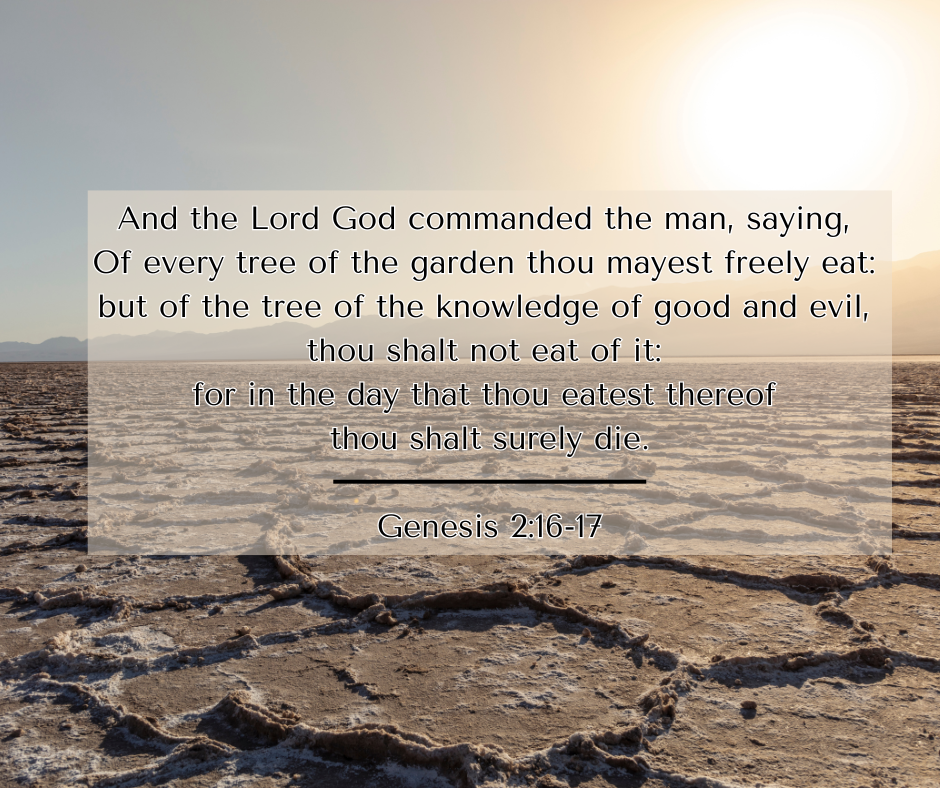
The world’s modern religious and philosophical traditions often reflect a common yearning for paradise, peace, or enlightenment. Yet few, if any, offer anything approaching the moral clarity or covenantal gravity of the Edenic command in Genesis 2:16–17. In place of a personal Creator issuing a relational and moral directive, most systems present sin as a matter of ignorance, spiritual imbalance, or social dysfunction. Death, when addressed at all, is typically seen as a natural phase, a karmic cycle, or an illusion to be overcome, not as the just judgment of a holy God. Even among traditions that speak of human error or divine justice, the idea that a single act of disobedience could introduce universal death and necessitate divine redemption is virtually unknown.
The survey that follows explores how various world religions and worldviews approach the foundational themes of Genesis 2:16–17: creation, command, sin, death, and redemption. While many echo fragments of biblical truth, such as the existence of a paradise or the presence of moral struggle, they ultimately fall short of the Edenic vision. Most fail to grasp or affirm the covenantal nature of sin, the moral absoluteness of divine authority, and the indispensable hope of a promised Redeemer.
Genesis does not begin with myth or metaphor; it begins with a command. In this simple prohibition lies the foundation of biblical theology: the holiness of God, the responsibility of man, the reality of sin, and the consequence of death. The competing visions of humanity tell us what man believes about himself. Genesis 2:16–17 tells us what God has spoken about us, and what we must hear to understand the gospel.
Islam: Mercy without Covenant Judgment
Islamic teaching affirms many of the surface elements found in the Genesis account: Adam and Eve placed in paradise, tempted by Satan, and ultimately disobedient (Qur’an 2:30–39; 7:19–25). This narrative, at first glance, seems to mirror Genesis 2 and 3. However, the theological framework within which Islam interprets these events stands in stark contrast to the covenantal structure of Genesis 2:16–17.
In Islamic theology, Adam’s act of disobedience is treated not as a covenantal rebellion but as a momentary lapse. Adam quickly repents, and Allah forgives him (Qur’an 2:37). There is no enduring consequence for humanity: no inherited sin nature, no judicial death penalty, and no cosmic rupture requiring redemptive intervention. Each person is born spiritually pure, bearing no guilt for Adam’s transgression. Sin, therefore, is individual and addressed through personal repentance and divine mercy. Salvation comes through one’s own righteousness, submission (Islam), and good deeds, not through a Redeemer who bears the penalty of sin (Abdulsalam, 2006).
In contrast, Genesis 2:16–17 introduces a moral command with eternal consequences. God’s word to Adam is not simply guidance; it is covenantal law. When Adam transgresses, death enters the human condition, not just as physical consequence, but as divine judgment upon moral rebellion. This foundational moment explains why all humanity is fallen and why the entire biblical narrative points forward to the need for a Redeemer (Romans 5:12–19).
Crucially, the Bible, like Islam, affirms both personal responsibility (“The soul that sinneth, it shall die” – Ezekiel 18:20) and divine mercy (“The LORD is merciful and gracious” – Psalm 103:8). Yet these truths are not severed from the reality of inherited sin and covenant guilt. In Scripture, mercy is not granted apart from justice; it is fulfilled through justice in the substitutionary work of Christ, the Second Adam. Personal repentance is essential, but it is efficacious only because it appeals to the finished work of a divine Redeemer who satisfies the penalty first established in Genesis 2:17.
Thus, Islam preserves certain ethical and moral elements, but it denies the covenantal and redemptive framework rooted in the Edenic command. Without original sin, there is no fallen nature to redeem; without a death penalty, there is no need for atonement; and without a divine Savior, there is no gospel. Genesis 2:16–17 introduces not only the human problem, but the theological foundation for its only solution: Christ crucified and risen.
| Element | Biblical View | Islamic View |
| Nature of the Command | A covenantal, moral directive from a personal, holy Creator | A divine instruction, not framed as a covenantal moral test |
| Disobedience | A rebellion that breaches a covenant and brings universal consequences | A lapse or error for which Adam repented; not inherited or binding on humanity |
| Consequence of Sin | Judicial death—both spiritual and physical—entering the human race as divine punishment | No inherited sin or death penalty |
| Nature of Death | A direct result of covenant violation; the fulfillment of a divine warning | A natural stage in life; not necessarily tied to Adam’s disobedience |
| Original Sin | All humanity is fallen in Adam; sin and death spread to all (Romans 5:12–19) | Rejected; humans are born pure and morally neutral |
| Personal Responsibility | Affirmed, but within the context of inherited sin and universal guilt | Affirmed independently; every soul is judged on its own merits (Qur’an 6:164) |
| Divine Mercy | Central to redemption; mediated through covenant and atonement by a Redeemer | Central to salvation; accessed through sincere repentance, not substitutionary atonement |
| Need for a Redeemer | Essential—Jesus Christ, the Second Adam, fulfills the broken covenant through substitutionary death | Denied—no need for a sin-bearing Savior; salvation comes through personal submission and good works |
| View of Adam | Federal head of humanity; his sin introduces guilt and death for all | First prophet; his mistake is individual and forgiven |
| Gospel Implication | Sin → death → atonement through Christ | Sin → repentance → forgiveness through God’s mercy |
Hinduism: The Absence of Covenant, Fall, and Redemption
Hinduism is grounded in a theological framework that differs profoundly from the covenantal worldview of Christianity. Human suffering, according to Hindu thought, stems from ignorance (avidya), attachment, and unwise actions, not from rebellion against a divine prohibition. There is no Eden, no forbidden tree, and no original sin narrative. Instead, life is shaped by karma, the moral law of cause and effect that unfolds across cycles of reincarnation. Death is not the outcome of a single act of disobedience; it is the inescapable result of accumulated karma (Achari, 2017).
Hindu spirituality emphasizes self-realization (moksha), a liberation achieved through shedding illusion, attachment, and ignorance, and ultimately merging the individual soul (atman) with Brahman, the ultimate reality. Redemption, in this view, is achieved through spiritual discipline, knowledge (jnana), and moral purity, not through repentance before a Creator or reliance on a divine atoning sacrifice (Upadhyay, Sanwal, & Goswami, 2024).
When compared to Genesis 2:16–17, the divergence becomes stark:
- There is no covenantal command from a personal Creator in Hinduism, only natural moral consequences within a cosmic order.
- Death is not framed as divine penalty, but as part of life’s cyclical structure and moral consequence.
- Human responsibility is affirmed, but not within a framework of covenant violation and inherited guilt; rather it is tied to escape from ignorance and karmic bondage.
- There is no anticipated Redeemer, because nothing has been broken in a covenant that requires substitutionary atonement. Salvation is something humans must pursue through spiritual discipline, not something God provides through sacrificial grace.
While Hinduism offers profound teachings on moral consequence and spiritual liberation, it lacks the theological architecture introduced in Genesis 2:16–17. Genesis provides a covenant-based understanding of sin, death, and redemption, a framework in which human rebellion against God, not merely ignorance or attachment, mandates divine intervention. The biblical narrative roots redemption in the promise of a Redeemer who bears the penalty for sin, something entirely absent in the Hindu worldview.
| Theological Element | Biblical View | Hindu View |
| Source of evil and death | Judgment for covenant breach | Consequence of ignorance and cumulative karma |
| Nature of divine law | Personal command from a holy Creator | Impersonal moral laws (karma, dharma) |
| Human fallenness | Universal impact from Adam’s disobedience | No ancestral sin; freedom impacted by ignorance |
| Death and redemption | Death announced as judicial penalty; redemption through Christ | Liberation (moksha) through self-effort, no divine substitution |
Buddhism: The Divergence of Fall and Liberation
In contrast to Christianity, Buddhism offers a fundamentally different diagnosis of the human condition. The root of suffering (dukkha) is traced to craving (tanha), attachment, and ignorance, not to defiance against a divine command. There is no Creator God issuing moral laws; instead, suffering arises from the mental and emotional patterns of human beings themselves.
In Buddhism, liberation (nirvana) is achieved through self-effort: practices such as mindfulness (sati), ethical conduct (sila), and insight (vipassana). The path is one of inner transformation rather than reconciliation with a Creator. There is no recognition of inherited guilt or fallen nature; each individual is responsible for working out their liberation through disciplined effort and enlightenment (Rahula, 2007).
Genesis 2:16–17 introduces a moral situation that Buddhism simply does not address: rebellion against a revealed command from a personal Creator incurs real death and necessitates divine redemption. Buddhist teaching, while deeply insightful about human suffering, does not speak to sin as covenantal offense or to death as judicial consequence. There is no gospel, no Redeemer, and no promise of restoration to unbroken fellowship with God. Instead, liberation is achieved through self-realization, not reconciliation.
Thus, when viewed alongside Genesis 2:16–17, Buddhism exemplifies a worldview that emphasizes human effort and enlightenment over divine covenant and redemption, which is a sharp divergence from the biblical story of fall and grace.
| Element | Biblical View | Buddhist View |
| Origin of suffering | Result of covenantal disobedience against God | Result of craving, ignorance, and attachment |
| Nature of divine command | A direct, personal moral law from a sovereign Creator | No Creator issuing commands; moral rules are human-designed |
| Role of death | Judicial consequence of disobedience; godly warning fulfilled | Natural cessation of life; part of samsaric existence |
| Human responsibility | Held accountable for inherited sin and personal rebellion | Responsible for moral and mental effort; self-liberation only |
| Means of redemption | Substitutionary atonement through the Savior, Jesus Christ | Self-effort toward enlightenment; no Savior figure present |
Sikhism: Covenant Breach vs. Ego-Based Spiritual Decline
In contrast to the covenantal framework of Genesis 2:16–17, Sikhism understands humanity’s spiritual downfall not as rebellion against a divine command, but as the inward corruption of haumai: the self-centered ego that forgets God. The biblical account centers on a personal, holy Creator issuing a clear moral command to His image-bearers, with disobedience bringing a definitive death sentence. Sikh theology, by contrast, does not contain an Edenic narrative, a forbidden tree, or any test of obedience rooted in divine law.
Rather, the Sikh path to liberation involves transcending ego and realigning the soul with divine reality through remembrance of God (Simran), devotional worship (Bhakti), and the reception of divine grace (Nadar). Sin is framed not as a violation of God’s moral authority, but as a failure to live in constant awareness and surrender to the Divine Presence. The primary human problem is alienation through pride, not covenant-breaking before a Lawgiver (Rani, 2017).
Though Sikhism acknowledges human frailty and affirms the necessity of divine grace, it lacks the theological structure found in Genesis 2:16–17. There is no moment of historical transgression that ushers in universal death; no divine prohibition whose breach demands redemptive justice. In Sikhism, salvation is a matter of spiritual enlightenment and internal transformation, not reconciliation through substitutionary atonement.
Ultimately, Genesis 2:16–17 presents a worldview in which death is the just result of violating a revealed command within a personal relationship with God. It lays the foundation for the gospel: a real Fall, a real judgment, and a real need for a Redeemer. Sikhism offers a rich moral vision, but it diverges entirely from the biblical portrayal of sin, judgment, and redemption as covenantal realities grounded in divine holiness.
| Element | Biblical View | Sikh View |
| Origin of evil or downfall | Covenant breach: disobedience to God’s command leading to death | Ego-driven forgetting of God (haumai), creating spiritual separation |
| Nature of divine command | Explicit moral boundary established by God | No Edenic test; guidance received through scripture and Guru teachings |
| Source of judgment | Death as judicial consequence of sin | Matter of spiritual imbalance and separation from God |
| Means of redemption | Through the promised Redeemer who fulfills the covenant | Liberation via devotion, remembrance, and grace; not substitutionary |
| Need for atonement | Death demands redemptive righteousness | Spiritual renewal achieved through mutual union with the Divine |
Bahá’í Faith: Covenant Reality vs. Spiritual Allegory
In direct contrast to the covenantal framework of Genesis 2:16–17, the Bahá’í Faith treats Adam not as the literal first man, but as a symbolic archetype representing the dawn of human spiritual consciousness. What Scripture portrays as a concrete, historical Fall—the moment humanity broke divine trust by disobeying a specific command—is recast in Bahá’í teaching as an allegory of spiritual immaturity. Sin is not viewed as a legal or relational breach with a holy God, but as a metaphor for early human ignorance and moral underdevelopment (Momen, 1989).
Consequently, the Bahá’í worldview denies the biblical doctrines of inherited guilt and divine judgment through death. Humanity is not seen as fallen in Adam or under condemnation, but as spiritually innocent, with each person responsible for their own moral and spiritual progress. Death is not a consequence of covenant disobedience, but a natural part of the created order, unrelated to any moral failure.
Within this progressive framework, the Bahá’í Faith teaches that divine revelation unfolds across epochs through successive manifestations of God, including Adam, Abraham, Moses, Jesus, Muhammad, and culminating in Bahá’u’lláh. Each messenger offers teachings appropriate for the age, advancing collective moral evolution rather than proclaiming one definitive covenantal arrangement. Salvation, therefore, is not secured through substitutionary atonement, but achieved through education, personal virtue, and communal advancement (2024).
While the Bahá’í system upholds noble ethical aims and reverence for divine wisdom, it fundamentally diverges from the moral structure of Genesis 2:16–17. The biblical account centers on a personal God who speaks with moral authority, imposes a clear command, and establishes a real consequence for its violation. This covenantal act frames all human history, for it introduces death as divine judgment and establishes the need for redemption, fulfilled in the gospel of Jesus Christ, the Second Adam.
Thus, while Bahá’í theology offers a hopeful view of moral development, it bypasses the central biblical claims of covenant-breaking, penal death, and the necessity of redemptive sacrifice. Genesis 2:16–17 is not an abstract parable but a foundational moment in salvation history. Its moral clarity and covenantal structure stand in sharp contrast to the symbolic and evolutionary interpretations of the Bahá’í Faith.
| Element | Biblical View | Bahá’í View |
| Adam and the Fall | Historical figure; Fall introduces inherited sin & death | Symbolic representation of human spiritual growth |
| Nature of sin and guilt | Covenant breach yields judicial death | No inherited guilt; sin is personal immaturity |
| Death’s origin | Divine penalty for disobedience | A part of divine unfolding; not punitive or covenantal |
| Path to redemption | Atonement accomplished by the Second Adam (Christ) | Progressive spiritual development through prophetic guidance |
| Need for sacrifice | Central to redemption | Absent; moral and spiritual evolution suffices |
Jainism: Karmic Consequence Versus Covenant Judgment
Jainism operates within a spiritual and philosophical system profoundly distinct from the moral architecture of Genesis 2:16–17. At the heart of Jain thought is ahimsa—the principle of non-violence toward all living beings—alongside rigorous asceticism, self-control, and the pursuit of karmic purity. Moral failure in Jainism is defined by actions that harm others or perpetuate attachment to the material world. These actions generate negative karma, which binds the soul to the cycle of samsara (rebirth) and results in suffering (Jaini, 2024).
Jainism does not acknowledge a personal Creator God who issues moral commands or enters into covenant with mankind. There is no divine lawgiver, no moral test rooted in a spoken command, and no historical moment akin to the Edenic probation described in Genesis 2:16–17. The human condition is not understood in terms of disobedience to a holy God, but as the result of metaphysical entanglement in karmic matter.
In the biblical account, God commands Adam not to eat of the tree of the knowledge of good and evil, grounding moral responsibility in a personal relationship. The consequence of violating that command is not just metaphysical but judicial. It is the righteous response of a holy and relational God to covenantal disobedience. In Jainism, by contrast, death is not judgment but the impersonal result of karmic imbalance. There is no divine wrath, no need for atonement, and no redemptive framework akin to the gospel’s resolution of the Edenic Fall.
Moreover, Jain soteriology emphasizes self-effort. Liberation (moksha) is achieved through intense self-discipline and ethical refinement, not through grace, divine intervention, or a Redeemer. The soul is believed to possess the capacity to free itself from karma without reliance on any external Savior (Jaini, 2024). This stands in stark contrast to Genesis, which lays the foundation for redemptive history: a real Fall, a real death sentence, and a real promise of deliverance through the Second Adam, Jesus Christ.
In sum, while Jainism recognizes the reality of moral consequence and the need for purification, it does so within a non-theistic, karmic system that lacks the personal, covenantal, and judicial elements central to Genesis 2:16–17. The moral test in Eden reveals a unique biblical theology, one that views sin as relational rebellion, death as divine judgment, and salvation as the gracious provision of God through His Word and covenant.
| Element | Biblical View | Jainist View |
| Nature of God | Personal, holy Creator who gives commands | No Creator God; the universe is eternal and self-existing |
| Origin of Moral Obligation | Divine command issued in covenantal relationship | Ethical duty rooted in ahimsa (non-violence) and karmic law |
| Definition of Sin | Rebellion against God’s command | Actions that cause harm and bind the soul with karma |
| Cause of Death | Judicial penalty for disobedience to God’s command | Karmic consequence of harmful actions |
| Fall of Man | A real, historical event resulting in separation from God | No concept of a historical Fall or Edenic disobedience |
| Role of Obedience | Obedience honors God’s authority and sustains life | Obedience purifies the soul and reduces karmic burden |
| Need for Redemption | Redemption is needed to reconcile with God and reverse the Fall | Liberation is achieved through personal discipline, not atonement |
| Means of Salvation | Atonement through a promised Redeemer (Jesus Christ) | Self-effort, asceticism, and detachment from worldly ties |
| View of Death | Divine judgment for sin | Natural result of karmic entanglement |
| View of Humanity | Created in God’s image with moral responsibility | Eternal soul bound by karma, striving for release |
Shinto: Ritual Disorder Without Moral Transgression
In stark contrast to the moral framework established in Genesis 2:16–17, Shinto, Japan’s indigenous religious tradition, does not include a concept of a divine moral test, a covenantal command, or a historical Fall. Its creation narratives—such as those involving the deities Izanagi and Izanami—describe the emergence of the world in mythic and poetic terms but lack any moment of moral rebellion or divine prohibition. Humanity is not portrayed as being placed under divine instruction or facing a decision that results in separation from the Creator.
The Shinto understanding of impurity (kegare) is not rooted in moral failure but in physical or spiritual pollution. This impurity arises from contact with death, disease, blood, or violations of ritual order, not from disobedience to a divine moral law. Misfortune is not seen as judgment for sin but because of imbalance, requiring purification through ceremonies such as harae or oharai, ritual offerings to kami (spirits), and observance of ancestral customs (Meiring, 2018). There is no need for confession of sin or substitutionary atonement because there is no sin in the biblical sense: no law broken, no covenant violated.
Thus, while Shinto fosters a strong sense of community, reverence for nature, and sacred traditions, it lacks the moral and covenantal categories central to Genesis 2:16–17. There is no Edenic moment of decision, no divine word tested through obedience, and no pronouncement of death as the just consequence of transgression. Human impurity in Shinto is cyclical and external, not moral and judicial.
By contrast, Genesis 2:16–17 presents a profoundly different theological vision. It introduces the human story not with ritual but with relationship, a covenantal bond initiated by a personal and holy God. The command not to eat of the tree of the knowledge of good and evil is both moral and relational, and the consequence of disobedience is a legal declaration of divine justice. Sin is not disorder but rebellion; death is not impurity but penalty. The result is not temporary misfortune but ongoing alienation from God that can only be reversed by divine redemption.
In summary, Shinto speaks of impurity and purification but not sin and judgment. It values harmony and ritual balance, but not obedience to a moral lawgiver. Genesis 2:16–17 stands apart by asserting that human history began with a real command, a real rebellion, and a real consequence, making way for a real Redeemer who alone can restore what was lost.
| Element | Biblical View | Shinto View |
| Origin of Moral Obligation | A clear command from a personal Creator | No divine command; moral life is tied to community and ritual |
| Source of Sin or Impurity | Rebellion against God’s covenant | Ritual impurity, spiritual imbalance, or cosmic pollution |
| Consequence of Disobedience | Death as divine judgment | Impurity corrected by purification rites; no moral penalty |
| Means of Transformation | Atonement through promised Redeemer | Cleaner space, offerings, festivals, and ritual practice |
| View of Death | Judicial consequence of covenant violation | Natural process; part of cosmic cycle, not divine justice |
| Role of Personal Repentance | Essential for restoring relationship with God | Rarely emphasized; focus is external ritual balance |
Taoism: Covenant Law vs. Cosmic Harmony
Taoism, rooted in the teachings of Laozi and expressed through texts like the Tao Te Ching, offers a vision of spiritual life radically different from the biblical narrative of Genesis 2:16–17. It presents no Eden, no divine command, and no transgression against a holy Lawgiver. Instead, human dysfunction is viewed as resistance to the Dao, the mysterious, unnameable principle that governs all reality with effortless spontaneity and balance. In Taoist thought, the ideal is wu wei (non-striving), the art of living in harmony with the Dao’s flow. Human suffering results not from moral rebellion but from disharmony and forced action that disrupts natural rhythms (Musacchio, 2025).
Unlike Genesis, Taoism does not recognize inherited guilt or judicial accountability before a personal Creator. There is no concept of a covenantal test or a death sentence tied to disobedience. Death itself is not a penalty but a natural and inevitable return to the cosmic order, part of the ceaseless cycles of transformation. Restoration is not achieved through confession or atonement but by intuitive alignment, yielding to the Dao rather than resisting it.
The theological chasm between Genesis 2:16–17 and Taoism is profound. Genesis presents humanity as morally accountable, placed under a covenant by a personal, righteous God who issues a specific command. The disobedience of that command introduces death, not as a mere return to nature, but as divine judgment for sin. It is this historical and judicial reality that establishes the need for redemption, ultimately fulfilled in Christ, the Second Adam.
Taoism, by contrast, is not concerned with moral law, guilt, or substitutionary redemption. It offers no historical Fall and no Redeemer, only a continuous invitation to dissolve the ego and merge back into the rhythms of the Dao. Where Genesis calls for repentance, Taoism calls for detachment. Where Scripture reveals a holy God whose word defines life and death, Taoism presents a cosmic force without personality or commands.
In short, Taoism defines human disorder as imbalance; Genesis 2:16–17 defines it as rebellion. Taoism prescribes harmony; Genesis proclaims judgment and promises redemption. One speaks of equilibrium, the other of covenant, and only one leads to the cross.
| Element | Biblical View | Taoist View |
| Source of Moral Order | A personal Creator issues a covenantal command | Impersonal cosmic Dao; moral harmony flows from natural order |
| Nature of Human Disharmony | Rebellion against God’s command establishes sin and brings death | Resistance to the Dao’s flow results in suffering and imbalance |
| Concept of Death | Death is judicial and declarative: consequences of disobedience | Death is organic and cyclical; natural return to cosmic balance |
| Need for Redemption | Yes, a Redeemer must fulfill the covenant and restore fellowship | No concept of forgiveness; redemption is attuned alignment |
| Means of Realignment | Repentance, faith, and divine forgiveness through Christ | Agents cultivate Wu Wei and inner harmony with the Dao |
| View of Humanity’s Condition | Fallen in Adam; guilt and spiritual death inherited | At one with nature; disruption is due to ignorance of the Dao |
Confucianism: Covenant Command vs. Cultivated Virtue
Confucianism, based on the teachings of the Chinese sage Confucius, emphasizes the cultivation of personal virtue (ren), ritual propriety (li), and moral integrity (yi) as the foundation of social harmony and human flourishing. This ethical system relies on moral education, family loyalty, and proper conduct to promote communal well-being (Du & Li, 2024). Notably absent from Confucian thought is any concept akin to Eden, a divine prohibition, or a historical Fall that affects all humankind. Confucius attributed moral corruption not to covenantal rebellion but to ignorance or neglect of ethical responsibility within society and family structures.
Where Genesis 2:16–17 introduces sin as relational defiance against a revealed divine command, Confucianism frames ethical failure as a failure of virtue and social duty. Restoration in Confucian understanding happens through self-cultivation and cultural refinement, whereas Genesis presents repentance before a holy God and trust in divine redemption.
Death, in Confucian thought, is viewed as a natural cessation of life, not a judicial consequence of moral disobedience. It marks the end of personal and familial influence, not divine retribution (Richey, n.d.). By contrast, the biblical narrative links death directly to covenant violation and lays the groundwork for redemption through the promised Redeemer.
While both traditions recognize moral decline and the importance of ethical improvement, they rest on entirely different theological premises. Genesis sees humanity as accountable to a sovereign Creator, bound by divine law, and in need of atonement. Confucianism sees people as communal actors who maintain harmony through virtue and tradition. Where Genesis calls for repentance and divine forgiveness, Confucianism calls for moral discipline and social propriety.
| Element | Biblical View | Confucian View |
| Source of Moral Order | Divine command from a personal God | Human-centered ethical tradition and cultural norms |
| Origin of Human Brokenness | Covenant disobedience leads to death and sin | Ignorance or neglect of moral and social virtue |
| View of Death | Judicial consequence of breaking divine law | Natural life event; moral consequences are social and relational |
| Necessity for Redemption | Yes, requires a Redeemer to restore fellowship with God | No, requires moral education and social harmony |
| Means of Restoration | Obedience to God and trust in promised Redeemer | Cultivation of virtues, ritual propriety, and harmonious living |
| Understanding of Sin | Rebellion against God’s revealed authority | Moral deficiency or relational disharmony |
| Historical Fall | Single event with universal consequences | No concept of a Fall affecting all humanity |
Rastafarianism: Covenant Death vs. Communal Liberation
Rastafarianism, though rooted in selective biblical symbolism—such as the portrayal of “Babylon” as a metaphor for corrupt Western systems—does not approach the Eden narrative as a foundational moment of moral history. There is no developed doctrine of original sin, no account of a cosmic rupture resulting from Adam’s disobedience, and no theological framework that treats death as divine judgment for breaking a covenantal command.
In Rastafarian belief, the dominant themes are liberation, cultural identity, and spiritual resistance. Redemption is not seen as a matter of reconciling fallen man to a holy Creator, but of emancipating oppressed people from systemic injustice. Figures such as Haile Selassie I, viewed by many Rastafarians as divine, symbolize divine kingship and the return to African identity. Moral transformation is tied to social revolution, cultural awakening, and spiritual resilience, not to covenant fidelity or repentance from sin against God (Mulder, 2016).
Genesis 2:16–17, by contrast, presents a clear moral command issued by a personal Creator, the violation of which introduces death into human history, not merely as biological cessation, but as the just penalty for sin. It defines humanity’s condition not as cultural exile but as covenantal rebellion. The consequence is not social subjugation, but divine alienation. This sets the stage for a redemptive plan centered on a sacrificial Second Adam, Jesus Christ, who restores the broken relationship between God and man.
Rastafarianism, while deeply engaged in the struggle for justice and dignity, redefines redemption in horizontal terms—liberation from human oppressors—rather than in vertical terms—reconciliation with God. Where Genesis sees the core human problem as sin, Rastafarianism sees it as oppression; where Genesis offers a Savior, Rastafarianism offers solidarity; where Genesis requires atonement, Rastafarianism champions resistance.
| Element | Biblical View | Rastafarian View |
| Origin of Sin | Covenant breach by Adam leading to spiritual & physical death | No Fall narrative or inherited guilt |
| Nature of Death | Judicial consequence of disobedience | Death seen as part of earthly struggle, not divine penalty |
| Need for Redemption | Yes—a Redeemer to repair violated covenant | Emphasizes community liberation and spiritual awakening |
| Means of Redemption | Atonement through Christ, the Second Adam | Cultural uplift, political resistance, spiritual identity |
| Understanding of Evil | Sin as relational violation of divine law | Babylonian oppression and systemic injustice |
| Focus of Salvation | Individual reconciliation with God | Collective restoration—social, spiritual, political |
| Eden and Covenant | Central narrative and moral test in human history | Largely symbolic and not foundational to theology |
Neopaganism: Covenant Law vs. Nature-Centered Autonomy
In Neopaganism, the story of Eden is frequently reinterpreted or wholly inverted. The serpent is often recast as a liberating figure who brings wisdom to humanity, and the act of eating from the tree is viewed not as rebellion but as an affirmation of human autonomy and spiritual awakening. Deities are celebrated as manifestations of nature’s power; goddess worship, seasonal cycles, and earth-centered rituals form the heart of spiritual practice (Urban, 2015).
Neopagan systems do not recognize divine command or covenantal disobedience. Sin is not rebellion but a discord with nature’s rhythms. Death is not judicial but part of nature’s cycle: transformational, symbolic, or metaphorical, rather than a penalty for a transgression. There is no concept of a Redeemer, because moral fault is not framed as violation of divine law but as misalignment with natural or personal intuition.
| Element | Biblical View | Neopagan View |
| Authority of God | A personal Creator gives a specific moral command | No supreme divine lawgiver; multiple gods or forces of nature |
| Nature of Human Rebellion | Disobedience to God’s command constitutes sin | Embracing autonomy and wisdom, not seen as moral transgression |
| Interpretation of the Serpent | A deceitful adversary who tempts rebellion | A symbol of hidden wisdom or empowerment |
| Meaning of Death | Judicial consequence of covenantal breach | Natural transformation, symbolic return to earth |
| Need for Redemption | Redemption through promised Savior (Christ) | No need for redemption; spiritual evolution or personal growth |
| View of Moral Failure | Rebellion disrupts fellowship with God | Misalignment with spiritual or ecological harmony |
Syncretistic Movements: Covenant Command vs. Spiritual Imbalance
Syncretistic movements such as Cao Dai, Falun Gong, and Tenrikyo approach human fallenness not as a literal breach of divine command, but as spiritual forgetting, imbalance, or loss of alignment. These systems blend elements from Eastern and Western traditions, emphasizing inner transformation, spiritual awakening, and the cultivation of harmony rather than historical transgression (Lu, 2005).
In these movements, moral imperfection is not framed as violation of divine law but as a departure from spiritual principles or karmic harmony (Bui & Bui, 2020). Recovery occurs through practice—meditation, self‑cultivation, and mental purification—rather than through repentance before a righteous lawgiver. There is no framework for a substitutionary atonement, no Edenic moment of testing, and no Redeemer figure offering restoration through sacrificial grace.
This divergence presents a fundamentally different view of death and redemption. Genesis 2:16–17 links death directly to moral failure and demands divine intervention. Syncretistic systems see death as part of the spiritual process: a natural transformation, a karmic consequence, or a transition within the cycles of spiritual evolution. Redemption is attained through enlightenment and moral refinement (Fukaya, 2021), not through faith in a Savior who bears the penalty for human disobedience.
| Element | Biblical View | Syncretistic View |
| Nature of the Fall | Historical disobedience against God’s command | Spiritual forgetting or imbalance, not a literal Fall |
| Origin of Sin | Rebellion against divine law | Neglect of spiritual principles or karmic alignment |
| Death | Divine judgment for covenant breach | Spiritual transformation or karmic consequence, not penalty |
| Need for Redemption | Yes—a Redeemer must atone to restore fellowship with God | No sacrificial atonement; emphasis on inner awakening |
| Means of Restoration | Grace through sacrifice and faith in Christ | Meditation, moral cultivation, spiritual discipline |
| Divine Lawgiver | Personal, sovereign God who pronounces moral command | Impersonal spiritual principles or universal harmony |
| Role of Covenant | Central: establishes responsibility and consequence | Absent: spiritual progress is self-guided, not covenantal |
Secular & Philosophical Worldviews: Creator’s Command vs. Self-Constructed Ethics
Secular and philosophical worldviews—including secular humanism, agnosticism, atheism, deism, and spiritual but not religious (SBNR) perspectives—reject the notion of a Creator who gives moral law. Within these frameworks, evil is understood through alternative lenses: social dysfunction, cultural conditioning, or existential malaise. Moral failure is not rebellion against divine authority, but breakdown within human systems, institutions, or personal psychology.
Death, according to secular thought, is a biological inevitability, not the outcome of moral failure. Meaning is constructed through human reason, creativity, or emotional connection, not discovered in divine revelation. Redemption, if sought, is self-actualization or therapeutic healing, not divine forgiveness or covenant restoration. There is no concept of original guilt, no Edenic rupture that affects every human being, and no promised Redeemer whose sacrifice resolves moral alienation before God.
| Element | Biblical View | Secular/Philosophical Views |
| Source of Moral Order | Divine lawgiver issuing clear command | Human reason, social consensus, or individual conscience |
| Understanding of Sin | Rebellion against a revealed moral command | Dysfunction, ignorance, or psychological misuse |
| Origin of Death | Judicial consequence of covenantal disobedience | Natural end to life; no moral causality |
| Meaning | Derived from divine revelation and covenant purpose | Constructed by individuals or communities |
| Need for Redemption | Yes—requires redemption through Christ, the promised Redeemer | Optional—self-improvement or societal reform |
| Means of Restoration | Grace-based reconciliation with God | Therapy, education, social reform, intellectual growth |
| View of Humanity’s Condition | Inherently fallen and in need of divine rescue | Fundamentally neutral or improvable through effort, not born guilty |
The Unique Theological Significance of Genesis 2:16–17
Among modern worldviews, Genesis 2:16–17 stands alone in unveiling a moral order grounded in a personal, sovereign Creator who issues a covenantal command. This text does not merely tell a story; it establishes a legal and relational framework in which human rebellion carries real consequences: death as divine judgment, not as mythological fate or natural outcome.
Only Genesis ties human sin to a real historical action—the choice in Eden—and links that action directly to death. This establishes the groundwork for the gospel: God’s promise of redemption through a Savior who obeys on humanity’s behalf (the so‑called Second Adam). Within this narrative, sin is not an abstract concept, ignorance, or imbalance. It is rebellion that fractures fellowship with God, and death is not simply physical decay but spiritual severance requiring supernatural restoration.
Other religions, philosophies, and belief systems may resonate with fragments of longing—peace, paradise, renewal, or liberation—but they lack the moral clarity, the judicial structure, and the historic promise encapsulated in Genesis 2:16–17. No other worldview affirms such a covenant, demands atonement, and addresses death as penalty for disobedience to a moral lawgiver.
Thus Genesis 2:16–17 becomes the theological hinge of Scripture: A real command → A real transgression → A real death sentence → A real Savior.
It is more than an origin story. It is the foundation of the gospel: divine law, human failure, and divine grace solving what began in the garden.