
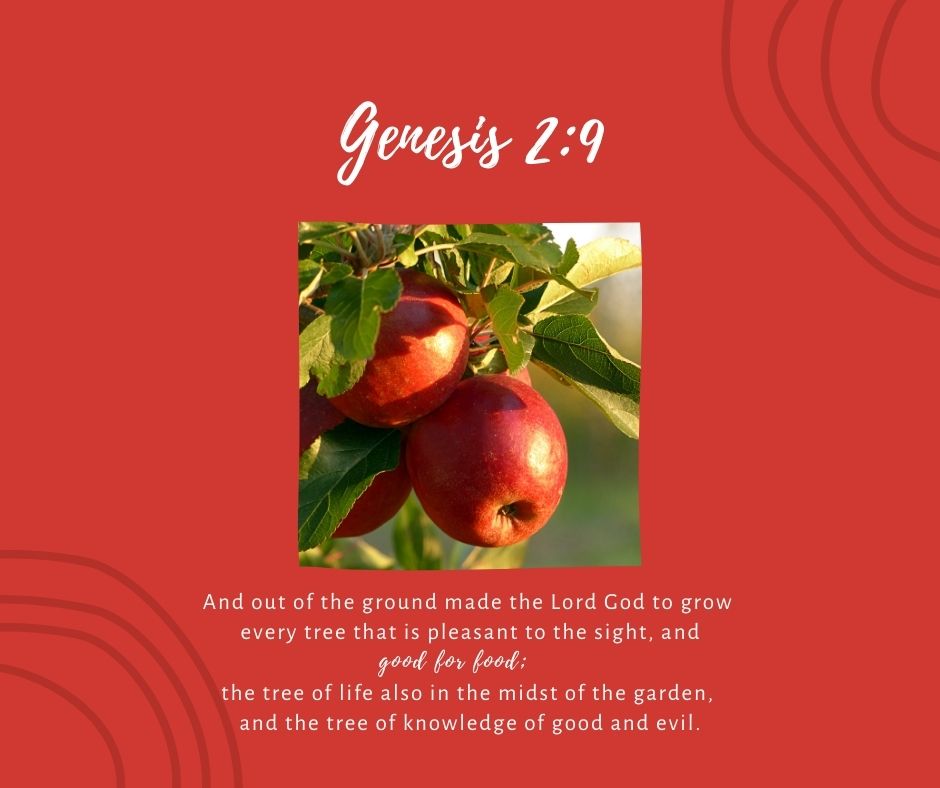
The phrase “good for food” in Genesis 2:9 is a brief yet deeply significant expression that offers insight into God’s provision, man’s dependence, and the moral structure of the created order. This phrase affirms the goodness of creation, the benevolence of the Creator, and the foundation for man’s responsible stewardship and moral accountability.
In its most immediate and literal sense, “good for food” indicates that the trees which God caused to grow were edible and designed to sustain human life. This reflects God’s deliberate care in supplying what was necessary for the nourishment and well-being of mankind. The trees were not wild or inaccessible; they were purposefully placed and divinely appointed to provide sustenance. John Calvin, in his Commentary on Genesis, highlights this as evidence of God’s kindness and provision, noting that God provided not only life but also the means by which life would be sustained (1554). The phrase thus reveals a world in which God’s generosity precedes man’s need, with provision already in place before the first hunger ever arose.
Theologians have consistently understood this as an affirmation of the goodness of the material world. Unlike philosophies that denigrate the physical or elevate the spiritual at the expense of the body, the biblical witness declares that physical needs are legitimate and that meeting those needs is part of God’s good design. To describe the trees as “good for food” is to affirm the created order as both functional and beneficial. Food itself, as a physical substance, is a gift from God, and its goodness lies not only in its utility but also in its role as a means of fellowship with the Creator who provides it.
Moreover, the phrase “good for food” frames the broader moral context of Genesis 2. God gave Adam and Eve freedom to eat from the trees He had made, with only one prohibition—the tree of the knowledge of good and evil. By stating that the trees were good for food, Scripture emphasizes the abundance of provision God gave in contrast to the single restriction He imposed. This underscores the righteousness of the command and the fairness of the test placed before man. The environment was not one of scarcity, where the forbidden tree might seem a necessary option, but of generous sufficiency. This reality amplifies the gravity of disobedience when it later occurs, as it cannot be justified by unmet needs or divine negligence.
The phrase also sets the stage for understanding the relationship between God’s provision and human obedience. By giving food that is good, God demonstrates His role as the provider, while man’s role is to receive with gratitude and to submit to the boundaries set by God. This arrangement affirms key doctrines of God’s sovereignty, human responsibility, and the covenantal structure of creation. The goodness of the food magnifies the sinfulness of transgression, not because the food of the forbidden tree was necessarily evil in itself, but because it was pursued apart from God’s will.
There is also a typological dimension worth considering. While the phrase “good for food” primarily refers to physical nourishment, some theologians have viewed Edenic provision as a shadow of the greater spiritual provision in Christ. The food in Eden was good, but not ultimate. In Christ, God offers the true Bread from heaven (John 6:35), who alone satisfies eternally. The contrast between the food that sustains life temporarily and the food that gives eternal life points to the unfolding revelation of God’s redemptive purposes. What was “good for food” in the garden pointed forward to what is “good for life” in Christ.
Furthermore, the tragic echo of the phrase in Genesis 3:6 must not be overlooked. When Eve looked upon the fruit of the forbidden tree and concluded that it was “good for food,” she used a legitimate standard—food’s goodness—to justify a disobedient act. This misuse of what is good becomes the doorway to sin. The food was indeed nourishing, but it was not to be taken. This moment illustrates a crucial theological truth: the goodness of a thing does not authorize its pursuit outside the bounds of God’s command. Sin often disguises itself in the form of good, and “good for food” becomes a reminder that even the best gifts of God can be misused when separated from obedience.
Modern biblical scholars affirm that this phrase encapsulates the doctrine of divine provision and human dependence. Kenneth Mathews, in The New American Commentary, stresses that Genesis 2:9 presents a creation environment that is both ordered and intentional (1996). Food is not an afterthought but central to man’s life and God’s sustaining grace. This supports a biblical theology of stewardship, in which mankind is entrusted with the care of creation while acknowledging God as the ultimate source of all provision.
In conclusion, the phrase “good for food” in Genesis 2:9 conveys far more than a description of edible trees. It is a theological declaration of God’s provision, the goodness of the physical world, and the framework for responsible human living under divine authority. It reveals a God who gives before He commands, a creation designed for life and blessing, and a moral order where obedience is the proper response to abundance. This phrase is foundational to understanding the nature of God’s goodness and the right relationship between Creator and creature. It also points forward to the fullness of God’s provision in Christ, who offers eternal sustenance to all who trust in Him.
Amen! As the title says, it’s really good! Anything God has done is unquestionably good! Thank you again, Br. Tharp, for your unending slew of factual and biblical information!
Pstr. Bugtong
Thank you, Pastor Bugtong. Your kind words are always a blessing and encouragement!