
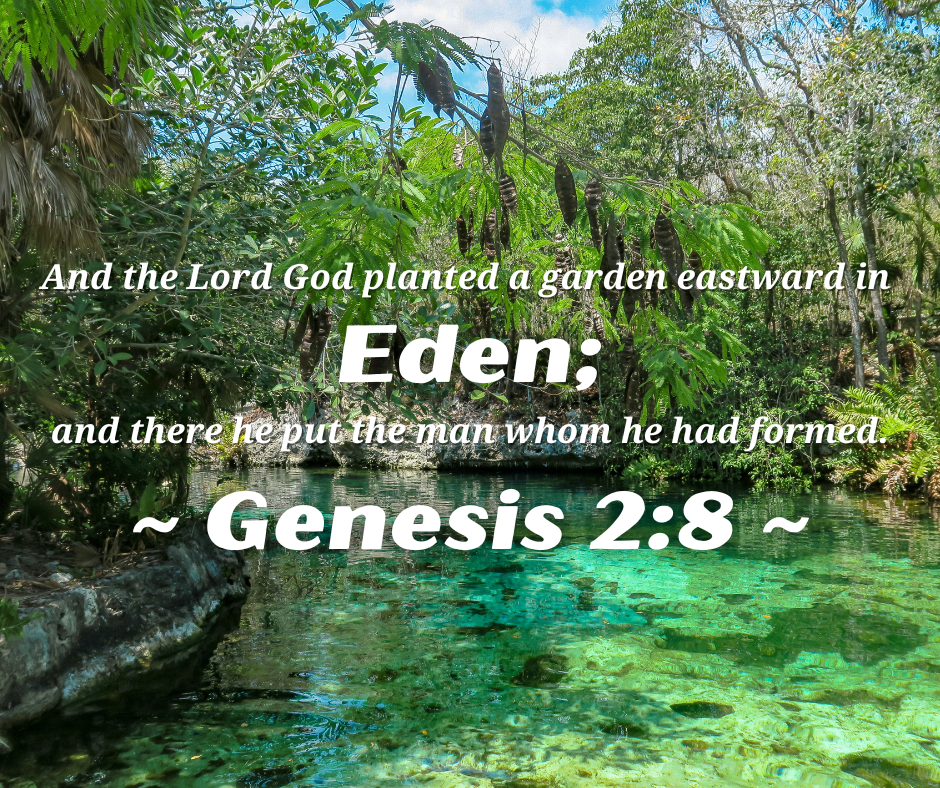
The word “Eden” (עֵדֶן, ʿēden) has captivated the attention of Jewish and Christian interpreters for centuries. Though modern readers often envision Eden merely as a garden paradise, the term itself is rich with linguistic nuance, geographical associations, and profound theological significance. Across the ages—from the theological reflections of Augustine of Hippo, to the exegetical rigor of John Calvin, to the insights of contemporary biblical scholarship—interpretations of Eden have varied in emphasis yet remained united in presenting it as a place marked by divine blessing, sacred order, and abundant provision. It stands not only as the setting of humanity’s beginning but also as a theological symbol of God’s intended harmony between Himself, humanity, and creation.
Eden as State of Innocence and Order
Augustine of Hippo offered a theological rather than purely linguistic interpretation. He viewed Eden not only as a physical garden but as a symbolic representation of mankind’s original state of righteousness. For Augustine, Eden represented order, peace, and intimacy with God—characteristics that were lost in the Fall. He emphasized the moral and spiritual condition of Adam and Eve in Eden rather than its geographical features, interpreting the garden as a place of covenantal testing and moral harmony (Rist, 2008).
Literal and Theological Eden
John Calvin, in his Commentary on Genesis, affirmed the historicity of Eden as a real place. Yet, he also underscored its theological significance. Calvin saw Eden as a tangible example of God’s abundant provision and as the location where the covenant of works was tested. Eden for Calvin was not merely an idyllic location, but the stage on which the drama of human obedience, temptation, and fall unfolded. He connected the garden’s beauty and order to the goodness of God, who provided everything for man’s flourishing (1554).
Sumerian-Akkadian Influence (“edinu”)
One of the earliest etymological connections proposed by scholars comes from the ancient Mesopotamian world. Victor P. Hamilton notes that the word Eden may be linked to the Sumerian-Akkadian term edinu, which refers to a wilderness or flatland. This theory suggests that the biblical Eden was set within the conceptual landscape of the ancient Near East, where flatlands or wildernesses were often considered places of beginnings, transition, or divine encounters (1989).
While this interpretation might seem at odds with the lush, fertile image of the Garden of Eden, it may be that the term originally described a broader geographical location—untouched and pristine—into which God then planted a garden. This supports the biblical view of Eden as divinely cultivated amid a more natural, wild setting (Gen. 2:5–8).
Hebrew Linguistic Roots – “Pleasantness”
The Hebrew root ע-ד-נ (ʿ-d-n), from which the word Eden is directly derived, is associated with pleasure, delight, or pleasantness. This traditional interpretation is affirmed by scholars such as Robert D. Bergen, who emphasizes that in Hebrew, Eden simply and literally means “pleasantness” (2018, p. 12). This meaning aligns seamlessly with the depiction of Eden as a place of beauty, joy, and harmony, where man enjoyed fellowship with God before sin entered the world.
This interpretation has deep roots in both Jewish and early Christian understanding. The Septuagint, the ancient Greek translation of the Old Testament, uses the word paradeisos (παράδεισος) for Eden—also meaning a garden or a park of delight—further reinforcing the idea of a place filled with joy and divine favor (Muraoka, 2009).
West Semitic Origin (“Place of Abundant Waters”)
Kenneth A. Mathews suggests that Eden likely derives from a West Semitic root meaning “a place of abundant waters.” This interpretation finds strong support in Genesis 2:10, which describes a river flowing out of Eden and dividing into four branches—an image of fertility and provision. Mathews points to Genesis 13:10, where the land near the Jordan is compared to “the garden of the LORD,” further emphasizing Eden’s identity as a well-watered and lush locale (1996).
This view reinforces the recurring biblical symbolism of water as a sign of life, blessing, and divine presence (cf. Psalm 1:3; Jeremiah 17:8). Eden, then, becomes the prototype of the places where God dwells with man and provides abundantly.
Aramaic and Ugaritic Origins (“To Enrich, Make Abundant”)
John H. Walton offers one of the most detailed linguistic studies, tracing Eden to an Aramaic cognate meaning “to enrich, make abundant.” He strengthens this interpretation by pointing to Ugaritic texts, which use similar roots in contexts of abundance and divine blessing. Walton’s research, along with the linguistic analysis by Tsumura, confirms that the term likely refers to a garden of divine abundance, especially one with a significant water source (2001).
For Walton, Eden is not only a paradise but also a sacred space, like a temple garden, where God and man dwell together. This interpretation has deep theological implications: just as temples were places of divine-human encounter, Eden was the original holy sanctuary. This theological trajectory culminates in Revelation 22, where the imagery of Eden is restored in the New Jerusalem with a river of life flowing from the throne of God.
Theological Summary and Canonical Significance
From ancient Mesopotamian etymologies to Reformation theology and modern biblical scholarship, the name Eden consistently conveys themes of abundance, pleasantness, divine blessing, and sacred order. While the precise linguistic origin remains debated, the theological unity of the concept is clear: Eden is the place where God intended mankind to flourish in fellowship with Him.
In the Bible, Eden is both a historical beginning and a typological foreshadowing of what is to come. The imagery introduced in Genesis 2:8 is echoed in prophetic literature (Ezekiel 36:35; Isaiah 51:3) and consummated in Revelation 22, where the Tree of Life reappears and healing waters flow from God’s throne.