
The opening passage of Genesis is a majestic and profound account of the creation of the universe by God. It begins with the powerful declaration: “In the beginning God created the heaven and the earth” (Genesis 1:1).
This statement sets the foundation for the entire Bible, affirming that God is the sovereign Creator of all things. At the outset, the earth is described as being “without form, and void” with darkness covering the deep, while the Spirit of God moves upon the face of the waters (Genesis 1:2).
God then proceeds to create the universe in six literal days, each marked by the phrase “the evening and the morning.”
Day 1: Creation of Light (Genesis 1:3–5)
God speaks the first recorded words, “Let there be light,” and light immediately comes into existence. God separates light from darkness, calling the light “Day” and the darkness “Night.” This shows God’s authority over creation and His ability to bring order from chaos.
Day 2: Formation of the Firmament (Genesis 1:6–8)
God creates the firmament, a vast expanse to divide the waters above from the waters below, and calls it “Heaven” (or sky).
Day 3: Dry Land, Seas, and Vegetation (Genesis 1:9–13)
God gathers the waters into one place, allowing dry land to appear, which He calls “Earth,” and the gathered waters “Seas.” He then commands the earth to bring forth vegetation—grass, herbs yielding seed, and fruit trees bearing fruit according to their kind. This act of creation highlights God’s provision for life and the inherent order within creation.
Day 4: Creation of Sun, Moon, and Stars (Genesis 1:14–19)
God sets celestial bodies in the firmament to divide day from night and to serve as signs for seasons, days, and years. The “greater light” (sun) rules the day, while the “lesser light” (moon) rules the night. He also creates the stars. These heavenly bodies are not objects of worship but serve practical purposes in marking time and giving light.
Day 5: Creation of Sea Creatures and Birds (Genesis 1:20–23)
God fills the waters with living creatures and the sky with birds. He blesses them, saying, “Be fruitful, and multiply, and fill the waters in the seas, and let fowl multiply in the earth” (Genesis 1:22). This blessing emphasizes both God’s care for His creation and His command for it to flourish.
Day 6: Creation of Land Animals and Mankind (Genesis 1:24–31)
God creates land animals—cattle, creeping things, and beasts of the earth. Finally, He creates mankind as the pinnacle of His creation: “So God created man in his own image, in the image of God created he him; male and female created he them” (Genesis 1:27).
Being made in the image of God signifies that humanity uniquely reflects God’s character, possessing rationality, moral responsibility, and the capacity for relationships. God grants mankind dominion over the earth and all living things, commissioning them to “be fruitful, and multiply, and replenish the earth, and subdue it.”
God also provides every herb bearing seed and fruit-bearing tree for food, emphasizing His care and provision. As God concludes His creative work, He observes that “it was very good.”
Day 7: God Rests (Genesis 2:1–3)
On the seventh day, God completes His creation and rests, not because He is weary but to set an example of rest and reflection. He sanctifies and blesses this day, establishing the pattern for the Sabbath—a day of rest and worship.
Narrowing the Focus
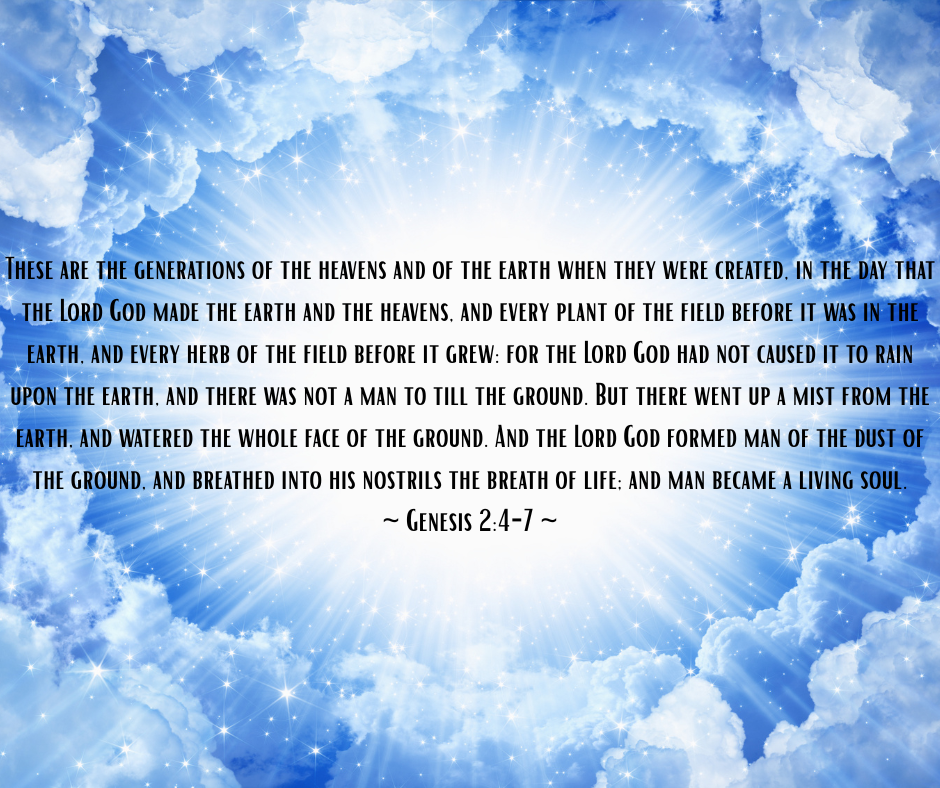
While Genesis 1:1–2:3 provides a sweeping, orderly overview of the creation of the universe, Genesis 2:4–7 narrows the focus to the intimate and personal creation of humanity. It begins with the statement: “These are the generations of the heavens and of the earth when they were created, in the day that the LORD God made the earth and the heavens” (Genesis 2:4).
This introduction marks a transition from the grand narrative to a more detailed and personal account. Unlike the majestic and declarative tone of Genesis 1, this section emphasizes God’s hands-on craftsmanship and personal involvement with His creation, particularly mankind.
God forms man from the dust of the ground and breathes into his nostrils the breath of life, making man a living soul (Genesis 2:7). This vivid description highlights the uniqueness and dignity of humanity, directly fashioned by God Himself. It also establishes that life itself is a gift from God, infused by His Spirit.
In this passage, God is referred to as “LORD God” (Yahweh Elohim), emphasizing both His covenantal relationship and His supreme authority as Creator. The combination of “Yahweh” (the personal name of God) and “Elohim” (a title signifying power and sovereignty) beautifully captures both God’s intimacy and His majesty.