
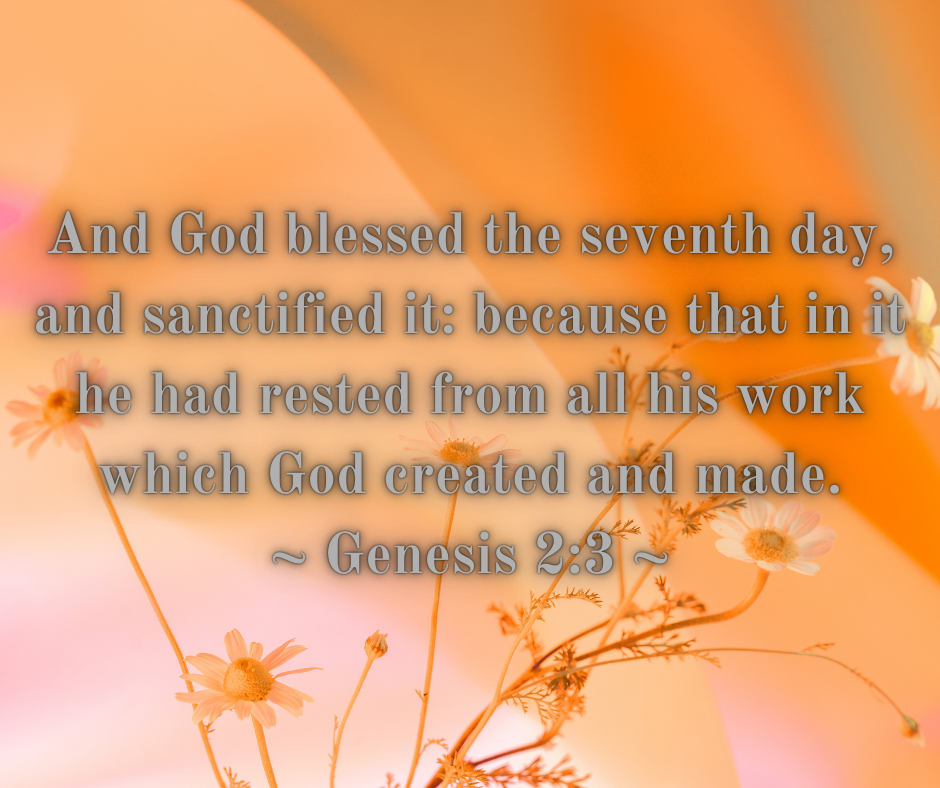
Many religious and philosophical traditions symbolize God’s rest as described in Genesis 2:2-3 as a moment of spiritual transformation—a state where creation reaches perfect harmony with the divine. Below are key perspectives from different worldviews that interpret God’s rest as the fulfillment of spiritual purpose.
Swedenborgianism (New Church): Regeneration and Spiritual Completion
The Swedenborgian tradition, founded on the teachings of Emanuel Swedenborg (1688–1772), views the Bible as entirely allegorical, with its deeper meanings hidden beneath the literal text. According to Swedenborg, Genesis is not merely a historical account of physical creation but a symbolic description of the process of spiritual regeneration.
From this perspective, God’s rest on the seventh day represents the culmination of a phase in the soul’s transformation. Just as God ceases from His creative work, so too does the spiritually awakened person enter a state of divine peace and enlightenment, having progressed beyond struggle and turmoil. Swedenborg describes this as the point at which the soul has been cleansed of selfish desires and attuned to divine love and wisdom. The Sabbath, in this sense, is not just a day of rest but an eternal spiritual state, where the soul abides in the presence of God (Heaven and Hell, 2000, pp. 233-234).
Gnosticism: Escape from the Material World into Divine Knowledge
Gnosticism, a mystical and esoteric tradition that emerged in the early Christian era, often interprets Genesis as a metaphor for the soul’s journey back to divine knowledge (gnosis). Many Gnostic sects held that the material world is a prison created by an inferior, flawed deity (the Demiurge) and that humanity’s true nature is divine but trapped within physical existence.
Within this framework, God’s rest in Genesis does not represent a moment of divine inactivity but rather the ultimate spiritual awakening—the point at which the soul transcends the illusions of the material world and returns to its true, spiritual home. In Gnostic thought, entering God’s rest means escaping ignorance and illusion, thereby achieving enlightenment and unity with the higher, unknowable God. It is the completion of the soul’s journey away from darkness and into divine light (Pagels, 1979, pp. 34-35).
Kabbalistic Judaism: Cosmic Harmony and the Unfolding of Divine Energy
In Kabbalah, the mystical branch of Judaism, creation is viewed as an intricate process of divine emanation, in which God’s infinite light is channeled into the universe through the Sefirot, a system of ten divine attributes.
God’s rest on the seventh day is not understood as a literal pause in activity, but rather a state of divine completeness, where the forces of creation settle into perfect balance. According to Jewish mysticism, the Sabbath is not merely a commemoration of creation’s completion but an invitation for humanity to participate in the cosmic harmony of divine presence. When people enter the Sabbath in a spiritual sense, they align their own souls with this higher order, experiencing a transformation that draws them closer to the divine reality.
Thus, in Kabbalistic thought, God’s rest is not a passive state but an active and ongoing invitation for humanity to enter divine wholeness—a profound shift in consciousness that aligns one’s soul with the flow of divine energy (Scholem, 1965, pp. 95-96).
Christian Mysticism: The Soul’s Union with God
Throughout Christian history, mystics such as Meister Eckhart, Gregory of Nyssa, and St. John of the Cross have interpreted creation as an ongoing spiritual process, rather than a singular historical event. These mystics believe that God’s rest in Genesis represents the soul’s ultimate union with God—a state in which inner striving ceases, and the believer rests completely in divine presence.
In Christian mysticism, the seventh day is not about physical inactivity but about spiritual stillness, a state in which the soul has surrendered its ego and fully opened itself to God’s love. This is the concept of divine rest—not mere leisure, but a deep, transformative peace where human will is fully harmonized with the divine will.
For mystics, prayer and contemplation lead the soul into this divine rest, mirroring the creation story where God’s work is completed, and peace reigns. The idea of the Sabbath rest becomes a metaphor for the journey of faith, culminating in eternal rest in God.
Theosophy: Spiritual Evolution and Divine Realization
Theosophy, an esoteric movement founded in the 19th century, synthesizes Eastern and Western spiritual philosophies and interprets sacred texts as symbolic representations of the soul’s evolution. In Theosophical thought, creation is an ongoing spiritual process, both at a cosmic level and within individual human beings.
From this perspective, God’s rest on the seventh day represents the completion of a cycle of spiritual growth, where the soul reaches a state of enlightenment and harmonizes with divine consciousness. Just as creation moves through phases, so too does the soul undergo successive stages of purification and transformation, ultimately arriving at a point of inner peace and unity with the Divine.
In Theosophy, rest is not inactivity but a higher state of being—where struggle gives way to spiritual wisdom, and the soul abides in divine knowledge (Blavatsky, 1888).
Hinduism (Advaita Vedanta): Moksha and the End of Illusion
In Hinduism, particularly in the Advaita Vedanta tradition, creation narratives are understood as symbolic myths that reflect the journey of the individual soul toward enlightenment. Unlike Western traditions that often view creation as a linear event, Hindu thought sees it as a cycle—a constant interplay of manifestation and dissolution.
In this worldview, God’s rest in Genesis resonates with the concept of moksha (liberation)—the final realization that the individual self (Atman) is not separate from the absolute reality (Brahman). Just as God ceases from His creative activity, the enlightened soul ceases from worldly striving, recognizing that all distinctions are illusions. The soul finds eternal rest in the unbroken peace of divine unity, beyond the cycles of birth and death (Radhakrishnan, 1994, pp. 672-675).
A Biblical Perspective: Rest in Christ
A faithful interpretation of Genesis holds that God’s rest refers to the completion of creation, not an ongoing transformation. However, Scripture extends this idea beyond Genesis.
Hebrews 4:9-10 states: “There remaineth therefore a rest to the people of God. For he that is entered into his rest, he also hath ceased from his own works, as God did from his.” This passage informs us that salvation in Christ is the ultimate fulfillment of God’s rest. When believers trust in Jesus, they no longer strive to earn righteousness through works; rather, they rest in the finished work of Christ.
In this sense, God’s rest in Genesis serves as a foreshadowing of the eternal Sabbath that believers will enter in heaven—a final state of peace, joy, and communion with God.