
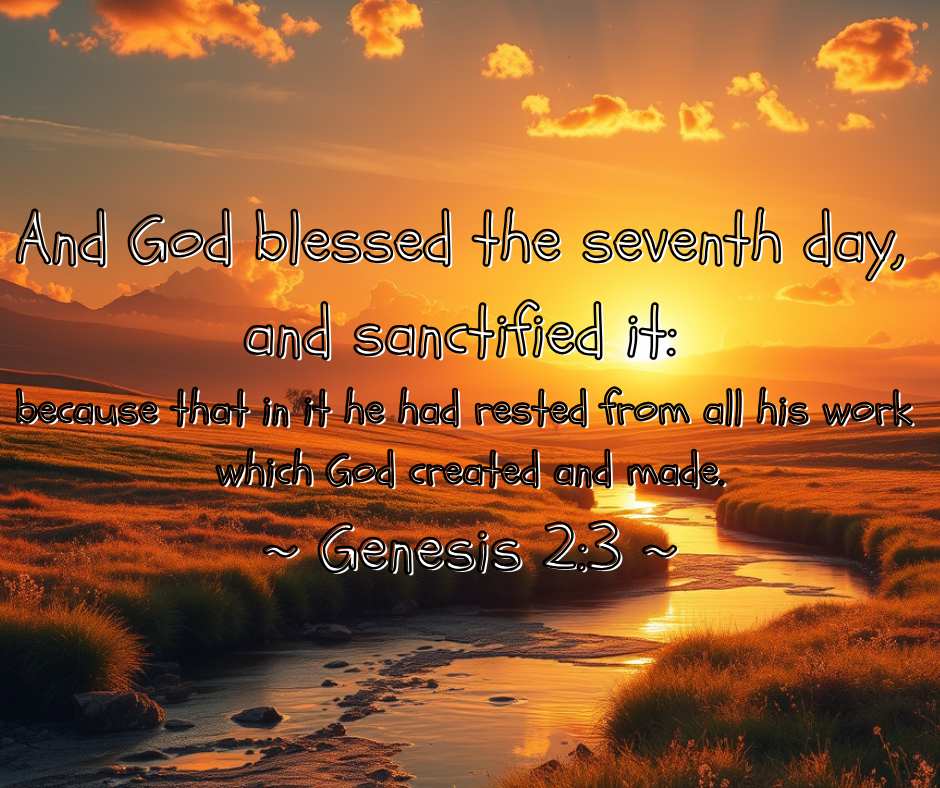
The creation narrative in Genesis presents a profound and unique event: God blesses a unit of time rather than a physical object, person, or place. This is the only instance during the creation process where God specifically blesses a period of time—the seventh day.
This act sets the seventh day apart from the rest of creation, marking it as holy. The term sanctified, as used in Scripture, refers to something set apart for God’s service (Everyday Study Bible, 2018, p. 10). From the very beginning, God established a rhythm of work and rest, not out of necessity—since He does not grow weary—but as a pattern for His creation to follow. By sanctifying the seventh day, God infused it with divine purpose, making it a day dedicated to Him.
The Holiness of Time Over Space
The sanctification of the seventh day carries deep theological significance. It is notable that the first occurrence of the word holy in Scripture is applied not to a place, an object, or even a person, but to time itself. This stands in stark contrast to pagan religions, which typically venerate sacred spaces—temples, mountains, or cities—while viewing time as an endless, cyclical process (Hamilton, 1989, p. 12). In contrast, the biblical worldview presents time as linear and purposeful, moving toward God’s ordained ends. The Sabbath, therefore, is not merely a pause in the cycle of days but a divinely instituted moment of holiness, directing human attention back to God.
A Day Set Apart for God
By sanctifying the seventh day, God declared it uniquely His, set apart from the ordinary flow of time and devoted to His purposes (Mathews, 1996, p. 179). This act of consecration reveals a fundamental truth about holiness: God alone is holy in His essence, and anything else that is deemed holy derives its sanctity from Him. In the Old Testament, objects, people, and places become holy only when they are set apart by God and dedicated to Him in the prescribed manner. The seventh day is the first thing in Scripture to be hallowed—imbued with a sacred status that properly belongs to God alone (Wenham, 1987, p. 36). This sets a precedent for the later establishment of the Sabbath as a covenant sign between God and His people (Exodus 20:8-11).
The Sabbath as a Reflection of God’s Holiness
The sanctification of the seventh day is not merely about rest but about communion with God. As a day set apart for Him, the Sabbath serves as a continual reminder of God’s sovereignty over time and creation. It underscores humanity’s dependence on God and the need to align life with His divine order. The concept of rest in Genesis 2:3 is not just physical cessation from labor but a deeper, spiritual rest—a participation in God’s completed work. This idea finds ultimate fulfillment in Christ, who offers rest for the soul (Matthew 11:28-30) and provides the eternal Sabbath rest for believers (Hebrews 4:9-11).
Thus, from the very beginning, the sanctification of time stands as a testimony to God’s authority, holiness, and purpose for His creation. The seventh day, blessed and set apart, calls humanity to recognize that life is not merely about productivity but about worship, reflection, and dwelling in the presence of a holy God.