
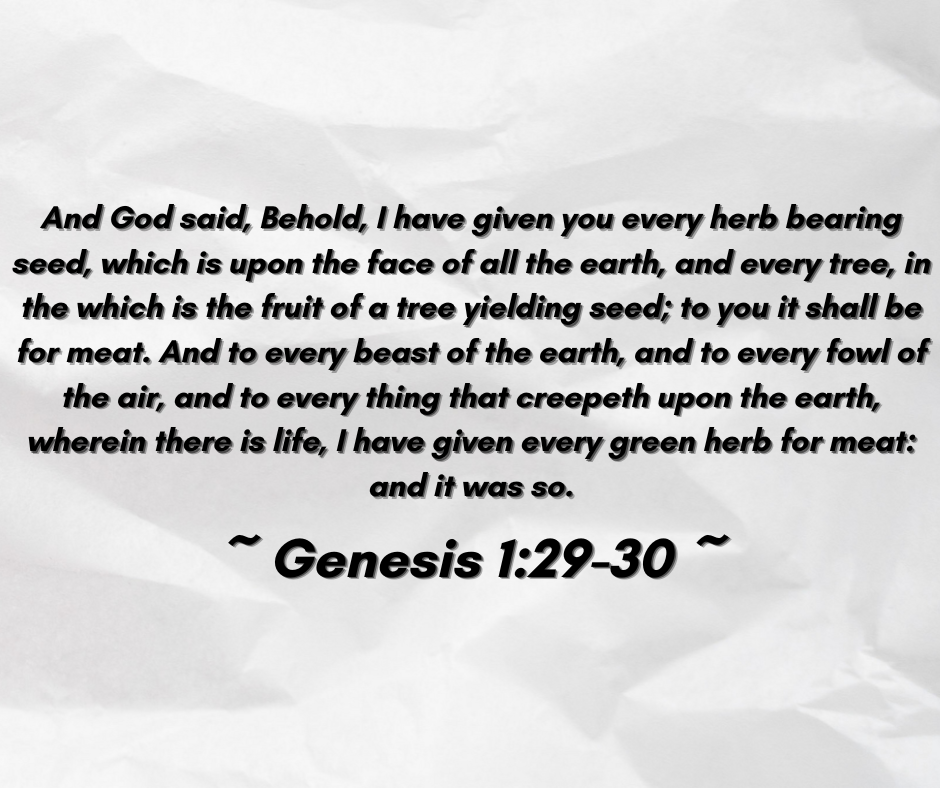
After the Flood, God expands human dietary permissions, declaring: “Every moving thing that liveth shall be meat for you; even as the green herb have I given you all things” (Genesis 9:3). The contrast between Genesis 1:29 and Genesis 9:3 suggests a fundamental shift in the human relationship with food, with meat consumption being explicitly sanctioned for the first time in biblical history. Theological interpretations of this change vary, with some viewing it as a divine concession to human frailty in a post-Fall world, while others argue that it was a pragmatic response to the altered conditions following the Flood.
Theological and Ethical Implications of Meat Consumption
The introduction of meat-eating has sparked extensive theological discussion regarding its moral and spiritual implications. Some Jewish rabbinic and Midrashic sources argue that God permitted meat consumption as a response to human moral decline rather than as an endorsement of an ideal dietary practice (Sarna, 1989, p. 61). The pre-Flood world had been characterized by escalating wickedness and violence:
- “And God saw that the wickedness of man was great in the earth, and that every imagination of the thoughts of his heart was only evil continually” (Genesis 6:5).
- “The earth also was corrupt before God, and the earth was filled with violence” (Genesis 6:11).
Given this moral decay, some interpretations suggest that permitting meat consumption was a way to regulate human behavior, redirecting mankind’s violent tendencies toward a controlled and ethical form of animal slaughter rather than unchecked bloodshed.
Additionally, even as God allowed meat consumption, He immediately imposed restrictions, demonstrating that it was not a license for unrestricted killing or indulgence: “But flesh with the life thereof, which is the blood thereof, shall ye not eat” (Genesis 9:4).
This command underscores the sacredness of life, with blood symbolizing vitality. Later, this principle would be reinforced in the Mosaic Law: “For the life of the flesh is in the blood: and I have given it to you upon the altar to make an atonement for your souls: for it is the blood that maketh an atonement for the soul” (Leviticus 17:11). The Noahic prohibition against consuming blood thus serves as a theological precursor to later sacrificial atonement themes found throughout Scripture.
Was Meat Consumption Already Practiced Before the Flood?
Although Genesis 9:3 formally grants permission for eating meat, some scholars suggest that this practice may have already existed before the Flood. In his Genesis commentary, Gordon Wenham (1987, p. 34) observes that certain pre-Flood events indicate a familiarity with animal use, both for sacrifice and possibly for sustenance:
- God provided garments of skin for Adam and Eve (Genesis 3:21), implying the death of an animal—possibly the first recorded instance of bloodshed.
- Abel, a shepherd, offered an animal sacrifice to God (Genesis 4:2-4), suggesting that animals were valued for more than just labor or companionship.
- Noah was instructed to distinguish between clean and unclean animals (Genesis 7:2), a distinction later associated with dietary laws in Leviticus.
This has led some commentators, such as Gispen (1982), to argue that Genesis 9:3 does not inaugurate meat-eating but rather ratifies an already existing practice.
The Fall and the Introduction of Death
John MacArthur emphasizes the theological significance of the Fall in relation to death, arguing that: “The Fall introduced decay and death into what was a pristine world” (The Battle for the Beginning: Creation, Evolution, and the Bible, 2001, p. 166). This perspective aligns with Paul’s teaching in Romans: “Wherefore, as by one man sin entered into the world, and death by sin; and so death passed upon all men, for that all have sinned” (Romans 5:12).
From a biblical standpoint, death—whether of humans or animals—was not part of God’s original plan but was a consequence of sin. If one accepts that animal death began after the Fall, it follows that meat-eating may have been practiced informally before the Flood but was officially sanctioned only afterward.
Perspectives from Early Church Fathers and Christian Theologians
Christian thinkers throughout history have debated the significance of meat consumption:
- Augustine (354–430 AD) argued that God’s permission of meat was a reflection of human sinfulness but not an ideal state, drawing on the idea that the pre-Fall world was one of harmony (City of God, 22.30).
- Thomas Aquinas (1225–1274) viewed meat consumption as part of the natural order in a fallen world, linking it to mankind’s dominion over creation (Summa Theologica, I, Q96, A1).
- John Wesley (1703–1791), founder of Methodism, saw vegetarianism as closer to the Edenic ideal, emphasizing compassion for animals in his ethical teachings (Maddox, 1994, p. 124).
These diverse perspectives illustrate that while meat consumption is biblically sanctioned, the theological implications remain a matter of interpretation.
Conclusion
Genesis 9:3 marks a turning point in human dietary practice, reflecting broader theological themes of sin, survival, and ethical responsibility. Whether it was a completely new permission or a formalization of an existing practice, this shift underscores the reality of a fallen world where moral boundaries were needed to regulate human behavior. Though meat-eating was permitted, it was not unrestricted—God imposed immediate ethical constraints to preserve the sanctity of life.
From a theological perspective, this passage reinforces the tension between divine concession and divine ideal. While God allowed meat consumption, it does not necessarily indicate that it was His ultimate intention for humanity. Rather, it serves as another example of God’s grace in accommodating human weakness while upholding moral principles.