
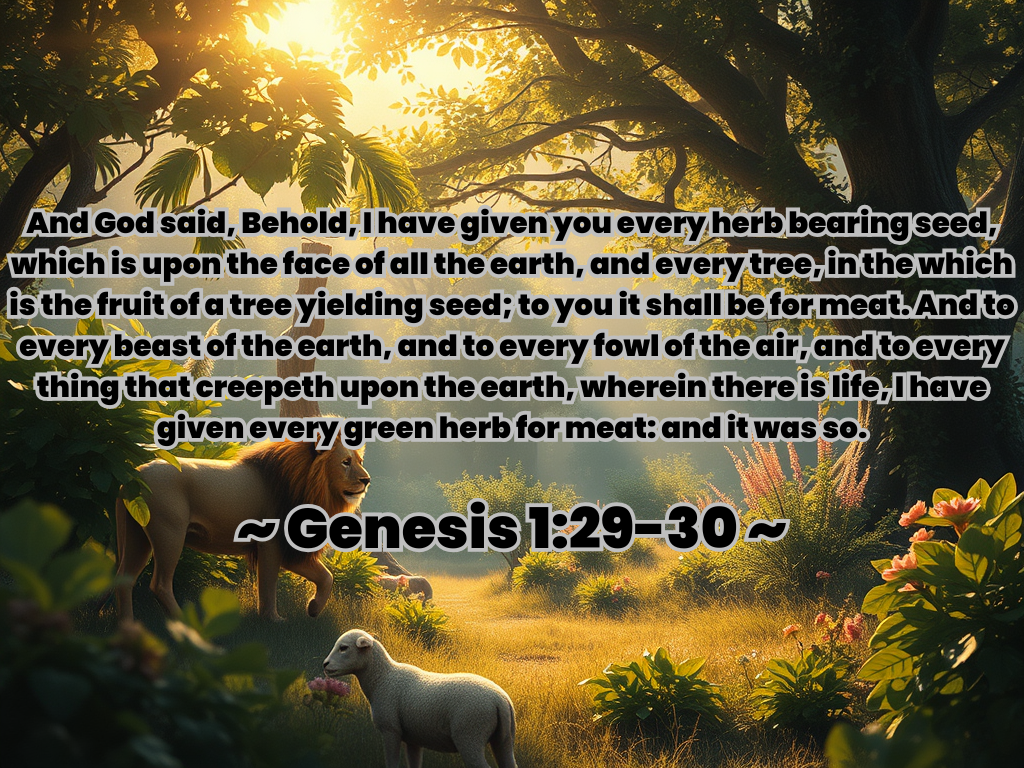
Genesis 1:29-30 presents a foundational passage in the biblical creation account, revealing God’s original provision of food for both humanity and animals. This passage is significant because it indicates that in the pre-Fall world, all living creatures were given only plant-based sustenance. The plain meaning of the text suggests that God’s design for creation was one of peace and nonviolence, where death and carnivory did not exist. This aligns with the broader biblical theme of a perfect and harmonious Edenic existence, which is echoed in prophetic visions of a restored creation (cf. Isaiah 11:6-9, Isaiah 65:25). The passage explicitly grants only plants as food, with no mention of meat consumption, reinforcing the idea that death was absent in the world as God originally created it.
Genesis 1:29-30 and the Vegetarian Diet of Creation
God’s words here explicitly limit food sources to plants, both for mankind and for animals. There is no indication that humans or animals were to consume meat at this stage in creation. This suggests that in the original, sinless world, all living beings thrived without predation or violence, supporting the idea that death was not part of God’s “very good” creation (Genesis 1:31).
This theme of a peaceful, nonviolent existence is reinforced by prophetic descriptions of the Messianic age, in which creation is restored to a harmonious state. Isaiah 11:6-9 portrays a future where the wolf lies down with the lamb, the lion eats straw like the ox, and no creature harms another. Similarly, Isaiah 65:25 states, “The wolf and the lamb shall feed together, and the lion shall eat straw like the bullock: and dust shall be the serpent’s meat. They shall not hurt nor destroy in all my holy mountain, saith the Lord.” These passages echo the Edenic ideal found in Genesis 1:29-30, reinforcing the view that God’s original design was a world free from death, violence, and carnivory.
Historical and Theological Interpretations
Jewish Interpretations
Ancient Jewish interpretations strongly affirm the vegetarian state of the original creation. The Midrash (Genesis Rabbah 34:1) comments that Adam and Eve were permitted only vegetation for food and that animals shared this same diet. Likewise, the Talmud (Sanhedrin 59b) explicitly teaches that Adam was not allowed to eat meat, indicating that humanity’s original diet was vegetarian. These interpretations support the idea that the pre-Flood world was governed by nonviolence, with neither humans nor animals consuming flesh.
After the Fall and the Flood, however, a significant shift occurred. In Genesis 9:3, after Noah’s departure from the ark, God expanded the dietary permissions, stating, “Every moving thing that liveth shall be meat for you; even as the green herb have I given you all things.” This implies that the consumption of meat was a post-Fall concession rather than part of God’s original intent.
Early Christian Interpretations
The early Church Fathers also upheld the interpretation that Genesis 1:29-30 describes a peaceful, death-free world.
- St. Basil (4th century), in his Hexaemeron, described the vegetarian diet in Genesis as evidence of God’s original plan for a world without bloodshed. He viewed this as a reflection of divine harmony, where all creatures coexisted peacefully.
- Augustine, in City of God, interpreted the provision of food in Genesis 1:29-30 as both a literal and symbolic demonstration of God’s sustenance for body and soul. He emphasized that the original creation was marked by peace, where death and predation did not exist. Augustine saw the introduction of carnivory as a consequence of sin’s corruption of the natural order.
Modern Evangelical Perspectives
Contemporary evangelical scholars affirm the idea that Genesis 1:29-30 reflects God’s original design for a death-free world.
- John MacArthur, in The Battle for the Beginning: Creation, Evolution, and the Bible, emphasizes that God’s creation was “entirely good, unmarred by violence or death” (2001, p. 166). He argues that death, suffering, and carnivory only entered the world after Adam and Eve’s sin.
- Ken Ham, founder of Answers in Genesis, also highlights Genesis 1:29-30 as evidence of an initial vegetarian state for both humans and animals. He argues that the absence of predation before the Fall underscores God’s provision for all life and the peaceful nature of creation before sin introduced death and suffering.
Theological Significance
The original vegetarian provision of food in Genesis 1:29-30 is theologically significant because it reinforces the doctrine that death was not part of God’s initial creation. This aligns with passages such as Romans 5:12, which states, “Wherefore, as by one man sin entered into the world, and death by sin; and so death passed upon all men, for that all have sinned.” The apostle Paul further elaborates in Romans 8:20-22 that creation itself was subjected to futility and corruption because of sin, awaiting redemption.
This understanding of Genesis 1:29-30 helps frame the broader biblical narrative:
- Creation – God originally designed a perfect, harmonious world where all creatures lived without death or violence.
- Fall – Sin corrupted creation, introducing suffering, death, and predation.
- Redemption – Through Christ, God is restoring all things, ultimately leading to a renewed creation where peace and harmony will be restored (Revelation 21:1-4).
Conclusion
Genesis 1:29-30 provides a clear biblical foundation for understanding God’s original provision for both humanity and animals. The passage suggests that the pre-Fall world was free from death, predation, and suffering, aligning with both Jewish and Christian historical interpretations. The transition to meat consumption after the Fall and the Flood highlights the impact of sin on creation. Furthermore, prophetic passages like Isaiah 11:6-9 and Isaiah 65:25 point to a future restoration of this peaceable state, reinforcing the idea that God’s perfect will is for a world without death and violence.
This passage not only reveals God’s abundant provision but also serves as a reminder of the hope of redemption—a return to the harmony and perfection that existed before sin entered the world.