
- I. Introduction
- II. Subtlety and Distortion in Eden
- III. The Serpent’s Subtlety and the Clarity of Doctrine
- IV. The Serpent’s Subtle Question and Theology’s Many Replies
- V. Following the Serpent’s Lead
- A. Twisting the Truth
- 1. False Light: Recasting the Serpent as Savior
- 2. Honoring the Deceiver: Serpent Veneration in the Ophites and Naassenes
- 3. False Liberation: Satan as Benefactor in Occult Thought
- 4. New Age Deception: Awakening Inner-Serpent Energy
- 5. Sexual Deviation: The Serpent-Seed Myth
- 6. The Serpent’s Paradox: When Evil Is Painted as Essential
- 7. A Voice of Empowerment? Feminist Revisions of the Serpent
- B. Sowing Doubt
- C. Global Distortions
- A. Twisting the Truth
- VI. The Serpent’s Question and the Church’s Calling
- VII. Answering the Serpent’s Question: Trusting God’s Word
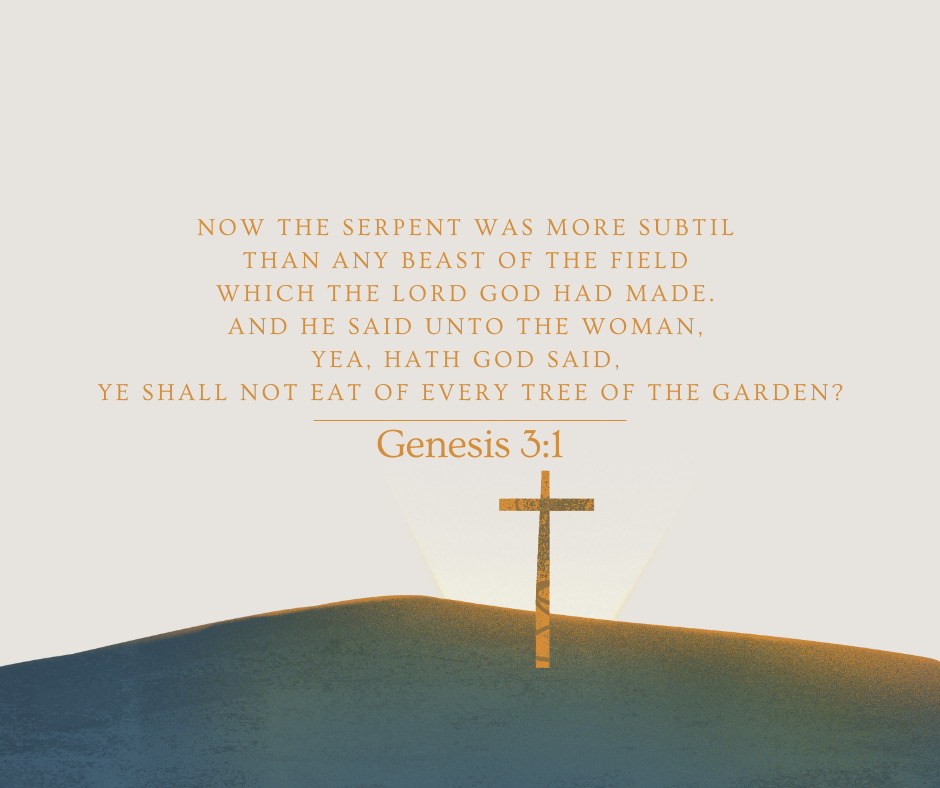
“Now the serpent was more subtil than any beast of the field which the Lord God had made. And he said unto the woman, Yea, hath God said, Ye shall not eat of every tree of the garden?” (Genesis 3:1).
I. Introduction
The opening chapters of Genesis lay the majestic foundation for all of Scripture. Genesis 1 introduces the sovereign God who speaks the universe into being, bringing light out of darkness and fullness out of nothing. Humanity—male and female—is created in His image, set apart from the rest of creation, and entrusted with the privilege and responsibility of dominion. Genesis 2 narrows the lens, showing us the formation of Adam from the dust, his placement in the garden, the divine command concerning the tree of knowledge, and the gift of Eve, drawn from his side to be his equal and covenant companion. The picture closes with a scene of perfect wholeness: man and woman together, naked and unashamed, living in innocence before God and one another.
But into this harmony comes disruption. Genesis 3 begins with a sudden, almost jarring change in tone. In one sentence the serenity of Eden is threatened. The serpent, a creature of God’s making, is introduced as the tempter’s instrument, raising questions that touch the deepest mysteries of evil, freedom, and rebellion. How could such a voice break into God’s good creation? Genesis doesn’t offer abstract theories but a concrete story that explains how sin entered the world through a real, historical fall.
The serpent’s opening line—“Yea, hath God said, Ye shall not eat of every tree of the garden?”—is deceptively simple and profoundly dangerous. It twists God’s generous command into something restrictive, casting doubt on His goodness and planting seeds of suspicion in the human heart. This first recorded speech from a non-human creature in Scripture is a deliberate contrast to God’s own words of blessing and command. With it, the age-old pattern of temptation is revealed: distort the truth, deceive the hearer, and drive a wedge between humanity and their Maker.
Genesis 3:1, then, is more than a curious story about a talking serpent. It sets the stage for the entire drama of redemption. Every sin since has followed the same path—questioning God’s Word, doubting His character, and preferring human judgment over divine wisdom. To grasp the weight of this verse is to see the root of all rebellion and the reason why the gospel of Christ is not optional but essential: only He can undo the serpent’s lie and restore what was lost in Eden.
II. Subtlety and Distortion in Eden
A. A Creature Twisted for Deception
Genesis 3 opens with words that feel both brief and ominous: “Now the serpent was more subtil than any beast of the field which the LORD God had made.” At first glance, this may appear to be nothing more than a curious detail about a particularly clever animal in God’s creation. The Hebrew word for “serpent” (nāḥāš) certainly allows for that straightforward reading; it is the ordinary term for a snake. Yet the narrative quickly reveals that this serpent is not ordinary at all. What begins as a description of a creature soon unfolds into an encounter with the adversary himself, working through the serpent as his mouthpiece.
Later Scripture confirms what Genesis only hints at: the serpent is more than an animal; he is the instrument of Satan. The book of Revelation identifies him plainly as “that old serpent, called the Devil, and Satan, which deceiveth the whole world” (Revelation 12:9; 20:2). The subtle deceiver in Eden is the same figure who, throughout history, wages war against God and His people. This continuity ties the first temptation in Genesis directly to the larger drama of redemption that stretches across the whole Bible.
It is also significant that the narrator presents the serpent first and foremost as a creature “which the LORD God had made.” In other words, he is not an independent rival to God, nor an equal force of darkness in some dualistic struggle. He is a created being, part of the world that God declared “very good” (Genesis 1:31), but now enlisted in rebellion. His cunning will soon become the tool by which humanity is enticed to doubt God’s Word and distrust His goodness. By introducing the serpent in this way, Scripture sets the stage for one of its central truths: evil is not co-eternal with God but arises within creation as defiance against Him. The serpent is a creature, but one whose subtlety is about to become the catalyst for humanity’s tragic fall.
B. The Subtlety of the Serpent
The key word in the verse, “subtil” (ʿārûm), is richly nuanced. In other parts of Scripture, particularly in Proverbs (Proverbs 12:16, 23), the same root can carry a positive sense of prudence, insight, or careful discernment. Shrewdness, in that context, is a sign of wisdom. Yet in Genesis 3, the nuance turns darker: the serpent’s subtlety is not life-giving but manipulative, not prudent but predatory. Interpreters differ on how to read this. Daniel Block argues that the serpent represents a kind of “wisdom not based on the fear of the Lord,”1 knowledge divorced from reverence for God, which Proverbs insists is the only true foundation of wisdom (Proverbs 9:10). John Walton similarly notes that shrewdness, when untethered from godly fear, becomes corrosive rather than constructive.2 John Davis offers another angle, suggesting that the word itself need not be taken negatively, but simply describes the serpent’s cleverness, which in turn made it a fitting vessel for Satan’s schemes.3
The narrator, however, seems to nudge the reader toward a negative reading through a striking wordplay. At the close of Genesis 2, Adam and Eve are described as “naked” (ʿărûmmîm), open and unashamed before one another and before God (2:25). Immediately afterward, the serpent is described as ʿārûm, subtil. The echo is intentional: the innocent vulnerability of humanity will now be confronted by a cunning adversary eager to exploit it. Innocence and subtlety are placed side by side, preparing us for a conflict where trust in God’s truth will be pitted against deception.4
Taken together, the literary and theological context suggests that ʿārûm here is no neutral descriptor. It is a signal of danger. What Proverbs celebrates as wise discernment has been twisted into craftiness, sharpened not for life but for destruction. The serpent may be part of God’s creation, but his subtlety is set against God’s goodness, and his cleverness is marshaled in service of rebellion. In just a few words, Genesis alerts us that the harmony of Eden is about to be tested and that the battle will not begin with swords or strength, but with words.
C. The Serpent’s Distortion of God’s Word
The serpent’s first recorded words in Scripture are nothing short of striking: “Yea, hath God said, Ye shall not eat of every tree of the garden?” (Genesis 3:1). This is the earliest instance of a non-human creature speaking in the biblical narrative, and its form is deliberate. It is not an outright contradiction of God’s word, but a subtle distortion of it. God’s original command was overwhelmingly generous: “Of every tree of the garden thou mayest freely eat” (Genesis 2:16). Only one tree was placed off limits. Yet the serpent reframes this abundant permission as an unreasonable restriction, as though God were more interested in withholding good than in granting it.
This is deception at its most dangerous: not bold-faced lies, but questions designed to twist perspective. Victor Hamilton captures the force of the serpent’s insinuation: “This God of yours is holding back from you. He lets you see, but not enjoy. Can you really trust a God like that?”5 Henry Morris likewise notes that the suggestion was subtle: perhaps God was not as good or as loving as Adam and Eve had assumed.6 By planting this seed of doubt, the serpent calls God’s character into question. He does not need to prove God false; he only needs to make Him appear less generous, less trustworthy, less good.
R. R. Reno underscores how the serpent achieves this by introducing ambiguity. The command, which was clear and straightforward, suddenly feels uncertain. Was it really every tree? Was the restriction broader than they had understood? If the boundary lines are blurry, then perhaps they can be redrawn. Once the authority of God’s word is destabilized, reinterpretation and even outright dismissal become thinkable. The serpent’s question thus creates a disorienting fog in which rebellion begins to look reasonable.7
In this way, Genesis shows us the anatomy of temptation: it does not begin with a denial of God’s existence, but with a distortion of His generosity. It shifts the focus from what God freely gives to what He withholds, from abundance to restriction, from grace to grievance. With a single question, the serpent recasts the Lord of life as a miser, and obedience as oppression. That same strategy remains recognizable in every age, for the ancient whisper still lingers: “Hath God said…?”
D. The Subtle Shift: Omitting the LORD
Another subtle but revealing detail lies in the serpent’s use of God’s name. Throughout Genesis 2, the narrative consistently refers to Him as YHWH Elohim, “the LORD God.” This pairing is significant. Elohim emphasizes God’s majesty and creative power, while YHWH, His covenant name, underscores His personal relationship and faithfulness to His people. Together, the two titles keep before the reader both God’s transcendence and His nearness, His greatness and His grace.
But when the serpent speaks in Genesis 3:1, the covenant name YHWH is conspicuously dropped. He refers to God only as Elohim. At first glance this might seem like an inconsequential variation, but its effect is profound. The serpent subtly reframes God, not as the intimate Lord who walks with His creatures, but as a distant deity, majestic perhaps, but detached, impersonal, and less approachable. Wenham observes that Eve mirrors this linguistic shift in her reply (3:2–3), already showing signs that the serpent’s framing has begun to alter her perception of who God is.8
This is no minor narrative quirk; it is a theological insight into how temptation works. Sin rarely begins with outright atheism, an open denial of God’s existence. Instead, it begins with distortion. The serpent does not say, “There is no God,” but rather presents Him as less than He truly is. He recasts the covenant LORD as a remote lawgiver, one whose commands may be questioned and whose character may be doubted. Once God is seen as distant, His Word feels negotiable. Once His goodness is questioned, His commands feel burdensome.
Here lies the danger: the fall begins not in the hand that takes the fruit, but in the heart that entertains a diminished view of God. The serpent’s omission of YHWH is a subtle strategy to erode trust. It is a reminder that spiritual deception often comes not with a shout of denial but with a whisper of distortion, turning the God who is near, faithful, and good into someone cold, withholding, and suspect. The ancient tactic remains familiar: temptation begins not with rejecting God outright, but with believing less about Him than He has revealed Himself to be.
In the end, Genesis 3:1 introduces more than a serpent; it introduces the first challenge to God’s goodness and truthfulness. The verse marks the shift from creation’s harmony to a contest of trust, where God’s clear and generous word is subtly reframed as restrictive. The heart of the temptation is not about fruit but about faith: whether humanity will believe the Lord who gives life or entertain suspicion about His character. This single question—“Hath God said?”—becomes the seed of all later rebellion, a pattern of deception that continues to echo in every age.
III. The Serpent’s Subtlety and the Clarity of Doctrine
Having paused over the details of the text itself—its language, imagery, and immediate meaning—we are now ready to follow the lines of theology that radiate outward from this single verse. Genesis 3:1 is not just narrative; it is a lens through which nearly every major doctrine comes into view. Like a prism held to the light, it refracts in many directions: here we see the essence of sin, the first challenge to God’s Word, the shadow of Satan’s craft, the vulnerability of humanity, the distortion of God’s character, and the anticipation of Christ who will answer the serpent’s lie.
A. Hamartiology
The serpent’s question reveals the essence of sin before the act of eating ever takes place. Sin germinates not in the hand but in the heart, in a subtle shift from trust to suspicion.
1. Sin as Unbelief
The serpent’s question reveals that sin begins long before an act is committed. It germinates in the soil of unbelief, a subtle refusal to rest in God’s Word as both true and good. Eve does not yet reach for the fruit; instead, she entertains the idea that perhaps God has not spoken clearly or kindly. This is the seed of sin. Faith trusts God’s speech as reliable; sin raises suspicion that His Word is negotiable. In this way, Genesis 3:1 makes clear that sin originates in the heart before it ever reaches the hand.
Unbelief always aims at God’s character. To doubt His Word is to question His truthfulness, and to question His command is to suspect His goodness. The serpent’s tactic is devastating because it undermines the very foundation of covenantal trust. By destabilizing God’s authority, Eve is drawn into a spiral of second-guessing that will eventually yield disobedience. This anticipates James’s description of desire conceiving and giving birth to sin (James 1:14–15).
For believers today, the lesson is sobering. Sin rarely begins with obvious rebellion. It begins with an inward shift: trust giving way to suspicion, faith eroded by doubt. Genesis 3:1 reminds us that the battle for holiness is waged first in the heart, where God’s Word must be received with faith and gratitude before it can shape our actions.
2. Sin as Relational Rupture
Sin is not merely the violation of a rule; it is the betrayal of a relationship. God had given Adam and Eve abundance—every tree of the garden except one—and His command was not arbitrary but covenantal. The prohibition was a boundary that reminded them of His Lordship. To question the boundary was to question the Giver Himself. Genesis 3:1, then, presents sin not as abstract law-breaking but as relational rupture, a breach of trust in the One who had shown nothing but generosity.
This relational dimension of sin explains why Scripture consistently frames disobedience as unfaithfulness. Israel’s idolatry is described as adultery, not merely legal trespass (Hosea 1–3). Likewise, Eve’s hesitation in the face of the serpent’s words is not just intellectual curiosity but a relational betrayal. To entertain the suggestion that God might be withholding is to impugn His character, to replace confidence with suspicion.
Understanding sin as relational rupture also clarifies why forgiveness must be personal, not merely transactional. Reconciliation is needed because trust has been broken. Genesis 3:1 is thus not only the origin of disobedience but the origin of alienation. It shows us that sin offends because it is against God Himself (Psalm 51:4), a truth that still speaks whenever His Word is doubted.
3. Sin as Internal Corruption
Jesus later teaches that “from within, out of the heart of man, come evil thoughts” (Mark 7:21–23). Genesis 3:1 illustrates this principle in narrative form. The serpent’s question distorts Eve’s perception: the restriction appears larger than it is, and God’s generosity smaller. This inner distortion then inflames desire: soon the tree appears “pleasant to the eyes” and “desirable for wisdom.” Finally, the corrupted perception and desire give way to outward act.
This pattern shows how sin operates as internal corruption before external rebellion. It is not only the breaking of a command but the warping of vision and affection. The serpent’s whisper reorients Eve’s gaze away from abundance toward prohibition and away from God’s goodness toward imagined lack. Once this shift occurs, sin’s momentum builds until action follows almost inevitably.
For us, the story is a mirror. We too find that temptation first captures the imagination before it moves the hand. Genesis 3:1 teaches that guarding the heart is the first step in resisting sin. As Proverbs 4:23 exhorts, “Keep your heart with all vigilance, for from it flow the springs of life.”
B. Bibliology
If sin begins in unbelief, it does so by first questioning God’s Word. Genesis 3:1 is the inaugural assault on revelation itself.
1. The Attack on Authority
The serpent’s first weapon is not denial but destabilization. By asking, “Has God said?” he calls into question the authority of revelation itself. The suggestion is subtle: perhaps God’s Word is not final, perhaps it may be judged and weighed by human reasoning. This is the first relativism, where revelation is subjected to suspicion rather than received as binding truth.
Every subsequent challenge to Scripture repeats this tactic. Whether by outright dismissal, selective editing, or cultural subordination, the authority of God’s Word is undermined when human judgment takes precedence. Genesis 3:1 shows that this is no neutral intellectual exercise but the very strategy of the adversary.
For the church today, the implication is clear: the authority of Scripture is not an academic abstraction but a spiritual battlefield. To confess that God has spoken is to reject the serpent’s oldest temptation: to enthrone our own reason above revelation.
2. The Attack on Clarity
The serpent’s distortion also plays on ambiguity. “Did God really say you may not eat from any tree?” he asks, exaggerating the prohibition until it sounds arbitrary and confusing. The actual command had been plain and generous: eat freely of every tree but one (Genesis 2:16–17). By muddying the clarity, the serpent makes obedience sound unreasonable.
This anticipates later attempts to relativize Scripture by portraying it as hopelessly obscure or culturally bound. Yet the doctrine of Scripture affirms that God speaks with sufficient clarity for His people to understand and obey (Deuteronomy 30:11–14; Psalm 19:7–8). The issue is not the opacity of God’s Word but the willingness of the human heart to hear it rightly.
For modern readers, the warning is timely. Skepticism often cloaks itself in the guise of sophistication, insisting that God’s commands are too unclear to be taken seriously. Genesis 3:1 unmasks this tactic: confusion is often a mask for evasion.
3. The Attack on Sufficiency
Finally, the serpent’s insinuation raises suspicion that God’s Word is incomplete. If His command is ambiguous or restrictive, perhaps something essential is being withheld. This frames revelation not as a gift but as a cage.
Against this, the biblical witness insists that God’s Word is sufficient for life and godliness (2 Timothy 3:16–17; 2 Peter 1:3). His speech is not stingy but abundant, not withholding but life-giving. The suspicion that something better lies beyond His Word is itself the seed of disobedience.
For believers today, the serpent’s strategy reappears whenever Scripture is treated as inadequate: when people turn to human wisdom, cultural trends, or spiritual novelties to supplement what God has spoken. Genesis 3:1 reminds us that the first temptation was not to atheism but to distrust the sufficiency of revelation.
C. Satanology
Genesis 3:1 is the Bible’s first glimpse of Satan’s activity. Later Scripture makes explicit what here is only implied: the serpent is a vessel for “that ancient serpent, who is called the devil and Satan” (Revelation 12:9).
1. Satan’s Nature
Genesis 3:1 does not name Satan directly, but later Scripture makes the identification explicit (Revelation 12:9). The serpent is more than an animal; he is the instrument of the adversary, the fallen angel who opposes God and deceives humanity. Yet he remains a creature, not a rival deity. His presence in Eden already underscores that evil is parasitic: it does not create but corrupts.
This is crucial for Christian theology. Satan is not equal to God in power or status; he is finite, dependent, and doomed. To mistake him for a cosmic dualistic force is to grant him more dignity than Scripture allows. Genesis 3:1 reminds us that he works through creation, not apart from God’s sovereignty.
Recognizing Satan’s creatureliness both humbles and strengthens us. It humbles because he is real and dangerous; it strengthens because his defeat is sure. The serpent is cunning, but he is not ultimate.
2. Satan’s Strategy
The serpent’s subtlety illustrates Satan’s signature method: deception. He does not march into Eden with force but whispers with distortion. He reframes God’s command, inflates the prohibition, and seeds suspicion. His genius lies in persuasion, not power.
This pattern recurs throughout Scripture. Paul warns that Satan disguises himself as an angel of light (2 Corinthians 11:14). Jesus calls him the father of lies (John 8:44). In each case, his danger lies in his ability to make falsehood sound plausible, even virtuous. Genesis 3:1 gives us the prototype: temptation begins with words twisted just enough to plant doubt.
For the church, this underscores why vigilance must be exercised not only against external persecution but internal distortion. Satan rarely arrives as open hostility; he comes clothed in ambiguity, half-truths, and questions.
3. Satan’s Limitations
Even here, Satan speaks only because God allows it. Like in the prologue of Job, where Satan can act only within boundaries set by the LORD, the serpent’s speech in Eden is permitted but not unrestrained. He is a rebel, but a bounded one.
This is a vital corrective to both fear and indifference. Satan is neither harmless myth nor unstoppable force. He is a real adversary, yet always under the leash of divine sovereignty. His end is already sealed, as Revelation makes clear.
Genesis 3:1 thus reminds us that spiritual warfare is real, but it is fought on ground where God is sovereign. The serpent whispers, but the final word belongs to the LORD.
D. Anthropology
If Satan’s tactic is distortion, humanity’s vulnerability is forgetfulness. Genesis 3:1 exposes not only the serpent’s cunning but also humanity’s frailty.
1. Innocence with Vulnerability
Genesis 3:1 reminds us that Adam and Eve were created innocent but not invulnerable. They bore no sin, yet they were not yet glorified; their state was probationary, capable of faithfulness but also susceptible to failure. This “in-between” condition is often misunderstood. Humanity was not created defective, but neither were Adam and Eve created beyond the possibility of temptation. The serpent’s question finds its target here: in their untested innocence, where trust was meant to mature into proven obedience.
This has profound implications for Christian anthropology. Human beings are not robots but moral agents, called to exercise trust and loyalty to God freely. The very presence of the command in Genesis 2, coupled with the serpent’s question in Genesis 3, highlights that obedience must be chosen in the arena of freedom. To be human, biblically speaking, is to be a creature of dependence, capable of honoring or rejecting the Word that sustains life.
Even today, we remain creatures of vulnerability. Though redeemed in Christ, believers live between justification and glorification, still exposed to temptation. Genesis 3:1 reminds us that temptation often strikes not at points of weakness but at points of innocence or good desire. Our anthropology must therefore be honest about human dignity and responsibility, while also candid about human frailty.
2. Temptation through Subtlety
The serpent’s method was not force but suggestion. He exaggerated the prohibition: “Did God really say you cannot eat from any tree?” By doing so, he shifted Eve’s focus from the abundance of God’s provision to the single tree withheld. This is the psychology of temptation: magnify the restriction, minimize the generosity, and suddenly obedience feels unreasonable.
This pattern is universal. We too are most vulnerable when we lose sight of what God has already given. Temptation thrives on distortion, when trust in God’s generosity gives way to fixation on what feels denied. Paul recognized this when he warned the Corinthians that their “minds may be corrupted from the simplicity that is in Christ” by the same subtlety that beguiled Eve (2 Corinthians 11:3).
In the church’s life, this calls for pastoral attentiveness. Temptation often looks less like overt rebellion and more like distorted perception. The antidote is gratitude: remembering the abundance of God’s gifts so that the single “no” does not eclipse the many “yeses.”
3. Human Responsibility
Genesis 3:1 also underscores human responsibility. Adam and Eve were not helpless victims; they had every reason to trust the God who had filled their garden with delight. The serpent’s question was persuasive, but it did not compel. To listen was a choice. This is a crucial truth: temptation may be external, but sin is internal. Responsibility lies with the one who entertains the lie.
Anthropology here resists determinism. Humanity is neither doomed to fall nor excused from culpability. The dignity of being made in God’s image includes the capacity to choose rightly; the tragedy of Genesis 3 is that Adam and Eve chose wrongly. Their failure cannot be excused as inevitable but must be acknowledged as rebellion.
This means that accountability is woven into human identity. Even when deceived, Adam and Eve were answerable for their decision. And so are we. In every generation, the serpent’s question is raised anew, and in every generation, human beings remain responsible for their response.
E. Theology Proper
The serpent’s distortion is ultimately an attack on God Himself.
1. God’s Truthfulness Questioned
The serpent’s strategy is theological at its core: by twisting the command, he implies that God may not be entirely honest. To entertain the question is to wonder whether God can be trusted. This is the first slander against the divine character. Genesis 3:1 thus reveals that sin is not only against law but against God Himself, whose truthfulness is placed in doubt.
Yet Scripture is unequivocal: God “is not a man, that He should lie” (Numbers 23:19), and His Word is truth (John 17:17). To suggest otherwise is to invert reality. The serpent’s whisper does not merely distort a command; it maligns the character of the One who gave it. This is why doubting God’s truthfulness is the essence of rebellion.
For believers today, the application is immediate. Whenever we treat God’s promises as uncertain, or His commands as negotiable, we repeat the first sin. The serpent’s question lives on whenever God’s integrity is made suspect. Theology proper insists: God cannot lie, and His Word stands firm.
2. God’s Goodness Distorted
The serpent not only questions God’s truth but casts suspicion on His goodness. By exaggerating the prohibition, he implies that God is stingy, withholding what could enrich human life. This subtle reframing makes divine generosity appear restrictive.
But the reality was the opposite: God had given every tree except one. His generosity was abundant, His restriction minimal. Genesis 3:1 thus illustrates how sin begins when divine goodness is reinterpreted as divine stinginess. It is the ancient version of what Paul diagnoses in Romans 1: exchanging the truth of God for a lie.
In our own lives, the same distortion creeps in whenever we imagine God’s commands as obstacles to joy rather than pathways to it. The serpent’s strategy remains potent precisely because it reframes obedience as deprivation, when in fact God’s commands are gifts meant for our flourishing.
3. God’s Generosity Overlooked
The most tragic element of the serpent’s distortion is how it blinds humanity to God’s generosity. Eve should have seen the garden as a theater of divine kindness. Instead, her gaze was narrowed to the single restriction. Genesis 3:1 exposes the ease with which abundance is forgotten when doubt takes root.
Theology proper insists on the opposite perspective: “God richly provides us with everything to enjoy” (1 Timothy 6:17). To question His generosity is to misread creation itself. The serpent’s lie was not only false; it was blind to the overwhelming evidence of divine provision.
For us, the takeaway is clear. Gratitude is not optional; it is protection. When we rehearse God’s generosity, we inoculate ourselves against the suspicion that He is holding out on us. Genesis 3:1 calls us back to thanksgiving as the posture that resists temptation and honors the Giver.
F. Christology
Though Christ’s name does not appear in Genesis 3:1, the verse already prepares the stage for His work.
1. The Protoevangelium Anticipated
The serpent’s question sets in motion the narrative that will culminate in the promise of Genesis 3:15: the seed of the woman who will crush the serpent’s head. From the very moment doubt is introduced, God begins to unveil redemption. The first gospel promise is already anticipated in the first whisper of deception.
This anticipatory note is crucial. Genesis 3:1 is not only the beginning of sin but the beginning of salvation history. The serpent’s question opens a drama that will lead, step by step, to the incarnation, cross, and resurrection. The stage is set for a conflict that spans Scripture: serpent versus seed, deception versus truth, death versus life.
For Christians, this deepens confidence in God’s sovereignty. Even as the serpent speaks, God’s plan for the Redeemer is already in view. The question that began in Eden finds its answer at Calvary.
2. Christ as the Second Adam
Genesis 3:1 also anticipates the contrast between Adam and Christ. Where Adam entertained doubt, Christ resisted. In the wilderness, Satan deployed the same tactic: twisting God’s Word, raising questions about His provision, tempting Jesus to mistrust His Father. But Christ, the second Adam, answered not with speculation but with Scripture: “It is written” (Matthew 4:4).
Paul makes this contrast central to his theology: “As in Adam all die, so also in Christ shall all be made alive” (1 Corinthians 15:22). The first Adam yielded to the serpent’s subtilty; the second Adam triumphed over it. Genesis 3:1 thus foreshadows not only humanity’s fall but also the shape of its redemption.
For us, this comparison offers hope. The serpent’s question still echoes, but Christ has already silenced it. Where we falter, He has stood firm. Our confidence is not in our resistance but in His victory.
3. Christ as the True Word
Finally, Christ comes as the incarnate Word (John 1:14), the ultimate answer to the serpent’s distortion. The first attack was against God’s speech; the final triumph is God’s speech made flesh. Jesus not only affirms the truth of God’s Word but embodies it.
This is why He could declare, “I am the way, the truth, and the life” (John 14:6). The serpent’s lie sowed death through doubt; Christ’s truth brings life through trust. Genesis 3:1 thus finds its resolution not in human resolve but in divine incarnation.
For the church, the implication is clear: our only hope against the serpent’s question is Christ Himself. He is the Word we cling to, the truth we confess, and the victory we share. The subtle voice of deception is still heard, but it is drowned out by the louder word of grace in Christ.
G. Summary
Genesis 3:1 is a microcosm of theology. It reveals the anatomy of sin (unbelief and rupture of trust), the first assault on God’s revelation, the deceptive craft of Satan, the vulnerability yet responsibility of humanity, the distortion of God’s goodness, and the anticipation of Christ’s victory. In this one verse, we see the entire redemptive drama in seed form. The serpent whispers, “Hath God said?” but Scripture answers across every doctrinal line: Yes, God has spoken. He is true, He is good, He is generous, and in Christ His Word triumphs.
IV. The Serpent’s Subtle Question and Theology’s Many Replies
Across the centuries, the church has never spoken with a single voice in every detail, and Genesis 3:1 is no exception. Each Christian tradition has read the serpent’s question through its own theological lens, asking what it reveals about sin, Scripture, Satan, and the human heart. At the broadest level, there is deep agreement: the serpent is understood as Satan’s instrument, and his words mark the decisive rupture that sets humanity at odds with God. Yet within that shared framework, the accents diverge. Reformed and Lutheran voices often stress inherited guilt and the corruption of the will, while Orthodox theology prefers the language of ancestral mortality and broken communion. Catholic thought frames the Fall in terms of the loss of original holiness and justice, while Protestant traditions emphasize the Word of God under attack. Arminian and Wesleyan interpreters underscore freedom and responsibility, complementing the Reformed insistence on sovereign grace with their doctrine of prevenient grace. Some traditions lean toward juridical categories of guilt and judgment; others, especially in the East, describe the Fall more therapeutically, as a wound requiring healing. These different emphases do not erase the common conviction that the serpent’s question sowed doubt and rebellion, but they do show how the same words, “Yea, hath God said?”, refract into a spectrum of theological insight across the body of Christ.
A. Reformed and Calvinist Views
Within the Reformed family, Genesis 3:1 is often seen as the clearest biblical picture of sin beginning with unbelief. The serpent’s craftiness is not simply zoological description but theological insight: here Satan strikes first at the Word of God, planting doubt where there had been trust. From this flows the Reformed insistence that sin is rooted in distorted desires and corrupted faculties.
The doctrine of total depravity—better called “radical corruption”—has one of its taproots here. Humanity after Adam is not merely weakened but fundamentally bent against God; the will, understanding, and affections are all touched by sin. The serpent’s initial whisper, repeated across generations, ensures that suspicion of God’s Word is humanity’s default posture.
Because Adam is understood as the federal head of the human race, his failure in Eden is not isolated but imputed. The Westminster Confession of Faith (VI.1) calls the Fall “by the subtilty and temptation of Satan,” a seduction that draws all his posterity into guilt and corruption. Only sovereign grace can break this cycle.9 For Reformed interpreters, Genesis 3:1 becomes Exhibit A for why the Word must be guarded, proclaimed, and applied with authority.
B. Arminian and Wesleyan Views
Arminian and Wesleyan traditions agree that the serpent’s question begins with a distortion of God’s Word, but they underscore human freedom and responsibility more directly. Adam and Eve, in this telling, truly stood at a crossroads: able to obey or disobey, not compelled one way or the other.
Original sin is acknowledged as real, but the Arminian solution emphasizes prevenient grace: a grace that restores to all people the ability to respond to God’s call. Where the serpent magnifies prohibition and obscures generosity, humanity still retains a God-given capacity to resist through reliance on grace.
This stream of thought often focuses on the moral psychology of temptation. The serpent’s craft was to distort Eve’s perception of God’s goodness, shifting the gaze from abundance to restriction. Writers like Jacobus Arminius and John Wesley saw in this story a mirror of the believer’s ongoing struggle: every temptation involves a subtle shift in focus, where grace is needed to strengthen the will to obey.
C. Lutheran Views
Lutherans read Genesis 3:1 with the conviction that the serpent’s lie inaugurated a catastrophic bondage of the will. For Martin Luther, the serpent’s subtlety was not an isolated trick but the beginning of humanity’s enslavement to sin, a bondage from which only God’s Word and promise could deliver.
Original sin is treated with robust seriousness. The Augsburg Confession (II) defines it as the loss of the fear of God, the loss of trust in Him, and concupiscence (the inordinate desires that flow from distrust). In other words, Genesis 3:1 is not simply the first temptation but the moment where trust unraveled, leaving behind a humanity that can no longer, by its own powers, cling to God.
Yet Lutheran readings also stress the gospel already glimmering in the background. Where the serpent’s lie (verbum mendacii) first appears, God responds with His verbum promissi, the promise of the coming seed. The serpent’s voice is real, but so is God’s answering Word of grace, which will not be silenced.
D. Roman Catholic Views
Catholic teaching locates the drama of Genesis 3:1 in the loss of original holiness and justice. The serpent’s voice is the entry point of sin, but the focus falls on what humanity lost by listening: communion with God, inner harmony, and freedom rightly ordered.
The doctrine of original sin, as articulated in the Catechism of the Catholic Church (396–401), emphasizes that this rupture is transmitted not merely by imitation but by propagation. Every human being is born deprived of that original justice, a deprivation distinct from personal sins but nevertheless a condition that inclines us away from God.
Here too the serpent’s insinuation is read as the seed of suspicion: by questioning God’s generosity, the serpent provoked humanity to prefer self to God. Catholic theology therefore reads Genesis 3:1 not only as a tragedy but also as the starting point for the history of salvation, in which Christ—the new Adam—restores what was lost.
E. Eastern Orthodox Views
The Orthodox tradition also affirms the serpent as Satan’s instrument and the Fall as a historical rupture, but it places the accent differently. Rather than emphasizing inherited guilt, Orthodoxy prefers the language of ancestral sin: what is passed down is mortality, corruption, and disordered desires, not juridical culpability.
The serpent’s question is seen as the moment humanity turned from communion with God toward corruption and death. The emphasis here is less on guilt and more on the therapeutic: the human condition needs healing, not simply acquittal. The serpent disordered communion; Christ restores and deifies.
Writers within Orthodoxy often highlight how mistrust of God’s goodness lies at the center of the Fall. Eve was not tempted by an arbitrary prohibition but by a false story about God’s character. Thus, the serpent’s whisper is as much a sickness of perception as an act of rebellion, a sickness that only Christ, the Physician of souls, can heal.
F. Anglican
Classic Anglicanism finds itself in close fellowship with both the Reformed and Catholic emphases, stressing the serpent’s deception and the universality of original sin. Article IX of the Thirty-Nine Articles describes this as “the fault and corruption of the Nature of every man,” a corruption deserving of God’s wrath.10
Yet Anglican voices often frame Genesis 3:1 with a particular emphasis on Scripture itself. The serpent’s question demonstrates why the church must “hear, read, mark, learn, and inwardly digest” the Word of God, as the Book of Common Prayer exhorts. In other words, the serpent’s subtlety reveals the need for Scripture to be not only affirmed but absorbed.
For Anglicans, then, Genesis 3:1 is both a theological tragedy and a pastoral reminder: only continual immersion in God’s Word equips believers to resist the half-truths and distortions of the serpent’s ongoing question.
G. Areas of Overlap and Divergence
Across these traditions, the common ground is striking. All affirm that the serpent is more than an animal: he is the instrument of Satan. All agree that the Fall begins with a challenge to God’s Word and that its consequences extend universally to humanity.
The differences, however, are no less significant. Reformed, Catholic, Lutheran, and Anglican streams emphasize inherited guilt as well as corruption, while Orthodoxy speaks more of inherited corruption and death. Reformed voices stress humanity’s total inability apart from sovereign grace, while Arminian and Wesleyan traditions emphasize prevenient grace enabling a genuine response. Pastoral accents also vary: Lutherans and Reformed circle tightly around the Word under assault; Catholics and Orthodox broaden to consider the therapeutic and juridical loss of communion.
H. Plain-Reading Evaluation
At its most text-centered, Genesis 3:1 foregrounds three realities: a real serpent as Satan’s instrument, the cunning subtlety of evil, and a direct assault on God’s spoken Word. Those traditions that emphasize satanic deception, the primacy of revelation, and unbelief as the root of sin align most directly with the plain reading of the passage.
Yet the complementary emphases of other traditions enrich this picture. Arminian and Wesleyan readings highlight the psychological dynamics of temptation and human accountability; Catholic and Orthodox readings deepen our grasp of sin’s consequences for communion with God; Anglican readings remind us of the necessity of digesting the Word. Taken together, these perspectives form a rich tapestry of interpretation, reminding us that the serpent’s question has always been heard as more than an ancient curiosity. It is the opening move in the drama of redemption, a voice that continues to echo, and a voice the church must continue to answer.
V. Following the Serpent’s Lead
The serpent’s question did not remain confined to Eden. Its echo has been heard throughout history, resurfacing in distorted teachings, skeptical criticisms, mythological parallels, and alternative worldviews. Each, in its own way, repeats the same ancient challenge: to twist God’s Word, cast doubt on His goodness, and recast His commands as burdensome rather than life-giving.
A. Twisting the Truth
If the serpent’s first question in Eden was designed to distort God’s Word, it is no surprise that his echo has carried into history through voices that do the same. Across time and tradition, groups and movements have reimagined the serpent not as the deceiver Scripture condemns but as a savior, liberator, or benefactor. In these reinterpretations, deception is rebranded as wisdom, rebellion as freedom, and disobedience as enlightenment. From the Gnostics who exalted the serpent as revealer of secret knowledge, to modern occultists and New Age seekers who see him as a symbol of inner power, to fringe doctrines that sexualize or sanctify his role, the thread is the same: the serpent’s lie is recast as truth. These alternative readings remind us how easily God’s Word can be inverted when human pride longs for autonomy and hidden knowledge.
1. False Light: Recasting the Serpent as Savior
One of the most striking distortions of Genesis 3:1 appears in Gnostic and esoteric traditions, where the serpent is not the deceiver but the deliverer. In texts like The Hypostasis of the Archons and The Apocryphon of John, the serpent is celebrated as the one who opens Adam and Eve’s eyes, granting them hidden knowledge. Here, the “Lord God” of Genesis is reimagined as the demiurge, an ignorant or even malicious creator who keeps humanity enslaved. Against this dark caricature, the serpent is reframed as the true friend of humankind, exposing the demiurge’s tyranny and pointing the way to liberation.11,12,13
This dualistic framework turns the biblical narrative on its head. Instead of temptation leading to sin and death, the serpent’s words become a gift of salvation, and God Himself is painted as the villain. Knowledge, not faith, is exalted as the path to freedom. The serpent is cast as the emissary of a higher spiritual power, the one who dares to challenge the demiurge’s oppressive rule. In this upside-down reading, deception becomes enlightenment, and rebellion is praised as redemption.
The same themes resurface in later esoteric and occult movements. Certain strands of Hermeticism, Kabbalistic speculation, and modern Theosophy draw on this imagery, treating the serpent as a symbol of awakening, hidden wisdom, or cosmic power.14 Even today, popular spirituality sometimes echoes this view, celebrating the serpent as a guide to self-realization and enlightenment.15 What Scripture presents as the cunning distortion of God’s good command is recast as a bold act of liberation.
At first glance, such readings may seem imaginative or intriguing, but they reveal the danger of following the serpent’s lead: treating his lie as light and his deception as truth. In every age, the same temptation lingers: to prefer a “secret knowledge” that flatters human pride over the plain Word of God that calls us to trust and obedience.
2. Honoring the Deceiver: Serpent Veneration in the Ophites and Naassenes
The Gnostic reimagining of the serpent as liberator did not remain a theory confined to hidden texts; in some sects, it grew into open veneration. In the second century, groups such as the Ophites and Naassenes treated the serpent of Genesis not as the deceiver but as a benefactor, the one who unlocked higher wisdom for humanity. To them, the serpent’s subtilty was not craftiness but enlightenment.
Early church theologians were keenly aware of these distortions. Irenaeus, writing in the late second century, reports that the Ophites claimed Sophia herself had become the serpent, “implanting knowledge in men, for which reason the serpent was called wiser than all others.”16 In this retelling, the creature Genesis presents as God’s adversary was reframed as humanity’s liberator, and the Lord was caricatured as the demiurge, a jealous, inferior deity.
Hippolytus, a generation later, described the Naassenes (whose name itself comes from the Hebrew nāḥāš, “serpent”) as placing the serpent at the center of their mysteries. They equated him with nous—intellect or divine mind—and treated him as a guide into hidden truths.17 For them, the serpent was no longer a beast of the field but a spiritual principle to be honored and even emulated.
Such veneration reveals just how far the serpent’s whisper could echo. What Scripture portrays as deception, these sects exalted as revelation. What God condemns as rebellion, they celebrated as redemption. By honoring the deceiver, they inverted the gospel itself, calling evil good and good evil, light darkness and darkness light. Their error stands as a sober reminder that whenever the serpent’s question is entertained, the door opens for his lie to be enthroned as truth.
3. False Liberation: Satan as Benefactor in Occult Thought
Flowing from the ways some early sects openly venerated the serpent, modern occult and Satanist movements push that inversion further. They don’t just recharacterize the serpent; they cast him as a benefactor, even a liberator. Genesis 3:1 becomes, in these circles, not a warning against deception but proof that the serpent frees humanity from “arbitrary” divine limits, restrictions supposedly placed by a jealous God.
Figures like Aleister Crowley and Anton LaVey are among those whose writings have been interpreted in this way, though the evidence is often more symbolic than systematic. Crowley, in Liber AL vel Legis (“The Book of the Law”), weaves themes of rebellion, knowledge, and sovereignty that echo the serpent’s question (“Hath God said?”) in Eden. For example, in the hymns and poetry linked to Lucifer and the serpent-like imagery, there is sometimes an emphasis on illumination, self-empowerment, and stepping beyond conventional moral constraints.18
Beyond Crowley, the New Age and occult milieu borrows heavily from esoteric reinterpretations of Genesis. A notable example is found in The Secret Doctrine by Helena Blavatsky, where she asserts that the Serpent of Genesis can be viewed as “the real creator and benefactor, the Father of Spiritual mankind” in certain symbolic frameworks.19 These readings often treat the serpent’s subtleness not as deception but as superior wisdom, as one who awakens humanity to higher truths, rather than one who entices to rebellion.
While these views are appealing to some—because they promise freedom, autonomy, and knowledge—they rest on a radical inversion of Scripture’s own message. Instead of portraying obedience and trust in God as life-giving, these traditions present disobedience as liberating. Instead of a covenant-relationship with a good God, they paint God as oppressive.
Scripture strongly rejects this inversion. The serpent’s question is not a pathway to knowledge and freedom; it is the gateway to sin, fear, and death (Genesis 3:1-7). And as the biblical storyline unfolds, Christ emerges as the true giver of life, not by rejecting God’s word, but by fulfilling it (John 8:47-58; Hebrews 4:12). The idea that Satan or the serpent is beneficent runs counter to the testimony of both the Old and New Testaments.
4. New Age Deception: Awakening Inner-Serpent Energy
While occult and Satanist movements often exalt the serpent as a liberator from divine authority, New Age spirituality tends to reframe him less as a rebel and more as a symbol of hidden potential. In this reading, Genesis 3:1 becomes an allegory of inner awakening, with the serpent cast not as a deceiver but as a metaphor for the dormant power within every human being. Many interpreters link this to the imagery of kundalini—the coiled “serpent energy” of Eastern mysticism—waiting to be stirred into life. In such a framework, the serpent’s “subtilty” (ʿārûm) is no longer a sign of craftiness but of heightened perception, a spiritual wisdom that opens the way to deeper realities and so-called “higher consciousness.”
New Age interpreters often draw from Eastern mystical traditions, especially yogic and tantric systems which speak of kundalini shakti, the serpent power coiled at the base of the spine, to be awakened through meditation and spiritual discipline.20 Some essays and spiritual blogs explicitly correlate the Edenic serpent and the biblical account to these ideas: Genesis becomes an allegory for spiritual development rather than a historical Fall.21 Others go further, proposing that the fruit was the awakening of consciousness (“knowing good and evil”) rather than a moral transgression.22
While these views can feel liberating to those dissatisfied with strict moralism, they rest on reinterpretations that move far from the original text. The serpent is no longer a creature of God’s making designed to test trust but becomes a symbol of mystical empowerment. This shift means Genesis 3:1 is read not as a warning against the deception of God’s command, but as a prompt to “rise up,” to open one’s eyes to spiritual possibility.
These reinterpretations typically rest on selective metaphorical readings, lifting imagery out of its biblical context and overlaying it with categories borrowed from Eastern mysticism. In doing so, they bypass central themes of the Genesis account—human accountability, divine judgment, and the reality of suffering—and replace them with a narrative of self-discovery and awakening. When the serpent is cast as a symbol of hidden energy or inner wisdom, the gravity of the Fall is diminished: sin becomes mere ignorance to be overcome, rather than willful rebellion against God’s word. In the end, the New Age model tends to downplay divine sovereignty and reframe salvation as a project of human aspiration, rooted more in self-realization than in Scripture’s call to trust and obedience.
5. Sexual Deviation: The Serpent-Seed Myth
If some New Age writers soften the serpent into a symbol of awakening, other groups take the story in a far darker direction. Rather than seeing Genesis 3:1 as a metaphor for inner growth, they interpret it as describing a literal, sexual transgression in Eden. According to what has come to be called the “serpent-seed” doctrine, Eve’s sin was not simply eating forbidden fruit but entering into sexual union with the serpent or with Satan himself. In this telling, the Fall was not merely moral or spiritual but hereditary, its corruption woven into human bloodlines. Cain, they argue, was the offspring of that union, representing a lineage set in opposition to the true descendants of Adam.
Various fringe movements have promoted versions of this teaching. The Unification Church, founded by Sun Myung Moon, interprets Eve’s sin as not simply disobedience but a physical relationship with Satan, which “contaminated” humanity’s bloodline and transmitted a legacy of corruption through all generations.23 According to this framework, the Fall was fundamentally a problem of lineage, not just morality. Restoration, therefore, requires not only forgiveness of sin but a literal cleansing of bloodlines. This conviction undergirds the Church’s famous “Blessing” ceremonies, in which mass weddings are understood to break participants free from the satanic or “Cain” lineage and graft them into God’s “true family,” initiated through Moon and his wife, Hak Ja Han, whom followers regard as the “True Parents” of restored humanity. The reinterpretation of the serpent’s role as a seducer rather than deceiver lies at the heart of Unificationist theology, and it places their system of salvation in sharp contrast with the Bible’s emphasis on faith in Christ’s atoning work.
Within Branhamism, the network of churches and movements tracing their origins to the mid-twentieth-century healing evangelist William Branham, the serpent-seed doctrine also occupies a central place. Branham repeatedly taught that Eve’s sin was not the eating of literal fruit but an illicit sexual union with the serpent, producing Cain as the offspring of that encounter.24,25 This interpretation reshapes the biblical narrative into a drama of corrupted bloodlines: Cain’s descendants embody satanic lineage, while Abel’s and Seth’s descendants represent the true line of Adam. For Branham, the story of redemption was therefore inseparable from questions of genealogy, race, and spiritual inheritance.
The theological consequences of this doctrine have been significant. Branham’s version of serpent-seed not only departs from orthodox Christian readings of Genesis but also lent itself to troubling racialized applications, with some of his followers extending the idea of “serpent lineage” to entire people groups. Scholars of new religious movements have noted that this teaching creates a dualistic anthropology, dividing humanity into irreconcilable categories of “true” and “false” seed.26 In doing so, it undermines the universality of sin and redemption emphasized in Scripture (Romans 3:23; Galatians 3:28). Far from being a minor exegetical quirk, the serpent-seed doctrine in Branhamism functions as a foundational lens through which both salvation history and human identity are interpreted.
Within the broader trajectory of serpent-seed teaching, Christian Identity represents its most racialized expression. Emerging in the United States in the early twentieth century and shaped by earlier British Israelite ideas, Christian Identity theology adapts Branhamite serpent-seed doctrine into a full framework of ethnic division. In this system, the Genesis account is reinterpreted to claim that Cain was the biological offspring of Eve and the serpent, and that his descendants survive as non-white races.27 Meanwhile, Adam and Eve’s other children, especially through Seth, are cast as the progenitors of the “true seed,” identified with white Europeans, particularly Anglo-Saxons, whom Identity adherents regard as the chosen people of God.
This reinterpretation effectively turns Genesis into a racial charter. The serpent’s role is expanded from deceiver to progenitor of corrupted lineages, and salvation history is collapsed into a biological contest between two bloodlines. Unlike earlier versions of serpent-seed teaching, which remained fringe doctrinal errors, Christian Identity harnessed the myth for explicitly political and social ends. It supplied theological justification for segregationist ideologies and white supremacist movements, making serpent-seed not only a misreading of Genesis but a weaponized narrative used to divide humanity along racial lines.
By redefining the Fall as a matter of biological contamination rather than spiritual rebellion, Christian Identity both distorts Scripture and hardens the serpent-seed doctrine into a racial worldview. Its adherents continue to appeal to Genesis 3:1 as evidence for this myth, demonstrating how far the serpent’s original question — “Hath God said?” — can be stretched when divorced from its biblical context.
All of these claims rest on fragile exegetical foundations. Proponents misinterpret the word “beguiled” in Genesis 3:13 as “seduced,” assume Cain’s paternity lies outside Adam, and treat metaphorical or symbolic language as though it were literal. Genesis 4:1, which names Adam as Cain’s father, leaves no room for a rival progenitor. Serpent-seed doctrine reflects a misuse of Hebrew, confusing figurative with literal meaning and filling textual silence with speculative myth.28
While the serpent-seed doctrine may sound provocative or sensational, it introduces serious theological and ethical problems. It reduces original sin to heredity instead of rebellion, it reimagines deception as seduction, and it has been weaponized in ways that bear bitter fruit in human history. Scripture, by contrast, emphasizes that sin began not with corrupted DNA but with a corrupted heart that chose to doubt God’s goodness and disobey His command.
6. The Serpent’s Paradox: When Evil Is Painted as Essential
While mainstream Mormon theology affirms the serpent as a manifestation of Satan and views the Fall as tragic, it also teaches that mortality, opposition, and the Fall were necessary conditions for human growth. In this framework, elements that orthodox Christianity sees only as evil—such as deception and the temptation by the serpent—are sometimes described in LDS sources as part of what allows agency to exist, and what makes meaningful choice possible.29
Some LDS scholars and devotional writers go further in reflecting on this paradox: that Satan’s act, while morally wrong, was foreseen by God and allowed to greater purposes, such as the coming of Christ, the possibility of repentance, and ultimately spiritual growth for humanity. In the LDS Student Manual “Genesis 3: The Fall,” for example, one reads that to “defeat the power which death had gained it became necessary that an infinite atonement be offered to pay the debt … and restore Adam and Eve … to immortal life through the resurrection.”30 This places the Fall and by extension the serpent’s role within a divine economy not a chaotic intrusion, but something God permits and transforms for good.
The phrase “Paradoxes in Paradise,” used in some BYU-studies, captures how some LDS commentators reflect on Genesis 3:1 with tension: on one hand, it is Eden’s irreparable rupture; on the other, it is also the moment when the conditions were set in motion for God’s plan of redemption to unfold.31 Even in Latter-day Saint discourse that remains fully within orthodoxy, there is an emphasis on how suffering, error, and opposition—including the serpent’s deception—become opportunities for faith, choice, and reliance on divine grace.
From a biblical standpoint, the Latter-day Saint emphasis on God’s sovereignty in the Fall is commendable. Scripture itself affirms that what was meant for evil can be overruled by God for good (Genesis 50:20; Romans 8:28). In that sense, LDS reflection rightly acknowledges that the serpent’s deception did not frustrate God’s purposes but became the occasion for redemption through Christ. Biblical Christianity, too, celebrates the paradox that out of humanity’s darkest moment came the promise of the Savior (Genesis 3:15).
Yet the strength of this paradox quickly becomes a pitfall when the serpent’s role is described as somehow necessary or beneficial in God’s plan. The Bible never portrays Satan as a partner in redemption but as the “murderer from the beginning” and “father of lies” (John 8:44). To cast his deception as a positive element risks blurring the crucial distinction between God’s sovereign use of evil and His authorship of good. While God overrules sin, He never needs it to accomplish His will.
Moreover, framing the serpent’s deception as paradoxically beneficial can unintentionally echo Gnostic patterns, where transgression becomes enlightenment and the tempter is subtly rehabilitated. By contrast, the biblical tradition maintains both sides of the paradox without compromise: the Fall was wholly evil, rooted in humanity’s rebellion and the serpent’s deceit, yet God in His grace brought forth salvation through the Seed of the woman. In this way, Christian doctrine safeguards the goodness of God, the seriousness of sin, and the glory of redemption without assigning positive value to the serpent’s lie.
7. A Voice of Empowerment? Feminist Revisions of the Serpent
Some feminist theologians and women scholars have offered alternative readings of Genesis 3:1 that seek to turn the serpent from villain into a catalyst for empowerment. Rather than viewing Eve’s encounter as solely the moment sin enters the world, these interpretations suggest it marks the beginning of Eve asserting agency and resisting oppressive patriarchal structures. In this framework the serpent’s question—“Yea, hath God said…?”—is not a wicked lie but has been re-read in some feminist circles as an invitation to question authority, to grow in discernment, even to challenge existing power relations that have historically enforced women’s subordination.
One such work is A Distinctive Reading of the Creation Story: Adam, Eve and the Serpent in the Traditional Accounts from the Feminist Perspective by Özsert (2023). Özsert argues that Eve is portrayed as “the first scientist,” someone who desires knowledge and the ability to distinguish good from evil. In this reading, the serpent is less the tempter and more an instigator of human maturity; the fruit-eating is reframed not simply as disobedience but as a painful yet necessary passage into awareness.32 Other feminist thinkers insist that God’s command in Eden functioned as a test of trust, and Eve’s engagement with the serpent—though morally problematic—is part of a larger narrative tension that includes growth, responsibility, and relational maturity.33
These interpretations offer unique insights, especially in contexts of historical injustice. They speak powerfully to women who have felt silenced or marginalized in theological tradition, reminding readers that the text also shows Eve engaging, questioning, and participating in the narrative rather than being a passive victim. They highlight the dignity and responsibility given even before the Fall, showing that both Adam and Eve are addressed by God, both culpable, both participants in the crisis of trust.
However, these feminist revisions meet serious theological challenges when weighed against the plain reading of Scripture and the broader biblical witness. First, Genesis 3 describes a clear act of rebellion: God had given a command, the serpent contradicts it, and Eve (and Adam) choose to disobey. To recast that as an act of liberation misunderstands the seriousness of divine command and the nature of sin as offense against God. Second, there is little textual basis for treating the serpent’s question as anything other than deceit; every New Testament usage that links the serpent with Satan treats him as the deceiver (2 Corinthians 11:3; Revelation 12:9). Third, these readings risk making the Fall into something akin to a feminist myth rather than a theological and historical event with cosmic consequences: alienation, judgment, and the need for redemption. Finally, while questioning authority can indeed be part of spiritual growth, the biblical narrative never presents the serpent as a positive teacher; his voice in Eden remains one that is hostile and that fractures trust rather than builds connection.
In the end, every reinterpretation—whether Gnostic, occult, New Age, serpent-seed, Mormon paradox, or feminist revision—bears the same family resemblance to the serpent’s first question. Each dresses the deceiver’s voice in new clothes, yet the underlying move is unchanged: God’s Word is blurred, His goodness is questioned, and His authority is reframed as an obstacle to freedom. Genesis 3:1 reminds us that the serpent’s craftiness lies not only in what was whispered in Eden but also in how that whisper keeps echoing through history. Against these distortions, the church must cling to the clarity of God’s revelation, remembering that true freedom is not found in twisting His truth but in trusting it.
B. Sowing Doubt
If reinterpretations tend to recast the serpent’s voice in more favorable tones, skeptical criticisms approach from another angle altogether: they dismiss the voice as myth, legend, or projection. Rather than twisting the serpent’s words into light, these critiques deny that the words have any basis in reality at all. From literary reductionism to psychological allegory, skeptics often argue that Genesis 3:1 reflects nothing more than ancient superstition or evolving human imagination. In this way, the serpent’s whisper of “Hath God said?” is echoed not in reinterpretation but in rejection, challenging the reliability of the text itself.
1. Is God Responsible for Evil?
One of the most enduring criticisms of Genesis 3:1 is the problem of evil. If the serpent was “more subtil than any beast of the field which the LORD God had made,” critics argue that the narrative itself makes God responsible for introducing a deceiver. Was this adversary fashioned with deceptive qualities from the start? If so, doesn’t that make God the author of evil? If not, then why place him in Eden at all? The skeptic’s question echoes the serpent’s own: is God truly trustworthy if He sets humanity in a garden where deception lurks?
The presence of the serpent in the story makes God appear to have stacked the cards against human beings. If God permitted the serpent’s voice to intrude, is He not indirectly culpable?34 For many modern readers, such concerns expose a deeper tension in theodicy: divine sovereignty must be upheld without rendering God responsible for evil.
a. Divine Sovereignty without Divine Culpability
The serpent is described as one of the creatures the LORD God had made, yet the narrative never suggests that God authored its malice or deception. Scripture consistently distinguishes between God’s sovereign permission of evil and His own holy character. James writes plainly: “God cannot be tempted with evil, neither tempteth he any man” (James 1:13). Evil, in the biblical perspective, is not a substance created by God but a twisting of the good that He made. Thus, the serpent’s cunning was not infused into creation as a defect, but emerged as corruption when God’s order was resisted.
The prologue of Job offers a parallel. Satan appears in God’s court and can act only within limits the LORD permits (Job 1:12). Likewise, Genesis portrays the serpent as real, active, and permitted, but its deception did not originate in God. This distinction is crucial: God rules over creation, even over those who rebel, yet He never produces or authors rebellion Himself.
b. Probationary Testing and Human Freedom
The presence of the serpent also served to create a genuine test of obedience. God had filled Eden with abundant provision, giving Adam and Eve permission to eat freely of every tree except one (Genesis 2:16–17). That command was clear, and the restriction minimal. The serpent’s question, then, was not evidence of an unfair deck stacked against humanity, but the arena in which their trust could either be confirmed or abandoned.
The Bible presents obedience as meaningful precisely because it is chosen. The call to “love the LORD thy God with all thine heart” (Deuteronomy 6:5) presupposes the possibility of refusing that love. Without such freedom, devotion would be mechanical rather than relational. The serpent’s presence gave Adam and Eve an opportunity to affirm their trust in God’s word, just as later Israel was called to choose obedience amid testing in the wilderness (Deuteronomy 8:2). That they failed does not indict the test as unjust but reveals the gravity of human responsibility before God.
c. God’s Redemptive Purposes
Finally, the allowance of the serpent serves the wider story of redemption. Evil is not necessary to God, but He is able to overrule it for His purposes. Joseph could say to his brothers, “Ye thought evil against me; but God meant it unto good” (Genesis 50:20). The same pattern holds in Eden: the serpent meant deception for ruin, but God used the event to unveil the first gospel promise: the seed of the woman who would crush the serpent’s head (Genesis 3:15).
Throughout Scripture, the serpent’s lie becomes the stage for God’s truth to shine more brightly. Where sin abounded, grace abounded much more (Romans 5:20). What the deceiver used to fracture creation, God used to point forward to Christ’s victory, where He triumphed “that through death he might destroy him that had the power of death, that is, the devil” (Hebrews 2:14). The serpent’s question, “Hath God said?” thus becomes not the last word but the opening note in a story that culminates in the greater Word made flesh (John 1:14).
Skeptics may question why God allowed the serpent at all, and why He would design a world where temptation could occur. But the biblical account consistently maintains three truths: God is sovereign but not the author of evil; humanity was free and accountable in its testing; and God’s purposes in redemption are not thwarted by rebellion but magnified through it. The serpent’s whisper of doubt may cast shadows, but in the sweep of the biblical narrative, even those shadows serve to highlight the brilliance of divine grace.
2. Questioning the Plausibility of the Serpent
After raising the question of God’s responsibility in allowing the serpent, many skeptics move to a different line of critique: the very plausibility of the narrative itself. For modern readers trained to expect scientific explanation and naturalistic probability, Genesis 3:1 often sounds less like sacred history and more like folklore. Can a serpent truly speak, reason, and engage in theological debate?
a. Talking Animals and Ancient Parallels
One of the most common objections raised against Genesis 3 is that the story of a talking serpent belongs in the same category as ancient fables and myths. Skeptics point to Aesop’s foxes and lions, Mesopotamian tales with talking donkeys, or Egyptian deities in animal form as evidence that the Bible is simply another expression of humanity’s early tendency to imagine animals with speech. In this view, the serpent in Eden is a stock character, a mythological device signaling that Genesis 3 should be read as legend, not history.
At first glance, the comparison seems persuasive. After all, animal speech is a familiar trope in ancient storytelling. But when we look more closely, the biblical narrative treats the serpent in a markedly different way. In fables, the animal’s wisdom or folly is its own; the point of the story lies in the beast’s cleverness or lack thereof. In Genesis, however, the serpent is not portrayed as an independent trickster but as the vessel of a darker presence. The text introduces him as “more subtil than any beast of the field” (Genesis 3:1), but later Scripture interprets this subtlety as the voice of Satan himself working through a creature (Revelation 12:9; 20:2). In other words, the serpent is not a fairy-tale animal who happens to speak; he is an instrument of spiritual intrusion into God’s good creation.
This distinction helps explain why the Bible offers no zoological justification for a snake’s speech. The narrative assumes something extraordinary is at work, just as in later accounts where demonic spirits indwell animals. The Gospels record unclean spirits entering a herd of pigs, who then rush into the sea (Luke 8:33), a vivid reminder that the spiritual world can, under divine allowance, intersect the natural in startling ways. The serpent’s words in Eden function in the same register. They are not meant to suggest that serpents, as a species, once possessed language, but that one serpent was co-opted as the mouthpiece of deception.
The original audience likely would not have stumbled over this detail in the way modern readers do. Instead, the serpent’s speech would have been recognized not as a biological anomaly but as a sign of supernatural agency intruding into human space. Unlike the comic animals of folklore, the serpent in Genesis speaks with chilling theological purpose: to cast doubt on the goodness and reliability of God’s word.
Seen in this light, the talking serpent is not a leftover from myth but a deliberate literary-theological choice. Its voice signals that what is happening in Eden is more than a garden dialogue; it is the eruption of cosmic rebellion into the human story.
b. Biological Implausibility and Modern Science
Modern readers sometimes frame the serpent’s speech in terms of biology and neuroscience, arguing that snakes quite literally lack the vocal apparatus or cognitive capacity to form words. Evolutionary biology adds that reptiles, with their simple brain structures, could never engage in the kind of abstract reasoning implied in Genesis 3. For many skeptics, this apparent implausibility is decisive: the story, they claim, cannot be historical because it contradicts what science knows about animal anatomy and behavior.
Yet this critique rests on a misunderstanding of what the biblical text is actually claiming. Genesis does not present the serpent as a naturally eloquent creature who, under normal conditions, converses with humans. Instead, the narrative frames the episode as a singular, unrepeatable intrusion into sacred history. The serpent’s words are not the product of reptilian neurology but of spiritual agency working through a creature. The focus of the text is not on biology but on theology, on the distortion of God’s command through a voice that should never have been speaking at all.
Scripture itself provides a helpful parallel in the story of Balaam’s donkey (Numbers 22:28–30). There, too, an animal speaks, not because donkeys have hidden linguistic ability, but because God permits it for a moment to rebuke a stubborn prophet. The serpent in Eden is the mirror image: an animal’s mouth is opened, not to warn or correct, but to deceive and destroy. In both cases, the speaking animal is a sign of divine permission, not natural capacity. One serves God’s purpose of correction, the other the adversary’s purpose of corruption.
In this sense, the serpent’s speech belongs in the same category as other extraordinary events in Scripture that transcend ordinary processes: the Red Sea parts, storms are silenced, the dead are raised. Each episode disrupts expectation for the sake of revelation. Genesis 3 should be read in this same key: a creature momentarily co-opted as an instrument of deception, not elevated into a species with permanent speech capability.
When skeptics insist on a biological explanation, they end up critiquing a claim the text itself never makes. Again, the ancient audience would have recognized it as a literary and theological signal of supernatural intrusion. The serpent speaks because something profoundly abnormal has invaded the normal order, not because snakes were ever designed with vocal cords.
Far from being a naïve relic of prescientific myth, the account of the serpent’s speech places the weight of the story exactly where it belongs: not on zoology, but on the crisis of trust in God’s Word.
c. Evolutionary Critiques and Primitive Cosmology
A further line of skepticism charges that the serpent of Genesis 3 is nothing more than a relic of pre-scientific superstition, a leftover from the mythological worldview of the ancient Near East. In this view, the text is of a piece with stories of enchanted gardens, magical trees, and talking beasts that circulated widely in Mesopotamia, Egypt, and beyond. Just as other cultures imagined cosmic serpents tied to fertility or chaos, Genesis is often accused of simply dressing those symbols in Israelite clothing. From this perspective, the story is read as “primitive cosmology,” not sober history: a tale for a prescientific age, lacking relevance in a world shaped by evolutionary biology and modern anthropology.
Yet such a critique overlooks both the uniqueness of the biblical account and the intention of the narrative. Unlike the myths of Israel’s neighbors, Genesis 3 does not portray the serpent as a divine rival, a chaos monster, or a fertility symbol. Instead, it reduces him to “a beast of the field,” a creature of God’s making, whose influence lies not in cosmic might but in cunning words. Where other traditions speak of serpents embodying vitality or battling gods, Genesis reframes the serpent as an instrument of deception, shifting the focus from cosmology to ethics. The problem introduced is not mythical chaos but human rebellion.
While Genesis employs familiar cultural imagery, it consistently “demythologizes” it, stripping away divine combat motifs and turning the serpent into a voice that challenges God’s word rather than a god in disguise. The story’s purpose is etiological, not mythological: it explains the human condition—alienation, toil, and death—through a theological lens, not through cosmological speculation. Far from being “naive,” the narrative demonstrates a remarkable restraint, using the serpent as a narrative device to confront the profound question of whether humanity will trust or doubt its Creator.
When viewed in this light, the charge of “primitive superstition” loses force. Genesis is speaking a theological word into its ancient context. Its enduring relevance lies precisely here: in taking a symbol familiar to the ancient world and reshaping it into the stage for humanity’s decisive moral failure. What skeptics dismiss as myth, the text presents as the first echo of a larger drama: the ongoing temptation to doubt the goodness of God’s Word.
d. Biblical Response
Taken together, the skeptical critiques—whether mocking the serpent as a fairy-tale animal, dismissing its speech as biologically impossible, or reducing the whole scene to primitive myth—miss the theological heart of the passage. Genesis 3:1 is a revelation of how sin entered the world through deception. The serpent’s voice is extraordinary precisely because evil itself is an intruder in God’s good creation. Just as Balaam’s donkey later speaks by divine permission to preserve truth, so here the serpent speaks under demonic influence to corrupt it. Far from undermining the narrative, the strangeness sharpens its point: the Fall is not ordinary history but sacred history, where the cosmic drama of trust versus rebellion is unveiled. The serpent’s words, “Hath God said?”, echo through every age as a reminder that the real implausibility is not talking animals, but humanity’s willingness to doubt the God who speaks truth.
3. Questioning Authorship: The Documentary Hypothesis
Having pressed the implausibility of talking animals, many critics turn next to literary details in the text itself. One of the most frequently raised is the serpent’s choice of words: he refers only to Elohim and never to YHWH Elohim (“the LORD God”), the compound title that dominates Genesis 2–3. Skeptics argue this is not a subtle theological cue but a sign of multiple hands at work. Within the framework of the Documentary Hypothesis, the shift is explained as a redactional seam, evidence that Genesis 2 (with YHWH Elohim) and Genesis 3 (with Elohim) originated in different traditions (the so-called J and E sources) that were later spliced together. On this reading, the serpent’s speech exposes the uneven editing of mythic materials rather than preserving a deliberate theological contrast.
Yet this interpretation underestimates the narrative artistry of the passage. The author of Genesis is not careless with names. Throughout the Pentateuch, the use of Elohim emphasizes God’s transcendence and power as Creator, while YHWH underscores His covenantal nearness to Israel. By using only Elohim, the serpent subtly recasts God as distant, impersonal, and abstract. The shift prepares the ground for temptation itself: if God can be reduced to a remote deity, His commands may seem less rooted in love and covenant fidelity and more like arbitrary restrictions. The theological effect, in other words, is precisely what the serpent intends: to distort God’s character before denying His word.
Moreover, the supposed “editorial seam” fails to account for the symmetry within the narrative. Eve mirrors the serpent’s usage in her reply (3:2–3), showing that the change is not an accident of redaction but a rhetorical strategy within the dialogue. The return to YHWH Elohim in the divine speeches that follow (3:8–13) confirms this. Far from being a clumsy patchwork, the variation in names functions to dramatize the contrast between how God speaks of Himself and how He is spoken of when His character is under suspicion.
To reduce the serpent’s word choice to an editorial relic strips the passage of its subtlety and leaves unrecognized its theological depth. Genesis 3:1 demonstrates that temptation begins not with outright denial but with reframing: turning the LORD God into a more remote Elohim, severing His transcendence from His covenant love. What skeptics label a redactional flaw is better understood as narrative precision: the serpent’s voice already beginning to sow doubt by redefining who God is.
4. Reducing the Serpent to Allegory and Projection
After raising questions of authorship and sources, some modern critics move in a different direction, shifting the debate from who wrote Genesis to why such a story would be told in the first place. Instead of seeing Genesis 3:1 as revelation, they read it as reflection, an imaginative mirror of human psychology and culture rather than a record of a decisive event.
Projection of Fear. One of the simplest proposals is that the serpent reflects ancient humanity’s natural fear of snakes. Since serpents have long been among the most common objects of dread across cultures, skeptics argue that Israelite storytellers projected that fear into the Eden account, transforming a biological danger into a myth about temptation and ruin. From this perspective, the story does not record an actual dialogue but encodes an instinctive phobia in symbolic form.
Cultural Conditioning of Shame. Others treat the serpent as a narrative device to explain why human beings feel shame, guilt, and alienation. In this sociological lens, the Eden story is not about a fall from innocence but a cultural myth that legitimizes moral codes: the serpent functions as a catalyst to explain why humans need rules, boundaries, and social restraint. Genesis 3 thus becomes an ancient attempt to grapple with the universal experience of fractured relationships and conscience.
Psychoanalytic Allegories. The psychoanalytic tradition adds a more ambitious layer. Freud famously read Eden as a drama of repressed desire: the serpent symbolizes forbidden impulses, and the eating of fruit marks the eruption of sexuality into human consciousness.35 Jung and his followers offered a different spin, treating the serpent as an archetype of individuation, the shadow side of the psyche that must be integrated for human maturity. In this view, the serpent’s question is not deception but invitation, nudging humanity toward self-awareness and growth.36
These approaches converge in one conclusion: Genesis 3 is not history but parable. The serpent becomes metaphor—whether for fear, repression, or individuation—representing inner human struggles rather than an external adversary. This has a certain appeal in modern contexts, since it makes the text feel timeless and relatable, a story about the perennial experience of doubt and desire.
The result is a domesticated serpent. What Scripture presents as an intruder with a voice and will becomes little more than a cipher of the human psyche. The Fall dissolves into abstraction: not a first act of rebellion, but an endlessly repeated cycle of human frailty. Yet Genesis does not let us stop there. The text insists that the serpent is not simply a mirror of our fears and desires but a real adversary who spoke, distorted God’s word, and set humanity on a trajectory of alienation from its Creator. Allegory may illuminate aspects of the human condition, but it cannot replace the biblical insistence that sin entered history through an actual moment of deception and disobedience.
5. The Serpent’s Shadow: Mythic Echoes in the Ancient World
Some liberal-critical scholars argue that the Eden narrative is not history at all but simply a vestige of ancient Near Eastern serpent myths. Critics have seized upon this argument to suggest that the serpent is nothing more than an ancient fable repackaged. In this view, Genesis 3:1 is reduced to a myth of human “coming of age,” with the serpent symbolizing the natural impulse to grow, to question, and to push boundaries. The subtle deceiver is reframed as a cultural leftover, a poetic way of explaining why humans both crave wisdom and struggle under limitation.
Yet when we place Genesis 3 alongside the serpent imagery of the broader ancient world, the contrasts prove as important as the similarities. As Nahum Sarna notes, and John Walton highlights, serpents across the ancient Near East were loaded with symbolic meaning: “Throughout the ancient world, [the serpent] was endowed with divine or semidivine qualities; it was venerated as an emblem of health, fertility, immortality, occult wisdom, and chaotic evil; and it was often worshipped.”37 In myth, serpents were larger-than-life figures: chaos monsters, guardians of immortality, or symbols of vitality and divine protection. In Genesis, however, the serpent is not divine at all, but a creature of the field, whose only weapon is a whispered question.
Mesopotamia. Nowhere is the serpent’s symbolic range more vivid than in the myths of Mesopotamia. In the Epic of Gilgamesh (Tablet XI), the weary hero finally discovers a plant with the power to restore youth, only to have it snatched away by a snake, which sloughs off its skin and slips back into the water.38 The serpent here is not a deceiver or tempter but a creature of instinct whose very biology—shedding its skin—made it a fitting emblem of perpetual renewal. Humanity, in contrast, remains bound to mortality. The tale becomes an etiological parable: snakes are “renewed,” but humans cannot escape death.
In Babylonian royal iconography, serpents again appear not as tempters but as cosmic guardians. The mušḫuššu, the “furious snake-dragon” of Marduk, was emblazoned on the Ishtar Gate of Babylon, a hybrid creature combining leonine and avian features with a serpentine body.39 Far from whispering temptation, this serpent symbol declared divine legitimacy, broadcasting the king’s authority as sanctioned by the great god of the city. It stood as a protective emblem, a visible reminder that Babylon’s might was shielded by supernatural patronage.
Even more striking is the Sumerian deity Ningishzida, whose very name can be translated as “Lord of the Good Tree” and who was often depicted with serpents rising from his shoulders. Closely tied to vegetation, fertility, and the underworld, he mediated between realms of life and death. Hymns portray him as a threshold figure, capable of uniting serpents and dragons, his mouth likened to the strike of a venomous snake, an image of potency and ritual authority.40 In Ningishzida, the serpent takes on divine voice and presence, not to distort a command but to enforce sacred order.
Taken together, these Mesopotamian traditions present the serpent as a symbol of vitality, divine patronage, and cosmic authority. Whether frustrating human longing for immortality, guarding the city’s gate, or embodying underworld power, the serpent is powerful but not crafty. It does not lure humanity into rebellion by twisting words. In Genesis 3:1, by contrast, the serpent’s potency lies not in skin-shedding or hybrid form but in its subtle speech, an utterly distinct role in the ancient landscape.
Canaan/Ugarit. In the myths of Ugarit (modern Ras Shamra), the serpent takes a very different shape. Here the “twisting serpent” Lotan (also spelled Litan or Leviathan) emerges as a monstrous embodiment of chaos, a seven-headed sea dragon allied with the forces of Sea (Yamm) and Death (Mot). In the Baal Cycle, the storm-god Baal, with the help of the craftsman-god Kothar-wa-Khasis, wages cosmic war against these enemies, ultimately subduing Lotan in a battle that dramatizes the triumph of order over chaos.41 The serpent in this context is not a sly tempter but an overwhelming threat to cosmic stability, a dragon whose very form represents the ungovernable and destructive powers of the deep.
This imagery reverberates into Israel’s own poetry, though with profound transformation. Biblical writers borrow the serpent/dragon language but put it in service of Yahweh’s sovereignty. Psalm 74:13–14 recalls God crushing the heads of the sea-monsters and breaking the heads of Leviathan. Isaiah 27:1 prophesies that the Lord will punish “Leviathan the piercing serpent, even Leviathan that crooked serpent.” The imagery is familiar, but its meaning is recast: Yahweh, not Baal, is the divine warrior who subdues chaos. The serpent is still a force to be vanquished, but within the biblical worldview, its defeat comes through the covenant God who rules all creation.
The contrast with Genesis 3:1 is striking. In Ugaritic myth, the serpent is massive, external, and violent, an adversary to be slain in open combat. In Eden, the serpent is small, internal, and persuasive, an adversary whose power lies in words, not weapons. The setting shifts from cosmic storm to garden stillness; the weapon shifts from monstrous strength to subtle distortion. The serpent of Lotan belongs to the realm of mythic chaos; the serpent of Genesis belongs to the realm of moral testing and covenantal obedience. Both traditions recognize the serpent as a force of disruption, but only Genesis dares to place that disruption in the intimacy of human trust in God’s Word.
Egypt. In Egyptian religion, serpents occupied a dual role: protectors on one hand, forces of chaos on the other. Perhaps the most iconic image is the uraeus, the rearing cobra that adorned the brow of pharaohs and deities. Representing the goddess Wadjet, the uraeus symbolized legitimacy, divine protection, and the power to strike down enemies. With its hood flared and fangs bared, it was believed to spit fire at the king’s foes. Artifacts and reliefs consistently show the cobra placed at the center of royal regalia, proclaiming that pharaoh ruled under divine sanction.42 In this form, the serpent was not a deceiver but a defender, an emblem of sovereignty and divine endorsement.
But Egypt also imagined serpents as cosmic adversaries. Every night, the great sun-god Ra sailed through the underworld, only to be threatened by Apophis (Apep), a massive serpent of chaos. In the “Book of Overthrowing Apep,” priests recited ritual curses, spat on effigies, and stabbed wax models to ensure the serpent’s defeat.43 The imagery was vivid: Apophis was a primordial enemy, a monstrous embodiment of disorder that had to be ritually destroyed again and again so that the cosmos would remain stable and the sun would rise. Unlike the serpent of Genesis 3, this Egyptian serpent was not cunning but colossal, not a questioner but a cosmic foe.
Not all serpent imagery was negative. Mehen, another great serpent, was imagined as coiling around Ra’s solar barque, encircling the god to protect him on his nightly journey. Some funerary texts describe Mehen as surrounding the blessed dead, shielding them from danger in the underworld. The board game Mehen, shaped as a spiraling snake, likely dramatized this protective role, symbolizing safe passage through life, death, and beyond.44 In this protective capacity, the serpent’s coils comfort rather than threaten, embodying divine guardianship rather than temptation.
Taken together, Egyptian serpent symbolism reveals a rich tapestry: the cobra that defends kingship, the chaos-serpent that endangers the cosmos, and the encircling Mehen who shields the vulnerable. In each case, the serpent functions on a cosmic stage, representing either divine legitimacy or the primordial threat of disorder. By contrast, Genesis 3:1 brings the serpent down to earth, no longer a massive cosmic power but a creature “of the field,” whose menace lies not in venom or chaos but in the subtle twisting of God’s word. The contrast underscores the biblical text’s distinctive message: it is not cosmic disorder that threatens humanity, but disbelief sown by a whispered lie.
Anatolia. Among the Hittites, the serpent appears again as a cosmic adversary, though with a uniquely Anatolian flavor. The myth of Illuyanka, preserved in festival texts, tells of a mighty serpent who defeats the storm-god Tarḫunz (or Teshub) in their first encounter. Shamed and weakened, the god retreats, only to plot a cunning counterattack. With the aid of the goddess Inara and a mortal named Ḫupašiya, Tarḫunz lures Illuyanka into a banquet of food and drink. Once the serpent is overfed and incapacitated, he is bound and slain.45 In another version, Illuyanka steals the god’s eyes and heart, forcing Tarḫunz’s son to recover them through a self-sacrificial ruse. The serpent is finally killed, but only at the cost of the son’s life.
These myths are striking for their ritual context: they were recited during the Purulli festival, which celebrated the renewal of the seasons and the restoration of cosmic order. Illuyanka’s defeat, therefore, dramatized not just divine vengeance but the cycle of chaos subdued and order reestablished. Like Lotan in Ugarit or Apophis in Egypt, Illuyanka embodies primordial disorder that must be ritually conquered to secure the world’s stability. The serpent here is colossal, violent, and external, a beast to be tricked, trapped, and slaughtered.
What is missing, however, is any notion of moral temptation or dialogue. Illuyanka never whispers a question, never distorts a divine command, never entices a human being toward rebellion. The Hittite serpent is an enemy of the storm-god, not a conversational deceiver of humanity. Its myth seeks to explain agricultural renewal and cosmic balance, not the origin of sin or the human condition.
Placed beside Genesis 3:1, the contrast is clear. In the Hittite story, the serpent’s defeat restores the seasons; in Genesis, the serpent’s subtlety disrupts humanity’s fellowship with God. The battlefield shifts from the cosmos to the human heart, from the clash of gods to the quiet moment of a creature’s question. The Illuyanka myth is a drama of storm and sacrifice; Genesis is a drama of trust and truth. Both feature serpents as disruptors, but Genesis gives the serpent a new role entirely, one whose danger lies not in brute force but in the deceptive power of words.
Synthesis. When viewed against this backdrop, the distinctiveness of Genesis 3:1 shines through. Across the ancient Near East, serpents appear as cosmic opponents, symbols of vitality, or emblems of divine protection. In Mesopotamia, the snake steals Gilgamesh’s plant of life and becomes a picture of renewal denied to mortals. In Ugarit, the writhing Lotan embodies chaos itself, to be crushed by a storm-god’s club. In Egypt, the serpent crowns pharaoh with legitimacy as the uraeus, or rises up as Apophis, the cosmic threat ritually overthrown each night. In Anatolia, Illuyanka is a monstrous foe bound and slain to restore order and fertility. These serpents belong to the grand stage of myth: cosmic combat, royal pageantry, cyclical life and death.
Genesis, by contrast, sets its serpent in a garden. It is not crowned with divinity, nor locked in combat with a god, nor celebrated as a royal emblem. It is a creature of the field, made by the Lord God, whose power lies not in fangs, coils, or cosmic strength but in a single, subversive question. The serpent is described as “subtil” (ʿārûm), a quality of cunning speech, not brute force. Its danger is not that it can swallow the sun or crush a king, but that it can sow doubt about God’s generosity and truthfulness. The narrative shifts the arena of conflict from the cosmic to the personal, from the clash of gods to the testing of human trust.
This difference is profound. Where Mesopotamian myth explains why humans cannot regain immortality, Genesis explains why humanity rebels against its Creator. Where Egyptian ritual secures the cosmos against nightly chaos, Genesis confronts the subtle corruption of the human heart. Where Ugaritic and Hittite myths thunder with battle cries, Genesis whispers with a question: “Yea, hath God said?” (Genesis 3:1).
In the end, the serpents of Mesopotamia, Canaan, Egypt, and Anatolia speak with many voices: symbols of power, chaos, renewal, or protection. They are echoes that ripple through the ancient imagination. But Genesis gives the serpent a voice unlike any other: not roaring in battle or emblazoned on a king’s crown, but quietly, cunningly challenging God’s Word. The ancient myths retain the background hum of cultural memory; Scripture sharpens that sound into a clear and unsettling note: the voice of deception, subtle and subversive, whose echo has haunted humanity ever since.
6. The Echo We Still Hear
In the end, the skeptical challenges—whether they assign God blame, demand biological plausibility, appeal to ancient myth, or collapse the story into psychology—share the serpent’s strategy of shifting our gaze from God’s clear word to our own doubts. Genesis 3:1 is not trying to prove snakes can talk; it is unveiling how unbelief begins: with a question that reframes God as distant, His goodness as suspect, and His command as negotiable. Read on its own terms, the passage holds three lines firm: God is sovereign yet not the author of evil; humanity was truly responsible in the test; and the Lord has already turned the scene of deception into the stage of promise (Genesis 3:15). The whisper “Yea, hath God said?” still echoes, but Scripture answers with a louder, older promise that does not waver.
C. Global Distortions
Many religions and philosophies tell their own serpent stories. The echoes are familiar—power, wisdom, vitality, chaos—but the voices they give the serpent differ. In these traditions, the serpent often speaks as a guardian, a giver, or a guide. Scripture, however, sharpens the sound into something far more unsettling. In Genesis, the serpent’s voice is not protective or enlightening but corrosive, a whisper that sows distrust in God’s Word. The ancient echoes may reverberate across cultures, but Genesis isolates a distinct voice: not the chant of a protector or the song of a revealer, but the quiet hiss of deception, the sound that forever changed the human story.
Hinduism and related Indian traditions. In South Asian religions, serpents (nāgas) appear as semi-divine beings who dwell at thresholds—by rivers, lakes, or underworld passages—and often serve as guardians of treasure or mediators of hidden wisdom. They are morally ambivalent: sometimes protectors, sometimes destroyers, never wholly evil but always potent. Later yogic and tantric traditions push the image even further. The kuṇḍalinī, the coiled serpent at the base of the spine, is envisioned as latent spiritual energy waiting to be awakened through meditation and disciplined practice. Here the serpent is not a deceiver at all, but a source of inner light, a symbol of liberation and heightened awareness.46,47 We encountered this same imagery earlier when exploring New Age reinterpretations of Genesis, where kundalini was re-cast as the “inner serpent power” said to awaken higher consciousness. In both cases, the serpent becomes an emblem of illumination from within. That stands in striking contrast to Genesis 3:1, where the serpent’s whisper does not elevate humanity but undercuts trust in God’s Word—nearly the inverse of these traditions.
Buddhism. Early Buddhist tradition remembers Mucalinda, the nāga-king, as sheltering the Buddha during a violent storm just after his awakening, coiling around him and spreading his hood as a living canopy. The serpent here guards and venerates the truth-bearer rather than questioning divine speech. It is a protector within a moral universe ordered by dharma, not a tempter who fractures trust.48,49
Islam. The Qur’anic retelling of humanity’s first transgression keeps the moral grammar of a whispered doubt but removes the animal intermediary: Iblīs (Satan) himself “whispers” and entices Adam and his wife to disobey (Quran 7:19–22; 20:120). The pattern—question, desire, breach—remains, yet the serpent is absent. The emphasis falls squarely on a personal spiritual adversary rather than a creaturely mouthpiece.50
Zoroastrianism. In Iran’s religious imagination, serpentine figures often personify cosmic evil: the dragon Aži Dahāka (later Zahhāk) stands as an enemy of truth and order. Serpents here are not subtle questioners but embodiments of demonic opposition, destined for defeat by the righteous. Genesis shares the intuition that the serpent is aligned with evil, yet its mode of attack is strikingly different: not open cosmic war but insinuating speech that undermines trust.51
Greek myth and philosophy. Some modern readers liken the serpent to Prometheus, the bringer of forbidden fire who defies the gods for humankind’s sake. But the analogy collapses at the point of evaluation: Greek lore often honors Prometheus as a benefactor, while the Bible indicts the serpent as a deceiver whose “gift” brings death. Greek religion also associates serpents with healing and renewal in the rod of Asclepius (a single serpent entwined on a staff), a medical symbol rooted in notions of rejuvenation. Genesis again cuts against the grain: the serpent’s “gift” dissolves health rather than restores it.
Animistic and Indigenous patterns. In many traditional cosmologies (e.g., Australian Aboriginal traditions), serpents loom as creator-guardians or storm-wielding powers: the Rainbow Serpent who shapes land and channels waters, a figure of fertility and danger in one.52 Trickster-serpent motifs also surface in African and Native American lore. Often the serpent mediates life’s thresholds.53,54 Yet Genesis places the crisis not in managing natural forces but in the trust—or distrust—of God’s Word.
Summary. Across civilizations, serpents almost always circle the same symbolic poles—power, knowledge, vitality, danger, chaos. But Genesis 3:1 cuts against the grain. Here the serpent is not a cosmic guardian or divine benefactor, not a sacred emblem of fertility or wisdom. Its strength lies not in mythic grandeur but in a whisper, words sharpened into weaponized doubt. Other traditions amplify the serpent as savior, healer, or guide; Scripture strips away the layers and unmasks it as the deceiver.
When set against world religions, Genesis shines with a peculiar distinctiveness. The many serpent stories scattered through human cultures read like faded echoes, fragments of an original memory shared by humanity but blurred and distorted across time. Where myth dressed the serpent in robes of glory, Genesis preserves the truth: the serpent was never divine, only deceptive; never liberator, always liar. What the nations remembered dimly, the Bible speaks plainly.
Paul describes a similar pattern in Romans 1: humanity once knew the truth of God but exchanged it for lies, trading the glory of the Creator for images and distortions. The global serpent myths bear witness to that exchange. They are echoes of an ancient recognition, refracted and reimagined until the deceiver is praised as savior and his whisper mistaken for wisdom. Against this cacophony, Genesis gives us the undistorted note: the serpent’s voice has never healed or enlightened but only sown doubt against the Word of God.
VI. The Serpent’s Question and the Church’s Calling
Having surveyed how the serpent has been reimagined by cults, skeptics, and world religions, we return at last to where Scripture itself directs our gaze: not to myth or symbol, but to the living community charged with resisting the serpent’s voice. Genesis 3:1 reminds us that deception is not a curiosity of ancient legend but an ever-present danger for God’s people. If cultures across time have carried distorted echoes of Eden, the church is entrusted with guarding the true and undistorted voice of God’s Word. Ecclesiology, then, is not a dry exercise in church order but the lived practice of a people who together answer the serpent’s ongoing question—“Yea, hath God said?”—with steadfast confidence that God has spoken, and His Word is life.
A. The Church as Guardian of God’s Word
The serpent’s first tactic was not an open denial of God but a subtle distortion. This shows us that the earliest and most enduring threat to God’s people is not militant atheism or external persecution, but the quiet corruption of revelation. For this reason, the church’s calling is to “rightly divide the word of truth” (2 Timothy 2:15) and to hold fast the faithful word (Titus 1:9). This means preaching and discipline are not optional extras but essential safeguards. Just as Eve faltered by entertaining a misrepresentation of God’s command, so the church falters whenever it tolerates false teaching or allows cultural narratives to reshape what God has spoken. The teaching office exists precisely to keep God’s Word clear in the face of cunning distortions.
B. The Ongoing Battle Against False Teachers
What began with a serpent’s whisper resurfaces throughout history in the voices of false prophets and heretics. Paul warned that some would use “cunning craftiness” to deceive (Ephesians 4:14), and Peter spoke of those who “twist the Scriptures” to their own destruction (2 Peter 3:16). This requires vigilance. The serpent’s echo can be heard in prosperity gospels that reduce God’s Word to a formula for wealth, in relativistic theologies that deny truth altogether, and in rigid legalisms that bury grace under rules. The local church, therefore, must be a place where believers are equipped to discern voices, answering deception not with speculation, but with the same words Christ used in the wilderness: “It is written” (Matthew 4:4).
C. The Necessity of Corporate Discernment
Genesis 3 also illustrates the peril of isolation. The serpent engages Eve while she’s alone. This underscores why the Christian life is never meant to be solitary. The communion of saints—gathered around Word and mutual exhortation—provides the shared discernment that protects believers from being “hardened by the deceitfulness of sin” (Hebrews 3:13). Corporate worship, pastoral oversight, and brotherly correction are not mere traditions; they are the church’s shield against the serpent’s voice. When believers stand together, bearing one another’s burdens and confessing one faith (Jude 3), the distortions of the serpent lose their isolating power.
D. Spiritual Warfare and the Church’s Mission
Revelation 12:9 later identifies the serpent as Satan, reminding us that the battle is not merely intellectual but spiritual. The church’s mission includes proclamation and pastoral care, but also resistance against “the wiles of the devil” (Ephesians 6:11). Ecclesiology, in this sense, is spiritual warfare. The armor of God—truth, righteousness, faith, the Word of God—is the church’s equipment for answering doubt and deception. The serpent’s cunning cannot be met with clever rhetoric but only with Spirit-empowered faithfulness. When the church gathers, prays, and proclaims, she is engaging not only in edification but in battle against the same adversary who first whispered in Eden.
E. The Centrality of Christ, the True Word
Above all, the church’s defense against deception rests not in structures or strategies but in Christ Himself, the incarnate Word (John 1:14). Where the serpent sought to obscure God’s generosity, the church proclaims that in Christ every promise of God is “Yes and Amen” (2 Corinthians 1:20). Ecclesiology is therefore Christocentric: preaching, discipline, and mission all exist to keep the community fixed on Him. Only Christ silences the serpent’s voice. Only Christ, the second Adam, has answered temptation perfectly and crushed the deceiver’s head (Genesis 3:15).
Summary: Genesis 3:1 reminds us that the serpent’s first weapon against God’s people was not the sword but the question: “Hath God said?” The church’s calling is to answer that question in every generation, not with silence, compromise, or speculation, but with the faithful proclamation of God’s Word. This means guarding the truth from distortion, equipping believers through sound teaching, practicing corporate discernment, engaging in spiritual warfare, and centering all on Christ, the incarnate Word. The serpent’s question still echoes today, but the church’s task is clear: to bear witness together that God has spoken, His Word is true, and in Christ the lie is undone. And for us, this calling is not abstract but personal: each congregation, each household, and each believer must take up the charge to treasure God’s Word, encourage one another in the faith, and speak truth with love and confidence in a world still tempted to doubt.
VII. Answering the Serpent’s Question: Trusting God’s Word
Genesis 3:1 does more than recount the first temptation; it speaks directly to the life of the church and to every believer today. The serpent’s whisper was not silenced in Eden. It continues to echo in subtle doubts, cultural voices, and the quiet struggles of the heart. For those in Christ, the verse presses us toward faithfulness: to hold fast to God’s Word, to resist distortion, and to walk together in trust. For those not yet in Christ, the verse lays bare the universal human condition: we have all doubted God’s truth and turned from His goodness. Yet into that brokenness comes the good news: the Word made flesh, who silences the lie and restores us to God.
A. Living Amid the Whisper
The serpent’s first tactic in Genesis 3:1 was not a violent strike or an obvious denial but a whispering question: “Yea, hath God said?” That question continues to echo in every believer’s life. It comes in quiet moments when God’s promises feel too good to be true, when His commands feel heavy, or when cultural voices mock His Word as outdated. We may not face the serpent in Eden, but we hear his question whenever doubt presses in: Did God really mean what He said?
For the church corporately, Genesis 3:1 is a reminder that deception rarely begins with a frontal assault. It begins with the erosion of confidence in God’s Word. For the believer personally, it is a call to vigilance. Each of us is tempted at times to reinterpret God’s truth to suit our desires, to minimize His generosity by magnifying His restrictions, or to exchange His clear voice for the fog of speculation. The serpent’s question is subtle, but it’s not harmless; it seeks to draw our hearts away from simple trust.
The practical application is therefore twofold: first, anchor yourself daily in God’s Word, for the only answer to the serpent’s question is the clarity of God’s speech. When Jesus Himself was tempted, He did not reason with the deceiver; He simply replied, “It is written” (Matthew 4:4). Second, cling to the goodness of God’s character. The serpent’s distortion made God appear stingy, but Scripture insists He “richly provides us with everything to enjoy” (1 Timothy 6:17). When doubt whispers that God is withholding good, we must preach to ourselves that He is generous, faithful, and true.
This verse teaches us that the Christian life is not lived only in the grand crises but in daily moments of trust. The serpent whispers at the crossroads of thought, affection, and desire. Do we believe God is good? Do we rest on His promises? Do we trust that His Word is life? Every time we resist the serpent’s question and choose to trust, we honor the God who has spoken.
B. From the Whisper of Doubt to the Word Made Flesh
The serpent’s question was the first seed of doubt, and humanity’s fall began not with an act of violence but with suspicion: Maybe God isn’t truthful. Maybe He isn’t good. Maybe we know better. That whisper still haunts us. We hear it whenever we justify sin, whenever we question whether God’s promises are real, whenever we imagine that joy lies outside His Word.
The Bible calls this unbelief sin. And sin is not just breaking a rule; it is distrusting and disobeying the God who made us. Like Adam and Eve, we have all listened to the whisper: “Hath God said?” In doing so, we have turned from His voice to our own, and the result is alienation, guilt, and death.
But the good news is that the whisper of deception does not have the last word. From the very moment the serpent spoke, God promised another voice: the Word that would be made flesh. Jesus Christ, the second Adam, entered the wilderness where Satan whispered again, and He triumphed, answering every lie with the truth of Scripture. On the cross, He bore the penalty of our rebellion; in His resurrection, He crushed the serpent’s head, fulfilling the promise first hinted at in Eden (Genesis 3:15).
The invitation of the gospel is clear: turn from the serpent’s question to God’s answer. Where doubt says, “Did God really say?” the gospel declares, “Yes, God has spoken in His Son” (Hebrews 1:1–2). Where suspicion whispers that God withholds good, the gospel proclaims that He has already given His best in Christ (Romans 8:32). Trusting Christ means silencing the serpent’s lie and embracing the God who is true, good, and generous.
If you are not yet a believer, Genesis 3:1 is not just ancient history; it’s your story too. The same whisper still seeks to turn your heart away from God. But today you can answer differently than Adam and Eve did. You can trust the One who is the Truth, who resisted temptation on your behalf, and who offers forgiveness and new life. The serpent’s whisper brings death, but the Savior’s voice brings life. Which voice will you follow?
- Daniel I. Block, study notes on Genesis, in Everyday Study Bible (Nashville: Holman Bible Publishers, 2018). ↩︎
- John H. Walton, Genesis, NIV Application Commentary (Grand Rapids: Zondervan, 2001), 204. ↩︎
- John J. Davis, Paradise to Prison (Salem: Sheffield Publishing Company, 1975), 86-87. ↩︎
- Allen P. Ross, “Genesis,” in The Bible Knowledge Commentary: Old Testament, ed. John F. Walvoord and Roy B. Zuck (Colorado Springs: Chariot Victor Publishing, 1985), 32. ↩︎
- Victor P. Hamilton, “Genesis,” in Baker Commentary on the Bible, ed. Walter A. Elwell (Grand Rapids: Baker Books, 1989), 13. ↩︎
- Henry M. Morris, The Genesis Record (Grand Rapids: Baker Books, 1976), 110. ↩︎
- R. R. Reno, Genesis (Grand Rapids: Brazos Press, 2010), 85-86. ↩︎
- Gordon J. Wenham, Genesis 1–15, Word Biblical Commentary 1 (Grand Rapids: Thomas Nelson, 1987), 73. ↩︎
- The Westminster Confession of Faith. The Westminster Standard. Accessed September 29, 2025. https://thewestminsterstandard.org/the-westminster-confession/#Chapter%20VI. ↩︎
- The Thirty-Nine Articles of Religion (1571). The Gospel Coalition. Accessed September 29, 2025. https://www.thegospelcoalition.org/publication-online/thirty-nine-articles/. ↩︎
- Tuomas Rasimus, Paradise Reconsidered in Gnostic Mythmaking: Rethinking Sethianism in Light of the Ophite Evidence (Nag Hammadi and Manichaean Studies 68; Leiden: Brill, 2009), 58-93. ↩︎
- Birger A. Pearson, Gnosticism, Judaism, and Egyptian Christianity (Studies in Antiquity and Christianity; Minneapolis: Fortress, 1990), 41-51. ↩︎
- Marcel Poorthuis, “The Hypostasis of the Archons 1–18 Revisited: A Close Reading,” Religions 15.7 (2024): 760, https://doi.org/10.3390/rel15070760. ↩︎
- Aryeh Krawczyk, “General Remarks on “The Serpent” as the Central Notion of the Torah and the Symbol of Life Itself,” Academia.edu, accessed September 9, 2025, https://www.academia.edu/35484149/General_remarks_on_the_Serpent. ↩︎
- Abraham P. DeLeon, “The Tree of Knowledge and Paths of the Serpent,” Journal of Social Justice 11 (2023): 1-23, https://transformativestudies.org/wp-content/uploads/The-Tree-of-Knowledge-and-Paths-of-the-Serpent.pdf. ↩︎
- Irenaeus, Against Heresies 1.30.1, in Ante-Nicene Fathers, vol. 1, ed. Alexander Roberts and James Donaldson (Buffalo, NY: Christian Literature Publishing Co., 1885), rev. ed., trans. Alexander Roberts and William Rambaut. Available at https://www.newadvent.org/fathers/0103130.htm. ↩︎
- Mark J. Edwards, “The Naming of the Naassenes: Hippolytus, Refutatio V.6–10 as Hieros Logos,” Zeitschrift für Papyrologie und Epigraphik 112 (1996): 74–80, https://www.uni-koeln.de/phil-fak/ifa/zpe/downloads/1996/112pdf/112074.pdf. ↩︎
- Johan Nilsson, “Aleister Crowley, “Hymn to Lucifer” (Undated) and The Book of Thoth (1944),” in Satanism: A Reader (New York: Oxford University Press, 2023), 153-173. ↩︎
- Steven Bancarz, “Proof the New Age Is Satanic,” Reasons for Jesus, May 13, 2016, https://reasonsforjesus.com/proof-the-new-age-is-satanic/. ↩︎
- Joseph Campbell, A Joseph Campbell Companion: Reflections on the Art of Living (San Anselmo, CA: Joseph Campbell Foundation, 2011), 117. ↩︎
- Anya Foxen, “Kundalini and Magic in Comparison,” Center for the Study of World Religions, Harvard Divinity School, September 24, 2024, https://cswr.hds.harvard.edu/news/2024/09/kundalini-and-magic-comparison. ↩︎
- Graham Pemberton, “What Do the First Three Chapters of Genesis Really Mean? Chapter 2: Further Thoughts,” Medium, May 10, 2023, https://graham-pemberton.medium.com/what-do-the-first-three-chapters-of-genesis-really-mean-chapter-2-further-thoughts-b6797482fd5c. ↩︎
- Holy Spirit Association for the Unification of World Christianity. The Divine Principle. Seoul: Sung Hwa Publishing Co., 2002, 58-61. ↩︎
- Robert Velarde, “Did Eve Have Sex with Satan? The Serpent Seed View of Genesis 3:15,” Christian Research Institute, January 31, 2025, https://www.equip.org/articles/eve-sex-satan-serpent-seed-view-genesis-315/. ↩︎
- “Serpent’s Seed,” William Branham Historical Research, accessed September 20, 2025, https://william-branham.org/site/research/topics/serpents_seed. ↩︎
- Charles Paisley, “The Case for the White Supremacist Origin of William Branham’s Serpent Seed Doctrine,” Christian Gospel Church, April 13, 2022, https://christiangospelchurch.org/the-case-for-the-white-supremacist-origin-of-william-branhams-serpent-seed-doctrine/. ↩︎
- Christian Identity’s New Role On The Extreme Right, Middlebury Institute Center on Terrorism, Extremism, and Counterterrorism (CTEC), August 6, 2021, https://www.middlebury.edu/institute/academics/centers-initiatives/ctec/ctec-publications/christian-identitys-new-role-extreme-right. ↩︎
- Ken Ammi, “Serpent Seed of Satan,” Academia.edu, June 18, 2016, https://www.academia.edu/41330051/Serpent_Seed_of_Satan. ↩︎
- Old Testament Student Manual: Genesis–2 Samuel. Salt Lake City: The Church of Jesus Christ of Latter-day Saints, 2003. “Genesis 3: The Fall.” Accessed September 21, 2025. https://www.churchofjesuschrist.org/study/manual/old-testament-student-manual-genesis-2-samuel/genesis-3-the-fall?lang=eng. ↩︎
- Ibid. ↩︎
- Julie M. Smith, Paradoxes in Paradise, Brigham Young University, Accessed September 21, 2025 https://scholarsarchive.byu.edu/mi/37. ↩︎
- Seher Özsert, “Yaratılış Hikayesinin Farklı Bir Okuması: Feminist Perspektiften Geleneksel Anlatılarda Adem, Havva ve Yılan,” The Journal of Academic Social Science Studies 16, no. 96 (2023): 79–90. https://doi.org/10.29228/JASSS.72235. ↩︎
- Jennifer Drummond, “Four Female Viewpoints on Eve,” Biblical Archaeology Society, October 17, 2024, https://www.biblicalarchaeology.org/daily/biblical-topics/bible-interpretation/four-female-viewpoints-on-eve/. ↩︎
- Muhammad Mohsin Masood, “The Theodicies of Allama Iqbal & John Hick,” Philosophy Now, issue 154 (2023), https://philosophynow.org/issues/154/The_Theodicies_of_Allama_Iqbal_and_John_Hick. ↩︎
- Moshe Halevi Spero, “Original Sin, the Symbolization of Desire, and the Development of Mind: A Psychoanalytic Gloss on the Garden of Eden,” ResearchGate, (July 2019), accessed September 25, 2025, https://www.researchgate.net/publication/334598194_original_sin_the_symbolization_of_desire_and_the_development_of_mind_A_psychoanalytic_gloss_on_the_Garden_of_Eden. ↩︎
- Raya Jones, “The Snake in the Mandala: Dialogical Aspects of Jung’s ‘A Study in the Process of Individuation,’” Journal of Analytical Psychology (March 13, 2020), accessed September 25, 2025, https://doi.org/10.1111/1468-5922.12593. ↩︎
- Walton, Genesis, 203. ↩︎
- W. G. Lambert, “Gilgamesh and the Magic Plant,” Biblical Archeologist, 45(2), (1982): 69, https://www.journals.uchicago.edu/doi/pdf/10.2307/3209699. ↩︎
- Chikako E. Watanabe, “The Symbolic Role of Animals in Babylon: A Contextual Approach to the Lion, the Bull and the Mušḫuššu,” Iraq 77, no. 1 (January 5, 2016): 215-224, https://doi.org/10.1017/irq.2015.17. ↩︎
- Walton, Genesis, 203. ↩︎
- Charles F. Pfeiffer, “Lotan and Leviathan,” The Evangelical Quarterly 26, no. 3 (1954): 208-211, https://biblicalelearning.org/wp-content/uploads/2020/10/Pfeiffer_Lotan_Leviathan_EvangQuarterly.pdf. ↩︎
- Ariadne Argyros, Reviving Ophidia: Godly Serpents in Ancient Egyptian Magic and Mythology, (MA thesis, University of Vermont, 2018), https://scholarworks.uvm.edu/context/hcoltheses/article/1278/viewcontent. ↩︎
- Sarah Colledge, The Process of Cursing in Ancient Egypt (MA thesis, University of Liverpool, 2015) , https://livrepository.liverpool.ac.uk/3000011/1/ColledgeSar_Sep2015.pdf. ↩︎
- Peter Piccione, “Mehen, Mysteries, and Resurrection from the Coiled Serpent,” Journal of the American Research Center in Egypt 27 (1990): 43-52, https://www.researchgate.net/publication/254148532_Mehen_Mysteries_and_Resurrection_from_the_Coiled_Serpent. ↩︎
- Gary Beckman, The Anatolian Myth of Illuyanka (Ann Arbor: University of Michigan, 1982), https://deepblue.lib.umich.edu/bitstream/handle/2027.42/77487/Illuyanka.pdf. ↩︎
- Srotoswini Borah, “‘Nagas’: The Religious Pantheon of Ancient India,” International Journal of Advances in Social Sciences 5, no. 4 (2017): 199-201, accessed September 26, 2025, https://ijassonline.in/HTMLPaper.aspx?Journal=International+Journal+of+Advances+in+Social+Sciences%3BPID%3D2017-5-4-3. ↩︎
- Kenn Døngart, “Kuṇḍalinī: The Hindu Tenets of the Serpentine Energy in Theory and Practice”, Academia.edu, (2016) accessed September 26, 2025, https://www.academia.edu/28222075/Ku%E1%B9%87%E1%B8%8Dalin%C4%AB_The_Hindu_Tenets_of_the_Serpentine_Energy_in_Theory_and_Practice. ↩︎
- “Udāna 2.1 (Mucalindasutta),” SuttaCentral (trans. Bhikkhu Sujato), accessed September 26, 2025, https://suttacentral.net/ud2.1/en/anandajoti?lang=en&reference=none&highlight=false. ↩︎
- “Muccalinda Sutta,” Access to Insight (trans. John Ireland), (1998), accessed September 26, 2025, https://accesstoinsight.org/ati/tipitaka/kn/ud/ud.2.01.irel.html. ↩︎
- Qur’an 7:19–22; 20:120, quran.com (Sahih International), accessed September 26, 2025. ↩︎
- “AŽDAHĀ (dragon),” Encyclopaedia Iranica, accessed September 26, 2025, https://www.iranicaonline.org/articles/azdaha-dragon-various-kinds/. ↩︎
- Veronica Strang, “The Summoning of Dragons: Ancestral Serpents and the Rainbow Serpent,” Anthrosource (2010), accessed September 26, 2025, https://anthrosource.onlinelibrary.wiley.com/doi/pdf/10.1111/j.1556-3502.2010.51205.x. ↩︎
- G. E. Lankford, “The Great Serpent in Eastern North America,” ResearchGate, 2007, accessed September 26, 2025, https://www.researchgate.net/publication/285980083_The_great_serpent_in_Eastern_North_America. ↩︎
- Sian Sullivan and Chris Low, “Shades of the Rainbow Serpent? A KhoeSan Animal between Myth and Landscape in Southern Africa—Ethnographic Contextualisations of Rock Art Representations,” Arts 3, no. 2 (2014): 215–444, accessed September 26, 2025, https://www.mdpi.com/2076-0752/3/2/215. ↩︎