
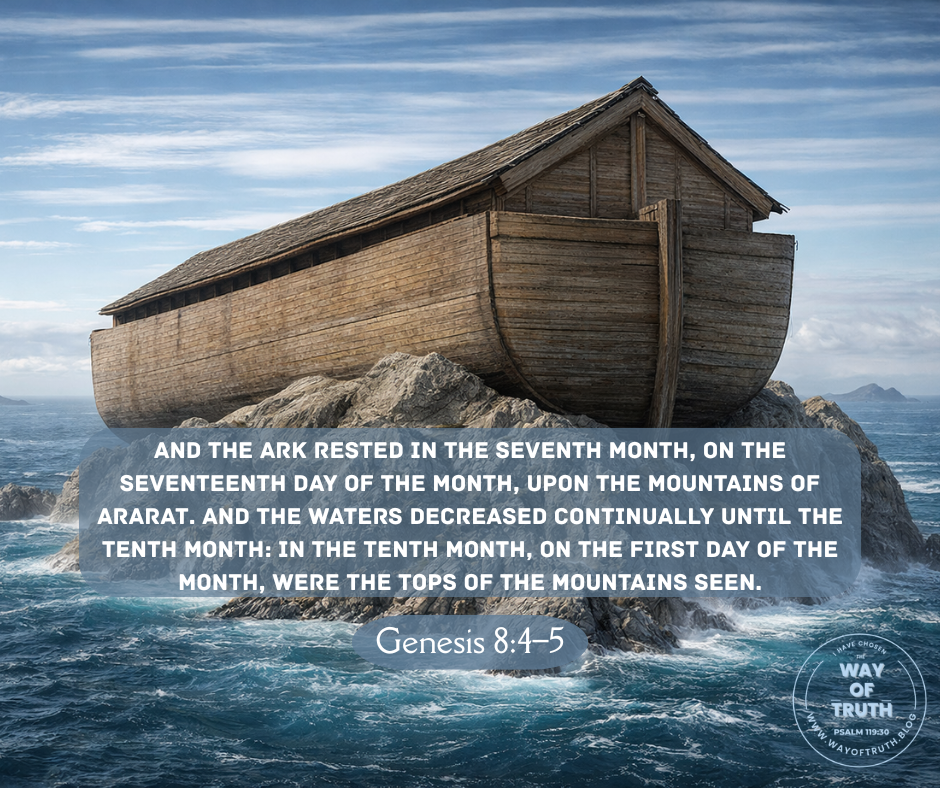
“And the ark rested in the seventh month, on the seventeenth day of the month, upon the mountains of Ararat. And the waters decreased continually until the tenth month: in the tenth month, on the first day of the month, were the tops of the mountains seen” (Genesis 8:4-5).
I. Introduction
In Genesis 8:4–5, the waters that once surged in unrestrained judgment are now in ordered retreat. The text records not a dramatic miracle in the modern sense, but a careful sequence of dates, locations, and observable changes. This is restoration unfolding under divine governance.
The passage follows the hinge statement of Genesis 8:1—“And God remembered Noah”—and begins to trace the outward effects of that remembrance. Historically, the specificity of time (“the seventh month, on the seventeenth day”) and place (“the mountains of Ararat”) situates the account firmly in real space and real chronology. Culturally, ancient Near Eastern flood traditions often dissolve into mythic vagueness at precisely this stage. Scripture does the opposite. It tightens the narrative with precision.
Within redemptive history, these verses do not yet describe deliverance from the ark, but they mark the first stable footing after judgment. Salvation has already been secured; now it’s being patiently revealed.
II. The Ark Comes to Rest and the World Reemerges
Genesis 8:4–5 records the first observable movements from judgment toward renewal after the Flood. The narrative slows here, and the prose becomes deliberately precise. Instead of sweeping theological explanation, the text offers dates, locations, and gradual processes. This is not narrative filler. The author wants the reader to see how restoration unfolds under divine governance: steadily, purposefully, and without spectacle. These verses describe deliverance secured and beginning to manifest in history.
A. Stability after Prolonged Upheaval
The statement that “the ark rested” marks a fundamental shift in the narrative. For months, the ark had floated without reference to land, direction, or stability. Its motion was entirely passive, governed by the waters God had released. The word rested conveys settling, repose, and the cessation of movement. The ark does not merely touch ground. It comes to rest.
This rest is not the result of Noah’s action or discernment. The text does not suggest that Noah steered the ark or sought land. In fact, Noah remains entirely absent from the verse. The focus is exclusively on what God has done to the waters. The ark rests because the chaos has been restrained. This reinforces a consistent theme in the Flood narrative: salvation is not achieved by human ingenuity but sustained by divine control.
Importantly, rest does not yet mean completion. The ark is grounded, but Noah remains inside. The world beyond the ark is still largely submerged and uninhabitable. The text resists the instinct to treat rest as resolution. Instead, rest functions here as a sign of transition. Judgment has reached its appointed limit, and stability has replaced instability, but the process of restoration is still unfolding.
The ark’s resting place signals that God’s wrath has been satisfied in full measure and that the created order is no longer under active judgment, even though its renewal will require patience.
B. Chronological Precision
The dating of the ark’s resting is unusually specific: “the seventh month, on the seventeenth day of the month.” This precision is not incidental. Earlier, Genesis 7:11 recorded the onset of the Flood on the seventeenth day of the second month. Exactly five months later, the ark comes to rest. The symmetry underscores intentionality rather than coincidence.
Such chronological care serves several purposes. Historically, it anchors the account in real time rather than mythic abstraction. Literarily, it slows the reader, inviting reflection rather than momentum. Theologically, it reinforces that judgment and mercy operate under the same sovereign authority. God does not unleash chaos and then wait for it to exhaust itself. He governs both the onset and the withdrawal of judgment with equal precision.
The seventh month will later carry liturgical significance in Israel’s calendar, but the text does not press that symbolism here. What matters is not festival association but measured timing. Restoration does not occur hastily. It follows a deliberate schedule known to God, not to Noah.
This chronological restraint also guards against triumphalism. The Flood does not reverse as suddenly as it began. God’s patience in restoration mirrors His patience in judgment. Both unfold according to divine wisdom rather than human expectation.
C. Geography without Speculation
The ark comes to rest “upon the mountains of Ararat,” not upon a single, identifiable peak. The plural form is significant. “Ararat” refers to a mountainous region corresponding to ancient Urartu, rather than to a specific summit. Scripture offers geographical realism without satisfying later curiosity or inviting speculation.
This restraint is instructive. The purpose of naming Ararat is not to enable archaeological recovery of the ark but to affirm that the event occurred in a real and recognizable world. The author situates the Flood within the known geography of the ancient Near East, reinforcing its historical character while resisting sensationalism.
The ark rests on elevated terrain. The waters recede downward, and stability emerges upward. While the text does not allegorize this movement, the imagery is consistent with broader biblical patterns in which high places signify refuge, security, and divine preservation. Yet the narrative remains grounded. The emphasis is not symbolic meaning but factual location.
By avoiding excessive detail, the text also prevents misdirected focus. The reader’s attention is kept on God’s action rather than on the artifact itself. The ark’s value lies in what it accomplished, not in where it might be found.
D. Controlled Reversal, Not Abrupt Rescue
Verse 5 introduces a key phrase: “the waters decreased continually.” The recession of the Flood is described as steady and progressive. This language deliberately contrasts with the suddenness of the Flood’s onset, when the fountains of the great deep were broken up and the windows of heaven were opened.
The continual decrease emphasizes restraint. God does not simply remove the waters in a moment. He governs their withdrawal over time, reasserting order where chaos once prevailed. This gradualism is not inefficiency, but intentional governance. The created order is being reestablished methodically.
For the reader, this introduces a tension between security and visibility. Noah is safe, but the world remains submerged. God’s promise of preservation has already been fulfilled in principle, yet its effects are only partially visible. This distinction is crucial. Scripture frequently portrays divine faithfulness as certain before it is complete.
The continual decrease also underscores patience as a virtue shaped by trust in God’s timing. Noah is given no new command here. He must wait within the ark while God continues His work unseen beneath the surface of the waters.
E. First Signs without Finality
Only in the tenth month, more than two months after the ark rests, do “the tops of the mountains” become visible. This detail reinforces how slowly restoration unfolds. The world does not reappear all at once. The first signs are partial and distant.
This moment is significant precisely because it’s restrained. The mountains’ peaks signal that judgment is truly past, but they don’t yet offer a place of habitation. Visibility does not equal readiness. God allows Noah to see evidence of progress without inviting premature action.
This teaches that divine faithfulness often reveals itself incrementally. God gives enough light to sustain hope without removing the need for continued trust. The mountain tops are a promise in outline form, not a finished reality.
The text resists dramatization. There’s no celebration or response recorded from Noah. Scripture allows the moment to speak quietly. The world is returning, but it does so under God’s pace, not human urgency.
In this way, Genesis 8:4–5 portrays restoration as ordered, patient, and entirely governed by God. Judgment ends decisively, but renewal advances deliberately, teaching the reader how to wait faithfully between promise and fulfillment.
III. Ark Searches, Historical Credibility, and the Discipline of Biblical Restraint
Genesis 8:4–5 is sometimes pressed into service by both defenders and critics of Scripture through appeals to modern searches for the remains of Noah’s ark. For some, the hope of discovery functions as an apologetic linchpin. For others, the absence of conclusive findings is treated as evidence against the Flood’s historicity. Both approaches, however, impose expectations on the text that it neither invites nor requires.
The passage itself exemplifies the same restraint that marks the Flood narrative as a whole. Genesis anchors the event in real time and real geography, yet it resists the kind of detail that would turn the ark into a perpetual object of verification. The reference to “the mountains of Ararat” situates the account within the known world of the ancient Near East, reinforcing historical realism without narrowing the focus to a single peak or recoverable site. This balance is consistent with the broader apologetic force of the passage: Scripture presents history with theological purpose, not with antiquarian curiosity.
Importantly, Genesis doesn’t ground its truth claims in the future availability of physical evidence. Its credibility rests on the coherence of its chronology, the consistency of its narrative logic, and the moral and theological intelligibility of its portrayal of divine judgment and restraint. The same text that specifies dates and sequences also withholds information about the ark’s later fate. That omission is not a weakness but a safeguard. It prevents faith from drifting toward relic-dependence and keeps attention fixed on God’s actions rather than on material remains.
Skeptical objections that equate non-recovery with non-historicity fail on multiple levels. From a historical standpoint, the absence of an artifact—especially in a tectonically active, mountainous region subject to erosion and climate extremes—carries little evidentiary weight. From a textual standpoint, the objection misunderstands the genre and intent of Genesis, which never promises archaeological retrievability. And from a theological standpoint, it overlooks a central theme of the passage: God’s works in history are meant to be remembered, trusted, and obeyed, not endlessly verified by discovery.
When read within its literary and canonical context, Genesis 8:4–5 stands as a reminder that Scripture is neither myth dressed as history nor history stripped of meaning. It’s a truthful account of God’s governance of the world, confident enough in its own authority to speak precisely where necessary and remain silent where curiosity would distract from faithfulness. Properly framed, modern searches for the ark neither bolster nor undermine the passage. They remain secondary to a text whose apologetic strength lies in its disciplined realism and theological clarity.
IV. Living Faithfully between Rest and Renewal
Genesis 8:4–5 speaks to a stage of deliverance that many believers recognize instinctively: safety has been secured, yet completion has not arrived. The ark rests, but the world is still submerged. The waters are retreating, but life outside the ark is not yet possible. This passage offers wisdom for seasons when God’s faithfulness is real but still unfolding, calling His people to patient trust, disciplined obedience, and hope anchored in His timing rather than their own.
A. Learning to Trust God’s Timing
One of the most practical lessons in Genesis 8:4–5 is that stability doesn’t automatically mean permission to move. The ark has come to rest, yet Noah remains inside. God has restrained the waters, yet Noah is not told to act. The temptation in such moments is to assume that rest equals readiness, that a pause in hardship signals an immediate green light. Scripture gently resists that assumption.
For believers, this speaks to seasons when God has clearly intervened—when danger has passed, prayer has been answered, or circumstances have stabilized—yet the next step remains unclear. Genesis 8 reminds us that God’s timing often includes a waiting period between rescue and release. That waiting is not wasted time. It’s a space in which trust is refined.
This passage encourages us to resist the urge to force progress simply because discomfort has lessened. Faithfulness sometimes means staying put when action feels overdue. God’s silence after deliverance is not indifference; it’s often instruction through restraint. He is as purposeful in what He withholds as in what He gives.
For congregations, this principle guards against impatience in seasons of transition. Growth, rebuilding, or renewed ministry should not be rushed simply because crisis has ended. God’s people are called to move when He speaks, not merely when circumstances change. Genesis 8 teaches that obedience includes waiting well.
B. Hope That’s Sustained
When the tops of the mountains become visible, the world has not yet returned to normal. What Noah sees is not restoration in full, but a sign that restoration is underway. This distinction matters deeply for the life of faith. God often provides enough evidence to sustain hope without satisfying every longing at once.
Believers frequently struggle with the tension between promise and fulfillment. We long for clarity, resolution, and visible fruit. Genesis 8 offers a corrective perspective: God may allow us to see progress without allowing us to possess completion. The visible mountain peaks are meant to encourage trust, not to prompt premature action.
This calls for gratitude without entitlement. The believer learns to thank God for partial answers without insisting that complete answer must follow immediately. Such faith is neither passive nor complacent. Itss attentive, patient, and grounded in God’s character rather than outcomes.
In the shared life of the church, this perspective fosters humility and perseverance. Ministry fruit may appear gradually. Healing, reconciliation, and renewal often come in stages. Genesis 8 teaches God’s people to recognize early signs of His work without demanding instant fulfillment. The church learns to celebrate beginnings while still committing to long obedience.
C. Faithfulness in the Quiet Seasons
Genesis 8:4–5 contains no recorded words from God to Noah. There is no new instruction, no reassurance, and no timetable given. God is clearly at work, but He is not narrating every step. This silence is not neglectful. It’s purposeful.
Many believers experience similar seasons. God has acted decisively in the past, yet the present feels quiet. Scripture affirms that such silence is not abandonment. The steady retreat of the waters reveals that God’s purposes are advancing even when He is not speaking audibly or dramatically.
This passage invites us to cultivate faith that doesn’t depend on constant explanation. Trust matures when obedience continues without fresh instruction. Noah remains in the ark not because he understands the full plan, but because he trusts the God who has already proven faithful.
For church life, this encourages stability in doctrine and practice during seasons of waiting. Not every season requires innovation or reinvention. Sometimes faithfulness means holding steady, guarding what God has entrusted, and refusing to mistake silence for stagnation. Genesis 8 reassures God’s people that unseen work is still real work.
D. A Call to Patient Witness
The Flood narrative reminds us that God’s judgment is real, but so is His mercy. Genesis 8:4–5 stands at the intersection of both. Judgment has ended, but renewal unfolds slowly. This has implications for how believers relate to the world around them.
Christians live among people who are often unaware that judgment has already been addressed at the cross, and that restoration is available through Christ. Like the world emerging from the Flood, many lives are still marked by the effects of sin even after deliverance has been made possible.
This passage calls us to patient witness rather than hurried proclamation. Just as God allows the world to reappear gradually, His people are called to bear witness with endurance and humility. The church proclaims hope rooted in certainty, not in pressure.
Practically, this shapes how we speak about salvation, repentance, and new life. We testify to what God has done, trust Him to bring growth in His time, and avoid forcing conclusions. Genesis 8 reminds us that God is not anxious about outcomes. His purposes move forward steadily, governed by wisdom rather than urgency.
In this way, the resting ark becomes a model for faithful living: secure in God’s provision, attentive to His timing, and confident that renewal—though gradual—is certain and directed by His hand.
V. Rest That Leads to New Creation
Genesis 8:4–5 doesn’t announce salvation in explicit gospel language, yet it quietly proclaims a pattern that Scripture later brings into full clarity. Judgment has passed, safety has been secured, and the future is opening, but not all at once. This movement prepares us for the deeper truth revealed in Jesus Christ, where deliverance is accomplished decisively, applied personally, and completed gloriously. The resting ark invites reflection not only on ancient history, but on the nature of salvation itself.
A. Salvation Accomplished before It’s Fully Experienced
If you don’t yet know Jesus Christ as your Lord and Savior, Genesis 8 offers an important insight: deliverance can be real even when life still feels unsettled. When the ark rests on the mountains of Ararat, Noah and his family are already saved from judgment. The waters that once threatened their lives no longer do so. Yet they remain inside the ark, waiting for the world to become habitable again.
This pattern mirrors the gospel. Salvation in Christ is not a gradual achievement earned over time. It’s a decisive act accomplished by God. At the cross, judgment was fully borne. Sin was condemned. Death was defeated. Those who trust in Christ are not partially saved or provisionally rescued. They are fully and completely secure.
Yet Scripture is honest about experience. Believers still live in a world marked by sin’s effects. Forgiveness is complete, but renewal unfolds. Peace with God is established, yet the fullness of restoration lies ahead. Genesis 8 helps us understand that this tension is not a contradiction. It’s the shape of redemption.
If you’re hesitant to believe because life doesn’t instantly improve, this passage gently challenges that expectation. God’s saving work is not measured by immediate comfort but by accomplished rescue. Just as the ark’s resting guaranteed safety before the land was restored, Christ’s finished work guarantees salvation even while the world remains broken.
B. Judgment Passed Over
The resting of the ark means judgment has run its course. The Flood waters recede because they have fulfilled their purpose. God does not overlook sin; He addresses it fully and decisively.
The gospel carries the same weight. Humanity’s problem is not merely confusion, weakness, or moral failure. It is guilt before a holy God. Genesis 8 stands on the far side of judgment, not beside it. That matters. The ark rests because God’s wrath has been satisfied.
In the New Testament, this truth finds its fulfillment in Christ. On the cross, Jesus bore the judgment sin deserves. God’s justice was not set aside; it was satisfied. Mercy did not cancel holiness but fulfilled it. This is why the gospel is not a message of self-improvement or spiritual progress, but of substitution and reconciliation.
If you’re tempted to believe that God simply ignores sin, Genesis 8 gently corrects that notion. The calm after the Flood exists because judgment has already fallen. Likewise, peace with God exists because Christ has already paid the cost. Salvation is costly, but the cost has been borne, not by us, but by Him.
C. Waiting Does Not Mean Uncertainty
After the ark rests, Noah waits. He doesn’t yet step out into the world. But his waiting isn’t anxious or uncertain. The visible mountain tops are signs that God’s work is advancing. Waiting, in this passage, isn’t doubt. It’s trust expressed through patience.
Many resist the gospel because they fear uncertainty. They want guarantees of ease, clarity, or control. Genesis 8 reframes that fear. God does not promise immediate resolution, but He does promise direction and faithfulness. Noah waits not because he doubts God, but because he trusts Him enough not to rush ahead.
The gospel invites the same posture. Trusting Christ doesn’t mean all questions are instantly answered or all struggles removed. It means placing confidence in God’s character rather than in personal outcomes. Faith rests before it rejoices.
If you’re waiting for every uncertainty to disappear before you believe, Genesis 8 offers a wiser invitation. God provides enough light to trust Him, even if He does not reveal every step at once. Waiting with Christ is not the same as waiting alone.
D. An Invitation to Enter God’s Rest through Christ
Genesis 8 ultimately points beyond itself. The ark rests on the mountains, but Scripture will later speak of a deeper rest that no flood, failure, or judgment can undo. That rest is found in Jesus Christ.
If you’ve never trusted Him, the invitation is not to fix yourself, improve your record, or prove your worth. It’s to enter the rest God has already provided. Christ has borne judgment. He has secured salvation. He calls sinners not to strive, but to come.
You can turn from sin because forgiveness is real. You can trust Christ because His work is finished. You can live for God’s glory because reconciliation has already been accomplished.
Genesis 8 reminds us that salvation isn’t chaos resolved by effort, but danger overcome by grace. The ark rests because God is faithful. The gospel calls you to rest in Christ for the same reason.
If you haven’t already, now is the time to trust Him. Receive the forgiveness He offers. Enter the rest He has secured. And begin a life shaped not by fear of judgment, but by confidence in the God who saves fully, wisely, and forever.