
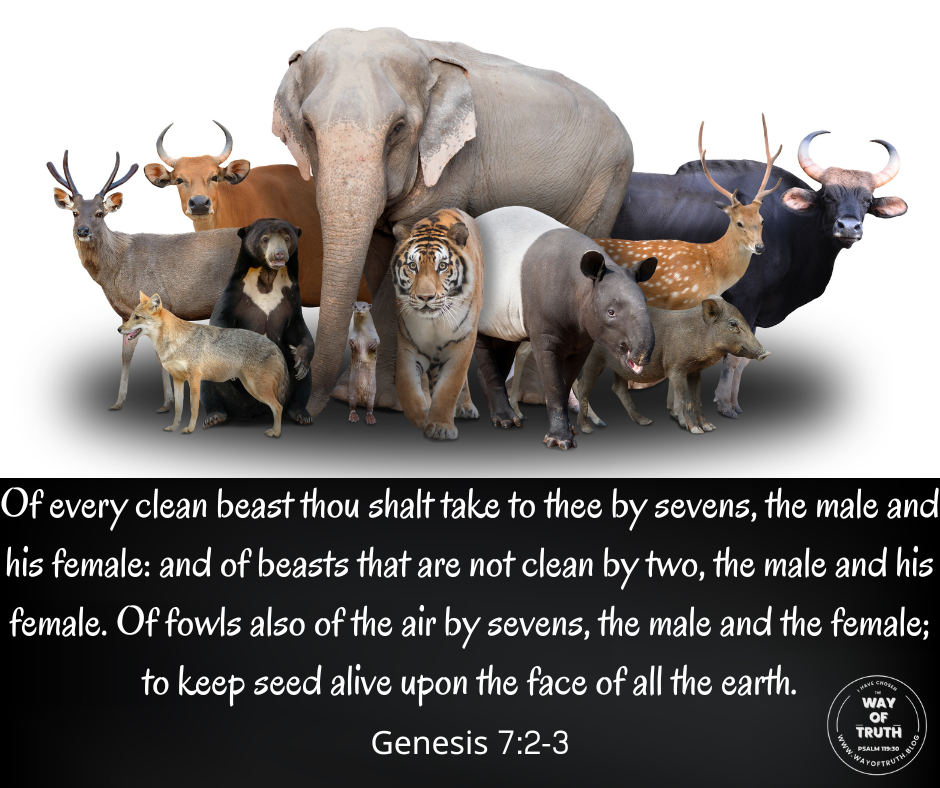
“Of every clean beast thou shalt take to thee by sevens, the male and his female: and of beasts that are not clean by two, the male and his female. Of fowls also of the air by sevens, the male and the female; to keep seed alive upon the face of all the earth” (Genesis 7:2-3).
I. Distinction Within Judgment and Preservation
Genesis 7:2–3 stands at a critical juncture in the Flood narrative of Genesis, immediately following the LORD’s decisive command for Noah to enter the ark (7:1). These verses clarify how life is to be preserved as judgment falls. Far from being a mere logistical aside, this instruction reveals God’s meticulous order, moral distinctions, and redemptive intent even amid global catastrophe.
Historically and literarily, this passage belongs to the primeval history (Genesis 1–11), a section concerned with origins of creation, sin, judgment, and grace. The specification of clean and unclean animals predates the Mosaic Law by centuries, indicating that moral and cultic distinctions are rooted not in Sinai legislation but in God’s earlier revelation and ordering of creation. Linguistically, the text reflects careful numerical symmetry and covenantal purpose, while culturally it assumes a worldview in which humanity is entrusted with stewardship over a differentiated creation.
Redemptively, Genesis 7:2–3 contributes to the broader biblical narrative by showing that divine judgment is never chaotic or indiscriminate. God preserves life intentionally, with an eye toward worship, continuity, and future blessing. The Flood is an act of cleansing, not annihilation; what God destroys is corruption, not creation itself.
II. Divine Precision in Preservation
Genesis 7:2–3 provides a divinely precise elaboration of God’s earlier command concerning the preservation of living creatures. These verses do not introduce a new purpose but refine the method by which God will accomplish His redemptive intention within judgment. The language is concrete, measured, and purposeful, reflecting not improvisation but foreknowledge. Each clause contributes to a tightly structured picture of divine order, moral distinction, and continuity of life. Rather than treating the animals as an undifferentiated mass, the LORD distinguishes kinds, numbers, and functions, revealing that preservation itself is an act of moral and covenantal significance. The text’s careful repetition, numerical symbolism, and purpose clauses must be read attentively, as they disclose how God governs life even as He prepares to judge the world.
A. Moral Distinction Before Sinai
The opening phrase, “Of every clean beast thou shalt take to thee by sevens,” immediately introduces a distinction that is both striking and theologically loaded. The Hebrew term for “clean” denotes ritual purity, acceptability, and fitness for approach to God. Crucially, this distinction appears long before the formal legislation of Leviticus, demonstrating that categories of cleanness and uncleanness are not arbitrary inventions of Mosaic law but part of an earlier divine moral ordering of creation.
The numerical instruction “by sevens” (literally “seven, seven”) emphasizes completeness and sufficiency rather than mere abundance. The text does not explicitly explain the reason here, but its placement anticipates future necessity without narrating it prematurely. The command assumes foresight: God provides more than the bare minimum required for survival. Preservation is not narrowly utilitarian; it is ordered toward future divine purposes.
Grammatically, the directive is addressed personally—“thou shalt take to thee”—reinforcing Noah’s role as a responsible steward acting under divine authority. Noah is not collecting animals according to personal judgment but executing a revealed classification already established by God. This underscores that moral distinctions originate with the Creator, not with human observation or preference.
B. Preservation Without Privilege
The contrastive clause, “and of beasts that are not clean by two,” introduces a deliberate asymmetry. Unclean animals are preserved, but only minimally. This is not a statement of lesser value in terms of creation, but of differing roles within God’s redemptive economy. Preservation does not imply equal function.
The pairing “by two, the male and his female” establishes reproductive sufficiency without excess. The emphasis is continuity of kind, not expansion. The text thus avoids both annihilation and favoritism. God does not eradicate what is unclean, nor does He elevate it beyond its appointed purpose.
Importantly, this distinction guards against later misreadings that equate cleanness with intrinsic moral superiority. The animals themselves are not moral agents; the categories relate to divine use and access, not inherent worth. The narrative carefully balances differentiation with preservation, preventing both sacrificial reductionism and egalitarian flattening.
Syntactically, the repetition of structure mirrors the earlier clause, reinforcing that both commands flow from the same divine authority. The difference lies not in who commands, but in what is commanded. God’s sovereignty governs both abundance and restraint with equal intentionality.
C. Creational Order Maintained in Crisis
The repeated formula “the male and his female” functions as more than biological notation. It deliberately echoes the language of Genesis 1, reaffirming that the Flood does not suspend creational order. Even under judgment, God preserves life according to the pattern He originally declared “very good.”
This phrase underscores complementarity as the means of continuity. The text offers no alternative models, no improvisation, and no ambiguity. Life proceeds as God ordained it from the beginning. The Flood, therefore, is not a reset of creation’s design but a purification of its corruption.
From a literary perspective, the repetition is emphatic and instructional. The narrator ensures that the reader understands preservation is structured, not accidental. Noah’s task is not merely to save individuals but to safeguard kinds through ordered reproduction.
Theologically implicit—but textually grounded—is the idea that divine judgment does not nullify divine order. God’s governance remains consistent across creation, fall, and judgment. The ark becomes a microcosm of ordered life under divine command, where chaos is excluded and continuity is protected.
D. Purposeful Preservation and Future Orientation
Verse 3 concludes with a rare explicit purpose clause: “to keep seed alive upon the face of all the earth.” The Hebrew infinitive expresses intention rather than result. God’s actions are not reactive; they are directed toward a defined future.
The term “seed” carries connotations of continuity, propagation, and promise throughout Scripture. Its use here situates the Flood within a forward-looking framework. Judgment clears the ground, but preservation ensures that history continues toward God’s purposes rather than ending in desolation.
The geographic phrase “upon the face of all the earth” reinforces the universal scope of both judgment and renewal. The Flood is global in reach, and so is God’s intention for restored life. Preservation is not localized or tribal; it is creational and comprehensive.
This final clause binds the entire command together. The distinctions of clean and unclean, the numerical differences, and the emphasis on male and female all serve this singular goal: the continuation of life as God intends it. The text thus portrays a God who governs history with foresight, precision, and restraint, ensuring that even in judgment, His creative purposes remain intact.
III. Order Against Chaos
Genesis 7:2–3 has long been a focal point for critics seeking to undermine the historical credibility, moral coherence, or internal consistency of the Flood narrative. Objections frequently cluster around three issues: alleged numerical contradictions, claims of retrojected Mosaic theology, and comparisons with ancient flood myths meant to reduce the biblical account to legend. These verses, however, withstand such challenges precisely because of their textual clarity and narrative restraint. Rather than revealing confusion or myth-making, Genesis 7:2–3 displays intentional differentiation, theological sobriety, and historical realism. The passage does not attempt to defend itself rhetorically; it simply speaks with the quiet authority of revelation. When examined carefully, its very specificity becomes one of its strongest apologetic features.
A. Alleged Numerical Contradictions
One of the most common skeptical claims is that Genesis contradicts itself by commanding two of every animal in Genesis 6:19–21, while later requiring seven pairs of clean animals in Genesis 7:2–3. Critics often present this as evidence of competing sources stitched together without coherence. This objection, however, collapses under basic literary and logical scrutiny.
Genesis 6 provides a general preservation mandate: no kind of land animal is to be excluded from survival. Genesis 7 then offers additional specification regarding certain categories of animals. This is not contradiction but supplementation. The text never claims that only two clean animals are to be taken; it simply states the minimum requirement for preserving kinds. Genesis 7 clarifies that clean animals require additional representation for purposes the narrative will later make explicit.
From a polemical standpoint, the objection reveals more about modern expectations of redundancy than about ancient narrative logic. Biblical Hebrew narrative regularly progresses from general instruction to detailed elaboration. The charge of contradiction assumes a flat reading that ignores narrative development.
Moreover, the text itself signals intentional clarification through temporal sequencing. Genesis 7:1 explicitly states, “And the LORD said unto Noah,” indicating a renewed divine address, not a competing tradition. The coherence of command and execution undermines claims of editorial confusion and instead reinforces the unity and deliberateness of the account.
B. The Charge of Retrojected Law
Another frequent objection asserts that the distinction between clean and unclean animals reflects Mosaic law retrojected into a pre-Israelite setting. According to this view, Genesis 7:2–3 must be anachronistic because Levitical purity laws had not yet been revealed. This argument, however, rests on a flawed assumption: that moral or cultic distinctions cannot exist prior to codification.
Scripture consistently portrays divine instruction as progressively revealed, not invented ex nihilo at Sinai. The presence of clean and unclean categories in Genesis indicates earlier divine communication, not later theological projection. Noah’s knowledge is assumed, not explained, precisely because the narrative treats these distinctions as already established.
Polemic against the text often assumes that law creates morality rather than formalizes it. Genesis presents the opposite view: God’s will precedes written legislation. Later legal texts articulate, systematize, and safeguard truths already known through revelation and practice.
Furthermore, the objection fails to explain why an editor intent on retrojection would introduce numerical complexity rather than uniformity. A myth-maker seeking coherence would simplify, not complicate. Genesis 7:2–3 preserves a difficult distinction because it reflects remembered instruction, not theological invention.
C. Flood Myths and Moral Contrast
Comparisons with ancient Near Eastern flood stories—especially the Epic of Gilgamesh—are often used polemically to argue that Genesis merely borrows mythological motifs. While superficial similarities exist, Genesis 7:2–3 highlights profound theological divergence rather than dependence.
In pagan flood narratives, the gods act impulsively, often regretting their own decisions, and preservation occurs through chance, deception, or favoritism. Animals are incidental, not purposefully ordered. By contrast, Genesis presents a single sovereign LORD who acts with moral clarity, foresight, and restraint. The precise differentiation of animals in Genesis 7:2–3 has no true parallel in mythic literature.
Apologetically, this distinction is critical. The biblical account grounds judgment in moral evaluation and preservation in covenantal intent. There is no divine panic, no rivalry among deities, and no accidental survival. The animals are preserved intentionally, proportionally, and for a stated purpose.
Rather than echoing myth, Genesis corrects it. The text confronts ancient worldviews by presenting a God who governs creation ethically and coherently. Genesis 7:2–3 thus functions not as borrowed legend, but as theological polemic against chaotic pagan cosmologies, asserting that history unfolds under the command of a righteous and purposeful Creator.
IV. Faithful Obedience in God’s Ordered World
Genesis 7:2–3 reminds the reader that obedience to God often unfolds through careful attention to detail rather than dramatic gestures. Noah’s faith is expressed not in speeches or emotions but in patient compliance with specific instructions that reflect God’s moral order and redemptive purpose. These verses press upon believers and the Church the reality that faithfulness is frequently quiet, methodical, and unseen by the world. God’s concern for ordered preservation amid judgment calls His people to trust His wisdom, honor His distinctions, and steward what He entrusts to them even when the reasons are not immediately visible. Application, therefore, arises not from speculation about the Flood but from submission to the God who governs life with intention and care.
A. Trusting God’s Wisdom
Noah is never told why clean animals are to be taken by sevens or unclean by two. He is simply commanded to act. Genesis 7:2–3 thus confronts a perennial temptation among believers: the demand for full explanation before obedience. Scripture repeatedly portrays obedience as a response to God’s authority rather than a conclusion reached after exhaustive understanding.
Practically, this challenges modern instincts that equate faithfulness with personal clarity or emotional certainty. Many of God’s commands appear excessive, impractical, or unnecessary from a limited human perspective. Noah could not yet see the altar of Genesis 8, but God had already accounted for it. Faith, in this sense, is trust in God’s foresight rather than confidence in one’s own insight.
Devotionally, the passage invites believers to examine areas where obedience is delayed because God’s purposes are not yet obvious. Genesis 7:2–3 teaches that God’s instructions often serve future ends beyond immediate circumstances. Faithful obedience honors God precisely by acting before those purposes are revealed.
For the Church, this underscores the importance of submitting to Scripture even when cultural pressure demands explanation, justification, or revision. The Church is not called to improve God’s commands, but to obey them faithfully, trusting that God’s wisdom exceeds present understanding.
B. Honoring God’s Distinctions Without Distortion or Pride
The distinction between clean and unclean animals provides a subtle but important lesson in how God establishes differences without implying contempt or superiority. All animals are preserved, yet not all are assigned the same role or function. This principle has practical relevance for both individual believers and the corporate life of the Church.
Spiritually, the passage guards against two errors: flattening God’s distinctions on one hand and turning them into grounds for pride on the other. God differentiates according to purpose, not favoritism. The clean animals are not “better” in essence, but they are designated for specific future use. Likewise, God assigns differing callings, responsibilities, and gifts among His people.
Ecclesially, Genesis 7:2–3 encourages the Church to value ordered diversity under God’s authority. Unity does not require uniformity, and faithfulness does not mean identical function. When distinctions are erased, God’s design is obscured; when distinctions are exalted as merit, God’s grace is misunderstood.
Devotionally, believers are invited to rest in God’s assignment rather than striving for another’s role. Noah does not negotiate the numbers. He receives and executes God’s order. In the same way, contentment and humility grow when believers accept God’s placement and purpose with gratitude rather than comparison.
C. Stewardship for a Future We May Not See
The closing purpose of Genesis 7:3—“to keep seed alive upon the face of all the earth”—casts obedience in a long-term, forward-looking frame. Noah’s labor benefits generations he will never meet. This forward orientation provides a profound model for Christian stewardship.
Practically, the passage reminds believers that faithfulness often invests in outcomes beyond personal lifespan or recognition. Noah builds, gathers, and preserves not for immediate reward but for continuity of life after judgment. Christian obedience likewise participates in God’s unfolding purposes across time.
For the Church, this has deep implications for discipleship, teaching, and mission. Faithful ministry is not measured solely by immediate visible success, but by whether it preserves truth, life, and witness for future generations. The Church, like the ark, is entrusted with preservation under divine command.
Devotionally, Genesis 7:2–3 encourages perseverance in seemingly mundane acts of faithfulness. God sees obedience that the world ignores. Just as Noah’s careful stewardship ensured life after the Flood, so ordinary acts of obedience today contribute to God’s ongoing work of renewal and witness.
Ultimately, this passage calls believers to live faithfully in the present with confidence in God’s future, trusting that obedience offered now will bear fruit according to His sovereign design.
V. Preserved by God, Saved in Christ
If you do not yet know peace with God, Genesis 7:2–3 quietly but powerfully points beyond itself to the heart of the gospel. These verses remind us that salvation has always been God’s initiative, God’s design, and God’s provision. Long before the Flood waters rose, God had already determined how life would be preserved. In the same way, long before we sense the weight of our sin or the nearness of judgment, God has already provided a means of rescue. The gospel is not humanity’s desperate escape plan; it is God’s gracious invitation to enter the refuge He Himself has prepared. What the ark was to Noah’s generation, Jesus Christ is to ours: the divinely appointed means of deliverance from righteous judgment and the doorway into new life.
A. Judgment Is Real, but God Provides a Way of Life
Genesis 7 assumes something modern culture often resists: judgment is real, deserved, and unavoidable apart from God’s provision. The animals are not preserved because the Flood might happen, but because it certainly will. The command to enter the ark exists precisely because destruction is coming. Scripture consistently teaches this same sobering truth about humanity’s condition before God.
The Bible declares that all have sinned and fall short of God’s glory. Sin is not merely personal failure or moral weakness; it is rebellion against a holy Creator. Just as the pre-Flood world stood under divine judgment, so every person stands accountable before God. Ignoring that reality does not remove it.
Yet Genesis 7:2–3 also reveals something essential: God does not delight in destruction. His judgment is purposeful, and His mercy is intentional. Before the rain falls, preservation is secured. Before judgment unfolds, salvation is offered.
The gospel proclaims that God has acted in the same way through Jesus Christ. God did not wait for humanity to improve itself. He sent His Son to bear judgment in our place. At the cross, God’s justice and mercy meet. Judgment is not denied; it is satisfied. And salvation is not earned; it is given.
B. Salvation Requires Entering God’s Appointed Refuge
One of the most striking truths in the Flood account is that survival depended not on effort, strength, or sincerity, but on being inside the ark. The animals were not saved by understanding the Flood, debating its fairness, or admiring the ark’s design. They were saved because they were brought into the refuge God provided.
The gospel makes the same claim. Salvation is not found in religion, morality, good intentions, or self-improvement. It is found in a Person. Jesus Christ Himself declared, “I am the way, the truth, and the life: no man cometh unto the Father, but by me” (John 14:6).
Christ is not one option among many; He is God’s appointed refuge. To be “in Christ” is to be sheltered by His righteousness, His atoning death, and His victorious resurrection. Outside of Him, judgment remains. Inside Him, there is forgiveness, reconciliation, and eternal life.
This exclusivity is not arrogance; it is mercy. Just as there was one ark sufficient to save all who entered, there is one Savior sufficient to redeem all who believe. God’s invitation is wide, sincere, and gracious, but it is also specific. Salvation comes God’s way, not ours.
C. A Gracious Invitation to Repent, Believe, and Live for God’s Glory
The Flood narrative does not end with the door of the ark standing open forever. There comes a moment when the door is shut, not by Noah, but by God Himself. That sober reality lends urgency to the gospel invitation. Scripture teaches that today is the day of salvation, and now is the acceptable time.
To repent is to acknowledge sin honestly before God and to abandon self-rule. To believe is to trust fully in Jesus Christ: His sinless life, His sacrificial death, and His bodily resurrection. Faith is not mere agreement with facts; it is personal reliance upon Christ as Lord and Savior.
The promise of the gospel is rich and sure. Those who come to Christ are forgiven completely, clothed in righteousness, reconciled to God, and given new life by the Holy Spirit. They are not merely spared from judgment; they are restored for fellowship, holiness, and eternal joy.
Come to Christ. Enter the refuge God has provided. And having been saved by grace, live for His glory, bearing witness to a watching world that salvation belongs to the Lord, and that in Jesus Christ, life is preserved forever.