
- I. Introduction
- II. The Rise of the Worshiping Community
- III. Upholding the Integrity of Early Worship
- A. The Charge That Organized Worship Could Not Have Originated So Early
- B. The Claim That the Verse Should Read “Then Began Men to Profane the LORD’s Name”
- C. The Allegation That Using the Name “LORD (YHWH)” Before Moses Is Anachronistic
- D. The Assertion That Religion Is Merely a Sociological Construct
- IV. Living as a People Who Call Upon the Name of the LORD
- V. An Invitation to Call Upon the Name of the Lord
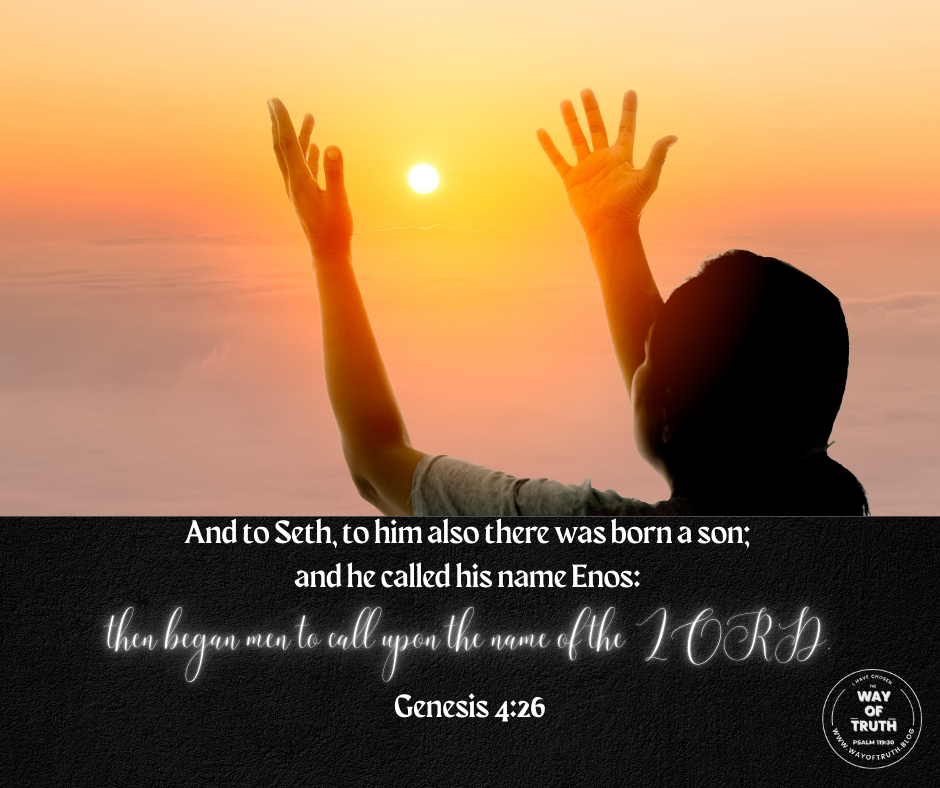
“And to Seth, to him also there was born a son; and he called his name Enos: then began men to call upon the name of the LORD” (Genesis 4:26).
I. Introduction
After tracing the violent legacy of Cain through his descendants, the inspired text now redirects our attention to the line of Seth, through which God will continue His redemptive purpose after Abel’s death (Genesis 4:25).
Historically, this passage stands centuries before the covenant with Abraham, long prior to the tabernacle or temple, and well before the Mosaic law codified sacrifice and priesthood. Yet here, at the dawn of human civilization, Scripture records the beginning of purposeful, public invocation of the LORD’s name.
Linguistically, Genesis 4:26 integrates genealogy and theology. The naming of Enos (meaning “man,” especially in his frailty) reflects an awareness of human mortality, a theme that will dominate Genesis 5. The phrase “call upon the name of the LORD” appears repeatedly in Scripture as a technical expression for worship, prayer, and covenantal devotion (e.g., Genesis 12:8; Psaslm 116:4; Joel 2:32). Thus, the verse situates the rise of public worship not as a late religious development but as an essential element of humanity’s restored relationship with God.
Theologically, the passage serves as a deliberate contrast: while Cain’s line builds cities and boasts in vengeance, Seth’s line begins to call upon the LORD. The narrative highlights two trajectories—one rooted in self-exaltation, the other in the worship of God—establishing the dual pattern that will shape the biblical story until the Flood and beyond.
II. The Rise of the Worshiping Community
A. God’s Gracious Continuation of the Worshiping Line
The verse opens with the birth of Enos to Seth, a genealogical detail that carries profound theological resonance when viewed in light of Genesis 4:25. There, Eve interprets Seth’s birth as God having “appointed” another seed in place of Abel, whom Cain slew. Importantly, the text does not portray this as a divine declaration but as Eve’s own Spirit-informed perception of God’s mercy in supplying a new line through which righteousness might continue. Her statement reflects a mother’s faith that God has not allowed the extinguishing of Abel’s legacy or the derailment of His purposes. Moses presents her words without correction or qualification, allowing her interpretation to frame the narrative movement into verse 26.
Thus, when the text notes that “to Seth… there was born a son,” it signals more than biological multiplication; it marks the extension of the line in which Eve perceives God’s gracious activity. The quiet introduction of Enos prepares the reader for a pivotal spiritual development. Through this continuing lineage, the narrative will highlight humanity’s reawakening to public worship and communal dependence upon the LORD. God’s mercy is not announced through thunderous revelation but through the steady preservation of a family that seeks Him.
B. Enos: A Name Reflecting Mankind’s Frailty and Need for God
Seth’s naming of his son carries exegetical significance that reaches beyond family tradition. The KJV’s “Enos” reflects the Hebrew ’ĕnôš, a term frequently used throughout the Old Testament to emphasize human frailty, mortality, and dependence. Whereas ’ādām often highlights humanity as God’s image-bearer, ’ĕnôš draws attention to humanity’s weakness in contrast to God’s strength. Within the poetic and wisdom literature, this word regularly evokes the fragility of human life—“What is man (’ĕnôš) that thou art mindful of him?” (Psalm 8:4). Whether Seth intentionally invoked this thematic meaning or Moses employs the etymology to shape the narrative’s theological emphasis, the effect is the same: Enos becomes emblematic of a humanity aware of its vulnerability before a holy God.
This harmonizes perfectly with the shift that follows. When mankind recognizes its frailty, it is then prepared to seek the Lord in dependence rather than self-reliance. The name “Enos” subtly prepares the reader for the spiritual awakening about to take place. In a world where Cain’s descendants forge tools, build cities, and exalt human achievement, Seth’s descendants begin by acknowledging the weakness of man and the necessity of divine help. Worship is born not out of human strength but out of conscious dependence.
C. The Emergence of Corporate Devotion in Human History
The temporal adverb “then” functions as more than a chronological marker; it signals a profound theological shift in the narrative. With the growing population of Seth’s line and the birth of a new generation, humanity moves from isolated acts of worship to a communal, identifiable pattern of devotion. Nothing in the text suggests that earlier godly individuals such as Adam, Eve, or Abel lacked prayer or sacrifice. Instead, the phrase indicates that at this particular moment in history, worship takes on a new public and corporate dimension. What had existed in a more private, familial form now becomes a recognizable, organized practice among a larger community.
The Hebrew grammar supports this reading. The verb conveys the sense of inauguration: this is the point at which a new pattern begins. In the larger literary structure of Genesis 4, this development stands in deliberate contrast to the cultural trajectory of Cain’s descendants. As Cain’s line advances outward—building cities, forging instruments, and cultivating technological skill—Seth’s line looks upward, forming the first community known for calling upon the LORD. The juxtaposition invites the reader to consider which legacy truly endures: the achievements of human ingenuity or the humble devotion of those who seek God.
D. The First Public Gathering of God’s Worshiping People
“To call upon the name of the LORD” captures the theological heart of the verse. Throughout the Old Testament, calling upon the name of the LORD functions as a rich idiom encompassing prayer, proclamation, sacrifice, dependence, and covenant allegiance. When Abram calls upon the LORD (Genesis 12:8; 13:4), he does so in the context of building an altar and publicly identifying himself with the God who called him. The psalmists employ the phrase to express both supplication and declaration—“I will take the cup of salvation, and call upon the name of the LORD” (Psalm 116:13). Joel prophesies that all who call upon the LORD shall be delivered (Joel 2:32), a promise Paul applies to salvation in Christ (Romans 10:13).
Within this canonical pattern, Genesis 4:26 should be read as indicating not mere verbal invocation but the birth of public, organized worship. This is the first moment when humanity as a collective identifies itself as belonging to the LORD and regularly gathers to seek Him. It is the moment when the faithful line distinguishes itself not through cultural or technological innovation but through spiritual allegiance. The verse depicts the formation of a worshiping community, an early foreshadowing of Israel’s assembly, the psalmic worship tradition, and ultimately the Church itself. While Cain’s city champions human progress, Seth’s community champions divine praise. Worship, not civilization, is the true marker of God’s people.
III. Upholding the Integrity of Early Worship
Genesis 4:26 has generated several lines of criticism in skeptical scholarship, ranging from claims about the supposed late development of organized religion to arguments about the anachronistic use of the divine name prior to Moses. Others propose alternative translations that invert the meaning of the passage, suggesting that humanity began to “profane” the LORD’s name rather than worship Him.
A. The Charge That Organized Worship Could Not Have Originated So Early
Some modern critics argue that Genesis 4:26 reflects an unrealistic picture of early humanity, claiming that organized worship would not appear so soon after humanity’s emergence. This objection rests not on textual analysis but on evolutionary assumptions about the development of religion. However, archaeological and anthropological evidence consistently demonstrates that humanity’s earliest cultures were profoundly religious. Burial rites, ritual objects, sacred sites, and symbolic artifacts appear as early as the oldest human remains. Far from being a late socio-cultural invention, religious expression is woven into the very structure of early human life.
Genesis, therefore, presents a picture that aligns with what we observe in the ancient world: early humanity was instinctively worshiping. The text does not depict worship evolving from primitive superstition into refined liturgy. Rather, worship arises from humanity’s awareness of its Creator and its need for Him. Genesis 4:26 simply records the moment when individual devotion becomes public declaration, not the moment worship originates. This framework is both historically credible and theologically consistent with the biblical portrayal of humanity made in God’s image, created for worship, and drawn to seek Him even after the fall.
B. The Claim That the Verse Should Read “Then Began Men to Profane the LORD’s Name”
A minority reading proposes that the verb “to call upon” may be read as “to profane,” suggesting that the Sethites initiated not worship but blasphemy. This view rests on an alternative vocalization of the Hebrew text, not on the consonantal structure itself. Because ancient Hebrew originally wrote only consonants, some scholars argue that a different set of vowels could yield the meaning “profane.” Yet this interpretation is exceedingly unlikely for several reasons.
First, the traditional vocalization is supported by the ancient versions (including the Septuagint), early Jewish interpreters, and the uninterrupted consensus of Jewish and Christian tradition. Second, the phrase “call upon the name of the LORD” is a well-established formula throughout Scripture, consistently referring to reverent worship, never profanation. Third, the narrative context sharply contrasts the self-exalting Cainite line with the God-seeking Sethite line; reversing the meaning here would collapse that contrast and inject unwarranted moral ambiguity into the flow of the chapter. The minority reading thus requires a radical reinterpretation of both the immediate context and the broader canonical use of the expression. In short, the traditional translation stands on far firmer textual and contextual footing.
C. The Allegation That Using the Name “LORD (YHWH)” Before Moses Is Anachronistic
Another common objection charges that the use of God’s covenant name, “LORD” (YHWH), here is anachronistic because Exodus 3:14–15 indicates that God revealed this name to Moses at the burning bush. Critics argue that its appearance in Genesis reflects later editorial activity rather than historical reality. However, this objection misunderstands both ancient Hebrew narrative technique and the theological function of the divine name in Genesis.
Throughout the Pentateuch, Moses—under divine inspiration—employs the name “LORD” when describing the God of the patriarchs, even if those patriarchs themselves may not have known or used the name with its later covenantal significance. This does not imply textual fabrication but narrative clarity. As the inspired narrator, Moses identifies the God whom Adam, Noah, Abraham, and others worshiped as the same God who later reveals His name to Israel. Genesis is not asserting that Adam or Seth consciously used the tetragrammaton as Israel later would; it simply uses the revealed name of God to make clear to the reader which God is being worshiped in the story.
Moreover, the claim of anachronism fails to recognize that Exodus 3 does not say the patriarchs never heard the divine name; it says they did not know it in its full covenantal significance. Thus, there is no tension between Genesis 4:26 and Exodus 3:14–15. The use of “LORD” in Genesis is not evidence of later interpolation but an inspired, theologically precise identification of the God who has been present from the very beginning.
D. The Assertion That Religion Is Merely a Sociological Construct
A broader philosophical critique argues that the origin of worship in Genesis 4:26 is not a historical event but a projection of later religious consciousness back into prehistory. According to this view, religion emerges not because God is real, but because early societies used ritual to structure communal identity or explain natural phenomena. This argument, however, collapses under scrutiny.
Scripture presents worship not as a human invention but as a response to divine revelation. Genesis chapters 1–4 portray God as actively communicating with humanity, instructing them, blessing them, judging sin, and offering mercy. The rise of communal worship in Genesis 4:26 is not a sociological development but a spiritual awakening grounded in the reality of God’s interaction with His people. Furthermore, the biblical worldview affirms that humanity is designed for worship; therefore, corporate worship arises not from cultural evolution but from theological orientation. When Seth’s descendants begin to call upon the name of the LORD, they are not inventing religion but reclaiming their created purpose in a communal form.
In this way, Genesis 4:26 offers a powerful apologetic statement: true worship is grounded in God’s revelation, not human imagination. It appears early in human history because worship itself is integral to what it means to be human.
IV. Living as a People Who Call Upon the Name of the LORD
A. Worship Begins with God’s Initiative and Grace
Genesis 4:26 reminds the Church that all true worship begins not with human ingenuity, but with the gracious initiative of God. The Sethite line emerges only because God mercifully preserves a family through which worship can flourish. Eve’s perception that Seth was “appointed” in place of Abel demonstrates that she recognized God as the One who upholds His purposes even when sin appears to disrupt them. This is profoundly encouraging for believers today. Our worship is never the product of our own spiritual brilliance; it is the fruit of God’s preserving and pursuing grace. Before humanity ever organizes itself into a worshiping community, God is already at work preparing the hearts and circumstances that make such worship possible.
In the Church’s contemporary life, this truth safeguards us from pride and self-reliance. We do not “build” worship; we respond to the God who has first spoken, first loved, and first acted. Corporate worship is therefore not a performance designed to impress God or attract the world; it is a humble acknowledgment that we exist because God has preserved us, forgiven us, and sustained us. When gathered worship becomes burdensome or mechanical, this passage reminds us to trace our worship back to its source: not our creativity, but God’s grace. Worship rekindles when we remember that we stand where we stand because the God of Seth and Enos has not abandoned His people.
Furthermore, the verse reassures weary believers that God always maintains a remnant. Even in a world marked by the spread of violence within Cain’s line, God raises up a people to call on His name. This serves as a needed reminder in seasons when the Church feels small or marginalized. The continuity of worship does not depend on human strength, cultural favor, or institutional power. God Himself ensures that His people will endure and His name will be praised among the nations. Thus, Genesis 4:26 invites us to worship with gratitude, knowing that every breath of devotion we offer is already upheld by God’s sovereign mercy.
B. True Worship Flows from the Recognition of Human Frailty
The naming of Enos—the frail one—highlights that healthy worship always begins with the right view of ourselves. The Sethites begin calling upon the LORD not because they regard themselves as spiritually capable, but because they understand their weakness. The soil of human frailty is fertile ground for worship. The recognition that we are limited, dependent, and mortal softens the heart toward the God who alone possesses power, strength, and life. In this way, Genesis 4:26 teaches a humility that prepares the Church for meaningful engagement with God. We worship not because we are strong, but because we are not.
This principle applies deeply to the rhythms of Christian life. Many believers delay prayer or worship because they feel too inadequate or overwhelmed. Yet this passage reassures us that our frailty is not a barrier to worship. Instead, it is the very reason we must worship. God does not call us to appear strong before Him; He calls us to acknowledge our weakness, just as the Sethites did. Their communal worship was not an act of self-confidence but an expression of need. In this we find encouragement: our insufficiency is not a liability in worship but an invitation to lean wholly on the sufficiency of God.
Furthermore, embracing our frailty fosters compassion within the Church. A community aware of its own weakness becomes gentle with others. Just as the Sethites gathered around a shared sense of dependence, so too should the people of God today gather with humility, patience, and understanding. Worship is not the assembly of the spiritually elite; it is the gathering of those who humbly acknowledge their desperate need for grace. In an age that prizes self-reliance and individualism, Genesis 4:26 summons us to rediscover the beauty of collective humility, where the Church admits together that apart from the LORD, we have nothing, and in Him, we have all.
C. Corporate Worship as the Essential Identity of God’s People
The transformation described in Genesis 4:26 from private devotion to public, communal worship reveals that God intends His people not only to honor Him individually but to gather corporately in His name. Individual worship is vital, but it is never enough to express the fullness of God’s purposes for His people. Public worship creates a community that is visibly identifiable, spiritually accountable, and missionally oriented. Through the Sethites’ gathering, Scripture introduces the foundational principle that God shapes His people as a worshiping assembly, not as isolated individuals but as a united body that proclaims His name together.
This is why the Church must guard its corporate worship fiercely. When communal worship becomes optional, secondary, or casual, the people of God lose something central to their calling and identity. The gathering of the saints is more than a weekly obligation. It is the visible manifestation of the redeemed community. In corporate worship, we confess our shared faith, sing of God’s greatness, and hear His Word proclaimed. These practices do not merely instruct us; they form us. They etch the truth of God into our hearts and bind us to one another in love.
Public worship also serves as the Church’s greatest witness to the watching world. Before believers ever evangelize with words, the very act of gathering declares that the LORD is worthy of devotion. The Sethites’ worship stood as a testimony against the rising secularism and self-sufficiency of Cain’s descendants. Likewise, when the Church gathers today, it stands as a living proclamation that God reigns. In a fragmented and distracted age, the communal calling upon the LORD’s name is itself a powerful apologetic. It is both a declaration to the world and a reminder to ourselves: we belong to God, and we gather before Him not as consumers, but as worshipers.
D. Public Invocation of God’s Name as Evangelistic Witness
When the Sethites began calling on the name of the LORD, they were not only worshiping. They were distinguishing themselves publicly from the surrounding culture. This act of invoking God’s name together served as a visible and audible testimony that they were a people under God’s authority. The Church inherits this pattern. Evangelism does not begin with programs or strategies; it begins with a community that openly acknowledges the LORD. Before the world hears the gospel preached, it sees the gospel embodied in a gathered people who honor the true God with humility, reverence, and joy.
Public worship is therefore a form of witness that shapes our evangelistic posture. When unbelievers observe a congregation that genuinely delights in God’s presence, submits to His Word, and loves one another, they encounter a testimony more persuasive than mere argument. Evangelism flows naturally out of a worshiping people because worship clarifies our allegiance, deepens our affections, and equips our speech. The Sethites did not gather because they had mastered evangelistic technique but because they recognized the LORD as the only source of life and hope. Their devotion became their witness, and so it is with the Church.
Moreover, the Church’s mission is nourished and sustained by worship. When the people of God call upon His name together, they are strengthened to proclaim His glory among the nations. A worshiping congregation becomes a sending congregation because worship lifts the heart above earthly concerns and aligns it with God’s redemptive purposes. Genesis 4:26 therefore teaches us that evangelism is not merely an activity of the Church. It is an overflow of the Church’s worship. A people who encounter the living God cannot help but desire that others know Him as well.
V. An Invitation to Call Upon the Name of the Lord
A. The Gospel’s Roots in Humanity’s Earliest Worship
Genesis 4:26 testifies to a profound and hopeful truth: even in humanity’s earliest generations—frail, fallen, and living under the shadow of death—God moved hearts to call upon His name. The dawn of public worship is a sign that grace was already at work in a broken world. Before covenants, sacrifices, and temples; before prophets, psalms, and apostles; before the Law and the Gospel; there was a people who gathered to seek the LORD together. Their calling upon the name of the LORD foreshadows the later cries for deliverance that echo through Scripture and culminate in the gospel of Jesus Christ. Though the Sethites lived millennia before Christ, their acts of worship anticipated humanity’s ultimate hope: the God who hears and the God who saves.
This connection between early worship and the gospel underscores a key biblical truth: salvation has always depended upon the gracious initiative of God and the faithful response of His people. The Sethites gathered not because they possessed spiritual superiority, but because God awakened them to their need. Likewise, every believer who now calls upon Christ does so because God first stirred his or her heart to faith. From the earliest chapters of Genesis onward, Scripture teaches that salvation is not earned; it is received. It is not the product of religious achievement but of divine compassion toward sinful humanity.
Even the phrase “call upon the name of the LORD” points directly to the gospel. This same expression appears in Joel 2:32 and is taken up by the apostle Paul in Romans 10:13: “For whosoever shall call upon the name of the Lord shall be saved.” The worship of Seth’s community thus becomes a prophetic preview of the gospel’s universal invitation. What the Sethites initiated in a small, early assembly now expands into a global call to salvation through the name of Jesus Christ, the name above every name. In this way, the gospel shines through Genesis 4:26 as both ancient and ever new: God invites frail humanity to call upon Him and live.
B. The Problem of Sin and the Need for a Substitute
The act of calling upon the LORD in Genesis 4:26 implicitly acknowledges a stark reality: humanity cannot save itself. The Sethites’ worship arose from a recognition of human frailty—symbolized in the name Enos—and human sinfulness, seen in the violence of Cain’s line and the spread of corruption hinted throughout Genesis 4–5. Worship flourishes where humility is present, and humility flourishes where sin is understood. The earliest worshipers called upon God not because they were righteous, but because they were not.
The gospel continues this same pattern. Scripture teaches that “all have sinned, and come short of the glory of God” (Romans 3:23). Like the generations of Seth, we stand in desperate need of God’s mercy. We cannot undo our guilt, repair our brokenness, or escape death through effort or ingenuity. The genealogy that follows in Genesis 5 reminds us repeatedly that death reigns over every descendant of Adam. Human frailty, highlighted in the very name Enos, confronts us with the truth that sin has corrupted our nature and severed our fellowship with God.
But within this helpless condition, the gospel announces hope. Where Genesis 4 shows humanity beginning to call upon the LORD, the New Testament reveals that the LORD Himself comes near in the person of Jesus Christ. The problem of sin cannot be resolved by human worship alone; it requires divine intervention. Christ, the perfectly righteous One, bears the penalty of sin on the cross and rises in victory over death, offering His righteousness to all who believe. Thus, the cry for deliverance begun by the Sethites finds its answer in Jesus, the true and final Seed who crushes the serpent and restores fellowship between God and man.
C. The Call to Repentance, Faith, and Public Identification with Christ
If you do not already know Jesus Christ as your Savior, the message of Genesis 4:26 offers you a personal invitation: just as the Sethites called upon the name of the LORD in their frailty, so you are invited to call upon Christ today. The gospel is not a command to make yourself worthy but a call to humble faith. To “call upon” Christ means to come to Him honestly, acknowledging your sin and trusting fully in His finished work. It is the cry of a heart that knows it cannot save itself and looks to the Savior who died and rose again.
Repentance involves turning away from sin, not as a way to earn salvation, but as the fruit of recognizing Christ’s lordship and the ugliness of sin that separates us from God. Faith involves resting entirely on Jesus, trusting His righteousness rather than your own. Scripture assures us that “he that believeth on the Son hath everlasting life” (John 3:36). This is not wishful thinking or vague spirituality; it is a concrete promise grounded in the character of God and the finished work of His Son.
But the gospel invitation does not stop with private faith; it extends to public identification. Just as the Sethites publicly gathered to call upon the name of the LORD, believers today are called to confess Christ openly, unashamedly, and joyfully. The Church itself is the modern assembly of those who call upon the name of the Lord Jesus (1 Corinthians 1:2). Coming to Christ means joining this worshiping people: sharing their hope, their mission, and their devotion. The God who formed the first worshiping community in Genesis now invites you into His redeemed community through the gospel. If you call upon Christ in sincere faith, He will save you, forgive you, and make you part of His eternal people.