
- I. Introduction
- II. When God Questions and Blood Speaks
- III. Divine Justice, Human Responsibility, and the Cry of Innocent Blood
- IV. Sin at the Door, Truth in the Text: Apologetic and Polemical Reflections
- V. Walking in the Light of God’s Question
- A. Embracing Honesty Before the All-Knowing God
- B. Taking Responsibility for Others
- C. Guarding the Heart While Sin Waits to Devour
- D. Bearing Witness to the God Who Sees and Judges Every Wrong
- E. Cultivating a Life of Prayerful Accountability
- F. Reflecting Christ’s Reconciling Love as Ambassadors of Peace
- VI. From the Cry of Blood to the Call of Grace
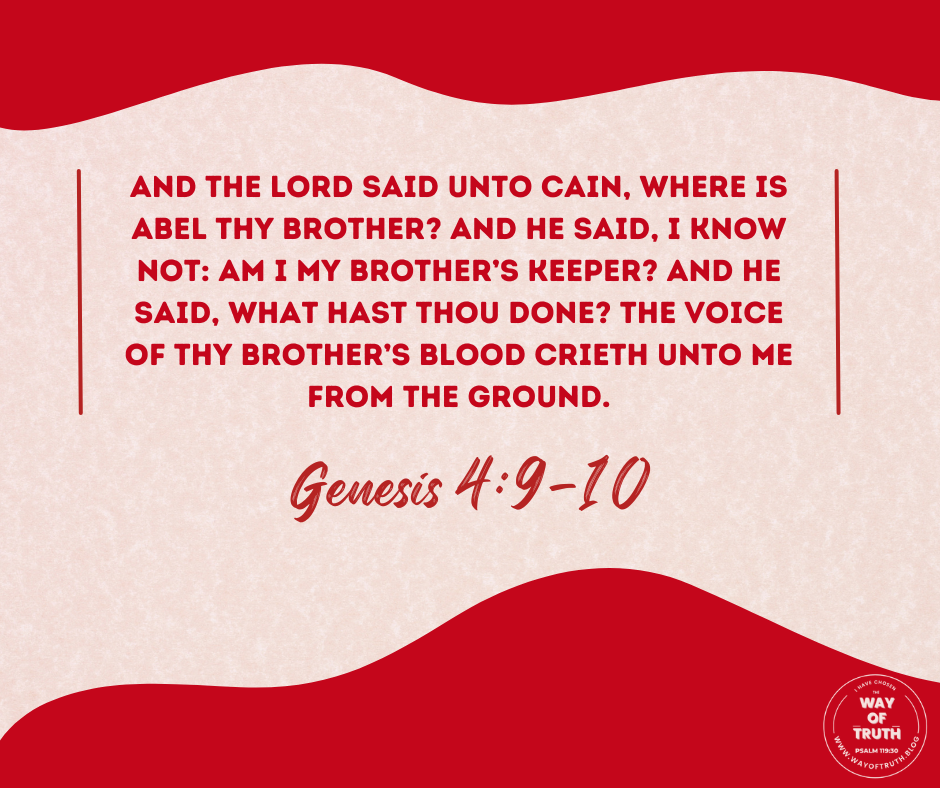
“And the LORD said unto Cain, Where is Abel thy brother? And he said, I know not: Am I my brother’s keeper? And he said, What hast thou done? the voice of thy brother’s blood crieth unto me from the ground” (Genesis 4:9-10).
I. Introduction
Genesis 4:9–10 stands at a solemn and defining moment in the early history of humanity. The first murder—Cain’s killing of his brother Abel—has already taken place in verse 8. Now the narrative shifts from fratricide to divine inquiry, from hidden violence to exposed guilt. The Lord Himself enters the scene, not as a distant observer but as the sovereign Judge who confronts sin, demands truth, and unveils the moral fabric of His world. Just as He questioned Adam after the fall (“Where art thou?”—Genesis 3:9), so He now questions Cain: “Where is Abel thy brother?” The question is not born of ignorance but of justice; God is giving Cain an opportunity to confess, repent, and step into the light he has tried to evade.
The historical and literary context heightens the weight of these verses. Cain and Abel represent the first generation born after humanity’s expulsion from Eden, and their story reveals how quickly sin metastasizes outside the garden. What began as disobedience in Genesis 3 has now escalated into violence. These verses show that sin is not an isolated incident but a spreading corruption that shapes relationships, families, and societies. Cain’s evasive reply—“I know not: Am I my brother’s keeper?”—echoes the deflection of Adam and Eve yet adds a sharper edge of defiance. This is the first recorded lie spoken to God and the first recorded instance of hardened denial in the face of divine questioning.
Verse 10 introduces one of Scripture’s most haunting images: “the voice of thy brother’s blood crieth unto me from the ground.” The Hebrew construction personifies Abel’s shed blood as a witness calling out for justice. In the ancient Near East, the ground was seen as the repository of spilled blood, symbolically absorbing both the crime and the cry of injustice. In biblical theology, however, God—not the soil—hears the cry. The Creator refuses to allow violence to sink unnoticed into the earth. These verses therefore anticipate later biblical themes: divine justice, the sanctity of life, the accountability of the sinner, and the principle that bloodshed demands a reckoning.
Within redemptive history, Genesis 4:9–10 marks an early revelation of God’s moral order. Even outside Eden, even before the giving of the Law, God shows that human beings answer to Him for how they treat their neighbors, especially those closest to them. The question “Where is Abel thy brother?” becomes a timeless summons, confronting humanity with its responsibility toward one another and exposing the heart’s attempts to hide sin behind clever words or hardened self-justification. The cry of Abel’s blood anticipates the greater cry of Christ’s blood (Hebrews 12:24), which speaks better things: not condemnation but redemption.
Thus, Genesis 4:9–10 is a profound theological window into the nature of sin, the justice of God, and the hope of a better word spoken through the gospel.
II. When God Questions and Blood Speaks
A. The Divine Question as Invitation to Confession
The narrative moves with solemn precision as the LORD confronts Cain after the murder of Abel. The use of the covenant name—YHWH—is significant. This is the God who has entered into personal relationship with humanity, not a distant judge issuing commands from afar. The encounter mirrors God’s earlier approach to Adam after the fall (Genesis 3:9). In both instances, God initiates conversation with a question. This is not because He lacks information—He is omniscient—but because divine questions serve a pastoral function: to awaken conscience, not to gather data.
The wording accentuates the personal dimension of the crime. The phrase “Abel thy brother” places Abel’s name before the relational term “your brother.” In Hebrew narrative style, such positioning is intentional. Before Cain ever speaks, the reader is reminded of the relational betrayal embedded in his act. Cain has not simply killed “a man.” He has murdered one who shared his blood, his household, and his earliest experiences.
God’s question marks the beginning of a judicial dialogue. As in ancient suzerain-vassal treaties, the superior (God) calls the subordinate (Cain) to account. The verse reveals a foundational doctrinal truth: God’s moral law and human accountability existed long before Sinai. Murder, and even the refusal to acknowledge its seriousness, is already understood as a direct violation of God’s design for human relationships and of His own holiness.
The question “Where is Abel thy brother?” therefore functions not only as confrontation but as grace. Before sentencing comes an opportunity for repentance, which is a pattern God repeats throughout Scripture (2 Samuel 12:1–7; Jonah 3; Revelation 2:5). Cain is given space to confess, but as the narrative reveals, that space is tragically wasted.
B. Cain’s Lie and Hardened Defiance
Cain’s response is a chilling display of hardened rebellion. The first half of his answer—“I know not”—is a straightforward lie. Cain knows exactly where Abel is; he placed him there. But the second half of the response—“Am I my brother’s keeper?”—is dripping with contempt. The term “keeper” carries deep biblical resonance. It is the very word used for Adam’s calling to “keep” the garden (Genesis 2:15). Cain deliberately rejects the God-given responsibility embedded in human identity: stewardship, care, and protection.
The rhetorical form of the question heightens its insolence. Cain attempts to shift attention away from his guilt onto God’s expectations, as though God is unreasonable for assuming such responsibility. His tone evokes the posture of scoffers described later in Scripture (Proverbs 21:24; Jude 18), whose arrogance blinds them to judgment.
Cain’s response reveals the psychological progression of sin described earlier in the chapter: sin crouches at the door (4:7), desire seizes the heart, and now unrepentant pride emerges in speech. His refusal to name Abel, even when pressed by God, highlights the dehumanizing nature of sin. He cannot honor the person he has wronged; he can only mock the One who questions him.
Hebrew narrative often communicates moral decline not through lengthy exposition but through dialogue. Here the text shows, rather than tells, that Cain’s heart is thoroughly corrupted: sinful action has now hardened into sinful posture. His defiance anticipates the prophetic declarations that God resists the proud (Psalm 138:6; Proverbs 3:34) and that a stiff-necked sinner invites judgment (Jeremiah 17:23).
C. God’s Charge and the Unmasking of Hidden Sin
God’s second question is not an inquiry but an indictment. The structure echoes His question to Eve in Genesis 3:13. It is a formal pronouncement of guilt, functioning like the opening statement in a legal proceeding. In ancient Near Eastern legal practice, an accuser would often begin with a summary question that exposed wrongdoing before presenting evidence. God follows this courtroom rhythm precisely: “What hast thou done?” cuts through the fog of deception and establishes culpability.
The question exposes a core truth: Sin cannot be hidden from God. Cain committed his crime “in the field” (verse 8), a location away from family presence, away from sacred space, and away from the eyes of others. But God’s omniscience renders physical location irrelevant. David later expresses this in poetic form: “Whither shall I go from thy spirit?” (Psalm 139:7). Cain stands as living proof that secrecy cannot shield the sinner from divine sight.
The grammar also matters. The perfect aspect in Hebrew implies that the deed is completed. The consequences are irreversible. God’s language places the weight of the crisis entirely on Cain. His earlier lie evaporates before the simplicity of God’s question. Nothing more needs to be said to establish guilt.
The verse reinforces the truth that God defines righteousness and sin, not human sentiment, emotion, or rationalization. Cain’s excuses carry no weight; divine holiness exposes all things as they truly are.
D. The Cry of Injustice and God’s Unyielding Justice
“The voice of thy brother’s blood crieth unto me from the ground” is one of the most haunting and evocative sentences in Scripture. The phrase “voice of thy brother’s blood” personifies Abel’s spilled blood as a witness calling out for justice.
The term “crieth” is a legal term that denotes a plea for justice. It is the same verb used of oppressed Israelites crying out in Egypt (Exodus 3:7). The ground—from which Abel offered his earlier sacrifice indirectly through his flock—now becomes the stage of his testimony. The earth that swallowed Abel’s blood becomes a witness against Cain.
In ancient Near Eastern culture, spilled blood was often viewed as an act that polluted the land. But Scripture transforms and elevates this concept: it is not the land that remembers. It is God. The blood cries “unto me,” He says. The implication is unmistakable: God Himself becomes the advocate for the victim.
Abel thus becomes the archetype of the righteous sufferer (Matthew 23:35; Hebrews 11:4). His death prefigures the martyrs whose souls cry from beneath the heavenly altar (Revelation 6:9–10) and ultimately points forward to the “better blood” of Christ (Hebrews 12:24), whose cry brings not condemnation but redemption.
Thus, Genesis 4:10 offers one of the earliest declarations of God’s unwavering commitment to justice: no cry of injustice goes unheard, and no shedding of innocent blood escapes divine reckoning.
III. Divine Justice, Human Responsibility, and the Cry of Innocent Blood
Genesis 4:9–10 opens a window into some of Scripture’s most foundational doctrines: human accountability, sin’s corruption, divine omniscience, the sacredness of life, and the ethical call to love one’s neighbor. The doctrines embedded in it are profound and essential.
A. Human Responsibility and the Rejection of Determinism
Cain’s dialogue with God decisively reinforces the scriptural doctrine of personal moral responsibility. When God asks, “Where is Abel thy brother?”, it becomes immediately clear that Cain’s actions are not excusable as the outworking of fate, environment, or divine coercion. Instead, Scripture consistently portrays human beings—even fallen ones—as free moral agents who choose their actions and therefore bear accountability for them. This is crucial: God does not confront Cain as though Cain were a victim of cosmic forces but as a man who has deliberately violated God’s standard.
This stands in contrast to fatalistic worldviews—ancient or modern—that treat human action as predetermined by impersonal necessity or psychological inevitability. Genesis 4 resists interpretations that diminish human accountability in favor of hyper-deterministic readings of divine sovereignty. God’s warning in 4:7 (“thou shalt rule over him”) already affirmed Cain’s capacity to resist sin’s power. Thus, both the murder and the lie cannot be blamed on inherited guilt or unavoidable compulsion.
The doctrine at stake is therefore crucial for biblical anthropology: humans are morally responsible creatures, and their choices matter before God. This lays the groundwork for all later doctrines of repentance, faith, judgment, and redemption.
B. The Progressive Corruption of Sin
Genesis 4:9–10 vividly demonstrates that sin is not static but expansive. What began as internal resentment (4:3-5) culminated in murder (4:8) and then metastasizes into falsehood and moral indifference (4:9). Cain’s sin does not remain contained. It grows, spreads, and deepens
Cain’s rhetorical question—“Am I my brother’s keeper?”—reveals a conscience bruised and bent by sin. Not only does he refuse to admit guilt, he rejects God’s moral structure for human relationships. Sin blinds the intellect (he attempts deception), hardens the heart (he shows no remorse), and disintegrates natural affection (he disowns responsibility for his own brother). Genesis 4 therefore illustrates how sin, once welcomed, incrementally erodes the moral faculties God designed to reflect His image.
This depiction of sin’s progressive nature becomes pivotal for later doctrines of sanctification and regeneration: without divine intervention, sin does not self-correct. It escalates.
C. Divine Omniscience and the Certainty of Judgment
God’s response in verses 9–10 underscores a vital doctrine: no sin is hidden from the Lord. Cain may attempt deception, but God already knows the truth and exposes it with perfect clarity. His question—“What hast thou done?”—is not investigative but judicial. It functions as the divine equivalent of a courtroom declaration, revealing God’s omniscient knowledge of human actions and intentions.
This portrayal of God’s omniscience is not merely descriptive; it forms the theological basis for divine justice. Because God sees all and knows all, His judgments are impartial, infallible, and righteous. Scripture repeatedly builds upon this foundation: “all things are naked and opened unto the eyes of him with whom we have to do” (Hebrews 4:13). As early as Genesis 4, the Bible teaches that human sin is never beyond divine awareness, making repentance not optional but necessary.
God’s omniscience also dismantles Cain’s attempt to evade responsibility. Divine justice is inescapable, not because God is harsh, but because He is holy. This makes Cain’s lie as irrational as it is immoral. The doctrine is therefore pastoral as well as judicial: it warns the sinner against self-deception and comforts the oppressed with the assurance that God sees every injustice, even when human systems fail.
D. Innocent Blood and the Foundations of Biblical Justice
The imagery of Abel’s blood “crying from the ground” introduces a major biblical doctrine: the moral voice of innocent bloodshed. This motif becomes central to Scripture’s understanding of justice, life, and atonement. Abel’s blood is not portrayed as magical or literally vocal; rather, it serves as a vivid symbol of the ethical outrage that murder provokes in the heart of God.
From this emerges the biblical doctrine of the sanctity of human life. Because Abel bears the divine image, his unjust death is an assault against God Himself (cf. Genesis 9:6). Life is sacred not solely because of its biological value but because it reflects the Creator. The ground receiving Abel’s blood now becomes a witness against Cain, anticipating later legal stipulations where land defiled by innocent blood must be cleansed (Numbers 35:33).
Moreover, Abel’s blood introduces a typological contrast foundational to soteriology: whereas Abel’s blood cries for justice, Christ’s blood “speaketh better things” (Hebrews 12:24), namely, mercy. In this way, Genesis 4 becomes an early theological precursor to the doctrine of substitutionary atonement. Abel’s death exposes humanity’s need for justice; Christ’s death satisfies that justice on behalf of sinners.
Thus, Genesis 4:9–10 stands at the headwaters of biblical teaching on justice, life, and redemption.
E. Brotherhood, Neighbor Love, and the Ethics of Responsibility
Cain’s infamous question—“Am I my brother’s keeper?”—is the negative articulation of a truth that reverberates throughout Scripture: God has designed humans to be responsible for one another. Cain’s refusal to acknowledge this reveals how sin corrupts not only personal morality but relational ethics. He denies the very fabric of human community established in creation.
This verse anticipates the later command in Leviticus 19:18 to “love thy neighbor as thyself,” as well as Christ’s teaching that this command is second only to loving God (Matthew 22:39). It also foreshadows the New Testament doctrine of the church as a body in which each member cares for the others (1 Corinthians 12:25; Galatians 6:2). Cain’s question is therefore more than a cynical dodge; it is a theological error. He attempts to abolish moral interconnectedness, but God reasserts it with divine authority.
Doctrine emerges from this narrative in a profoundly practical way: to deny responsibility toward one’s brother is to deny God’s design. The image of God binds human beings together with moral obligations. To harm another image-bearer is to rebel against God; to care for another is to honor Him.
This section of Genesis thus lays an early, foundational stone for Christian ethics: responsibility toward others is not optional—it is woven into the very nature of being human.
IV. Sin at the Door, Truth in the Text: Apologetic and Polemical Reflections
Genesis 4:9–10 stands as one of Scripture’s earliest direct confrontations with moral evil, human denial, and divine justice. These verses expose the heart of sin, answer key objections raised by skeptics, and articulate the biblical worldview with clarity and power. Far from being an ancient myth or moral fable, this passage speaks meaningfully into modern debates about morality, justice, divine judgment, and the human condition.
A. The Problem of Evil and the God Who Confronts It
Skeptics often argue that the existence of evil—especially violent evil—contradicts belief in a good and all-powerful God. Genesis 4 presents a profoundly different picture. Instead of portraying God as absent or indifferent, the narrative depicts Him stepping immediately into the situation, questioning Cain, exposing the sin, and declaring His knowledge of the crime. God is not distanced from the moral fractures of the world He created; He is the first to acknowledge the injustice and the first to demand an account for it.
This fundamentally reshapes how the problem of evil should be framed. The presence of evil does not contradict God’s goodness; rather, God’s response to evil reveals His goodness. The alternative, a world without God, strips Cain’s act of any objective moral significance, reducing it to evolutionary behavior or the survival of the fittest. Only a righteous, personal, holy God can call evil what it is and hold moral agents accountable for their actions. Genesis 4 therefore provides a foundation for objective morality: if Abel’s murder is truly wrong, even in principle, then there must exist a transcendent moral Lawgiver whose character defines righteousness.
B. The Divine Question and the Exposure of Human Evasion
God’s question—“Where is Abel thy brother?”—is not an inquiry born of ignorance but a summons to confession. Cain’s response unveils the essence of human fallen nature: denial, deception, and defiance. His words—“I know not” and “Am I my brother’s keeper?”—show that the first murderer is also the first liar after the Fall. He knows precisely what happened, yet he attempts to cloak his guilt with sarcasm and feigned innocence.
Apologetically, this exposes a fundamental flaw in secular views of human nature that assume people are basically good and merely shaped by environment or circumstance. Cain cannot blame upbringing, trauma, or societal pressures; he rebels knowingly, volitionally, and arrogantly. Sin is not a disease we catch. It is a posture of the heart. Modern philosophies that deny human depravity or reduce wrongdoing to psychological maladjustment ultimately fail to explain Cain-like behavior. Genesis 4 offers a more honest anthropology: humanity suppresses truth, evades responsibility, and resists God’s moral authority.
This is why the gospel is necessary, not because humanity lacks information, but because humanity lacks righteousness.
C. Abel’s Blood and the Biblical Response to Injustice
The statement, “the voice of thy brother’s blood crieth unto me from the ground,” establishes a foundational biblical doctrine: God sees, hears, and responds to every instance of injustice. Abel cannot speak, but God hears. The earth receives the blood, but God interprets it. In the silence of the fallen world, God is the Advocate of the innocent.
This carries significant apologetic weight. One of the strongest emotional arguments against Christianity is the claim that God does nothing in the face of suffering or oppression. But Genesis 4 contradicts this assumption. God does not need a human witness to testify; injustice itself testifies before Him. Divine justice is not only reactive. It is investigative, comprehensive, and certain. No suffering is unseen. No act of violence is overlooked. No cry for justice is lost in the wind.
Furthermore, the passage teaches that justice belongs to God, not to human vengeance. Cain’s punishment is measured, purposeful, and administered by the Judge of all the earth. In a world where justice is often delayed, denied, or distorted, Genesis 4 reminds believers that divine justice may be delayed but never denied, postponed but never discarded.
D. Pagan Parallels and the Uniqueness of Biblical Justice
When compared to ancient mythological accounts of sibling conflict, Genesis 4 stands alone in its ethical clarity and theological coherence. Pagan narratives often depict gods who act out of jealousy, whim, or malice, with human suffering as collateral damage. In contrast, the God of Genesis is righteous, rational, and morally consistent. He does not lash out impulsively, nor does He punish arbitrarily. He questions Cain to draw out confession, pronounces judgment based on truth, and administers justice with precision.
This apologetic contrast is essential. Critics who claim the Old Testament simply borrows pagan themes overlook the profound distinctions in worldview. Genesis 4 presents a God who is transcendent yet personal, sovereign yet compassionate, just yet patient. No ancient myth provides such a coherent moral universe. This moral distinctiveness is evidence of divine revelation, not cultural borrowing.
E. Divine Judgment Versus Human Violence
At this point, skeptics frequently raise a common objection: “If God condemns Cain for killing Abel, why does He later command Israel to destroy the Canaanites?” The challenge assumes that divine judgment and human murder are ethically equivalent, but Genesis 4 immediately separates the two. Cain’s act is condemned because it is personal, premeditated, and unjust. He kills not as an instrument of divine justice but as an act of envy and unrighteous anger.
By contrast, the judgment upon Canaan is God’s moral response to generations of collective evil (Genesis 15:16). It is slow, measured, and rooted in divine omniscience, not human impulse. Israel acts only at God’s command, only after centuries of divine patience, and only against nations whose wickedness has reached a fullness God alone can perfectly discern. Human murder is forbidden because humans are not God; divine judgment is righteous because God is perfectly just.
Thus, the objection fails to recognize the difference between sinful human violence and holy divine justice. Genesis 4 leads readers to see that God’s moral standard condemns murder precisely because human beings do not have the authority or purity to wield judgment in the way God does. Far from undermining biblical ethics, the condemnation of Cain reinforces the moral consistency of God throughout Scripture.
V. Walking in the Light of God’s Question
Genesis 4:9–10 is a divinely inspired window into the human heart, the nature of sin, the responsibility of community, and the God who sees. These verses call believers—and the Church collectively—to a life shaped by truth, compassion, accountability, and reconciling grace.
A. Embracing Honesty Before the All-Knowing God
Cain’s answer—“I know not”—reveals not just a lie but the deeper spiritual disease of denial. Instead of repentance, he constructs a false reality. Instead of confessing guilt, he attempts to evade the gaze of the God who cannot be deceived. This is a sober reminder that concealment is often the first instinct of a sinful heart. We hide behind excuses, distractions, and busyness; we rationalize our anger, justify our jealousy, or minimize our harsh words.
Yet God’s initial question—“Where is Abel thy brother?”—is fundamentally pastoral. It invites confession, not condemnation. It mirrors the question He asked Adam—“Where art thou?”—revealing a God who seeks out sinners even when they run from Him. For believers today, this means cultivating a daily rhythm of honesty before God. Prayer becomes not a performance but a place of truth-telling. Self-examination becomes an act of grace rather than dread, because the God who probes the heart also delights to forgive. Walking in truth, rather than in self-deception, is the doorway to spiritual freedom and renewed fellowship with God.
B. Taking Responsibility for Others
Cain’s counter-question has become the anthem of moral indifference. His evasion reflects the worldview that life is fundamentally self-centered and that others’ needs or suffering should not disrupt personal comfort. But Scripture forcefully denies this philosophy. From the beginning, God designed humanity for community: relationally, spiritually, and morally bound to one another.
Practically, this means believers must cultivate eyes that see and hearts that respond. The Christian life is not lived in isolation but in mutual care. Parents shepherd the hearts of their children; spouses care sacrificially for one another; church members bear burdens, restore the fallen gently, and encourage the fainthearted. Even in society, believers carry a sense of moral responsibility, not as political crusaders but as compassionate neighbors who see suffering and respond with Christlike care.
This responsibility is not intrusive meddling but faithful stewardship of relationships. We are not called to control others, but we are absolutely called to care for them. To ignore a brother or sister drifting into sin, overwhelmed by sorrow, or crushed by hardship is to echo Cain’s dismissive cry. To move toward them is to reflect the heart of the One who keeps His people faithfully.
C. Guarding the Heart While Sin Waits to Devour
Though God warned Cain in verse 7, these verses reveal the tragic result of ignored warnings. Sin did not pounce suddenly; it grew within Cain’s heart: first as anger, then as resentment, then as hostility, and finally as murder. This progression teaches believers to take early spiritual danger seriously. Emotions such as envy, annoyance, bitterness, and self-pity may appear small, but they breed spiritual decay when left unchecked.
This means we must confront sinful desires while they are still seeds. A harsh thought should be addressed before it becomes a harsh word. A jealous impulse should be confessed before it becomes a grudge. A moment of self-pity should be corrected by truth before it becomes a settled posture of victimhood. Christians cannot prevent the temptation from knocking, but they can prevent it from taking up residence.
Within the Church, this calls for a culture of discipleship where believers support one another in the battle for holiness. Pastors, elders, and mature Christians can help others recognize danger signs and respond with humility rather than defensiveness. The goal is not perfectionism but watchfulness, living with a sober awareness that sin crouches close but God’s grace equips His people to resist.
D. Bearing Witness to the God Who Sees and Judges Every Wrong
“The voice of thy brother’s blood crieth unto me from the ground” teaches that injustice does not go unnoticed by heaven. Even when the world seems silent, God hears every cry and sees every wrong. This truth strengthens believers who endure mistreatment, betrayal, or slander. They are not forgotten, and their pain is not dismissed by the One who hears the blood of the oppressed.
This produces deep rest in God’s character. Christians do not need to avenge themselves, because vengeance belongs to the Lord. They can forgive without pretending the wrong was insignificant. They can release bitterness because God will deal with injustice righteously.
This truth compels the Church to be a place where justice and mercy meet. A congregation that reflects God’s character will protect the vulnerable, confront wrongdoing in love, and refuse to silence the cries of those wounded by sin, whether through abuse, oppression, or interpersonal conflict. The Church becomes a refuge precisely because it mirrors God’s commitment to truth and righteousness.
E. Cultivating a Life of Prayerful Accountability
God’s question to Cain models the kind of loving accountability necessary for spiritual health. Accountability is not suspicion; it is care. It is not moral policing; it is spiritual friendship. When believers willingly invite others to ask them hard questions, they imitate the wisdom of God’s pastoral approach.
In practice, this means developing relationships marked by trust and transparency. It means giving someone permission to ask about temptations, spiritual dryness, unresolved anger, or relational conflict. For churches, this involves encouraging discipleship relationships, elder oversight, and small groups where honesty is normalized. When Christians lovingly engage each other in this way, they help one another avoid the path of Cain and pursue the path of Christ.
F. Reflecting Christ’s Reconciling Love as Ambassadors of Peace
Genesis 4:9–10 reveals humanity divided by sin, but the gospel creates a family united in love. Believers are called to embody the opposite of Cain’s spirit: not destroying life but nurturing it, not denying responsibility but embracing it, not harboring resentment but pursuing reconciliation.
In relationships, this looks like patient listening, gentle correction, quick forgiveness, and proactive peace-making. In worship, it looks like confessing relational sins and seeking restored fellowship. In mission, it looks like offering the world a glimpse of the harmony God intends for redeemed humanity. A church shaped by Genesis 4:9–10 becomes a living testimony that, through Christ, brothers no longer kill brothers. Instead, they become keepers, helpers, intercessors, and friends.
VI. From the Cry of Blood to the Call of Grace
If you don’t already know Jesus Christ as your Lord and Savior, Genesis 4:9–10 offers one of Scripture’s most sobering and yet hope-filled windows into your spiritual condition. Here we see the first recorded murder, an act of violence born from unchecked anger and a heart estranged from God. But even more striking is what follows: God hears the cry of Abel’s blood. The ground itself becomes a witness. The earth that received the shed blood becomes, in a sense, a courtroom floor, and the life that was taken becomes a testimony against the one who took it.
This reveals a profound truth: sin always speaks. It rises before God. It exposes the guilty. It demands justice. Abel’s blood cried out because something terribly wrong had taken place, and Scripture teaches that God will never ignore sin, whether the sin is violent like Cain’s or quiet and internal like jealousy, pride, lust, bitterness, or unbelief. Even sins we think are hidden—from others or even from ourselves—are fully visible to the God who searches the heart. Every person, by nature, stands where Cain stood: guilty before a holy God, unable to justify themselves, and powerless to silence the cry of their own sin.
But this is not where the story must end for you. The God who heard Abel’s blood has also provided another blood: a blood that “speaketh better things than that of Abel” (Hebrews 12:24). Abel’s blood cried judgment. The blood of Jesus Christ cries mercy. Abel’s blood exposed guilt. Christ’s blood removes guilt. Abel’s blood testified to what Cain deserved. Christ’s blood testifies to what sinners may receive: full pardon, complete forgiveness, and perfect righteousness in the sight of God.
Jesus Christ, the eternal Son of God, entered the world and lived the perfect life that no one else could ever live: free from sin, pure in heart, and flawless in obedience. He loved perfectly, honored the Father perfectly, and embodied righteousness in every thought, word, and action. Yet this perfect Savior willingly suffered and died on a cross, shedding His blood as an atoning sacrifice for sinners. He bore not merely the physical pain of crucifixion but the spiritual weight of divine judgment. He took what we deserved so that we might receive what only He deserved.
Then, three days later, He rose from the dead in triumph. His resurrection is heaven’s public declaration that His sacrifice was accepted, His work was sufficient, and His victory was absolute. The blood that cried from the ground in Genesis 4 brought condemnation. The blood that flowed from Calvary brings peace, reconciliation, and everlasting life.
The gospel calls you to do what Cain refused to do: confess your sin honestly before God, turn from it, and come to Him in faith. You don’t need to hide from God. You don’t need to excuse yourself. You don’t need to fear that your guilt is too deep or your shame too heavy. The grace of Christ is greater than every sin, even those you are afraid to name. When you place your trust in Jesus Christ—resting not in your own efforts but in His finished work—you are forgiven fully, declared righteous, adopted as God’s child, and given a new heart and a new life. The path of Cain leads to judgment; the path of Christ leads to eternal joy.
This invitation is deeply personal. God is speaking through His Word even now. Scripture promises: “Whosoever shall call upon the name of the Lord shall be saved” (Romans 10:13). That word whosoever extends to all, no exclusions, no exceptions. It includes the broken, the weary, the guilty, the self-righteous, the fearful, and the uncertain. It includes you.
Christ stands ready to forgive, ready to restore, ready to cleanse, and ready to welcome you home. Do not let sin’s cry be the final word over your life. Let the blood of Jesus speak a better word: the word of grace, the word of mercy, and the word of salvation.
Come to Him. Trust Him. Let the cry of judgment be silenced forever by the voice of redeeming love.