
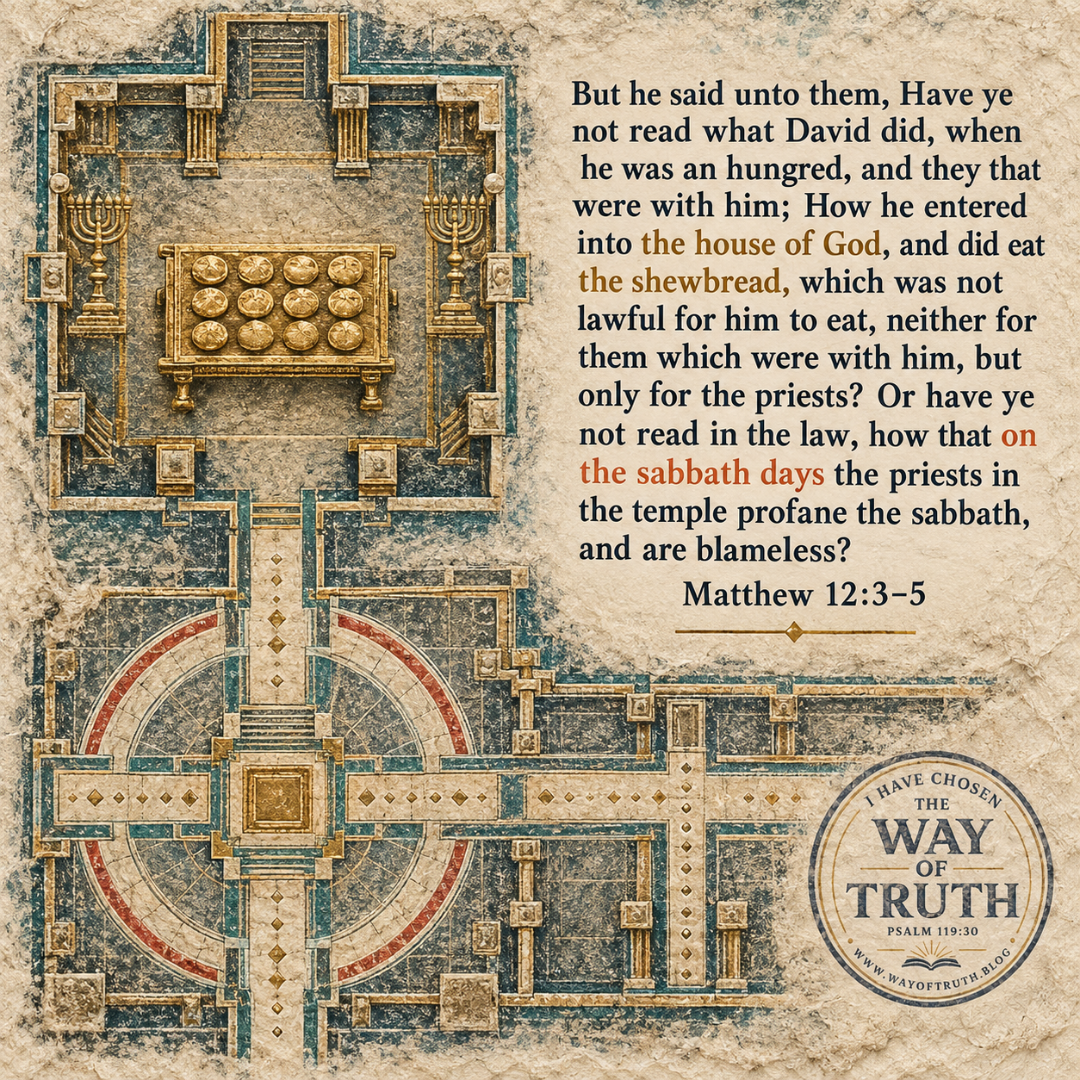
Jesus’ response to the Pharisees begins with a question that must have stung a little: “Have ye not read?” Of course they had read. These weren’t people unfamiliar with Scripture. The Pharisees took the Law seriously. They studied it, taught it, debated its meaning, and tried to regulate daily life according to it. Yet when they saw Jesus’ hungry disciples plucking grain on the Sabbath, they concluded, “Behold, thy disciples do that which is not lawful to do upon the sabbath day” (Matthew 12:2).
Jesus answers their accusation by taking them back to the very Scriptures they believed they were defending. He doesn’t dismiss the Old Testament as outdated. He doesn’t suggest that careful obedience no longer matters. He doesn’t respond, “Rules aren’t important; just follow your heart.” Instead, He essentially tells the Pharisees that they’ve failed to understand the Bible they know so well. There’s a difference between knowing what Scripture says and understanding what Scripture means.
Matthew 12:1–2 has already set up the issue. The disciples were hungry, and as they passed through the grainfields they plucked grain and ate it. The act itself was permitted under the Law. Deuteronomy 23:25 allowed a traveler to pluck grain from a neighbor’s field by hand. The Pharisees’ objection therefore concerned the Sabbath, not theft. They had interpreted the disciples’ simple act of gathering food as prohibited work.
Jesus now gives them two biblical examples that expose the weakness in that reasoning: David eating the shewbread and the priests working in the temple on the Sabbath. The examples are different, but together they make a powerful point. God’s commandments can’t be faithfully understood by isolating one rule from everything else God has revealed.
David, Hunger, and Holy Bread
Jesus first takes the Pharisees back to an event recorded in 1 Samuel 21. David was fleeing from Saul and arrived at Nob hungry and in need of food. He asked Ahimelech the priest for bread, but ordinary bread was unavailable. The only bread available was holy bread that had been placed before the Lord.
According to the Law, the shewbread was set apart for the priests. Leviticus 24:9 says: “And it shall be Aaron’s and his sons’; and they shall eat it in the holy place: for it is most holy unto him of the offerings of the LORD made by fire by a perpetual statute.” Jesus doesn’t pretend that this restriction didn’t exist. In fact, He states it plainly: “which was not lawful for him to eat, neither for them which were with him, but only for the priests.”
Jesus isn’t arguing that God’s commands are unimportant whenever someone has a pressing need. He doesn’t negate the command in order to defend David. He acknowledges the restriction while deliberately calling attention to an extraordinary biblical situation in which holy bread was given to a hungry man. The priest himself had placed conditions upon David’s receiving it, particularly concerning ceremonial purity. After those conditions were addressed, the bread was given.
Why would Jesus choose this episode? At the very least, it shows that the Pharisees’ interpretation of religious holiness was too mechanical. They’d created a way of reading God’s commandments that could look very strict while missing what the biblical record itself demonstrated about human need, sacred service, and God’s purposes.
There’s also an important connection between David and what’s happening in Matthew. David was God’s anointed king, although he was rejected and pursued at the time. His followers shared his hunger and hardship. Now the greater Son of David is standing before the Pharisees, and His disciples are hungry.
Jesus hasn’t yet finished the argument. In the verses immediately following our passage, He will declare, “in this place is one greater than the temple” (Matthew 12:6), appeal to God’s desire for mercy rather than empty sacrifice in verse 7, and finally announce, “For the Son of man is Lord even of the sabbath day” (Matthew 12:8). So, the David comparison isn’t random. The Pharisees are criticizing the followers of the Messiah while failing to recognize who’s standing among them.
What Jesus Isn’t Approving
There is a useful distinction here because David’s conduct in 1 Samuel 21 included more than eating bread. David gave Ahimelech a misleading explanation about why he was there. Jesus’ reference to David does not mean He approves everything David did during that episode. Scripture frequently records the actions of flawed people without approving every part of their behavior.
Jesus specifically points to David’s hunger and the eating of the shewbread. We should therefore stay with the point Jesus makes rather than treating His citation as a blanket endorsement of everything David did in the chapter.
This is one reason careful reading matters. Biblical characters aren’t automatically moral examples simply because the Bible records what they did.
Priests Who “Profane” the Sabbath Yet Remain Blameless
Jesus’ second example is even harder for the Pharisees to escape: “Or have ye not read in the law, how that on the sabbath days the priests in the temple profane the sabbath, and are blameless?” At first that sounds almost shocking. The priests profane the Sabbath?
Jesus is speaking according to the Pharisees’ simplistic understanding of Sabbath work. The priests certainly performed physical labor on the Sabbath. Animals had to be handled and sacrificed. Offerings had to be prepared. The prescribed temple service continued. In fact, the Law itself commanded additional sacrifices on the Sabbath: “And on the sabbath day two lambs of the first year without spot, and two tenth deals of flour for a meat offering, mingled with oil, and the drink offering thereof: This is the burnt offering of every sabbath, beside the continual burnt offering, and his drink offering” (Numbers 28:9–10).
Here’s the problem for the Pharisees. If their definition of Sabbath observance were applied without distinction, the priests would have to disobey God in order to obey God. God commanded Sabbath rest. God also commanded Sabbath temple service. Obviously, God didn’t contradict Himself.
The problem wasn’t with God’s Law. The problem was with an interpretation that flattened the Law into a set of isolated regulations without considering how God Himself intended those commands to function together.
The priests performed labor on the Sabbath, yet Jesus says they “are blameless.” Their activity didn’t constitute sinful Sabbath breaking because the same God who gave the Sabbath also commanded their temple service. Scripture interprets Scripture. One command from God should never be interpreted in a way that makes obedience to another command from God sinful. That principle seems obvious when stated plainly. It becomes less obvious when our own traditions have been repeated so long that we begin to treat them exactly like Scripture.
The Danger of Reading Our Rules Back Into God’s Word
The Pharisees’ problem wasn’t that they cared too much about Scripture. They cared too little about what Scripture actually meant. Their concern for Sabbath holiness had accumulated interpretations, restrictions, and applications. Some may originally have been intended to protect obedience. But a safeguard around a command can gradually become confused with the command itself. That still happens.
We read a biblical command. We make an application. The application becomes a tradition. The tradition becomes an expectation. Eventually, anyone who violates the expectation is treated as though they’ve violated the Word of God. That progression can happen so subtly that we barely notice it.
Jesus interrupts the process with four simple words: “Have ye not read?” Go back to the text. Look again. Read more carefully. Read the passage beside the rest of Scripture. Ask whether God actually said what you’re insisting He said. That’s not a call to loosen our commitment to Scripture. It’s a call to tighten it.
Scripture Doesn’t Need Our Help to Be Consistent
Some critics of the Bible point to passages like these and argue that biblical law contradicts itself. One command requires Sabbath rest while another requires priests to perform sacrifices on the Sabbath. But Jesus’ argument depends upon exactly the opposite conclusion.
The commands aren’t contradictory because they address different responsibilities within the same divinely ordered system. The priests weren’t rebels against the Sabbath while serving in the temple. Their Sabbath service had been commanded by the Lord Himself. What looks contradictory only becomes contradictory when one command is pulled away from its biblical setting and treated as though no other divine instruction exists.
The same is true of David and the shewbread. Jesus doesn’t deny that the bread was sacred or ordinarily restricted to priests. He draws attention to a biblical event that exposes the inadequacy of the Pharisees’ rigid reasoning.
Nor should this passage be twisted into the idea that Old Testament law was bad and Jesus came to oppose it. Jesus defeats the Pharisees’ accusation with the Old Testament itself. The disagreement isn’t Jesus versus Scripture. It’s Jesus versus a faulty interpretation of Scripture.
That distinction remains extremely important whenever someone claims that Christ replaced biblical authority with a vague ethic of kindness. Jesus certainly teaches mercy, and the next verses will explicitly raise that issue. But His mercy isn’t rebellion against God’s revelation. It reflects the purpose and character already revealed within it.
When Our Rules Become Heavier Than God’s
There’s something uncomfortable about this passage because it’s much easier to recognize Pharisaical reasoning in somebody else than in ourselves. Most of us aren’t standing beside a grainfield debating Sabbath regulations. But we can still add our expectations to God’s Word.
Sometimes those expectations involve worship styles, clothing, entertainment, schooling choices, Bible-reading routines, holiday observances, political involvement, family practices, church traditions, or countless other matters. Some convictions in those areas may be wise. Some may even be very wise. But a wise personal conviction is still not automatically a divine command.
We should never weaken something God has clearly commanded merely because obedience is inconvenient. Jesus’ response to the Pharisees gives us no permission to do that. But neither should we strengthen our own preferences until they carry an authority God never gave them.
The challenge is learning the difference. That requires more than finding a verse that seems to support what we already believe. Jesus expected the Pharisees to read Scripture broadly enough to notice David, the priests, the Sabbath, the temple, and the larger purposes revealed throughout the Law. We need that same humility.
Before judging another believer, we should ask: Has God actually forbidden this, or have I concluded that it’s unwise for me? Before declaring something sinful, we should ask: Can I demonstrate that conclusion from Scripture in its context? Before becoming irritated because another Christian does something differently, we should ask whether the disagreement concerns a command of God or simply a different application of biblical wisdom.
That doesn’t make truth relative. Quite the opposite. It prevents our opinions from competing with truth. There are matters where Christians must stand firmly. Scripture gives commands we don’t have the authority to negotiate away. Sin doesn’t become acceptable because culture approves it. Truth doesn’t change because obedience becomes unpopular. But firmness where God has spoken should be matched by humility where He’s allowed liberty. That balance can protect churches from a great deal of unnecessary division.
A congregation can become spiritually exhausting when people feel they must conform not only to Scripture but also to everybody else’s unwritten rules. Sometimes no one can even point to where a rule came from anymore. “That’s just how faithful Christians do it” becomes the explanation. Jesus teaches us to ask a better question: What has God actually said?
That question also reaches into our private lives. We can burden ourselves with standards God never gave us. We can feel guilty because our prayer time wasn’t long enough, our Bible reading didn’t look impressive enough, our service wasn’t visible enough, or our spiritual routine didn’t resemble someone else’s.
Spiritual discipline is good. Faithfulness matters. But God doesn’t ask us to impress Him with a religious performance. He calls us to know Him, obey Him, trust Him, and walk faithfully according to His Word.
And notice the irony of Matthew 12. The Pharisees are so occupied with detecting a Sabbath violation that they barely seem to notice the hungry people standing in front of them. Religious scrutiny can do that to us. We can become so interested in whether someone has followed our rules correctly that we stop seeing the person.
The Church should be known for serious obedience to Scripture, but serious obedience should make us more like the God who gave Scripture. It should produce holiness, mercy, truth, patience, humility, and love. If our Bible knowledge consistently makes us harsher, prouder, and quicker to condemn, something has gone wrong in the reading.
And there’s another responsibility here. We’re called not merely to defend biblical truth among ourselves but to proclaim it to people who desperately need Christ. The world doesn’t need Christians to offer another complicated system of human regulations. It needs the gospel. We glorify God when we hold firmly to everything He has actually said, refuse to place our own authority beside His, and point people beyond religious performance to the Lord Jesus Christ.
The Greater Son of David Is Standing Here
Perhaps you’ve spent much of your life thinking Christianity is mainly about getting enough rules right so that God will finally accept you. Matthew 12 points in a very different direction. The Pharisees were extraordinarily serious about religious behavior, yet they were standing face-to-face with Jesus Christ and failing to recognize Him. It’s possible to become very good at religion while remaining far from the Savior.
That matters because our deepest problem can’t be solved by becoming more careful rule-keepers. Our problem is sin. Scripture says: “For all have sinned, and come short of the glory of God” (Romans 3:23). Sin is more than occasionally making poor decisions. We’ve failed to love God as He deserves. We’ve broken His commands in thought, attitude, word, and action. No amount of religious activity can erase that guilt. And sin carries a terrible penalty: “For the wages of sin is death” (Romans 6:23).
But God didn’t leave sinners without hope. The One speaking to the Pharisees in Matthew 12 is the Savior God sent for us. Jesus Christ lived without sin and willingly went to the cross, where He gave Himself for sinners. “Christ died for our sins according to the scriptures; And that he was buried, and that he rose again the third day according to the scriptures” (1 Corinthians 15:3–4).
Jesus didn’t come merely to make us more religious. He came to save us. At the cross, He bore the judgment our sins deserve. On the third day He rose bodily from the grave, defeating death and demonstrating that His saving work was complete.
You can’t earn that salvation by keeping enough rules, joining a church, performing religious ceremonies, giving money, becoming more respectable, or trying harder to be a good person. God calls you to repent and believe. To repent means that you turn from your sin toward God. To believe means that you place your trust in Jesus Christ rather than yourself, your works, or anything else you might hope will make you acceptable before God. The promise is wonderfully simple: “Believe on the Lord Jesus Christ, and thou shalt be saved” (Acts 16:31).
If you’ve been trying to carry the impossible weight of making yourself acceptable to God, Christ invites you to stop trusting in yourself and trust Him. Come to Him as you are, but come willing to leave your sin behind. Believe that He died for you and rose again. Receive the forgiveness that only He can give.
Then live, not as someone desperately trying to earn God’s favor, but as someone redeemed by grace and called to walk under the good authority of Christ. The greater Son of David has come. He’s not merely another religious teacher adding more weight to our shoulders. He’s the crucified and risen Lord who saves sinners. Trust Him, follow Him, and let your life be lived for His glory.
Questions to Carry with You
- Am I careful to distinguish between what Scripture actually commands and the personal convictions, traditions, or preferences I’ve developed around it?
- When I disagree with another believer, do I first ask whether God has clearly spoken on the matter, or am I too quick to treat my own application as the only faithful one?
- Does my study of Scripture increasingly produce humility, mercy, obedience, and love, or has biblical knowledge sometimes become a tool for finding fault with others?
- Where might I be carrying religious expectations that God Himself has never placed upon me, and how would greater confidence in the sufficiency of His Word change that?
- How can I glorify God by holding firmly to His truth while showing the mercy of Christ and clearly pointing others to the gospel?