
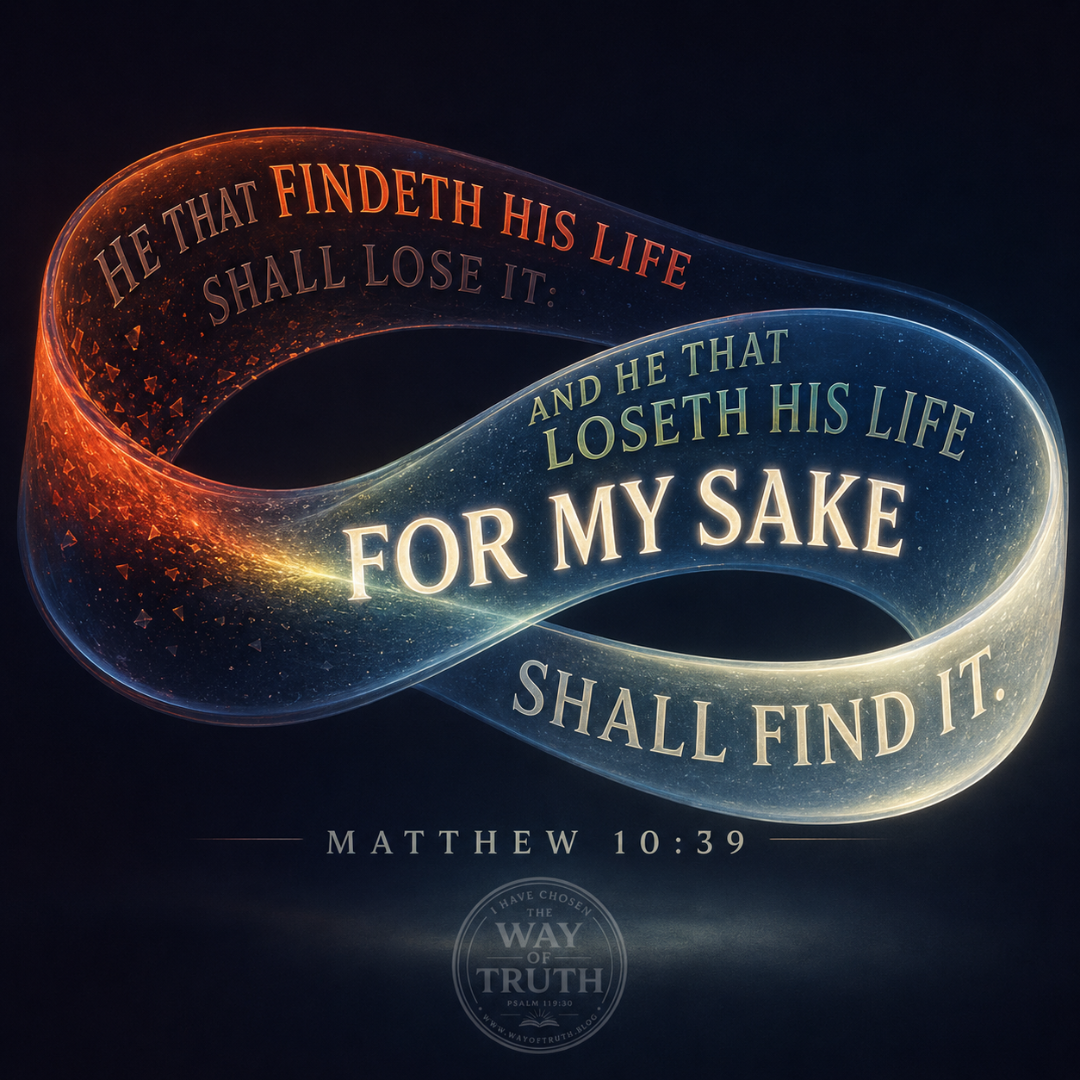
Matthew 10:39 brings Jesus’ teaching about costly discipleship to a pointed conclusion. He’s already warned that loyalty to Him may bring opposition, public hostility, and even division within a household. In verse 37, He requires a love greater than our love for the closest members of our family. In verse 38, He requires us to take up the cross and follow Him. Now He presses the matter to its deepest level: What will we do when faithfulness to Christ appears to threaten life itself?
The verse is deliberately paradoxical. The person who succeeds in preserving their life loses it, while the person who gives up their life for Christ finds it. Jesus isn’t playing with words or trying to sound mysterious. He’s exposing the limits of self-preservation. There are moments when holding on becomes the surest way to lose, and surrender becomes the only way to keep what truly matters.
This statement also gathers up much of the missionary discourse that began earlier in the chapter. Jesus sent the apostles into a hostile world as “sheep in the midst of wolves” (Matthew 10:16). He warned them of councils, scourging, betrayal, hatred, and death. Yet He also told them not to fear those who can kill the body but can’t kill the soul. Matthew 10:39 is therefore not an abstract saying about personal growth. It’s Christ’s answer to a disciple standing under pressure and wondering whether obedience is worth the cost.
When “Finding” Life Means Saving It for Ourselves
“He that findeth his life” doesn’t refer to healthy self-understanding or discovering one’s abilities. In this setting, it describes the person who secures or preserves their earthly life by refusing the cost of following Christ. They “find” the safety they were seeking. They may keep their place in the family, avoid the anger of authorities, preserve their reputation, or escape physical death. It can look like a sensible success.
Jesus says that such a person “shall lose it.” The loss is greater than the temporary life they managed to protect. Earlier in the discourse, Jesus spoke of God’s judgment, the soul, confession before the Father, and denial before the Father (Matthew 10:28, 32–33). Those statements give this warning an eternal horizon. A person may preserve their breathing, comfort, and social acceptance while forfeiting the life that only Christ can give.
This doesn’t mean that every fearful failure proves a person eternally lost. Peter later denied Jesus under pressure, yet he wept bitterly, was restored, and went on to confess Christ openly. Matthew 10:39 describes the direction of a life and the allegiance governing it, not the claim that one sinful collapse lies beyond grace. There’s a difference between stumbling in fear and choosing self-preservation as one’s master. One can be forgiven; the other must be forsaken.
Nor does Jesus condemn taking lawful precautions. In this same chapter, He tells the disciples to flee from one city to another when persecuted (Matthew 10:23). Avoiding danger isn’t automatically cowardice. The question is whether we’re using a wise means of continuing Christ’s work or abandoning Christ in order to protect ourselves. Flight may be faithful. Denial isn’t.
The Life That’s Lost for Christ
The second half of the verse is just as strong: “he that loseth his life for my sake shall find it.” In the immediate context, losing one’s life can mean literal death. Jesus had already spoken plainly about people who “kill the body” (Matthew 10:28). We shouldn’t soften His words until they mean nothing more than tolerating a bad day with a pleasant attitude. The first disciples had to be ready to die rather than deny their Lord, and believers in many places still face that choice.
At the same time, the principle reaches every disciple, including those who never face martyrdom. To follow Christ is to surrender ownership of one’s life. Our plans, ambitions, comfort, money, reputation, relationships, abilities, and years no longer sit beyond His authority. This surrender may become visible in one final act of costly faithfulness, but it begins in ordinary obedience. The martyr’s courage isn’t manufactured in the final five minutes. It grows through a life that’s already learned to say, “I belong to Christ.”
Jesus uses the same word for “life” in both halves of the statement. The life clutched in self-rule is lost; the life entrusted to Christ is found. We don’t keep one life while receiving an unrelated prize. Christ restores life to its proper center and carries it beyond the reach of death. In Him, surrender isn’t erasure. It’s rescue.
This is why the verse doesn’t teach salvation by heroic sacrifice. Death can’t wash away sin merely because it’s painful or courageous. The thief on the cross had no lifetime of religious achievement to offer, yet Christ promised him paradise when he turned to Him in faith (Luke 23:42–43). The believer’s sacrifice doesn’t purchase eternal life. Rather, willingness to lose everything for Christ reveals that one has recognized Him as more valuable than everything else.
The Words That Guard the Promise: “For My Sake”
The phrase “for my sake” is essential. Jesus doesn’t pronounce a blessing upon every form of loss. People can lose health through neglect, relationships through cruelty, employment through dishonesty, and freedom through crime. Such losses may be painful, but pain alone doesn’t make them crosses. Scripture says, “But let none of you suffer as a murderer, or as a thief, or as an evildoer, or as a busybody in other men’s matters” (1 Peter 4:15).
Neither is Jesus encouraging recklessness, self-harm, or the deliberate pursuit of persecution. Christians aren’t called to prove devotion by creating needless disasters and then placing a religious label on the wreckage. When suffering comes because we obey Christ, refuse sin, speak the truth in love, and confess the gospel, we may rightly suffer “for” His sake. The cause, not merely the pain, defines the loss.
These words also protect believers from spiritual abuse. A religious leader, family member, or organization may demand unquestioning loyalty and call resistance selfish. But Jesus didn’t say, “Lose your life for the sake of anyone who claims to represent me.” No pastor, ministry, denomination, or political cause possesses Christ’s authority over the conscience. Faithful churches point people to the Lordship of Christ and the authority of His Word; cults and controlling leaders place themselves in the center. A demand to conceal abuse, tolerate exploitation, cut off reasonable questions, or obey commands contrary to Scripture isn’t a call to take up the cross. It’s a misuse of sacred language.
“For my sake” also reveals the extraordinary identity of the One speaking. If an ordinary teacher demanded that followers value him above family, safety, and life itself, the demand would be morally monstrous. Jesus can speak this way only if He’s worthy of the allegiance that belongs to God. Throughout Matthew, He doesn’t merely direct people toward an impersonal principle. He calls them to Himself. The person who loses life for Jesus doesn’t place hope in sacrifice; they place hope in the Lord for whom the sacrifice is made.
One Truth Repeated Along the Way
Jesus returns to this truth several times. After predicting His death and resurrection, He says, “For whosoever will save his life shall lose it: and whosoever will lose his life for my sake shall find it” (Matthew 16:25). Mark and Luke preserve the same teaching, and John records its picture of a grain of wheat dying in order to bear fruit. Jesus then says, “He that loveth his life shall lose it; and he that hateth his life in this world shall keep it unto life eternal” (John 12:25).
The wording in John doesn’t require self-loathing. To “hate” one’s life in this world is a forceful contrast: present life must not be loved above eternal loyalty to Christ. Scripture never presents the human person as worthless. Human beings bear God’s image, and the Father’s care extends even to the hairs of His children’s heads (Matthew 10:30). Precisely because life is God’s gift, we must not turn it into our god.
The recurrence of this hard saying across the Gospel accounts strengthens rather than weakens its historical credibility. The early church didn’t preserve a harmless Jesus designed to win easy approval. It faithfully handed down a demand that exposed shallow discipleship and offered no advertising-friendly promise of uninterrupted comfort. The accounts differ slightly in setting and phrasing, as truthful witnesses commonly do, but they agree on the substance: life centered on self is finally lost, and life surrendered to Christ is eternally secured.
This teaching also differs sharply from both modern self-fulfillment and impersonal resignation. Our culture often tells us that life is found by making the self’s desires supreme. Some philosophies seek freedom by becoming detached from desire and accepting fate. Jesus offers neither enthronement of the self nor surrender to blind fate. He calls us into personal allegiance to the living Son of God. The Christian loses life not because the self is meaningless, but because Christ is Lord. The result isn’t emptiness, but life found in Him.
Open Hands in a World That Teaches Us to Clench
This verse reaches into ordinary decisions long before anyone threatens us with death. Most of us are skilled at protecting the small kingdoms we’ve built. We protect the version of ourselves we want others to admire. We guard plans we never submitted to God. We avoid needed obedience because it might cost money, convenience, influence, or someone’s approval. Self-preservation rarely introduces itself with a villain’s speech. More often, it sounds practical: Surely Christ wouldn’t ask me to risk this relationship. Surely silence is wiser. Surely obedience can wait until it’s less expensive.
Jesus invites us to ask a more searching question: What am I trying to save at the expense of faithfulness to Him?
For one believer, the answer may be a reputation at work. Telling the truth, refusing a dishonest shortcut, or declining to participate in degrading conversation may make advancement harder. For another, it may be family approval. Honoring parents and loving relatives remain Christian duties, but neither requires hiding one’s faith or joining in sin. Someone else may be guarding a dream so tightly that every interruption feels like an enemy, even when God has placed a needy person directly in the path.
Losing life for Christ doesn’t always feel dramatic. It may look like giving time when no recognition follows, forgiving when pride wants to keep a record, confessing sin rather than managing appearances, or serving in a place that seems too small to matter. It may require refusing an opportunity that would reward compromise. It may mean continuing to speak of Christ with gentleness after previous conversations went badly. These acts don’t earn God’s favor. They show that His favor in Christ has begun to loosen our grip on ourselves.
The church needs this open-handed discipleship. Congregations become unhealthy when members treat preferences as possessions to defend at all costs. Styles, traditions, roles, recognition, and influence can quietly become little “lives” we’re determined to save. Biblical truth must never be surrendered for the sake of peace, but personal preference must never be promoted to the rank of biblical truth. Unity grows when believers hold Christ and His Word firmly while holding status and preference lightly.
In worship, this verse calls us beyond singing about surrender while carefully protecting every private exception. Worship declares that Christ is worth more than the life we could build without Him. In mission, it frees us to proclaim the gospel even when the response may be indifference, ridicule, or rejection. We don’t need to be rude, combative, or careless. But we do need to be unashamed. The gospel can’t be proclaimed by a church whose first commandment is “Stay comfortable.”
There’s also deep encouragement here. Jesus doesn’t merely command loss; He promises life: “shall find it.” Nothing given to Christ is finally wasted. The world may call a faithful life unsuccessful because it didn’t gather enough comfort, attention, money, or control. Christ measures differently. The quiet act of obedience that no one remembers is known to Him. The opportunity declined for conscience’s sake isn’t forgotten. The witness rejected by people is confessed before the Father by the Son.
If you recognize how tightly you’ve been clinging, don’t turn this passage into a reason for despair. Bring that fear honestly to Christ. Courage isn’t pretending that loss doesn’t hurt. It’s trusting that Jesus is better than what obedience may cost. Ask Him for grace to obey the next clear command rather than imagining every possible crisis at once. The Lord who sees the sparrow and numbers the hairs of your head isn’t careless with a life placed in His hands.
The Savior Who Lost His Life and Took It Up Again
Perhaps you can feel the weight of Jesus’ words but know that your life has never truly belonged to Him. The answer isn’t to begin performing painful acts in hopes of proving yourself worthy. Christianity isn’t a contest to see who can suffer most. It begins with what Christ has done for sinners who could never rescue themselves.
God gave you life and made you for His glory, yet sin turns His gift inward. We choose our will over His, love created things above the Creator, and try to keep control of a life that already belongs to Him. “For all have sinned, and come short of the glory of God” (Romans 3:23). Sin isn’t merely a collection of unfortunate mistakes. It’s rebellion against the holy God, and its rightful penalty is death: “For the wages of sin is death” (Romans 6:23). If we stand before God carrying only our own goodness, we remain guilty.
But the One who spoke Matthew 10:39 didn’t remain at a safe distance from suffering. Jesus Christ, the sinless Son of God, went willingly to the cross. He didn’t die for His own wrongdoing. He bore the judgment sinners deserve, offering the sufficient sacrifice that we could never provide. “Christ died for our sins according to the scriptures; And that he was buried, and that he rose again the third day according to the scriptures” (1 Corinthians 15:3–4). His resurrection wasn’t a comforting symbol pasted onto tragedy. He rose bodily and victoriously, defeating death and proving that His saving work was accepted.
This matters because your surrender can’t atone for your sin, but His blood can. Your courage can’t conquer the grave, but His resurrection has. Salvation is God’s gift, received through repentance and faith. To repent is to turn from sin and self-rule; to believe is to entrust yourself to Jesus Christ as Lord and Savior. He promises forgiveness, a new life, and eternal salvation to all who come to Him in faith.
You may fear that surrendering to Christ will cost you the life you wanted. In one sense, it will. He doesn’t offer to become a helpful addition to a life still ruled by self. Yet whatever He asks you to release is nothing compared with what’s found in Him: peace with God, cleansing from sin, a new heart, a place among His people, purpose that survives disappointment, and life that death can’t take.
Come to Christ honestly. You don’t need polished words or a religious résumé. Confess your sin, abandon every claim to save yourself, and trust the crucified and risen Lord. Place the life you can’t keep into the hands of the Savior who can’t lose it. Then live, by His grace, for His glory.
Reflection and Response
- What comfort, relationship, ambition, reputation, or measure of control am I most tempted to preserve at the expense of obedience to Christ?
- Is there a clear command of Christ that I’ve delayed because I’m waiting for obedience to become less costly?
- When I suffer, do the cause and manner of my suffering show faithfulness to Christ, or might some of the pain come from pride, poor judgment, or wrongdoing that I need to confess?
- How can I help my church hold firmly to biblical truth while releasing personal preferences, status, and recognition for the sake of unity and mission?
- In what specific way can I entrust my life to Christ and show that I believe His promise that the life surrendered to Him is the life truly found?