
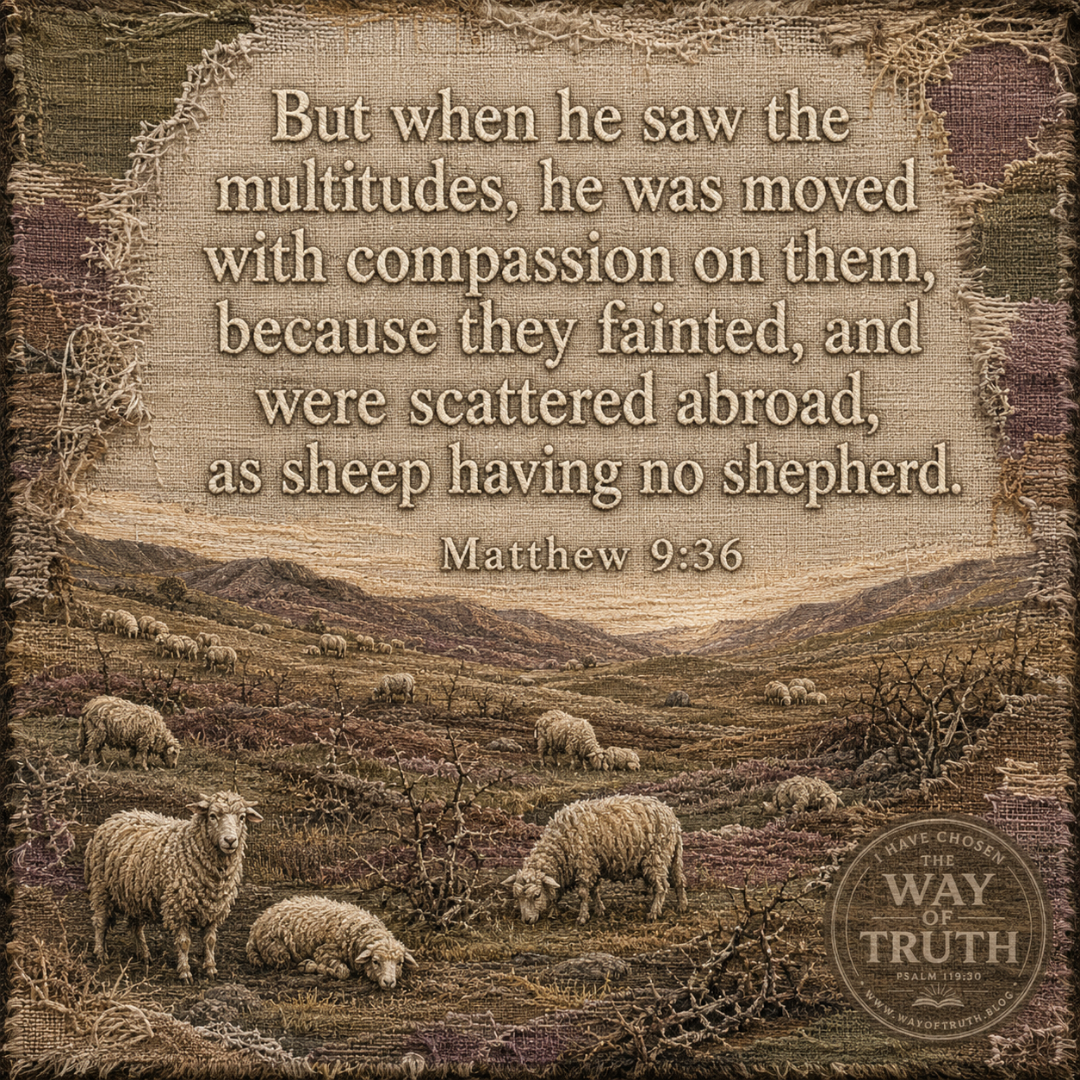
Matthew 9:35 describes Jesus traveling through cities and villages, teaching in synagogues, preaching the gospel of the kingdom, and healing sickness and disease. Verse 36 then draws our attention from what Jesus did to what He saw and felt while doing it.
The opening word, “But,” marks a meaningful turn. The previous verse presents a ministry of remarkable power and broad reach. Everywhere Jesus went, bodies were healed, truth was proclaimed, and the authority of God’s kingdom was displayed. Yet Jesus didn’t view the multitudes as proof of a successful public ministry. He saw troubled people.
“When he saw the multitudes” means more than noticing that a crowd had gathered. Many people can look at a crowd without truly seeing anyone in it. We may see traffic, inconvenience, noise, statistics, customers, voters, or strangers. Jesus saw people with burdens, wounds, sins, fears, and eternal souls.
The Lord’s attention wasn’t reserved for those who approached Him politely, understood Him correctly, or had their lives neatly arranged. He saw the confused, the exhausted, the overlooked, and the spiritually vulnerable. Nothing in the verse suggests that every person in the crowd understood who He was. Many probably didn’t. His compassion began with His character, not with their comprehension.
That’s comforting. Christ’s awareness of human need isn’t shallow, hurried, or distracted. He doesn’t merely see what we show in public. He sees beneath it.
Compassion Stirred in the Heart of Christ
Matthew tells us that Jesus “was moved with compassion on them.” This wasn’t a passing feeling or a polite expression of concern. The wording describes deep inward pity. Their condition touched Him profoundly.
Some people imagine holiness as coldness, as though being untouched by human sorrow were a mark of spiritual strength. Jesus shows the opposite. Perfect holiness didn’t make Him distant. Because His heart was perfectly pure, He saw suffering without the selfishness, impatience, prejudice, or suspicion that often clouds our vision.
His compassion also reveals the reality of His humanity. The eternal Son of God truly entered our world and experienced genuine human emotion. He wasn’t merely appearing to be human or acting out sympathy from a safe distance. He felt the misery before Him.
At the same time, His compassion displays the heart of God. Scripture repeatedly presents the Lord as merciful toward the weak, the wandering, and the afflicted. Jesus didn’t persuade a reluctant Father to care about sinners. In Christ, the compassionate purpose of God came near enough to be seen, heard, and touched.
Christ’s compassion shouldn’t be confused with sentimental approval. Matthew doesn’t say the multitudes were innocent or that their beliefs and choices didn’t matter. Jesus preached repentance, exposed hypocrisy, warned of judgment, and called people to obedience. Genuine compassion tells the truth because deception eventually harms those who believe it.
The Jesus who pitied the multitudes is the same Jesus who confronted sin. There’s no conflict between the two. A physician who refuses to name a deadly disease isn’t compassionate, no matter how reassuring his bedside manner may be. Christ loves too faithfully to comfort people with lies.
Worn Down and Thrown About
Jesus was moved with compassion “because they fainted, and were scattered abroad.” The picture is stronger than that of people who simply needed a good night’s sleep. They were worn down, distressed, and cast about. Life hadn’t merely made them tired; it had left them vulnerable and without reliable spiritual direction.
The surrounding verses help us understand their condition. Jesus had encountered disease, disability, death, demon possession, social exclusion, desperate parents, religious controversy, and people seeking help from every direction. The needs were physical, emotional, moral, and spiritual. These crowds lived in a broken world, and that brokenness had reached into every part of life.
They also lived among religious leaders, yet Jesus described them as people without a shepherd. Religious activity was plentiful, but faithful spiritual care was scarce. The presence of teachers, ceremonies, and institutions didn’t automatically mean that the people were being led toward God.
The contrast with the Pharisees in the previous verse is especially sobering. After Jesus delivered a demon-possessed man, the Pharisees responded, “He casteth out devils through the prince of the devils” (Matthew 9:34). They looked at an act of mercy and called it the work of Satan. Jesus looked at the people and was moved with compassion.
The Pharisees saw a threat to their standing. Jesus saw sheep in distress.
This warns us that a person can possess religious knowledge and still be painfully unlike the Lord. Correct vocabulary, a recognized position, or an impressive public reputation can’t substitute for a heart shaped by truth and mercy.
The words “as sheep having no shepherd” draw upon an image found throughout Scripture. Sheep aren’t equipped to direct, defend, or rescue themselves. Without a shepherd, they wander, scatter, become easy prey, and struggle to find safe pasture.
When Moses asked God to appoint someone to lead Israel after his death, he prayed that the congregation would not be “as sheep which have no shepherd” (Numbers 27:17). Centuries later, God condemned Israel’s unfaithful leaders because they had neglected and exploited His flock. He promised, “Behold, I, even I, will both search my sheep, and seek them out” (Ezekiel 34:11). He also declared, “And I will set up one shepherd over them, and he shall feed them, even my servant David” (Ezekiel 34:23).
Matthew 9:36 stands within that larger biblical story. Jesus didn’t merely recognize the absence of a faithful shepherd. His teaching, healing, authority, and compassion revealed that the promised Shepherd had arrived. The One who saw the scattered sheep was already seeking them.
This truth becomes unmistakable when Jesus later declares: “I am the good shepherd: the good shepherd giveth his life for the sheep” (John 10:11).
A shepherd does more than feel sorry for sheep from a distance. He goes after them, leads them, feeds them, guards them, and, in the case of Christ, lays down His life to save them.
The image also confronts human pride. Modern culture celebrates complete self-direction. We’re encouraged to invent our own truth, follow our own desires, and treat personal independence as the highest good. Scripture gives a more honest diagnosis. Left to ourselves, we don’t reliably find our way to God. We wander.
That’s not an insult to human dignity. It’s a truthful description of human need. Our dignity comes from being made in God’s image, but our safety and salvation depend upon being brought under the care of the Shepherd.
Compassion That Leads Somewhere
Matthew 9:36 isn’t an isolated observation. It prepares the way for what follows. Jesus tells His disciples that the harvest is plentiful, commands them to pray for laborers, and then sends the twelve out to minister in His authority.
His compassion moved toward action.
This protects us from two common mistakes. One is a concern for truth that has little tenderness for suffering people. The other is an emotional concern for people that offers comfort without truth. Jesus held mercy and truth together perfectly. He preached, taught, healed, confronted, prayed, and sent workers.
On another occasion, when Jesus saw people “as sheep not having a shepherd,” His compassionate response was that “he began to teach them many things” (Mark 6:34). Teaching truth wasn’t separate from compassion. It was one of compassion’s necessary expressions.
False shepherds reverse this pattern. They use needy people to gain influence, money, loyalty, or control. Some religious groups insist that safety can be found only through unquestioning submission to their organization or chosen leader. Matthew 9:36 points in a different direction. The sheep ultimately belong to Christ. Every pastor, teacher, or ministry worker serves beneath His authority and must answer to Him.
The Church does need faithful human shepherds, but it doesn’t need spiritual celebrities who make themselves indispensable. Good servants lead people toward Christ, not into dependence upon themselves.
Learning to See with the Shepherd’s Heart
This verse invites us to examine not only how we serve, but how we see.
It’s possible to be surrounded by people while remaining largely untouched by their needs. A crowded workplace, neighborhood, store, church, or online community can become background noise. We may sort people quickly into categories: helpful or difficult, responsible or irresponsible, agreeable or irritating. Jesus looked longer and deeper.
Following Him means learning to see a person rather than merely reacting to a behavior. Someone’s sharp response may come from fear. Withdrawal may conceal grief. Repeated failure may reflect years of confusion, poor guidance, or spiritual bondage. Compassion doesn’t excuse sinful conduct, but it keeps us from reducing a person to the worst thing we’ve noticed about them.
The Church should be a place where worn and scattered people encounter both truth and patient care. That requires more than a friendly greeting at the door. It involves listening, teaching sound doctrine, bearing burdens, correcting gently, protecting the vulnerable, visiting the lonely, discipling new believers, and remaining present when someone’s recovery is slower than we hoped.
Wounded sheep aren’t always tidy. They may ask the same question more than once. They may struggle to trust. They may take a few steps forward and then stumble. Compassion serves them without pretending that growth is effortless.
Church leaders should pay particular attention to the warning contained in the shepherd image. Peter instructed elders: “Feed the flock of God which is among you, taking the oversight thereof, not by constraint, but willingly; not for filthy lucre, but of a ready mind; Neither as being lords over God’s heritage, but being ensamples to the flock” (1 Peter 5:2–3).
Spiritual leadership isn’t ownership. Christ’s people aren’t tools for building a platform or protecting a reputation. They’re His flock, purchased at immeasurable cost.
This passage also keeps Christian mission properly balanced. Matthew 9:35 joins preaching, teaching, and acts of mercy. We shouldn’t use physical suffering as a stage prop for preaching, nor should we address temporary needs while withholding the gospel that speaks to eternity. Christ cared about whole people. Faithful ministry should reflect that same breadth.
Compassion should also shape the unity of the Church. Believers sometimes become so consumed with defending preferences, traditions, personalities, or ministry territories that they forget the multitudes outside who are fainting and scattered. The needs of a lost world are too serious for needless rivalry. We don’t have to erase every difference, but we must remember whom we serve and why we’re here.
The immediate context also challenges us to pray and participate. Jesus’ compassion led to His command that the disciples pray for laborers, followed by their own commission. We should be careful when asking God to send someone. Sometimes His answer is to send the person who prayed.
You might not be called to public preaching, foreign missions, or formal church leadership. But you can still notice the overlooked person, speak truth graciously, encourage a discouraged believer, support gospel ministry, teach your children, pray for the lost, and explain the hope you have in Christ. Compassion becomes visible through ordinary obedience.
There’s also a personal comfort here. Perhaps you identify more closely with the scattered sheep than with the workers. You feel worn down, uncertain, spiritually neglected, or forgotten. Matthew 9:36 assures you that Christ sees clearly. His compassion isn’t irritated by your weakness. Bring your confusion and exhaustion to Him. Let His Word correct your wandering, His grace strengthen your heart, and His people help carry your burdens.
The glory of God is seen not only in Christ’s power to heal but also in His willingness to care. The Lord of heaven looked upon troubled people and didn’t turn away. As His followers, we glorify Him when His truth steadies our convictions and His compassion softens our hearts.
The Good Shepherd Still Seeks the Wandering
Perhaps the picture of scattered sheep feels uncomfortably personal. You may have spent years trying to guide your own life, only to discover that independence can’t heal guilt, conquer death, or bring you back to God.
The Bible explains why we’re lost: “All we like sheep have gone astray; we have turned every one to his own way; and the LORD hath laid on him the iniquity of us all” (Isaiah 53:6).
Our deepest problem isn’t merely that life has mistreated us. We’ve sinned against the God who made us. “For all have sinned, and come short of the glory of God” (Romans 3:23). Sin includes the wrong things we’ve done, the good we’ve refused to do, and the stubborn desire to rule ourselves apart from God.
Sin carries a real penalty. “For the wages of sin is death” (Romans 6:23). We can’t remove our guilt through good intentions, religious activity, generosity, or self-improvement. Lost sheep can’t rescue themselves by promising to wander more carefully.
But the Shepherd came looking for us.
Jesus Christ, the sinless Son of God, entered our broken world and lived in perfect obedience to the Father. He then willingly gave His life upon the cross. He didn’t die for sins of His own. He bore the judgment deserved by sinners.
Scripture declares: “Christ died for our sins according to the scriptures; And that he was buried, and that he rose again the third day according to the scriptures” (1 Corinthians 15:3–4).
His resurrection wasn’t merely a comforting ending to a tragic story. Christ conquered death. The risen Savior offers forgiveness, reconciliation with God, new spiritual life, and eternal salvation to all who come to Him.
God calls you to repent and believe. To repent is to turn from sin and surrender your claim to govern life apart from God. To believe is to place your trust in Jesus Christ, relying upon who He is and what He accomplished rather than upon your own goodness.
The remaining words of Romans 6:23 offer this gracious promise: “but the gift of God is eternal life through Jesus Christ our Lord.” Salvation isn’t a wage earned by deserving people. It’s a gift received by faith.
You don’t need to clean yourself up before coming to Christ. You come because you can’t cleanse or save yourself. Tell Him honestly that you’ve sinned. Turn from your rebellion, trust in His death and resurrection, and receive Him as your Savior and Lord.
The Shepherd who saw the fainting multitudes still receives wandering sinners. Don’t remain scattered when Christ is calling you home. Trust Him today, follow His voice through His Word, and live the life He gives for the glory of God.
Questions for Reflection and Response
- When I look at struggling people, do I see inconveniences and problems, or souls who need truth and compassionate care?
- Has familiarity with Christian teaching made me more like Christ, or have I become knowledgeable without becoming merciful?
- Where might God be calling me to turn compassionate concern into prayer, practical service, or gospel witness?
- Am I helping people depend more fully upon Christ, or am I seeking recognition, control, or personal importance through ministry?
- In what area of my life do I need to stop wandering in self-direction and submit more fully to the care and leadership of the Good Shepherd?