
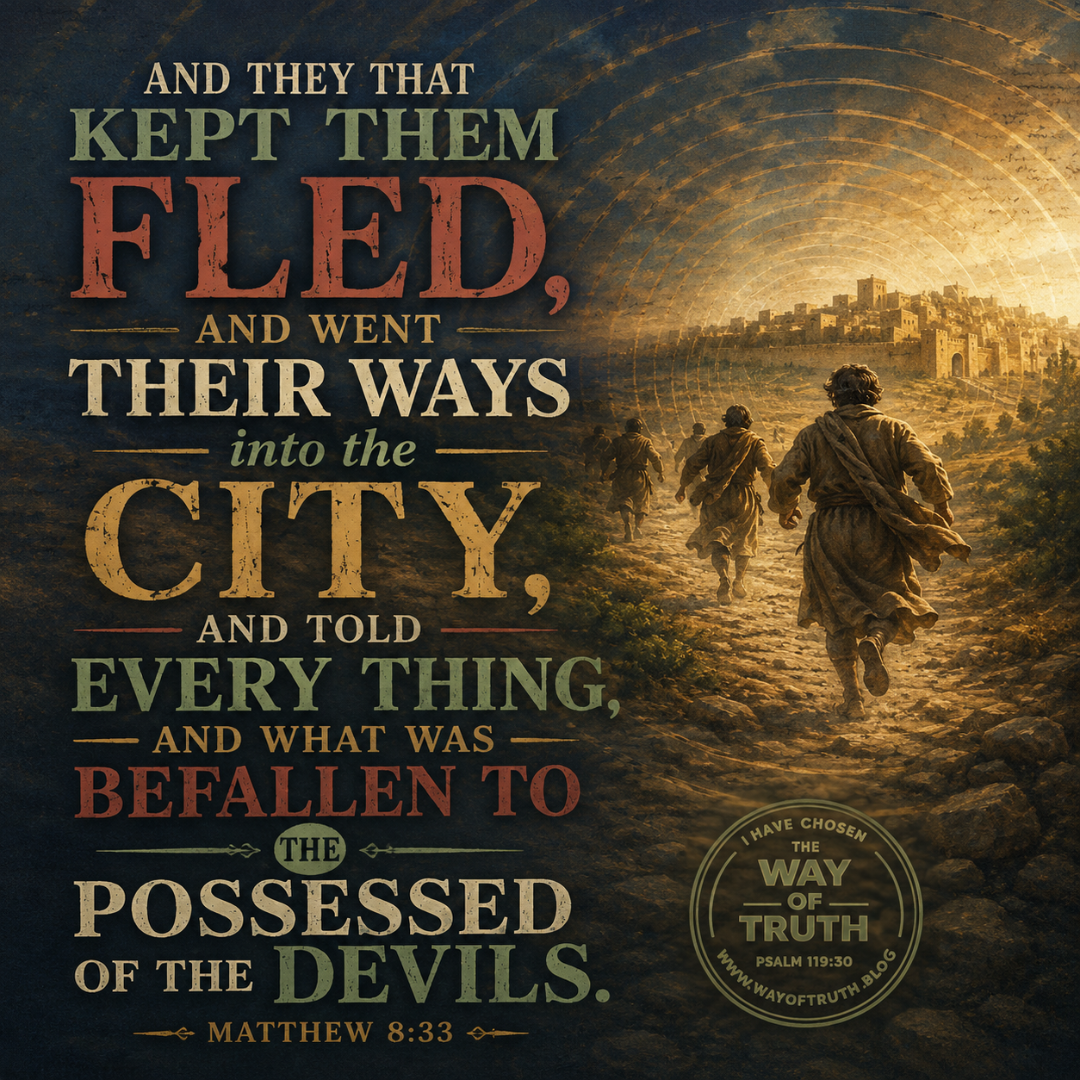
Matthew 8:33 comes immediately after one of the most startling scenes in the earthly ministry of Jesus. The devils had begged for permission to enter the herd of swine, Jesus had spoken one commanding word, “Go,” and the whole herd had rushed violently into the sea and perished in the waters. Now Matthew turns our attention away from the sea and toward the city. The men who kept the swine saw enough to know they couldn’t simply return to business as usual.
“And they that kept them fled.” Their reaction was immediate. They didn’t pause to calculate losses, hold a meeting, gather more evidence, or tidy up the story so it sounded respectable. They ran. And honestly, who could blame them? A herd of swine had just plunged into the sea after Jesus commanded devils to depart from two tormented men.
Yet their flight was more than panic. It became testimony. They “went their ways into the city, and told every thing.” These keepers became the first messengers of what had happened. Matthew doesn’t describe them as disciples. He doesn’t tell us they understood Jesus rightly. He simply says they reported what they saw. The works of Christ don’t remain hidden in private corners. His authority becomes public. His mercy becomes known. His power forces a response.
The phrase “told every thing” suggests that they reported the whole event as they understood it. They told about the herd, certainly, but Matthew adds something important: “and what was befallen to the possessed of the devils.” The loss of the swine wasn’t the whole story. The delivered men were part of the report. The city heard not only that animals had perished, but that men once possessed, violent, and unreachable had been set free.
That detail keeps the verse from becoming merely a story about fear and economic loss. It’s also a story about witness. The people in the city were now accountable to the truth that Christ had come among them with authority over darkness and compassion toward ruined men.
The text doesn’t let the delivered men fade into the background. That’s easy for us to miss because the destruction of the swine is dramatic. A whole herd rushing down a steep place into the sea is the sort of scene that grabs attention. But Matthew makes sure we also see the human mercy in the middle of the disturbance.
These men had previously been described as “exceeding fierce, so that no man might pass by that way” (Matthew 8:28). They were feared, avoided, and likely written off by the surrounding community. People knew the danger they posed, but nobody could deliver them. Their misery had become part of the landscape, like a broken road everyone learned to avoid.
Then Jesus came.
This verse builds on the previous passages by showing the spreading impact of Christ’s authority. In Matthew 8, Jesus has healed a leper, healed the centurion’s servant, healed Peter’s wife’s mother, calmed the storm, and now delivered men possessed with devils. His authority isn’t narrow. Disease obeys Him. Distance doesn’t limit Him. Fever leaves at His touch. Wind and sea submit to His rebuke. Devils must yield to His command. Matthew 8:33 shows that such works can’t stay isolated. What Christ does in one place becomes news in another.
There’s also a quiet warning here. The city will now hear of both loss and mercy. They will hear that property was destroyed, but they will also hear that people were delivered. What will matter most to them? That question hangs over the verse and prepares us for the next one, where the whole city comes out to meet Jesus and asks Him to depart.
The keepers’ report becomes a test for the city. Will they see the delivered men and rejoice? Will they recognize the authority of Christ and bow before Him? Or will they measure the presence of Jesus mainly by the cost He brought to their local economy?
That same question still has teeth. Many people are willing to admire Jesus as long as He doesn’t disturb their priorities. But the real Christ doesn’t come as a harmless decoration for our already-settled lives. He comes as Lord.
The Truthfulness of an Unpolished Report
This verse also carries a simple mark of historical honesty. Matthew doesn’t present the event like a polished legend designed to flatter everyone involved. The witnesses aren’t heroic apostles standing boldly before kings. They’re swine keepers who flee into town. Their report includes an uncomfortable mixture of mercy and loss. The people who hear it don’t respond nobly in the next verse. Nothing about this reads like a carefully sanitized religious tale.
That matters when skeptics treat the Gospel accounts as if they were merely spiritual myths. Matthew gives us earthy details: men, swine, keepers, a city, fear, public report, and a community reaction. The account isn’t vague. It’s rooted in witnessed events. The keepers weren’t asked to interpret the full theological meaning of what happened. They simply told what occurred.
Some modern readers try to explain away demon possession as nothing more than misunderstood mental illness. Christians should speak carefully and compassionately about mental suffering. Not every affliction is demon possession, and careless claims can harm people deeply. But this passage itself doesn’t allow us to reduce the devils to symbols or psychological metaphors. They speak. They recognize Jesus. They beg permission. They enter the herd. The text presents personal evil spirits under the absolute authority of Christ.
At the same time, this passage doesn’t encourage unhealthy obsession with demons. The center isn’t darkness. The center is Christ. The devils aren’t sovereign rivals to God. They’re defeated rebels who can’t act beyond the permission of the Lord Jesus. Matthew doesn’t invite us to fear them as though they were equal powers. He shows us Christ reigning over them.
A different kind of objection concerns the destruction of the swine. Some ask how the event can be morally coherent. That question deserves care, but Matthew 8:33 helps us keep the emphasis where the text places it. The keepers told both what happened to the herd and what happened to the men. The event reveals the destructive nature of evil and the priceless worth of human beings made in the image of God. Christ’s mercy toward the tormented men isn’t a side note. It’s central.
The world often reverses that order. It mourns material loss more deeply than spiritual bondage. It gets upset when Jesus disrupts business but stays strangely calm when souls are ruined. Scripture corrects our scale of value.
When Christ’s Work Becomes Public
The keepers “went their ways into the city.” The miracle moved from the lonely place of the tombs into the public life of the community. That’s often how the works of God operate. Christ saves, delivers, heals, restores, and transforms real people, and then the evidence of His grace becomes hard to ignore.
The Christian faith isn’t built on private imagination. It’s not merely a feeling tucked away inside religious people. The Gospel concerns real sin, real guilt, a real Savior, a real cross, a real resurrection, and real transformed lives. When Jesus changes a person, that change may begin quietly, but it doesn’t remain invisible forever.
The keepers may not have understood the glory of Christ, but they carried news of His power. In that sense, they remind us that truth can be reported even by people who haven’t yet rightly responded to it. A person can speak accurately about Jesus and still not worship Him. A community can hear about His mighty works and still reject His presence. Knowledge is a mercy, but knowledge alone isn’t saving faith.
That’s sobering. The city received a report. They weren’t left ignorant. They heard that something beyond ordinary human power had happened. They heard that men once possessed of devils had experienced a dramatic change. They had enough light to come and consider Christ.
The Bible often shows that hearing truth brings responsibility. “Faith cometh by hearing, and hearing by the word of God” (Romans 10:17). But hearing also exposes the heart. Some hear and believe. Some hear and harden. Some hear and become curious for a moment but unwilling to yield. Matthew 8:33 stands in that tense space between report and response.
This is where the passage presses gently but firmly on us. What do we do when the truth of Christ reaches us? Do we treat it as interesting religious information? Do we talk about it, analyze it, and then move on? Or do we bow before the Lord who has authority over every visible and invisible power?
The Church Must Tell the Whole Story
There’s a needed lesson here for the Church. The keepers “told every thing.” They didn’t report only the part that was easiest to explain. They told what happened to the herd and what happened to the men. In a much greater and clearer way, believers are called to tell the whole truth about Christ.
We must tell of His authority, not merely His kindness. We must tell of His compassion, not merely His judgment. We must tell of sin, but also of grace. We must tell of the cross, but also of the resurrection. We must tell of repentance, faith, forgiveness, new life, and coming judgment. A reduced view of Jesus may feel less offensive, but it can’t faithfully represent the Savior revealed in Scripture. The real Christ, as revealed in the Bible, saves sinners and reigns as Lord.
The Church should also notice whom Jesus valued in this passage. The possessed men had been dangerous. They had frightened the region. They weren’t respectable prospects. No one would have looked at them and said, “There’s a promising ministry opportunity.” Yet Jesus crossed the sea and delivered them. Their condition didn’t repel Him. Their bondage didn’t intimidate Him. Their isolation didn’t make them worthless.
That should shape how we view people. The Church must never measure human worth by usefulness, pleasantness, social polish, productivity, or personal comfort. Some people come with heavy burdens, complicated stories, frightening pasts, or visible scars from sin and suffering. The Lord isn’t confused by such people. He knows exactly what sin has done, what the devil has damaged, and what grace can restore.
This passage also reminds us that faithful witness may disturb settled communities. When Christ works, people may not immediately rejoice. Some may focus on what changed, what was lost, what became uncomfortable, or what can no longer continue. We shouldn’t be surprised when the Gospel unsettles a town, a household, a workplace, or even a church culture that has grown too comfortable with brokenness.
For personal obedience, Matthew 8:33 asks us whether we’re willing to tell what Christ has done. Not with exaggeration. Not with drama for drama’s sake. Not with a spiritual sales pitch. Just tell the truth. Tell what Scripture says. Tell how the Lord saves. Tell how His grace has met you. Tell how His Word has corrected you. Tell how His mercy has held you.
And when we tell it, we must keep people at the center, not programs, numbers, platforms, or appearances. The keepers told what happened to the herd, but also what happened to the men. In our churches, ministries, and daily conversations, we should ask: Are we more concerned about preserving comfort than seeing captives set free? Are we more protective of systems than souls? Are we more bothered by inconvenience than moved by mercy?
Christ is glorified when His people value what He values. He valued the deliverance of tormented men. He valued human souls over local convenience. He valued mercy enough to step into a place others avoided. If we belong to Him, we must learn to walk with that same heart.
A Savior Worth More Than Everything We Fear Losing
The report of Matthew 8:33 points us toward the Gospel because it shows us a world that desperately needs more than management, manners, and temporary peace. The men in the tombs didn’t need a little encouragement and a better routine. They needed deliverance. And while not everyone’s life looks as dramatic as theirs, every sinner needs rescue at the deepest level.
You may read this passage as someone who feels more like an observer than a ruined man in the tombs. You’ve heard about Jesus. You know the stories. You may even find them compelling. But the question isn’t only whether you’ve heard what Christ has done. The question is whether you’ve come to Him personally.
You may read it as someone who knows what bondage feels like. Sin promises freedom, but it doesn’t give freedom. It takes. It hardens. It isolates. It makes a person less whole, not more. The penalty for sin isn’t small, because sin is rebellion against the holy God who made us. “For the wages of sin is death” (Romans 6:23). That’s not meant to frighten us, but it is meant to wake us.
The good news is that Jesus Christ came to save sinners. He didn’t merely command devils beside the sea. He went to the cross, bearing the judgment sinners deserve. He shed His blood as the sacrifice for sin. He died, was buried, and rose again the third day in victory over sin, death, and the devil. The Savior who had authority over darkness also has power to forgive, cleanse, and make new.
Don’t stop at being impressed by Jesus. Don’t merely admire His power from a distance. Come to Him. Turn from sin. Trust Him as Lord and Savior. His mercy isn’t too weak for your guilt. His grace isn’t too thin for your past. His authority isn’t too small for your bondage.
If you’re outside of Christ, the invitation is gracious and real: repent and believe the Gospel. The Lord Jesus receives sinners who come to Him in faith. In Him there is forgiveness, new life, peace with God, and eternal salvation. Trust the Savior who commands darkness, delivers the captive, and is worthy of your whole life.
Reflection and Response
- When I hear or read of Christ’s mighty works, do I respond with worship and obedience, or do I keep Him at a safe distance?
- Are there people I’ve quietly written off as too broken, difficult, or far gone for the mercy of Christ?
- What “loss” or disruption am I most tempted to fear if Jesus takes full authority over an area of my life?
- Am I telling the whole truth about Christ: His mercy, His authority, His cross, His resurrection, and His call to repentance and faith?
- How can my church, family, or daily witness better reflect the value Jesus places on souls?