
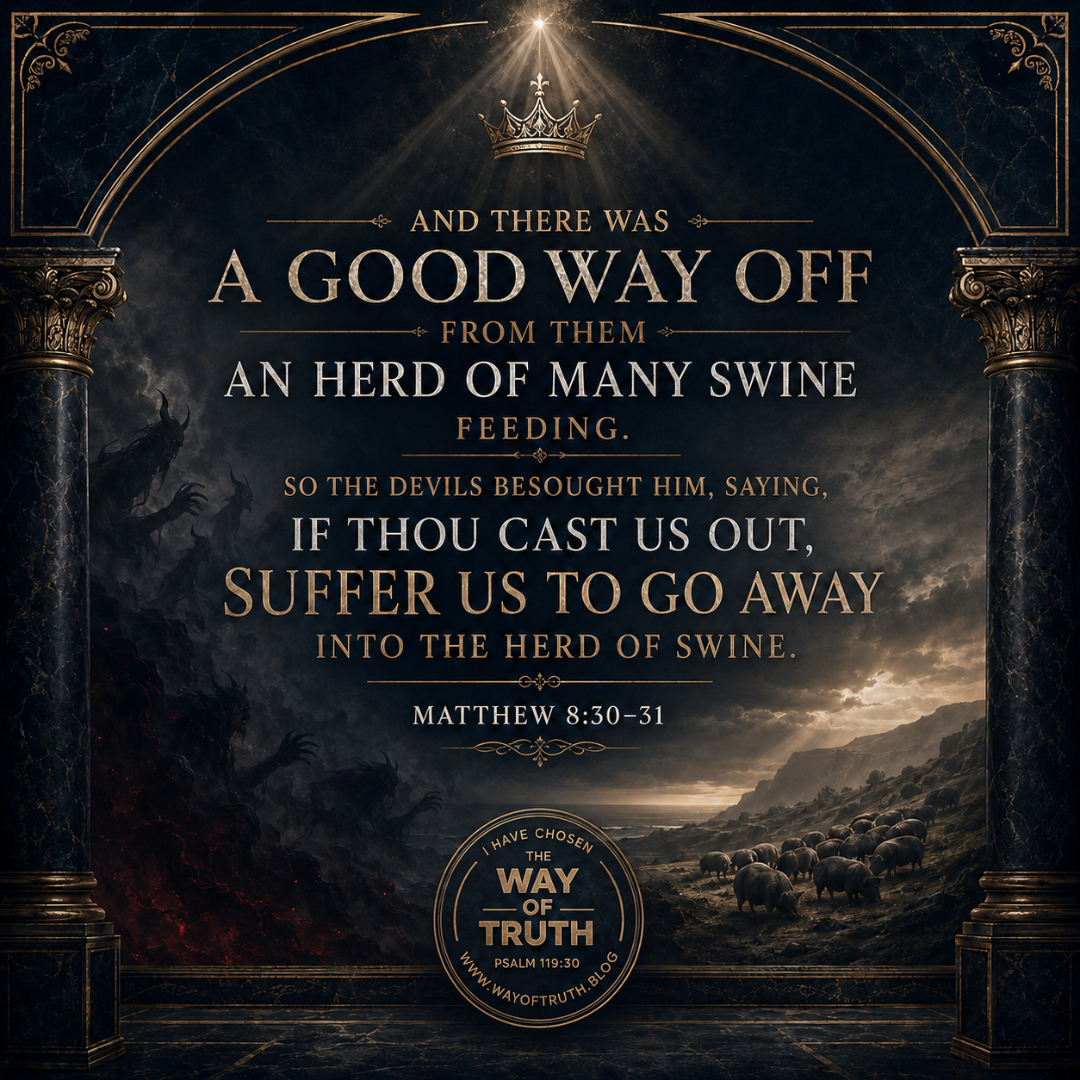
Matthew 8:30–31 may seem like a small transition in the larger account of Jesus casting out devils from the two men in the country of the Gergesenes. At first glance, the verses simply tell us there was a herd of swine nearby, and the devils asked Jesus to send them into the animals. But the details matter. Scripture doesn’t waste words, and this brief exchange reveals the helplessness of evil before Christ’s authority.
The scene has already moved from the storm-tossed sea to the demon-haunted shore. In Matthew 8:23–27, Jesus rebuked the winds and sea, and “there was a great calm.” Then, in Matthew 8:28–29, two men possessed with devils met Him, and the devils cried out, recognizing Him as “Jesus, thou Son of God.” The disciples had asked, “What manner of man is this?” The devils knew the answer, though they didn’t respond with faith, love, or worship.
Now the passage builds on that truth. The One who commands creation also commands the unseen realm. The devils don’t threaten or overpower Jesus. They don’t negotiate as equals. They beg.
That’s a sobering and comforting word.
Matthew tells us, “there was a good way off from them an herd of many swine feeding.” The swine weren’t right beside the men, but at some distance. The picture is almost strange in its ordinariness. On one side, two tormented men have become a terror to the region. On the other, a herd of swine is simply feeding. Life looks normal until Christ exposes what’s been ruling the place.
That’s often how darkness works. It may rage violently in some places and remain hidden in others. It may destroy lives while the world keeps grazing along, so to speak, pretending everything’s fine. Yet when Jesus arrives, nothing remains hidden. His presence brings the real issue into the light.
“The Devils Besought Him”
Matthew says, “So the devils besought him.” That word carries the idea of pleading or begging. The devils aren’t shown as bold rebels standing firmly before Jesus. They’re terrified creatures under authority. They’ve already asked, “art thou come hither to torment us before the time?” Now they ask permission.
This is important because Scripture never presents Satan or demons as equal opposites to God. Christianity isn’t a dualistic religion where good and evil are two eternal powers locked in a fight. The devil, evil, and demonic oppression are real, but none of it is sovereign. God alone is eternal, uncreated, almighty, and holy.
The devils’ request exposes their limits. They can’t even enter a herd of swine without Christ’s allowance. That should reshape how believers think about spiritual conflict. We shouldn’t be foolish, flippant, or careless about evil. Scripture calls us to sobriety, watchfulness, prayer, and resistance. But we also shouldn’t live as though the devil has the final word. He doesn’t. He never has.
The devils say, “If thou cast us out.” The “if” doesn’t suggest they doubt Jesus’ power. They know He can cast them out. The question is what He’ll command and where He’ll permit them to go. Their words are filled with dread because they know His authority is absolute.
They then ask, “suffer us to go away into the herd of swine.” In plain terms, “Permit us.” That’s the heart of the passage. Darkness must ask permission.
This doesn’t mean we can answer every question about why God permits evil for a season. Scripture doesn’t give us a tidy explanation for every painful event. And honestly, some attempts to explain suffering too neatly can sound more like dismissiveness than shepherding. The Bible gives us something better than a simplistic answer: it gives us the sovereign Christ. Evil may be permitted for a time, but it’s never free from divine rule, never outside divine knowledge, and never beyond divine judgment.
The Unclean Spirits and the Unclean Herd
The mention of swine isn’t accidental. Under the law of Moses, swine were unclean animals. Leviticus 11:7 says, “And the swine, though he divide the hoof, and be clovenfooted, yet he cheweth not the cud; he is unclean to you.” Matthew doesn’t pause to explain why a herd of swine was there. The region appears to have had a Gentile or mixed setting, and the presence of the swine reminds the reader that Jesus has crossed into territory where uncleanness is everywhere: unclean spirits, unclean animals, tombs nearby, and men cut off from ordinary life.
Yet uncleanness doesn’t frighten Christ. He doesn’t avoid the place or keep a safe religious distance. He steps into the region and confronts the bondage directly.
That is part of Matthew’s larger portrait of Jesus. In Matthew 8, Christ cleanses a leper, heals a Gentile centurion’s servant, restores Peter’s wife’s mother, calms a storm, and now confronts demonic oppression. He’s not defiled by what He touches. He makes clean what sin, sickness, fear, and darkness have ruined.
This points us forward to the cross. Jesus didn’t save sinners by standing far away from our uncleanness. He came into this fallen world, took upon Himself true humanity, lived without sin, and bore the judgment His people deserved. As 1 Peter 2:24 says, “Who his own self bare our sins in his own body on the tree.” The Holy One entered the place of curse, not because He was overcome by it, but because He came to redeem.
Answering Honest Questions and Distortions
Some readers stumble over this passage because of the demons. Modern people often try to explain away demonic activity as a primitive misunderstanding of mental illness. We should be careful here. Scripture doesn’t teach that every form of suffering, illness, distress, or unusual behavior is demonic. The Bible distinguishes between sickness and demon possession. We should never use this passage as an excuse to treat hurting people harshly or superstitiously.
At the same time, we shouldn’t flatten the text into something Matthew didn’t say. Matthew presents these devils as personal, speaking, aware, fearful, and subject to Christ. The passage isn’t merely describing inner turmoil or social alienation. It’s describing real spiritual bondage and the greater authority of Jesus over it.
Others may object to the differences between Matthew’s account and the parallel accounts in Mark and Luke, where one man is emphasized. But this isn’t a real contradiction. Matthew tells us there were two men. Mark and Luke focus especially on one, likely the more prominent spokesman or the one whose restoration is followed in greater detail. Saying one man was central to the account doesn’t deny that another was present. If two people are in a room and one does the talking, it’s perfectly normal to tell the story by focusing on the speaker.
Another distortion would be to treat this passage as though it gives believers a formula for controlling the spiritual realm. It doesn’t. The point isn’t that we learn to command demons by our own power. The point is that Jesus reigns. Spiritual confidence doesn’t come from technique, volume, emotional intensity, or religious bravado. It comes from belonging to Christ.
There’s also a moral question some readers raise: why would Jesus permit the devils to enter the swine? The next verse shows the herd rushing violently into the sea. The text doesn’t tell us every reason Christ allowed this, so we shouldn’t pretend to know more than Scripture reveals. Yet the passage does show at least this: the destructive nature of the devils is exposed, the men are delivered, and the value of human souls is shown to be greater than material loss. That last point will become painfully clear when the people of the city later ask Jesus to leave. They seem more troubled by the loss of swine than by the bondage of men.
That’s uncomfortably modern. We still live in a world that can value profit over people, comfort over deliverance, and normalcy over truth.
When Christ’s Authority Becomes Our Comfort
This passage gives the Church a deeply practical comfort: evil isn’t ultimate. The devils begged Jesus. They didn’t command Him. They didn’t outmaneuver Him. They didn’t surprise Him. They needed permission.
That truth should steady believers when the world feels spiritually dark. We may look around and see confusion, cruelty, addiction, false teaching, broken homes, rising hostility toward truth, and deep wounds in people made in the image of God. Some days it can feel like darkness is running the table. But Matthew 8:30–31 reminds us that darkness isn’t on the throne. Christ is.
This doesn’t make us passive. It makes us faithful.
Because Christ reigns, we pray with confidence. We don’t pray as people trying to pry mercy out of a reluctant Savior. We pray to the Lord who crossed the sea, entered the troubled region, and delivered men no one else could help. We bring Him the names, burdens, fears, and battles that feel beyond human repair. We don’t need to pretend we have control. We need to come to the One who does.
Because Christ reigns, we worship with reverence. A shallow view of Jesus produces shallow worship. If He’s merely a teacher, example, or religious inspiration, then worship becomes a mood. But if He’s the Son of God before whom devils tremble, then worship becomes holy, grateful, and serious. Not gloomy, but serious in the best sense. We’re not singing to a vague spiritual idea. We’re worshipping the King.
Because Christ reigns, we resist sin with hope. Sin often lies to us by acting stronger than it is. It says, “You’ll never change. This habit owns you. This fear defines you. This bitterness is just who you are now.” But sin is a liar, and the devil is a liar. The believer doesn’t fight for victory in his own strength, but from the safety of belonging to Christ. Romans 6:14 says, “For sin shall not have dominion over you: for ye are not under the law, but under grace.” That doesn’t mean obedience is effortless. It means bondage isn’t our master.
Because Christ reigns, the Church must care about deliverance more than comfort. The men in this passage had become isolated, feared, and written off. Nobody was strolling through that area saying, “Lovely neighborhood, just mind the demon-possessed men by the tombs.” People avoided them. Jesus didn’t. He came to the place others couldn’t pass.
That should shape our mission. The Church shouldn’t be known for avoiding broken people. We must be wise, yes. We should not romanticize danger or pretend every situation is simple. But we must never forget that Christ sends His people into a world full of spiritual need. Some people are trapped in visible sin. Others are trapped in private despair. Some are hardened. Some are ashamed. Some are angry because they’re wounded. Some are so used to chains that freedom sounds frightening.
The answer isn’t human cleverness. The answer is Christ proclaimed, trusted, obeyed, and displayed through humble, patient love.
This passage also reminds us to value people rightly. The devils asked to enter swine. The men needed deliverance. Soon the region will have to decide what matters more: rescued souls or lost property. That same test comes to us in quieter forms. Do we care more about smooth church routines than wounded people? More about being right than being redemptive? More about our preferences than the mission of the gospel? More about keeping things tidy than seeing captives set free?
Christ’s authority should make us both brave and tender. Brave, because darkness must bow to Him. Tender, because the people trapped in darkness aren’t our enemies. They’re souls in need of mercy.
And personally, this passage calls us to humility. The devils had accurate theology in one sense. They knew Jesus was the Son of God. But they had no repentance, no love, no surrender, no worship. That’s a warning. It’s possible to know true things and remain unchanged. It’s possible to speak religious language and still resist the Lord. Real faith does more than recognize Christ’s authority. Real faith bows before Him, trusts Him, and follows Him.
So don’t settle for being impressed by Jesus. Come to Him. Trust Him. Obey Him. Worship Him. The One whom darkness must ask permission from is the same Savior who welcomes sinners and restores ruined lives.
The Savior Who Frees What Sin Has Bound
There’s an invitation in this passage, even though the scene itself is intense. The devils are afraid of Jesus, but sinners are invited to come to Him. That difference matters. Darkness trembles because Christ is Judge. The repentant sinner may come because Christ is Savior.
The men in this account couldn’t free themselves. Their condition was beyond human help. People could avoid them, fear them, talk about them, and keep their distance from them, but they couldn’t restore them. Then Jesus came.
That’s what every sinner needs.
Our deepest problem isn’t merely that we’ve made mistakes, lost our way, or failed to become the best version of ourselves. Our deepest problem is sin against a holy God. Romans 3:23 says, “For all have sinned, and come short of the glory of God.” Sin brings guilt, corruption, separation from God, and judgment. Romans 6:23 says, “For the wages of sin is death.” That’s not pleasant to hear, but it’s merciful for God to tell us the truth.
The good news is that Jesus Christ came to save sinners. He’s not merely stronger than demons; He’s the Redeemer who went to the cross. He lived the sinless life we haven’t lived. He died in the place of sinners, bearing the judgment they deserved. He rose again in victory over sin, death, and the devil. As 1 Corinthians 15:3–4 says, “Christ died for our sins according to the scriptures; And that he was buried, and that he rose again the third day according to the scriptures.”
The passage before us shows that evil must yield to Christ’s command. The gospel shows something even more wonderful: guilt can be forgiven by Christ’s blood, hearts can be made new by His grace, and sinners can be brought into peace with God.
Maybe you feel too unclean to come to Him. Come anyway. He’s not defiled by your sin. He cleanses sinners. Maybe you feel too bound, too ashamed, too far gone, or too spiritually confused. You’re not beyond His reach. The men in Matthew 8 weren’t beyond Him, and neither are you.
The call of the gospel isn’t to fix yourself first and then approach Jesus. The call is to repent and believe on Him. Turn from sin and self-rule. Trust Christ as Lord and Savior. Rest your hope not in your works, your feelings, your church background, or your ability to improve, but in His finished work.
The Savior before whom devils begged is also the Savior who says, “Come unto me, all ye that labour and are heavy laden, and I will give you rest” (Matthew 11:28). Come to Him in faith. Receive His mercy. Follow Him in newness of life. Live for His glory, because there’s no kinder Master and no greater King.
Reflection and Response
- Where do I need to remember that darkness isn’t sovereign, and that Christ still rules with absolute authority?
- Am I treating spiritual conflict with either careless denial or unhealthy fear, instead of sober confidence in the Lord Jesus?
- Are there people I’ve quietly written off whom Christ may be calling me to love, pray for, and point toward the gospel?
- Do I value comfort, routine, or material security more than seeing lives restored by the grace of Christ?
- Is my knowledge of Jesus leading me to worship, obedience, repentance, and faith, or have I settled for merely knowing true things about Him?