
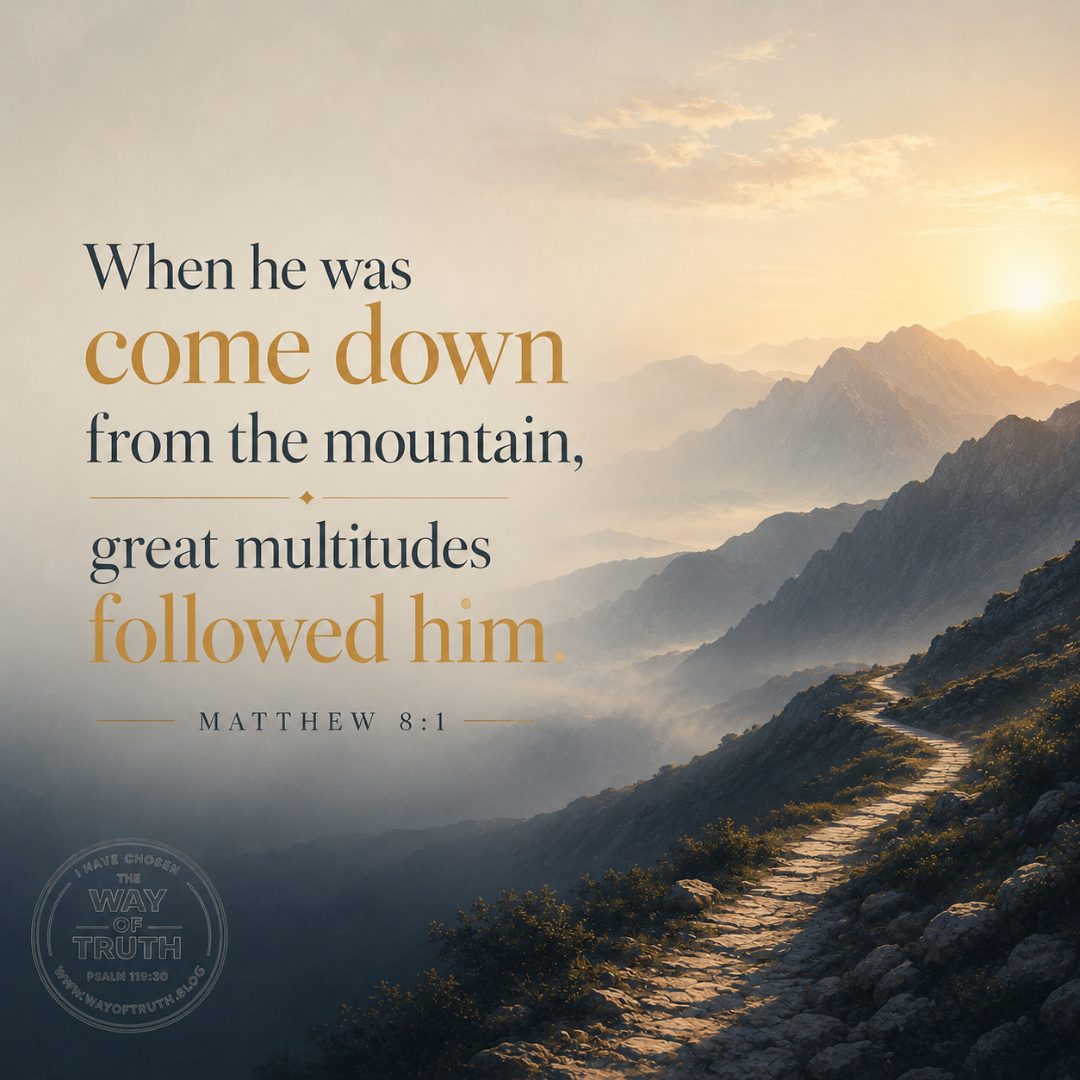
Matthew 8:1 is a short verse, but it stands at an important doorway in Matthew’s Gospel. Jesus has just finished the Sermon on the Mount. The people were astonished because “he taught them as one having authority, and not as the scribes” (Matthew 7:29). Now Matthew tells us, “When he was come down from the mountain, great multitudes followed him.”
Jesus doesn’t remain on the mountain as a distant teacher admired from below. He comes down. The One who has declared the kingdom now walks among the needy, the diseased, the outcast, and the burdened. Matthew 5–7 shows the authority of Christ’s words. Matthew 8 begins to show the authority of Christ’s works. The same Lord who taught with divine authority will now cleanse the leper, heal the servant, restore the fevered, cast out devils, and calm the sea.
The mountain setting naturally reminds us of Moses, who came down from Mount Sinai after receiving the law. But Jesus is greater than Moses. Moses received the law from God; Jesus speaks as the divine King. Moses came down bearing commandments written on tables of stone; Jesus comes down embodying the grace and truth of God. He hasn’t abolished righteousness. He has fulfilled and deepened its true meaning. And now, as He descends, the crowd follows Him.
The “great multitudes” are important, but we should notice what Matthew does and doesn’t say. He doesn’t say they all believed savingly. He doesn’t say they all repented. He doesn’t say they all understood who Jesus truly was. They followed Him, but the Gospel will later show that crowds can be amazed without being converted, impressed without being surrendered, and near Jesus outwardly while still far from Him inwardly.
That’s a sobering distinction. Following Jesus physically isn’t the same as trusting Him spiritually. Being part of the crowd isn’t the same as becoming His disciple. Many people were drawn to His authority, His miracles, His compassion, and His power. But true discipleship requires more than interest. The Sermon has already made that clear. The narrow way, the good tree, the solid foundation, and the doing of Christ’s words all press the same truth upon us: Christ must not merely be admired. He must be received, trusted, obeyed, and worshiped.
There’s also a subtle defense of the reliability of Scripture here. Matthew’s account doesn’t read like myth or religious theatre. It moves naturally from teaching to public response, from a mountainside setting to travel, from crowds to individual encounters. The Gospel writer isn’t crafting vague spiritual symbolism detached from history. He presents Jesus acting in real places, among real people, with public consequences. Christianity isn’t built on private visions hidden from scrutiny. It’s grounded in God’s work in history through His Son.
Some skeptical readers may dismiss the crowds as exaggerated religious enthusiasm. Others may reduce Jesus to a moral teacher whose influence spread because He said inspiring things. But Matthew won’t allow that smaller view. Jesus’ authority isn’t merely rhetorical. He doesn’t only speak beautifully; He rules over uncleanness, sickness, demons, nature, sin, and death. Matthew 8:1 is the first step down the mountain toward that fuller demonstration.
Cultic and heretical distortions often try to make Jesus less than Scripture presents Him to be: a created being, a prophet only, a moral reformer, or one spiritual master among many. But Matthew has already revealed Him as the King who declares the law’s true meaning, speaks with unmatched authority, and calls all men to build their lives upon His words. This verse places the reader in motion with Him. The question isn’t simply, “Will the crowd follow?” The deeper question is, “Will I follow Him as Lord?”
Following Christ Beyond Astonishment
Matthew 8:1 invites us to examine what kind of follower we are. The crowd followed Jesus down the mountain. That was good as far as it went. Better to follow Him than ignore Him. Better to be drawn by His words than hardened against them. Better to move toward the light than settle comfortably in darkness. But Scripture presses us further. Why are we following Him?
Some follow Jesus because they admire His ethics. They like the Sermon on the Mount as a moral vision: love your enemies, do good, avoid hypocrisy, forgive, pray, give, seek first the kingdom. And yes, His teaching is beautiful. But if we stop at admiration, we’ve missed the point. Jesus didn’t preach to win compliments. He preached as King. His words aren’t decorative quotes for coffee mugs, though some of them do look nice there. His words are life, authority, judgment, mercy, and command.
Others follow because they hope Jesus will improve their lives. They want peace, healing, stability, family restoration, or relief from trouble. Those aren’t wrong desires. Many came to Jesus in desperate need, and He was full of compassion. But Christ isn’t a tool for building our preferred version of life. He is Lord. He may heal, restore, provide, and comfort, but He also corrects, commands, exposes, and leads us where we wouldn’t naturally choose to go.
For believers, this verse calls us to keep walking with Christ after the sermon ends. It’s one thing to be stirred by the Word on Sunday. It’s another thing to follow Jesus down the mountain into Monday morning. The true test of hearing isn’t whether we felt moved in the moment, but whether we continue with Him in ordinary obedience.
That means Christ’s authority must come with us into our private thoughts, homes, workplaces, churches, conversations, habits, conflicts, and decisions. We can’t leave His words on the mountain. We follow the Speaker. The Lord who says, “Judge not,” also searches our harshness. The Lord who says, “Seek ye first the kingdom of God,” also confronts our worry and divided priorities. The Lord who warns about the broad way also calls us to examine whether we’re drifting with the crowd or walking with Him.
This has a direct application to the Church. A healthy church isn’t merely a gathering of people impressed by Jesus. It’s a people who follow Him together. We hear His Word together. We submit to His authority together. We confess our sins, encourage the weak, carry burdens, proclaim the gospel, and worship Him as Lord. The Church isn’t meant to be a crowd hovering around religious excitement. It’s a redeemed people walking behind the King.
Matthew 8:1 also encourages humility. The “great multitudes” remind us that Jesus drew all kinds of people. Some were needy. Some were curious. Some were hurting. Some were confused. Some likely had mixed motives. That sounds uncomfortably familiar, doesn’t it? We often come to Christ with needs we can barely explain and motives that need refining. Yet He’s gracious. He doesn’t despise the needy who come near. He teaches, receives, cleanses, heals, and saves.
But His compassion shouldn’t make us casual. The same Christ who came down from the mountain is the One whose words must be obeyed. We glorify God by following His Son not only when obedience feels inspiring, but when it feels costly. We glorify Him when we forgive instead of nursing bitterness, pray instead of performing righteousness for attention, tell the truth instead of managing appearances, and trust Him instead of building on sand.
This verse also calls us to gospel witness. Great multitudes followed Jesus, but multitudes still need to hear who He is. Many people today admire Jesus at a distance. They like selected sayings. They respect His compassion. They may even speak warmly of Him. But they don’t yet know Him as Savior and Lord. Believers have the privilege and responsibility of pointing them beyond admiration to repentance and faith. We can lovingly say, “Come and see the Christ who doesn’t merely teach truth, but is the truth. Come to the King who came down in mercy, went to the cross for sinners, and rose again in victory.”
So, let’s not be content with being near the crowd. Let’s follow Christ personally, humbly, obediently, and openly. Let’s walk with Him down the mountain, into the needs of the world, under the authority of His Word, and for the glory of God.
The Savior Who Came Down to Save
Maybe you respect Jesus. Maybe you admire His teaching. Maybe, like the multitudes in Matthew 8:1, you’re drawn to Him in some way. That’s no small thing. But the Bible lovingly calls you to more than interest. It calls you to come to Christ Himself.
The truth is that every one of us has sinned against God. We haven’t loved Him with all our heart. We haven’t obeyed Him as we should. We’ve broken His commandments in thought, word, desire, and action. Sin isn’t just a mistake or a weakness. It’s rebellion against the holy God who made us. And because God is righteous, sin brings judgment. “For the wages of sin is death” (Romans 6:23).
But Matthew 8:1 points us toward the mercy of Christ. Jesus came down from the mountain to move among broken people. Even more wonderfully, the Son of God came down from heaven to save sinners. He didn’t remain distant from our misery. He took on human flesh, lived without sin, fulfilled all righteousness, and went willingly to the cross. There He bore the penalty sinners deserve. He died, was buried, and rose again the third day, victorious over sin and death.
The same Jesus who taught with authority also has authority to forgive. The same Jesus who cleansed lepers and healed the sick can cleanse the soul from sin. You can’t save yourself by religious effort, good intentions, church attendance, moral improvement, or being part of the crowd. Salvation is found in Christ alone.
The call of the gospel is plain: repent and believe on the Lord Jesus Christ. Turn from sin and self-rule. Trust in Him, not in your own goodness. Receive Him as Savior and Lord. God promises forgiveness, new life, and eternal salvation to all who come to Christ in faith.
Don’t settle for admiring Jesus from a distance. Come to Him. Follow Him. Trust Him. He’s gracious, mighty to save, and worthy of your whole life. And if you already know Him, live today for His glory with renewed gratitude that the King came down to redeem sinners like us.
Reflection and Response
- Am I merely impressed by Jesus’ teaching, or am I actively submitting to Him as Lord?
- Where do I need to follow Christ “down the mountain” into ordinary obedience?
- How can my life better show that Christ’s Word governs my thoughts, choices, relationships, and worship?
- In what ways can I help my church become less like a religious crowd and more like a faithful people following the King together?
- Who in my life admires Jesus from a distance, and how can I lovingly point that person to the gospel of salvation in Him?
Amen, dear brother for this article and the rest!
Pstr. Bugtong
Thank you, Pastor Bugtong! I truly appreciate it. God bless you!
[…] builds naturally upon Matthew 8:1. Jesus had come down from the mountain and great multitudes followed Him. Now Matthew shows what […]