
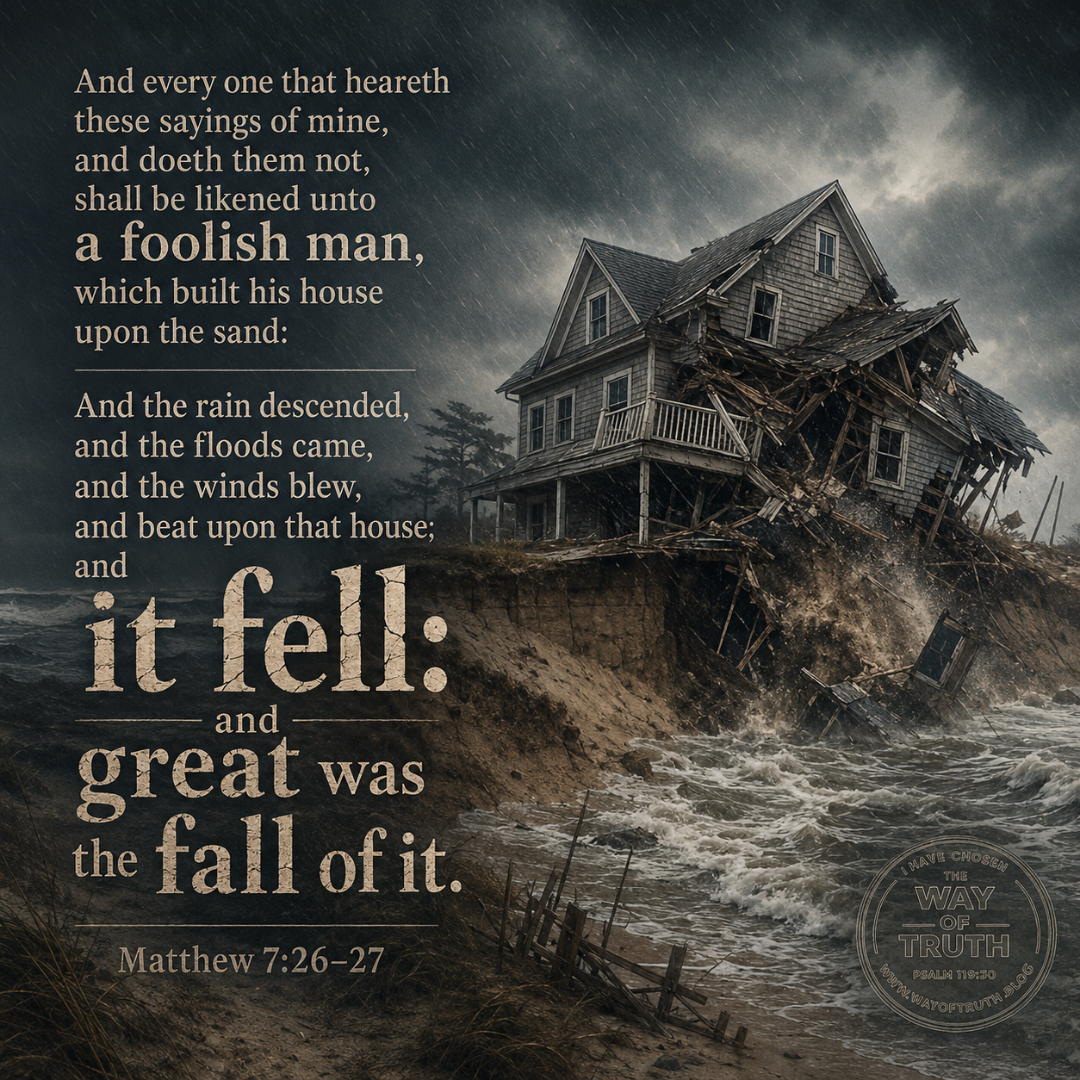
Matthew 7:26–27 brings the Sermon on the Mount to its final warning. Jesus has already described the wise man in verses 24–25 as the one who hears His sayings and does them. Now He turns to the opposite case: “every one that heareth these sayings of mine, and doeth them not.”
The foolish man isn’t someone who never heard. He’s not someone completely untouched by truth. He hears the same words the wise man hears. He’s exposed to the teaching of Christ. He may admire it. He may even agree with parts of it. But he doesn’t obey it. The difference between the two builders isn’t access to information, religious vocabulary, or outward familiarity with Jesus’ words. The difference is submission.
This builds directly on the previous warning in Matthew 7:21–23. There Jesus warned that not everyone who says, “Lord, Lord,” will enter the kingdom of heaven, but “he that doeth the will of my Father which is in heaven.” In verses 24–27, Jesus gives a picture of that same truth. A profession without obedience is like a house without a foundation. It may stand for a while. It may look impressive from the outside. It may survive fair weather. But when the storm comes, the truth of the foundation is exposed.
The “sand” represents instability. It’s not that the foolish man built nothing. He built a house. He made an investment. He put effort into something. But he built on the wrong foundation. Spiritually, this is the danger of building life on religious appearance, personal morality, emotional experiences, cultural Christianity, family tradition, good intentions, church attendance, or vague admiration for Jesus while refusing to surrender to Him as Lord.
The storm imagery is sobering. “The rain descended, and the floods came, and the winds blew.” Jesus repeats the same storm language used of the wise man’s house. Both houses are tested. The life built on obedience to Christ isn’t storm-free, but it is storm-secure. A life built on hearing without obeying may appear safe until pressure reveals its weakness.
This passage also guards us against a common distortion of Christianity. Some reduce faith to mere outward activity, as though obedience earns salvation. That’s not what Jesus teaches. The Sermon on the Mount repeatedly exposes the heart. True obedience flows from a heart humbled before God, dependent on grace, and submitted to Christ. At the same time, others distort grace into permission to ignore Christ’s commands. This passage gives no comfort to that idea. The Lord who saves is also the Lord who must be obeyed.
Skeptics may object that Jesus’ warning is too severe. “Great was the fall of it” sounds final and frightening because it is. But severity isn’t cruelty when danger is real. A bridge inspector who warns that a bridge is unsound isn’t being unkind. A doctor who names a deadly disease isn’t being harsh. Christ tells the truth because He’s merciful. He doesn’t flatter unstable foundations. He exposes them before the final storm arrives.
No ancient wisdom teacher, religious founder, or moral philosopher speaks with this authority. Jesus doesn’t merely say, “Follow wise principles.” He says that the destiny of a person’s life depends on how he responds to “these sayings of mine.” Scripture presents Christ not as one voice among many, but as the final and rightful Lord. His words carry divine authority, and to hear them without obeying them isn’t harmless indecision. It’s folly.
Building Before the Storm
This passage presses us to ask a very practical question: What are we building on?
Not what do we claim to believe when life is calm. Not what do we post, sing, quote, or defend in conversation. Not even what do others assume about us. The question is deeper: Are we hearing Christ’s words and doing them?
That question isn’t meant to drive sincere believers into panic. Jesus isn’t calling His people to a life of nervous spiritual self-measurement, where every weakness becomes proof that we’re lost. The wise man in the previous verses isn’t sinlessly perfect. He’s obedient in direction, not flawless in performance. He hears Christ, trusts Christ, follows Christ, repents when he fails, and keeps returning to the Lord’s words as the true foundation.
But this warning should disturb comfortable hypocrisy. It should unsettle a faith that listens but never changes, agrees but never submits, admires Christ but quietly negotiates with sin. There’s a kind of hearing that leaves the soul untouched. A person can sit under sermons for years and still build on sand if the Word never moves from the ear to the heart, from the heart to the will, and from the will to the life.
That has direct application to personal devotion. Bible reading isn’t meant to be spiritual decoration. The Word of God is meant to govern us. When Christ teaches us to forgive, we can’t keep nursing bitterness and call it discernment. When He teaches purity, we can’t keep secret sin and call it weakness. When He teaches trust, we can’t enthrone anxiety as though worry were a responsible life strategy. Worry often feels productive, but it’s never paid a bill, healed a body, or strengthened a soul. It just rearranges the furniture in a house already shaking.
This passage also speaks to the worship and unity of the Church. A congregation must not build on personality, entertainment, tradition, politics, programs, or numbers. Those things may draw attention, but they can’t bear the weight of eternity. The Church is safest when it’s built on Christ’s Word, centered on Christ’s gospel, and shaped by obedience to Christ’s commands. A church may appear outwardly successful and still be structurally unsound if it’s unwilling to submit to Scripture.
For believers, this means humility. None of us has outgrown the need to hear and obey. The older saint, the new convert, the pastor, the parent, the worker, the student, the exhausted caregiver, and the person quietly fighting temptation all need the same foundation. Christ’s words aren’t optional upgrades for advanced disciples. They’re the ground beneath the whole life of faith.
This warning should also stir our mission. If Christ speaks of a “great” fall, then we can’t treat the lost casually. People around us are building lives every day: careers, families, reputations, retirement plans, online identities, moral philosophies, and private hopes. Some of those houses look strong. Some are beautifully decorated. But if they’re not built on Christ, they can’t stand before God.
That shouldn’t make us proud. It should make us compassionate. We don’t proclaim the gospel as people who figured out construction better than everyone else. We proclaim it as those who were rescued from sand and given a Rock. We bear witness because Christ is worthy, because God is glorified when sinners are saved, and because love warns before the storm.
A believer who takes this passage seriously will pray something like this: “Lord, don’t let me be merely a hearer. Show me where I’ve admired Your truth without obeying it. Teach me to build my thoughts, habits, relationships, work, worship, and witness on Your Word.” That’s not a prayer of despair. It’s a prayer of grace-trained wisdom.
The storm will come. Trials come in this life. Death will come unless Christ returns first. Judgment will come. The issue isn’t whether the house will be tested. The issue is whether it’s been built on the words of the King.
The Savior Still Calls the Foolish Builder
Maybe as you read this, you recognize something painful. You’ve heard Christ’s words before, but you haven’t truly submitted to Him. Perhaps you’ve known the language of Christianity, respected the Bible, attended church, or tried to live decently, but deep down you know your life has been built on something other than Christ. The kindness of God is that you’re hearing this warning now, not after the fall.
Jesus’ words are serious because sin is serious. We’ve all sinned against God. We’ve loved ourselves more than our Creator. We’ve broken His commandments in thought, desire, word, and action. The penalty for sin isn’t merely a difficult life or a guilty conscience. Scripture warns of judgment and eternal separation from God. A house built on sand may stand for a season, but it can’t stand before the holy God.
But the same Christ who warns sinners also saves sinners. Jesus didn’t come merely to give moral instruction. He came to redeem. He lived in perfect obedience to the Father. He fulfilled the righteousness we’ve failed to live. He died on the cross as the sacrifice for sin, bearing the judgment sinners deserve. He rose again from the dead, victorious over sin, death, and the grave.
That means forgiveness isn’t found in trying harder to reinforce a sandy foundation. It’s found in coming to Christ Himself. You can’t repair your soul with better intentions. You can’t save yourself with religious effort. You need the Savior.
The call of the gospel is simple and searching: repent and believe on the Lord Jesus Christ. Turn from sin. Stop trusting your goodness, your record, your sincerity, your religious background, or your ability to manage life on your own. Trust Christ. Receive Him as Savior and Lord. He gives forgiveness, new life, reconciliation with God, and eternal salvation to all who come to Him in faith.
And if you do come, you won’t find Him reluctant. The One who warns of the falling house is the same One who welcomes sinners to build on the Rock. Come to Christ. Trust Him. Follow Him. Live for His glory. The storm is real, but His grace is greater, His foundation is sure, and His mercy is still offered today.
Reflection and Response
- Where am I most tempted to hear Christ’s words without actually obeying them?
- What part of my life may look stable outwardly but isn’t truly built on submission to Christ?
- How can I help strengthen my family, church, or community by encouraging obedience to Scripture rather than mere religious appearance?
- How does this passage move me to glorify God through a more serious, humble, and obedient faith?
- Who in my life needs to hear the gospel warning and invitation with both truth and compassion?