
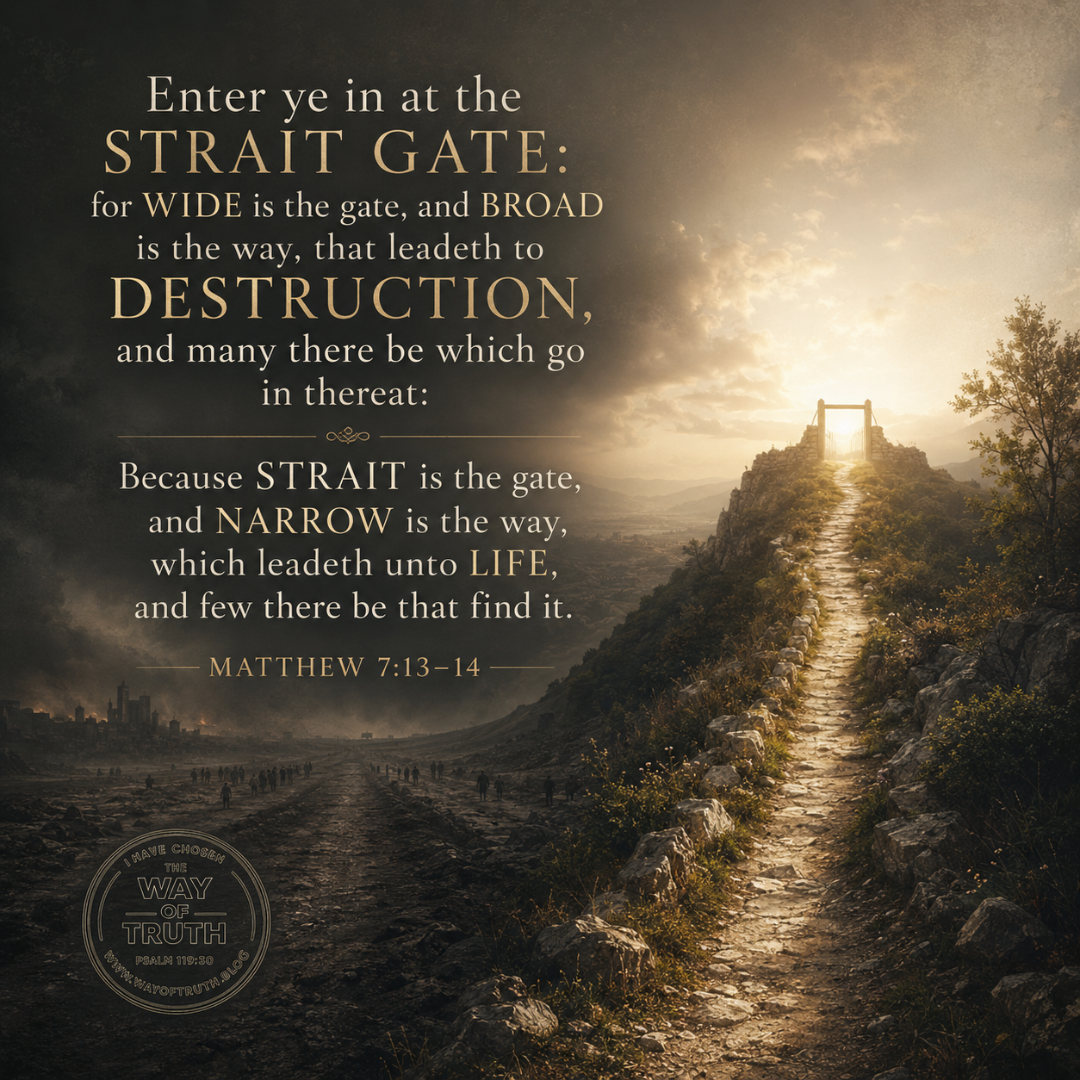
This passage is personal, direct, and urgent. The word strait carries the idea of restriction, difficulty, and narrowness. Jesus isn’t saying the gate is hidden because God is unwilling to save. He’s saying the gate is narrow because the way of life is found only on God’s terms, not ours.
This follows naturally from everything Jesus has been teaching in the Sermon on the Mount. He has exposed shallow religion, self-righteousness, lust, anger, hypocrisy, materialism, anxiety, judgmental pride, and prayerless self-dependence. He has shown that true righteousness isn’t merely outward performance but a heart brought under the rule of God. Now He presses the listener to make a decision.
There’s a kind of hearing that never becomes entering. A person may admire Jesus’ ethics, appreciate His wisdom, quote the Golden Rule, and still remain outside the gate. That’s sobering. Jesus isn’t merely asking whether we like His teaching. He’s calling us to come under His authority.
This also guards us from a common modern distortion. Some treat Jesus as though He were only a gentle moral teacher whose main message was, “Be nice and everything will turn out fine.” But Matthew 7:13–14 won’t allow that. Jesus speaks of two gates, two ways, two destinations, and two groups of people. That’s not vague spirituality but divine truth spoken with holy clarity.
And yet the command is gracious. Jesus says, “Enter.” The gate is narrow, but it’s open. The way is difficult, but it leads to life. The warning is severe because the Savior is merciful. A doctor who refuses to say the word cancer may sound pleasant, but they’re not loving. Jesus tells the truth because He loves sinners enough to warn them.
The Broad Road and the Danger of Destruction
Jesus says, “wide is the gate, and broad is the way, that leadeth to destruction, and many there be which go in thereat.” The broad way is attractive because it asks little of us. It has room for pride, self-rule, respectable sin, private rebellion, religious hypocrisy, and spiritual laziness. It’s wide enough for people who reject God openly and for people who use religious language while refusing to surrender to Him.
The broad road doesn’t always look wicked in obvious ways. Sometimes it looks successful, polished, educated, moral, and socially approved. It may have a nice sign, decent landscaping, and a very active events calendar. But Jesus tells us where it leads: “destruction.”
That word shouldn’t be softened into mere inconvenience or disappointment. Jesus is speaking of final ruin before God. Scripture consistently teaches that sin brings judgment. “The soul that sinneth, it shall die” (Ezekiel 18:20). “The wages of sin is death” (Romans 6:23). The broad way may feel open, easy, and popular, but its destination is terrible.
This challenges one of the strongest assumptions of our age: that popularity equals truth. Many people assume that if most people believe, accept, or practice something, then it must be basically safe. Jesus says otherwise. “Many” enter through the wide gate. The crowd may be large, but it’s not Lord.
This also speaks to non-Christian religions and modern spiritual movements. Many paths may claim to lead upward, inward, or toward enlightenment, but Jesus doesn’t present salvation as a human search for a generic divine reality. Scripture reveals the holy God who made us, the sin that separates us from Him, and the Savior who alone brings reconciliation. The biblical message isn’t one option among many equally valid paths. It’s God’s revealed truth.
That sounds narrow to modern ears. But truth is narrow by nature. Two plus two doesn’t become five because a committee votes on it. A bridge doesn’t become safe because drivers feel optimistic about it. And the way to God doesn’t become broad because sinners prefer more options.
The Narrow Way That Leads to Life
Jesus continues, “Because strait is the gate, and narrow is the way, which leadeth unto life, and few there be that find it.” The narrow way isn’t narrow because God delights in making salvation difficult to access. It’s narrow because life is found only through repentance, faith, and submission to God’s revealed will.
The whole Bible moves toward this truth. In Genesis, sin brings death and separation from God. In the Law, God reveals His holiness and man’s guilt. In the prophets, God calls His people back from rebellion and promises redemption. In the Gospels, Christ comes as the promised Savior. He later says plainly, “I am the way, the truth, and the life: no man cometh unto the Father, but by me” (John 14:6). The narrow gate of Matthew 7 fits perfectly with the exclusive saving work of Christ.
That exclusivity is often considered offensive, but it’s not cruel. If there’s only one cure for a deadly disease, it’s not unloving to tell people where to find it. If there’s only one door out of a burning building, the loving thing is to point to that door and urge people to go through it. Jesus doesn’t narrow the way to keep sinners out. He reveals the narrow way so sinners may enter and live.
Still, we shouldn’t miss the cost. The narrow way is the way of discipleship. It’s the way of denying self, taking up the cross, following Christ, forgiving enemies, seeking first the kingdom of God, loving truth more than approval, and obeying God even when obedience is costly. This isn’t salvation by works. We’re saved by grace through faith, not by earning our place on the road. But the road of life is never a road of unchanged rebellion.
A person who says, “I want Jesus as Savior, but I want to remain lord of my own life,” hasn’t understood the gate. Christ saves sinners from sin, not for sin. He receives the guilty freely, but He doesn’t leave them as they were. The narrow way isn’t sinless perfection in this life, but it is a real direction. Sometimes believers stumble. Sometimes we limp. Sometimes we need the Shepherd to pull us out of a ditch we had no business wandering into in the first place. But by grace, the path is still Christward.
False Readings and Hard Questions
Some have misused this passage to teach that only a tiny, elite religious group can be saved, usually their own group. Cults often use verses like this to create fear-driven loyalty: “Only our organization is the narrow gate.” But Jesus doesn’t point people to a human institution as the gate. He points people to the way of life under God’s authority, ultimately fulfilled in Himself.
Others twist the passage in the opposite direction. They argue that because God is loving, the broad way can’t really lead to destruction. But that rejects Jesus’ own words. A loving Christ warns of judgment because judgment is real. We don’t honor Jesus by reinterpreting His message into a softer version that seems more palatable.
A skeptic might object, “Isn’t it arrogant to say there’s only one way?” But Christians aren’t claiming to have invented the way. We’re receiving what God has revealed. There’s a big difference between arrogance and submission. Arrogance says, “My opinion is supreme.” Faith says, “God has spoken, and I must bow before Him.”
This passage also shows the moral coherence of Scripture. The Bible doesn’t flatter humanity. It doesn’t pretend most people naturally drift toward holiness. It tells the truth about sin, self-deception, crowds, and judgment. We may not like that diagnosis, but it matches the world we actually live in. People don’t need to be trained to be selfish. We tend to find the broad road just fine without any help.
Walking the Narrow Way Together
The application of this passage begins with honest self-examination. Jesus isn’t asking us to identify which road everyone else is on while assuming we’re obviously fine. The Sermon on the Mount has been pressing deeper than appearances from the beginning. So, we should ask soberly: Have I entered the narrow gate, or have I merely learned the language of those who talk about it?
For believers, this passage calls us to renewed seriousness without despair. The narrow way isn’t always easy, but it is good. It’s the road of life. When obedience feels costly, when truth makes us unpopular, when holiness requires saying no to what our flesh wants, Jesus reminds us that the destination matters. The broad road may offer comfort now, but it ends in destruction. The narrow road may feel difficult now, but it leads to life.
This should shape the worship of the Church. We gather not to entertain religious consumers but to worship the God who saves sinners and calls His people to walk in truth. Church life shouldn’t be built around making the narrow way seem broad enough to offend no one. There’s a kind of church culture that quietly tries to sand down the sharp edges of Jesus’ teaching so everyone feels comfortable. But Jesus’ words aren’t ours to manipulate. They’re ours to receive, proclaim, and obey.
At the same time, we must not confuse narrowness with harshness. Some people act as though being on the narrow way means becoming narrow in patience, mercy, and kindness. That’s not the way of Christ. The narrow way is marked by holiness, but also humility. Truth doesn’t need a sour attitude to make it stronger. We can speak plainly without sounding like we were baptized in lemon juice.
This passage also strengthens the Church’s mission. If the broad way leads to destruction, then evangelism isn’t optional. It’s love in action. We proclaim the gospel because people truly need Christ. We warn because Jesus warned. We invite because Jesus said, “Enter.” Every believer has a responsibility to bear witness to the Savior, not with manipulation or pride, but with urgency, compassion, and confidence in the truth.
Parents should teach their children that following Christ isn’t merely a family tradition or a moral lifestyle. It’s the way of life. Pastors should preach the whole counsel of God, including the warnings that make people uncomfortable. Christians in workplaces, neighborhoods, and families should live in such a way that the narrow road becomes visible: integrity when dishonesty would benefit us, purity when compromise is easy, forgiveness when bitterness feels justified, courage when silence would be safer.
And personally, this text calls us to examine our daily direction. The narrow way is walked one step at a time. The question isn’t only, “Did I once make a profession?” but also, “Am I following Christ now?” Are my choices shaped by His Word? Am I resisting sin or making peace with it? Am I seeking first the kingdom of God or simply adding religious language to a life of self-rule?
The glory of God is at stake in how we walk. A life surrendered to Christ declares that God is better than sin, His truth is better than the crowd’s approval, and His kingdom is worth more than the world’s applause. The narrow way may not always be the easiest road, but it’s the only road where the traveler can say, “The Lord is my shepherd” and know that the path ends not in ruin, but in life.
The Gate Is Narrow, But It’s Open
If you’ve never truly come to Christ, Matthew 7:13–14 isn’t meant to leave you merely frightened. It’s meant to wake you up and point you to the Savior. Jesus tells the truth about the broad road because He doesn’t want you to perish on it. He calls you to enter the narrow gate because there’s life in Him.
The Bible teaches that all of us have sinned against God. We haven’t loved Him with all our heart. We haven’t loved our neighbors as ourselves. We’ve chosen our own way, defended our own pride, excused our own sins, and often preferred the broad road because it lets us feel in charge. But sin isn’t a small thing. It brings guilt before a holy God, and its penalty is death and judgment.
Yet God, in mercy, sent His Son. Jesus Christ lived the righteous life we can’t. He perfectly obeyed the Father. He went to the cross, not for His own sins, but for sinners. He shed His blood as the atoning sacrifice for sin. He died, was buried, and rose again in victory over sin and death. The Savior who warns of destruction is the same Savior who endured the cross so that sinners might be forgiven and brought to God.
You can’t save yourself by being religious, sincere, moral, or well-liked. The broad road has plenty of room for all of that. Instead, you must come to Christ. Turn from sin and trust Him. Believe that His death is sufficient, His resurrection is true, His mercy is real, and His lordship is good.
The narrow gate isn’t a call to earn salvation. It’s a call to stop trusting yourself and come to the only Savior. Christ receives sinners who come to Him in repentance and faith. In Him there’s forgiveness, cleansing, new life, adoption into God’s family, and eternal hope.
So don’t merely admire the gate. Don’t stand near it. Don’t assume that being around Christian things is the same as entering. Come to Christ Himself. Trust Him, follow Him, and live for the glory of God, who graciously opens the way of life.
Reflection and Response
- Have I personally entered the narrow gate through repentance and faith in Christ, or have I been relying on religion, morality, family background, or outward appearance?
- Where am I most tempted to choose the broad road because it feels easier, more popular, or less costly?
- How can my obedience show that God’s glory matters more to me than comfort, approval, or convenience?
- Who in my life needs to hear the loving warning and gracious invitation of the gospel, and how can I speak to them with both truth and compassion?
- Does my church life, worship, and witness reflect the seriousness of Jesus’ words and the hope of the life He gives?