
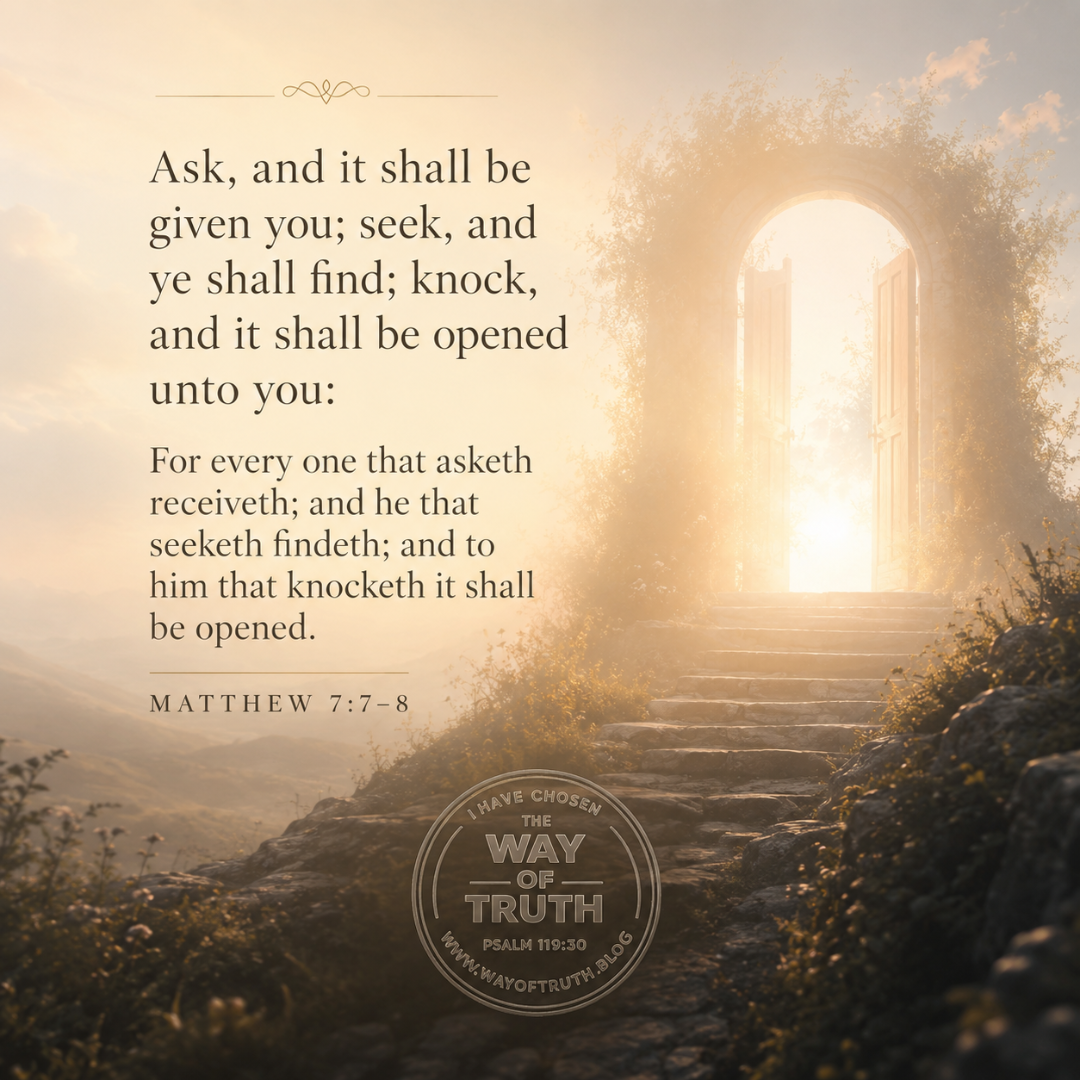
Matthew 7:7–8 comes after a series of deeply searching teachings. Jesus has warned His disciples against hypocritical judgment, calling them first to deal with the beam in their own eye before trying to help a brother with his mote. Then He warned them not to treat holy things carelessly by casting pearls before swine. That raises a very practical question: how can anyone actually live this way? How can we be humble without becoming passive? How can we be discerning without becoming harsh? How can we correct another person without pride? How can we walk away from mockery without bitterness? How can we live the Sermon on the Mount at all?
Jesus answers by calling His disciples to prayer.
“Ask, and it shall be given you.” The command is simple enough for a child to understand, yet deep enough to sustain a believer through a lifetime. Asking assumes need. It’s not the posture of self-sufficiency. It’s the posture of a son or daughter coming to the Father with empty hands.
Jesus doesn’t say, “Impress God, and it shall be given you.” He doesn’t say, “Earn, and it shall be given you.” He says, “Ask.” Prayer begins where pride ends. The person who asks has admitted, “Lord, I don’t have what I need unless You give it.”
The Christian life isn’t powered by spiritual swagger. No one obeys Christ by simply gritting his teeth and saying, “I’ve got this.” Usually, when we say, “I’ve got this,” heaven and our closest friends already know we absolutely don’t have it. The Lord is gracious enough to teach us something better: ask.
Then Jesus says, “Seek, and ye shall find.” Seeking adds desire and pursuit. It’s not a careless mumble tossed toward heaven while the heart remains elsewhere. Seeking implies that God Himself, His will, His wisdom, His righteousness, and His kingdom are worth pursuing. This connects closely with Matthew 6:33: “But seek ye first the kingdom of God, and his righteousness; and all these things shall be added unto you.”
The disciple doesn’t merely ask for things. He seeks the Lord’s will. He seeks understanding. He seeks righteousness. He seeks grace to obey. He seeks the Father Himself.
Then Jesus says, “Knock, and it shall be opened unto you.” Knocking pictures persistence at a door. It suggests desire strong enough to continue. The believer doesn’t pray once and then conclude that God must not care. He keeps coming. Not because God is reluctant, cold, or distracted, but because faith learns to wait upon the Lord.
Verse 8 reinforces the promise: “For every one that asketh receiveth.” This is broad, gracious, and deeply encouraging. Yet it must be understood within the context of Jesus’ teaching and the wider witness of Scripture. Jesus isn’t presenting prayer as a blank check for selfish desire. He’s not teaching that God becomes a vending machine if we press the right spiritual buttons. Scripture won’t allow that reading.
James later writes, “Ye ask, and receive not, because ye ask amiss, that ye may consume it upon your lusts” (James 4:3). John writes, “And this is the confidence that we have in him, that, if we ask any thing according to his will, he heareth us” (1 John 5:14). So, Matthew 7:7–8 isn’t a promise that God will indulge every appetite. It’s a promise that the Father hears and answers His children when they come to Him in faith, dependence, and submission to His will.
This matters because many distortions of this passage have caused confusion and heartache. Some teach that if you ask with enough faith, God must give you health, wealth, promotion, romance, comfort, or whatever earthly outcome you desire. That’s not biblical Christianity. It treats God less like the holy Father and more like a divine delivery service.
Others swing in the opposite direction and act as though prayer hardly matters at all. They believe God is sovereign, which is true, but then speak as though human prayer is nearly pointless, which isn’t true. Jesus commands us to ask, seek, and knock. God’s sovereignty doesn’t cancel the need for prayer. Instead, it gives prayer a solid foundation. We pray because the Father reigns, because He hears, because He gives, because He opens doors that no one else can open.
Skeptics sometimes object that prayer is irrational because not every request is granted exactly as asked. But that objection assumes that the only meaningful answer is immediate agreement. No wise parent operates that way. A loving father may say yes, no, wait, not that, not yet, or something better. If earthly parents know that love sometimes refuses, then how much more does the heavenly Father know it?
The uniqueness of Scripture stands out here. In many ancient religions, prayer could become an attempt to manipulate the gods, bargain with them, flatter them, or awaken their attention. In many modern worldviews, prayer is reduced to therapy, mindfulness, or inner self-expression. But Jesus reveals something far better: the living God invites His people to come to Him as Father. Prayer isn’t magic. It’s not self-talk. It’s not manipulation. It’s communion with the God who knows, rules, gives, corrects, and loves.
That means Matthew 7:7–8 isn’t merely a comforting slogan. It’s a command wrapped in a promise. Ask. Seek. Knock. Your Father isn’t absent. Your need isn’t ignored. Your obedience isn’t unsupported. The door isn’t locked against the child who comes by faith.
Praying With the Confidence of Beloved Children
The practical force of this passage is wonderfully direct: believers should pray. Not theoretically. Not occasionally. Not only when every other option collapses and we finally remember that we’ve got a spare tire in the trunk called God. We should pray as people who truly believe the Father hears us.
This begins with humility. “Ask” exposes our need. Many Christians would rather work, plan, worry, analyze, fix, and overthink before they pray. Some of us can turn worry into an Olympic sport. I may or may not have a few gold medals in this event. We rehearse conversations that haven’t happened, solve problems we don’t control, and carry burdens God never assigned to us. Yet Jesus gives us a better way. Ask.
Ask for wisdom before you speak. Ask for humility before correcting someone else. Ask for courage before making a hard decision. Ask for patience before responding to someone who seems especially gifted at testing your sanctification. Ask for grace to forgive. Ask for strength to obey. Ask for love for people who aren’t easy to love.
Prayer isn’t an excuse for laziness. Jesus also says, “seek.” Seeking means we pray with movement. We ask God for wisdom, and then we open His Word. We ask for holiness, and then we flee temptation. We ask for reconciliation, and then we speak with humility. We ask for gospel opportunities, and then we pay attention to the people around us. We ask God to help the Church grow in unity, and then we refuse to feed gossip, resentment, and division.
The believer who prays rightly isn’t passive but dependent. There’s a great difference.
“Knock” teaches persistence. Some matters require long obedience and repeated prayer. A wayward child may not return overnight. A hardened heart may not soften after one conversation. A besetting sin may not be conquered in a single dramatic moment. A church burden may not be lifted immediately. A season of grief may not pass quickly. Jesus doesn’t shame His people for continuing to knock. He invites them to do so.
This has direct application to the life and unity of the Church. Churches aren’t strengthened by human talent alone. Programs can be helpful, organization matters, and leadership requires diligence, but no church can manufacture spiritual life. We must ask God to save sinners, sanctify believers, raise up faithful servants, heal wounded relationships, protect sound doctrine, and make His people fruitful.
A prayerless church may still be busy, but busyness isn’t the same as spiritual health. A church can have full calendars and empty dependence. It can have polished systems and little hunger for God. Matthew 7:7–8 calls the Church back to its knees, not as a ceremonial habit, but as a confession that Christ’s people need the Father’s grace for everything.
This passage also guards us from pride in ministry. When God uses our words, our service, our teaching, our encouragement, or our witness, we should remember where the fruit came from. We asked, and God gave. We sought, and God led. We knocked, and God opened. That leaves no room for strutting around like spiritual peacocks. The glory belongs to God.
It also encourages believers in evangelism. We’re responsible to proclaim the gospel, but we can’t open blind eyes by our own power. We can’t raise the spiritually dead. We can’t argue someone into the kingdom through cleverness alone. We speak truth, we answer honestly, we live faithfully, and we pray earnestly. We ask God to give repentance. We seek opportunities to make Christ known. We knock, trusting Him to open doors for His Word.
This is especially important after Matthew 7:6. Jesus has just taught discernment regarding those who trample holy things. But discernment must not become coldness. When we step away from fruitless arguments, we shouldn’t stop praying for the person. We may no longer cast pearls into open contempt, but we can still ask God to break hard hearts. Sometimes the wisest answer is silence before the mocker and pleading before the Father.
Personally, Matthew 7:7–8 invites every believer to examine the reflexes of the heart. What do we do first when we’re afraid? When we’re offended? When we’re confused? When money is tight? When the future feels foggy? When someone wounds us? When temptation feels strong? When we feel spiritually dry?
Jesus isn’t scolding His disciples here. He’s inviting them. The Father’s door isn’t guarded by indifference. Heaven isn’t annoyed by needy saints. The Lord doesn’t roll His eyes when His children come again. You may grow tired of hearing yourself pray about the same burden, but your Father doesn’t grow weary in love.
At the same time, this passage calls us to trust the Father’s wisdom. Faith doesn’t demand that God answer on our schedule or according to our limited understanding. A child may ask for something harmful, foolish, or premature. A loving father doesn’t grant every request exactly as spoken. He gives what’s good.
That means unanswered prayer isn’t proof of divine neglect. Delayed answers aren’t proof of divine absence. Different answers aren’t proof that prayer failed. Sometimes God gives the thing requested. Sometimes He gives endurance. Sometimes He gives correction. Sometimes He gives deeper dependence. Sometimes He closes the door we wanted opened because He’s keeping us from something we can’t see.
The call, then, isn’t merely “pray more,” though many of us certainly need that. The call is: come to the Father with confidence shaped by submission. Pray with honesty. Pray with persistence. Pray with Scripture in your mind. Pray with God’s glory as your highest aim. Pray for your own needs, yes, but also pray for the holiness of the Church, the spread of the gospel, the salvation of the lost, the strengthening of weary saints, and the name of Christ to be honored in your home, workplace, church, and community.
Ask, because you’re needy. Seek, because God is worthy. Knock, because the Father is gracious.
And when He gives, when He leads, when He opens, give Him the glory. The purpose of answered prayer isn’t merely that our lives become easier. It’s that our trust deepens, our obedience grows, Christ is magnified, and others see that the living God is faithful.
The Open Door for Repentant Sinners
Maybe you’re reading Jesus’ words about asking, seeking, and knocking, and you feel a quiet ache in your heart. You want to come to God, but you know something’s wrong. You don’t merely need help with life. You need forgiveness. You need mercy. You need to be made right with the God who made you.
The Bible teaches that all of us have sinned. We haven’t loved God as we should. We haven’t obeyed Him fully. We’ve gone our own way in thought, desire, word, and action. Sin isn’t a small mistake that God simply overlooks. “For the wages of sin is death” (Romans 6:23). Sin separates us from God and brings us under His righteous judgment.
But the good news is that God has made the way for sinners to come to Him.
Jesus Christ, the eternal Son of God, came into the world, lived without sin, died on the cross for sinners, and rose again from the dead. He didn’t die as a helpless victim. He gave Himself as the perfect sacrifice. “Christ died for our sins according to the scriptures; And that he was buried, and that he rose again the third day according to the scriptures” (1 Corinthians 15:3–4).
Because Jesus has died and risen, forgiveness isn’t earned by religious performance, moral improvement, or trying to balance the scales. Salvation is received by repentance and faith. To repent is to turn from sin and self-rule. To believe in Christ is to trust Him personally, completely, and gladly as Lord and Savior.
The promise of Matthew 7:7–8 doesn’t mean sinners can come to God on their own terms. It means the door of mercy stands open through Christ. He’s the way to the Father. He’s the Savior that sinners need. And He’s not reluctant to save those who come to Him.
So come honestly. Don’t hide behind excuses. Don’t wait until you feel worthy, because you’ll never make yourself worthy enough to deserve grace. Come as a sinner in need of mercy. Ask God to forgive you. Seek Christ as your Savior. Knock at the door of grace, trusting the One who said, “him that cometh to me I will in no wise cast out” (John 6:37).
If you don’t yet know Jesus Christ as your Lord and Savior, turn to Him today. Confess your sin. Trust His death and resurrection. Receive His forgiveness. Follow Him in faith. The Father doesn’t invite sinners to come so He can mock their need. He invites them to come because Christ is mighty to save.
And for the believer, let the gospel keep shaping your prayers. You don’t come to God because you’ve been impressive this week. You come because Jesus has opened the way. Live, pray, obey, worship, and witness for the glory of the One who gave His Son to bring you home.
Reflection and Response
- Where do I most often rely on myself instead of asking the Father for help, wisdom, strength, or grace?
- Am I seeking God’s will with real desire, or am I mainly asking Him to approve what I already want?
- What burden, person, or spiritual need has God called me to keep bringing before Him with faithful persistence?
- How can my prayer life better serve the unity, holiness, worship, and gospel mission of the Church?
- Who in my life needs the gospel, and how can I pray, speak, and live in a way that points them to Christ for God’s glory?
[…] 7:9–10 continues Jesus’ teaching on prayer from the previous verses. In verses 7–8, Jesus commands His disciples to pray with persistence and confidence. In verses 9–10, He […]