
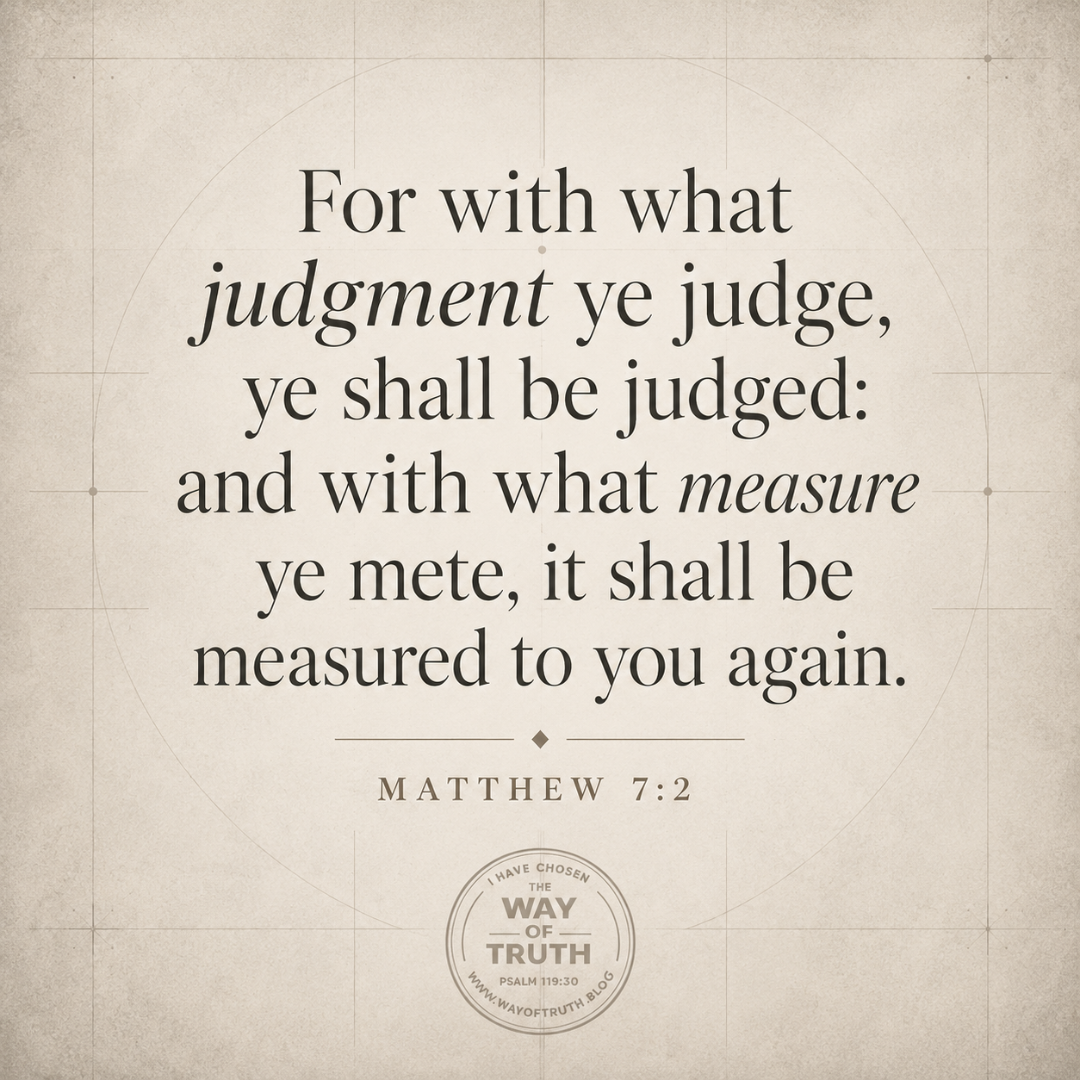
Matthew 7:2 continues directly from Jesus’ command in Matthew 7:1: “Judge not, that ye be not judged.” Verse 1 tells us what not to do. Verse 2 tells us why we must take it seriously. Jesus isn’t saying that all moral discernment is wrong. He’s not telling believers to switch off their minds, pretend evil is good, or treat false teaching as harmless. Later in the same chapter, He commands His disciples to recognize false prophets by their fruits. That requires judgment, but it requires the right kind.
Here, Jesus is warning against a proud, condemning, harsh, hypocritical spirit. The issue isn’t whether truth matters. Truth matters deeply. The issue is whether we handle truth as humble sinners rescued by grace or as self-appointed judges who forget we also stand before God.
The phrase “with what judgment ye judge, ye shall be judged” teaches a sober principle: the standard we use against others will expose us. If we judge others harshly, carelessly, unfairly, and without mercy, we reveal a heart that hasn’t properly reckoned with God’s mercy toward us. We may think we’re measuring someone else, but Christ says the measure has a way of turning around in our own direction. That should be enough to make any thoughtful believer slow down before speaking.
Jesus then says, “and with what measure ye mete, it shall be measured to you again.” The picture is simple and ordinary. In daily life, people measured grain, goods, or materials. A person could measure generously or stingily, honestly or dishonestly. Jesus uses that familiar image to teach a spiritual truth. The “measuring cup” we use on others says something about what we believe righteousness looks like. If our measure is full of suspicion, contempt, exaggeration, and impatience, we shouldn’t be surprised when that same spirit comes back upon us.
This doesn’t mean we earn God’s mercy by being merciful. Scripture is clear that salvation is by grace through faith, not by works. But it does mean that those who have truly received mercy should become merciful people. James 2:13 says, “For he shall have judgment without mercy, that hath shewed no mercy; and mercy rejoiceth against judgment.” Jesus is pressing the same truth into the conscience. A merciless spirit is not a small personality quirk. It’s a spiritual warning light blinking on the dashboard. And unlike the check-engine light, this one shouldn’t be ignored for six months while hoping it magically resolves itself.
This passage also builds on what Jesus has already taught in the Sermon on the Mount. He has warned against outward religion that performs righteousness for applause. He has exposed anger, lust, retaliation, hypocrisy, divided treasure, and anxious unbelief. Now He turns to the way disciples view other people. That order matters. The person who’s been corrected by Christ in secret should be careful before correcting others in public. The disciple who has prayed, “forgive us our debts, as we forgive our debtors” shouldn’t become severe toward fellow debtors.
This verse is sometimes distorted in two opposite ways. Some skeptics and modern readers use Matthew 7:2 to claim Christianity forbids all moral evaluation. That doesn’t fit the context. Jesus Himself teaches moral truth, exposes sin, calls for repentance, and warns against false prophets. On the other hand, some religious people ignore the warning altogether, using doctrine as a weapon while forgetting humility, patience, and mercy. That also violates the passage. Christ gives neither permission for moral cowardice nor permission for spiritual cruelty.
False religious systems and cultic movements often misuse judgment in one of these directions. Some create controlling environments where leaders judge harshly but can’t be questioned. Others erase biblical categories of truth and sin in the name of tolerance. Scripture gives a better way. God alone is the final Judge. His Word is the standard. His people must speak truth, but they must do so as forgiven sinners who know the weight of grace.
The moral coherence of this passage is striking. Jesus doesn’t abolish justice. He purifies it. He doesn’t silence truth. He humbles the truth-teller. He doesn’t say sin is harmless. He warns that our way of confronting sin may itself become sinful. That’s not contradiction. It’s divine wisdom reaching into the motives of the heart.
The Cup We Use on Others
Matthew 7:2 calls believers to examine not only what we think about others, but how we think about them. It’s possible to be right about the facts and wrong in the spirit. It’s possible to identify a real sin, error, or weakness and still handle it in a way that dishonors God. Jesus is teaching us that the heart behind our judgment matters.
This applies first in ordinary personal relationships. In the home, we can become experts at measuring everyone else’s faults while ignoring our own. A husband may notice every impatient word from his wife while excusing his own coldness as “just being tired.” A parent may correct a child’s bad attitude while ignoring the poor example they set. A friend may feel wounded by neglect while being strangely blind to the ways they’ve also neglected others. Jesus’ words slow us down. Before we measure someone else, we should ask whether our measure is honest, humble, and shaped by grace.
This also applies in the church. The church must never abandon discernment. Love doesn’t require pretending false doctrine is harmless or unrepentant sin is healthy. A congregation that refuses all correction isn’t loving but spiritually unsafe. Yet correction in the church must be marked by humility, patience, and a desire for restoration. Galatians 6:1 says, “Brethren, if a man be overtaken in a fault, ye which are spiritual, restore such an one in the spirit of meekness; considering thyself, lest thou also be tempted.” That last phrase belongs right beside Matthew 7:2. Consider yourself. Remember your weakness. Don’t walk into correction like a sheriff riding into town. Walk in like a fellow sinner carrying the medicine of truth.
This verse also speaks to Christian witness. A harsh, contemptuous, mocking spirit damages our testimony. The believer is called to proclaim the gospel, and the gospel includes hard truths: sin is real, judgment is coming, and Christ is the only Savior. But if we proclaim those truths with smugness, we distort the message with our manner. We should never soften God’s truth to make it more acceptable, but we should also never harden our tone to make ourselves feel more righteous. The cross leaves no room for pride. We’re not saved because we measured up. We’re saved because Christ stood in the place of sinners who didn’t and couldn’t.
Matthew 7:2 is especially needed in an age of instant opinions. Social media trains people to judge quickly, publicly, and often without full knowledge. A rumor appears, and within minutes the internet forms a courtroom, appoints itself judge, jury, and executioner, and then moves on to lunch. Christians shouldn’t be shaped by that spirit. We belong to Christ. We should be slower than the world to condemn, more careful than the world with facts, more merciful than the world in tone, and more concerned than the world with restoration.
This doesn’t mean we should be silent in the face of evil. There are times when love requires clear rebuke. There are times when protecting others requires naming danger plainly. There are times when truth must be defended without apology. But even then, Matthew 7:2 stands guard over our hearts. Are we judging by Scripture or by personal irritation? Are we seeking God’s glory or our own vindication? Are we grieved over sin or secretly pleased to have something to criticize? Are we applying the same biblical standard to ourselves that we apply to others?
The believer who wants to glorify God must ask these questions honestly. God isn’t honored by careless condemnation. He’s honored when His people reflect His holiness and His mercy together. The Lord is perfectly righteous, yet He’s patient. He sees all sin clearly, yet He delights to save. His people shouldn’t be loose with truth, but neither should we be stingy with mercy.
This passage also calls us to gospel mission. When we speak to the lost, we must remember that unbelievers don’t need our contempt. They need Christ. That doesn’t mean we flatter sin or hide the reality of judgment. It means we speak as people who know what it is to be rescued. The world doesn’t need Christians who act shocked that sinners sin. It needs Christians who can say, with tears and conviction, “There’s judgment, but there’s also mercy in Jesus Christ.”
In daily life, one helpful practice is to pause before forming a conclusion about someone else. Ask: Do I know the whole situation? Have I prayed? Would I want to be judged this way? Am I using the same measure on myself? Is my goal restoration, protection, correction, or merely self-satisfaction? These questions don’t weaken discernment. They strengthen it by removing the fog of pride.
Matthew 7:2 teaches us that the measure we carry matters. A believer should carry the measure of Scripture, not personal preference; the measure of truth, not gossip; the measure of mercy, not bitterness; the measure of humility, not superiority. We’re not called to be blind. We ‘e called to see clearly, beginning with ourselves.
The Good News for Those Who Don’t Measure Up
Maybe this verse has made you uneasy, and honestly, that may be a mercy from God. If we were judged by the same harsh, selfish, selective standards we’ve sometimes used on others, not one of us would stand. We’ve condemned what we secretly excused in ourselves. We’ve noticed specks while ignoring beams. We’ve wanted mercy when we failed and justice when others failed us. That’s not merely bad manners. It’s sin before a holy God.
The Bible teaches that God is righteous and that every person will answer to Him. We’ve sinned in our thoughts, words, actions, motives, and desires. Romans 3:23 says, “For all have sinned, and come short of the glory of God.” The penalty for sin is death and judgment. Romans 6:23 says, “For the wages of sin is death; but the gift of God is eternal life through Jesus Christ our Lord.” That’s the great problem: we need mercy, but God can’t pretend sin is harmless.
The good news is that God has provided salvation through His Son. Jesus Christ, the sinless Son of God, came into the world, lived in perfect righteousness, died on the cross for sinners, and rose again from the dead. He bore the judgment sinners deserve so that all who repent and believe in Him may be forgiven, reconciled to God, and given eternal life. First Corinthians 15:3–4 says, “Christ died for our sins according to the scriptures; And that he was buried, and that he rose again the third day according to the scriptures.”
Matthew 7:2 reminds us that we can’t save ourselves by measuring others. We can’t climb above guilt by pointing downward at someone else. The only safe place for sinners isn’t in the judge’s seat, but at the feet of Christ. There, proud hearts are humbled. Guilty sinners are cleansed. Harsh people learn mercy. Broken people receive grace.
Come to Christ in repentance and faith. Don’t trust your goodness, your religion, your knowledge, or your ability to find people worse than you. Trust the Savior who died and rose again. He offers forgiveness, new life, and eternal salvation to all who call upon Him. And having received His mercy, live for His glory by becoming the kind of person who handles truth with humility, correction with love, and people with the grace of those who’ve been forgiven much.
Reflection and Response
- Where am I tempted to judge others by a stricter measure than I use for myself?
- When I correct or evaluate someone, is my goal restoration, protection, and truth, or am I feeding pride, irritation, or resentment?
- How can I better reflect God’s glory by joining biblical discernment with humility, patience, and mercy?
- In my home, church, workplace, or online interactions, where do I need to become slower to condemn and quicker to pray?
- How can the mercy I’ve received in Christ make me more faithful and compassionate in sharing the gospel with the lost?