
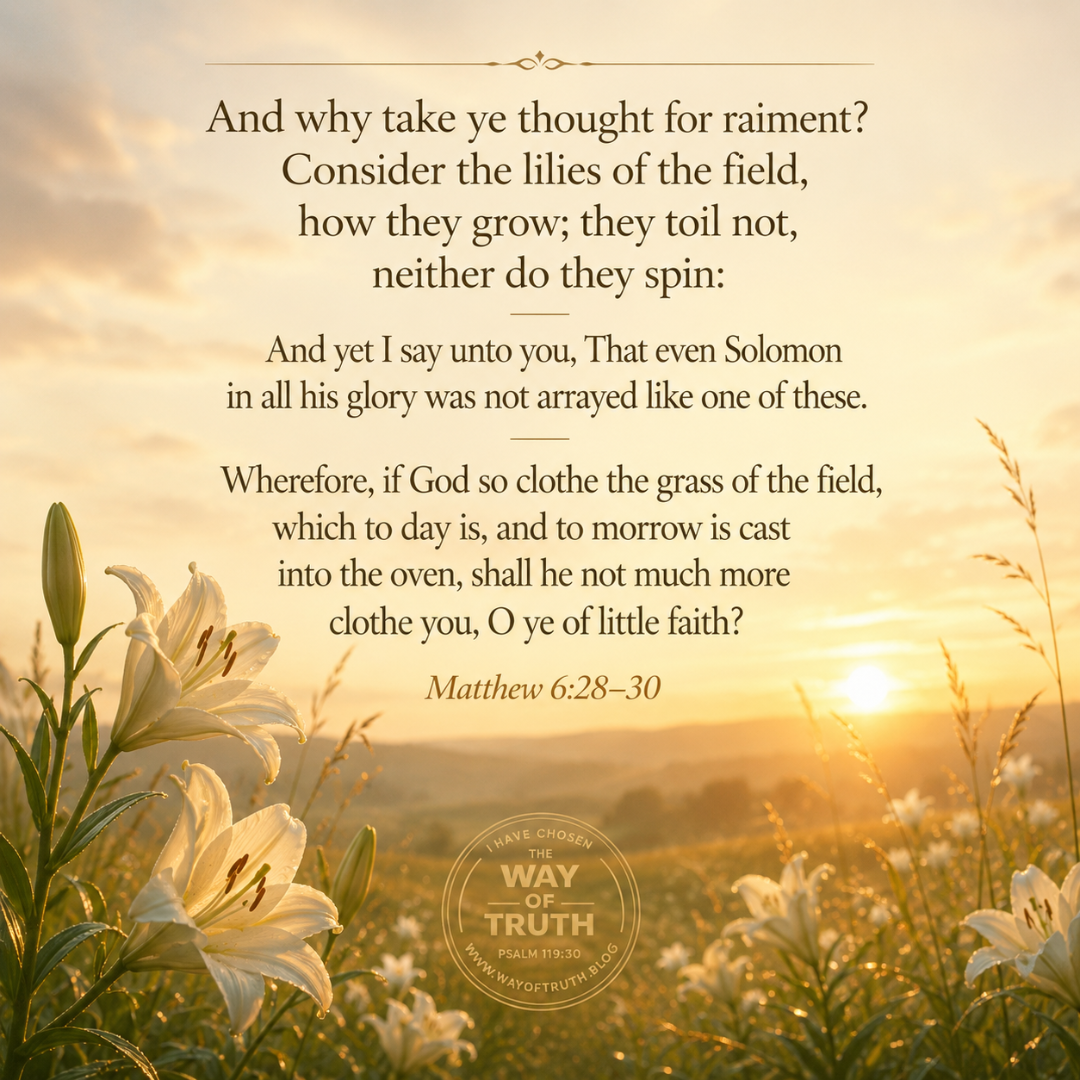
Jesus continues His tender but searching correction of anxious care. In the previous verses, He has already told His disciples not to live under the rule of worry about food, drink, or life itself. He pointed them to the birds of the air, not because birds are more important than people, but because they are less important, and yet the Father still feeds them. Now He turns from food to clothing: “And why take ye thought for raiment?”
This isn’t a rebuke against wearing, buying, and replacing worn-out clothes, or of planning responsibly. Scripture never praises carelessness. The issue is anxious preoccupation. Jesus is speaking to the kind of worry that keeps rehearsing need as though God is absent, indifferent, or unable to provide.
Then He says, “Consider the lilies of the field, how they grow.” That word “consider” matters. Jesus doesn’t tell us to ignore reality. He tells us to look more carefully at it. Faith isn’t closing our eyes and pretending life is easy. Faith is opening our eyes and seeing God’s hand in what we usually overlook.
The lilies don’t “toil” or “spin.” They’re not working looms, managing supply chains, comparing fabrics, checking sale prices, or asking whether free shipping applies. They simply grow under the creative and sustaining care of God. Their beauty isn’t self-manufactured. It’s received.
Then Jesus compares them to Solomon: “That even Solomon in all his glory was not arrayed like one of these.” Solomon was known for wealth, splendor, wisdom, and royal magnificence. If anyone in Israel’s history could have dressed impressively, it was him. Yet Jesus says that a passing flower, growing quietly in a field, displays a beauty greater than royal luxury.
That’s not an insult to Solomon. It’s a revelation of God’s artistry. Human glory, even at its height, can’t surpass the effortless beauty God gives to a flower.
Verse 30 presses the argument home: “Wherefore, if God so clothe the grass of the field, which to day is, and to morrow is cast into the oven, shall he not much more clothe you, O ye of little faith?” The grass is temporary. It’s alive today and gone tomorrow. In that culture, dried grass or field growth could be used as fuel. Something so short-lived, so easily discarded, is still adorned by God.
So, Jesus reasons from the lesser to the greater. If God clothes temporary grass with beauty, will He neglect His own children? The answer is meant to be obvious: of course not.
The phrase “O ye of little faith” isn’t cruel. Jesus doesn’t say they have no faith. He says their faith is small, strained, and easily shaken by earthly need. That’s often where we live too. We believe God is Lord of heaven and earth, yet we panic over tomorrow’s closet, bill, interview, diagnosis, grocery list, or unanswered email. Our theology may be sound, while we try to manage our lives like God stepped away from the throne.
This passage also fits beautifully within the wider witness of Scripture. In Genesis, God clothes Adam and Eve after their sin, covering their shame with coats of skins: “Unto Adam also and to his wife did the LORD God make coats of skins, and clothed them” (Genesis 3:21). In the wilderness, God preserved Israel so that their clothing didn’t wear out: “Thy raiment waxed not old upon thee” (Deuteronomy 8:4). In Isaiah, salvation itself is pictured as being clothed by God: “he hath clothed me with the garments of salvation, he hath covered me with the robe of righteousness” (Isaiah 61:10).
So, Matthew 6:28–30 isn’t merely about fabric. It’s about the Father’s faithful care for His people. Clothing represents need, dignity, covering, and daily provision. Jesus uses a simple field flower to teach a deep truth: the God who gives beauty to fading grass won’t abandon those made in His image and redeemed by His grace.
There are distortions to avoid. Some may twist this passage into a rejection of work, prudence, budgeting, or responsibility. But Jesus doesn’t praise laziness. The Bible consistently honors diligent labor. Others may turn this into a prosperity promise, as though faith guarantees fashionable abundance or a trouble-free life. That also misses the point. Jesus isn’t promising luxury. He’s calling His disciples to trust the Father for what they need while seeking first His kingdom.
A skeptic may object, “But believers still experience poverty, hardship, and unmet needs.” That’s true. Scripture doesn’t hide that. The same Bible that tells us God provides also shows saints enduring hunger, loss, persecution, and suffering. Yet Jesus isn’t saying the Christian life is untouched by hardship. He’s teaching that anxiety isn’t the proper ruler of the believer’s heart because the Father remains faithful even when life is lean. God’s care isn’t measured only by how much we possess, but by His wise, present, and sustaining love.
The world often teaches us to measure worth by appearance, brand, status, and visible security. Ancient cultures did this too, and modern culture has only upgraded the wardrobe and added better lighting. Jesus cuts through all of it. The flower has no social status, no wealth, no self-display campaign, and yet God clothes it beautifully. The disciple’s worth isn’t established by outward appearance, but by the Father’s care.
From Field Flowers to Faith-Filled Rest
This passage invites believers to slow down and examine the roots of anxiety. Jesus isn’t merely telling us, “Stop worrying.” He gives us a reason to stop being ruled by worry: the Father’s care is already visible all around us. The lilies aren’t just decoration in the sermon. They’re witnesses. Creation is preaching quietly, if we’ll listen.
For the believer, this means we should learn to see ordinary beauty as a reminder of divine faithfulness. A flower by the roadside, a tree in bloom, the changing colors of a field, even the simple provision of clothing in the closet can become small prompts to worship. We don’t worship creation, but creation points beyond itself to the Creator. The flower says, in its own silent way, “Look what God gives to something that’s here today and gone tomorrow. Will He forget you?”
This matters because anxiety often narrows our vision. It makes the urgent thing feel like the only thing. A bill becomes bigger than God’s providence. A job concern becomes bigger than God’s calling. A need becomes bigger than God’s character. Jesus widens our view. He brings our eyes back to the field, back to the Father, and back to the truth that life is upheld by more than our own effort.
That doesn’t mean effort is wrong. A Christian should work honestly, plan wisely, save responsibly, and care for family needs. The point isn’t that work is beneath us. The point is that worry must not rule us. We can work without worshiping work. We can plan without pretending we control everything. We can steward resources without treating possessions as our savior.
This passage also speaks to the Church. A congregation can become anxious about many things: finances, attendance, facilities, cultural pressure, leadership burdens, ministry needs, and the future. These concerns aren’t imaginary. Churches should be wise and faithful. But the Church must never be driven by panic. The same Father who clothes the grass also cares for the body of Christ. Our mission doesn’t rest on human cleverness, market appeal, or outward impressiveness. The Church’s confidence rests in the living God.
That truth should shape our worship. We gather not as spiritual consumers trying to maintain an image, but as dependent children coming before a faithful Father. Worship reorders what we love. It reminds us that the God who made the lilies is more glorious than Solomon, more dependable than wealth, and more beautiful than anything the world can display.
It should also shape our unity. Anxiety often makes people impatient, defensive, and self-protective. When we fear there won’t be enough, we’re tempted to compete, compare, and complain. But when we trust the Father’s provision, we’re freed to be generous, patient, and gentle with one another. A church full of anxious striving will struggle to love well. A church resting in the Father’s care can serve with open hands.
This passage also calls us to humility. We’re not self-sustaining creatures. Every breath, meal, garment, opportunity, and protection comes from God’s hand. Even our ability to work is a gift. That should humble us without crushing us. We’re dependent, but we’re not abandoned. We’re needy, but we’re not worthless. We’re weak, but we’re loved.
It also calls us to glorify God in ordinary life. Getting dressed in the morning can become more than routine. It can become a quiet reminder: “Father, You have provided for me. Help me live today for Your glory.” Buying what we need can become an act of gratitude rather than grasping. Facing what we lack can become an invitation to pray rather than spiral into fear.
And this passage should move us toward gospel witness. Many people around us are exhausted by image-management, financial fear, and the pressure to prove their worth. They may look successful on the outside while inwardly feeling threadbare. Believers have an opportunity to speak of a Father who sees, provides, and gives something far better than outward covering. We can tell them of Christ, who covers sinners not with temporary beauty, but with righteousness, forgiveness, and eternal life.
The flowers of the field don’t preach the whole gospel, but they do prepare the heart to hear it. They tell us we’re not living in a universe of cold accident. We live before the God who creates, sustains, adorns, and cares. And in Christ, we see the fullest display of that care. The Father didn’t merely give us clothing, food, and daily mercy. He gave His Son.
So, when worry rises, don’t simply scold yourself. Look where Jesus tells you to look. Consider the lilies. Consider the Father. Consider how temporary grass is clothed with beauty. Then bring your need, your fear, your schedule, your family, your work, your church, and your future before Him. The Father knows what His children need, and His care is wiser than our anxiety.
The Better Covering Christ Gives
Maybe you’re reading this and realizing that your deepest need isn’t clothing, money, stability, or relief from anxiety. Those needs matter, and God is compassionate toward them. But beneath them is a greater need: to be made right with God.
The Bible teaches that we’ve all sinned against the Lord. We haven’t loved Him with all our heart. We haven’t trusted Him as we should. We’ve tried to clothe ourselves in good intentions, religious activity, moral effort, comparison, success, or respectability. But none of those things can cover sin before a holy God. They may impress people for a while, but they can’t cleanse the heart.
Sin brings guilt, separation from God, and judgment. “For the wages of sin is death” (Romans 6:23). That’s the bad news we must not soften. But the same verse continues with glorious mercy: “but the gift of God is eternal life through Jesus Christ our Lord.”
This is where the message of Matthew 6:28–30 points us beyond earthly provision to eternal grace. The Father who clothes the grass has provided a far greater covering for sinners. Jesus Christ, the Son of God, came into the world without sin. He lived in perfect obedience to the Father. He died on the cross as the sacrifice for sinners, bearing the penalty we deserved. He rose again from the dead, victorious over sin, death, and the grave.
You can’t save yourself by worrying and trying harder or looking better on the outside. You need Christ. And He’s not a reluctant Savior. He calls sinners to come to Him. He receives those who repent and believe. To repent is to turn from sin and self-rule. To believe is to trust in Jesus Christ alone as Lord and Savior.
The promise of the gospel isn’t merely that God will help you feel calmer, though His peace is real and precious. The promise is forgiveness, reconciliation with God, new life, and eternal salvation. In Christ, the believer is clothed in righteousness that doesn’t fade like grass and can’t be purchased like royal garments. It’s received by grace.
So come to Christ. Bring Him your sin, your fear, your shame, and your need. Don’t hide behind appearances. Don’t wait until you feel worthy. The gospel is for the unworthy, the guilty, the weary, and the needy. Trust in the Lord Jesus Christ and live from this day forward for the glory of God who provides, forgives, sustains, and saves.
Reflection and Response
- Where has anxiety narrowed my vision so that my needs feel larger than my Father’s care?
- How can I practice “considering the lilies” by noticing God’s ordinary provisions and turning them into worship?
- Am I working and planning faithfully, or am I trying to carry tomorrow in a way God never commanded me to carry it?
- How can my trust in God’s provision strengthen the unity, generosity, and mission of my church?
- Who in my life needs to hear that Christ offers a better covering than success, appearance, morality, or self-effort?