
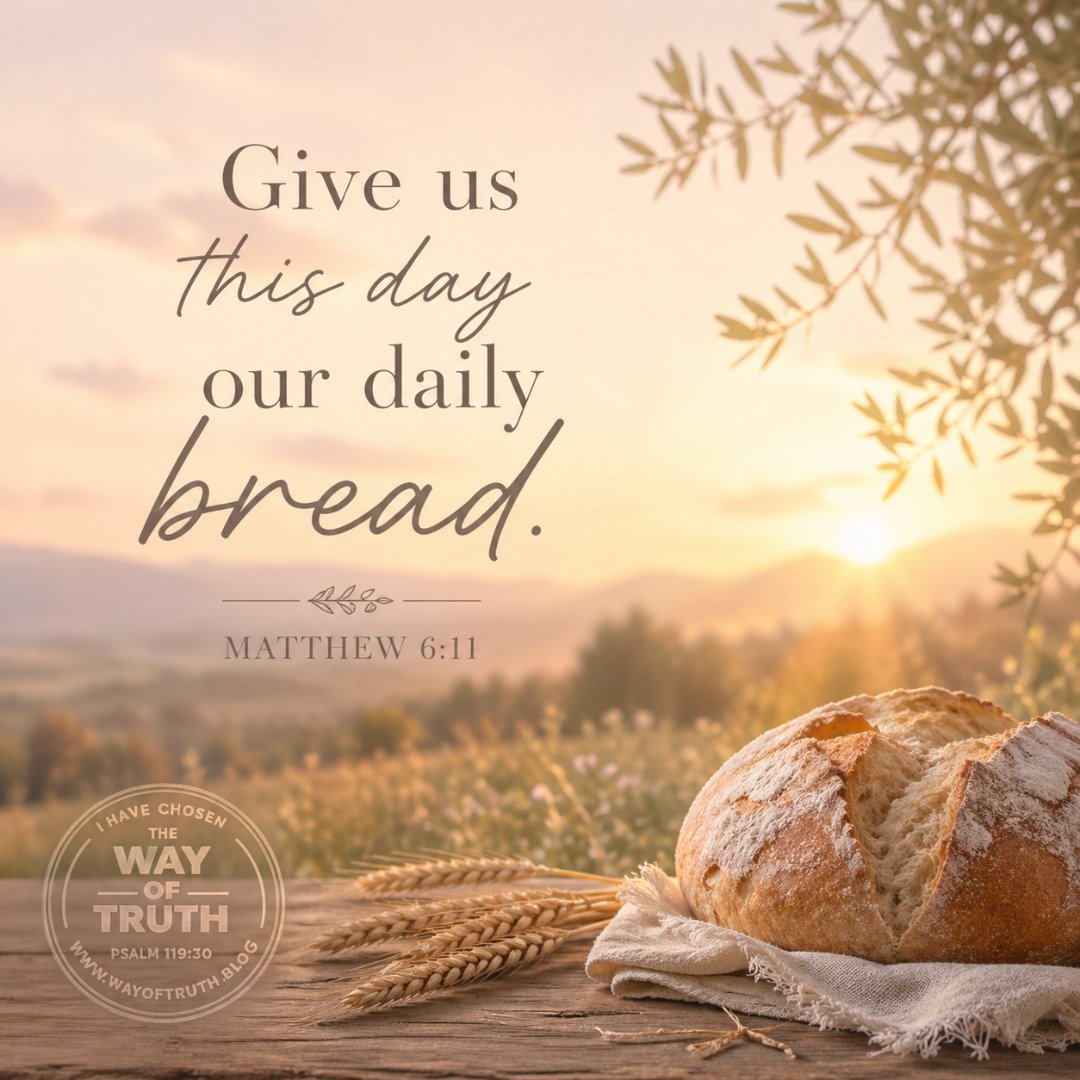
At first glance, this line from the Lord’s Prayer seems almost too simple. No long phrases. No elaborate theology. Just a straightforward request: “Give us this day our daily bread.”
But that simplicity is exactly the point.
Following the previous verse—“Thy kingdom come. Thy will be done in earth, as it is in heaven”—this request shows us something important about how God’s kingdom works in real life. We don’t just talk about God’s will in big, sweeping terms. We trust Him in the ordinary, everyday needs that keep us going.
“Bread” here represents more than literal food, though it certainly includes that. It’s a way of speaking about our daily provision, everything we truly need to live. Food, shelter, strength, clarity, even the grace to get through a hard day. It’s all wrapped up in that one word.
And notice the timing: “this day.” Not next week. Not a lifetime supply. Just today.
That connects directly to how God dealt with Israel in the wilderness. In Exodus 16, God gave manna one day at a time. If they tried to store it up out of fear, it spoiled. Why? Because God wasn’t just feeding them. He was teaching them to trust Him daily.
This verse carries that same heartbeat.
It also corrects a misunderstanding that prayer can be used as a way to manipulate God or impress Him with words. But Jesus has already said earlier in the chapter that the Father knows what we need before we ask (Matthew 6:8). So, this request isn’t about informing God. It’s about forming us. It trains us to depend on Him.
There have been attempts to over-spiritualize this verse, reducing “bread” only to spiritual nourishment, like the Word or Christ Himself. While Scripture does describe Christ as the bread of life (John 6), the context here is grounded in real, daily needs. It’s not either/or. It’s both. God cares about your soul and your grocery list.
In a world that prizes self-sufficiency, this verse firmly pushes back. It reminds us that no matter how stable things feel, we’re still dependent creatures. Every meal, every paycheck, and every breath ultimately comes from the hand of God.
Living One Day at a Time Under the Care of a Faithful Father
There’s something deeply freeing about this verse, but it can also feel a little uncomfortable.
We tend to want control. We like planning ahead, building reserves, making sure we’re covered. And there’s wisdom in that. Scripture doesn’t condemn responsible stewardship. But this verse exposes something beneath our planning: Why do we feel secure?
Is it because we’ve built enough? Or because we trust God?
“Give us this day our daily bread” calls us to live with open hands. It doesn’t forbid preparation, but it refuses to let preparation become our source of peace. God alone holds that place.
It also reshapes how we pray. Instead of only bringing God the big crises, we begin to involve Him in the everyday. The meeting you’re nervous about. The unexpected expense. The energy you don’t feel like you have today. Nothing’s too small.
And notice the word “us.” This isn’t just a personal prayer. It’s a shared one. It pulls us out of a purely individual mindset and reminds us that we’re part of a body. When we pray for “daily bread,” we’re also praying for the needs of others: our church, our neighbors, and even believers across the world.
That has real implications.
If we’re asking God to provide daily bread for “us,” then we should be willing to be part of how He answers that prayer. Generosity, hospitality, and meeting practical needs aren’t extras. They’re woven into the life of someone who truly understands this verse.
There’s also a subtle check against anxiety here. Later in the chapter, Jesus will say not to worry about tomorrow (Matthew 6:34). This verse prepares us for that. If God is faithful to provide today, then tomorrow is in His hands too.
It’s not that we never feel concern. It’s that we bring those concerns to the One who actually sustains us.
And let’s be honest, sometimes we act like we’re the ones holding everything together. As if the universe might wobble if we take a day off. This verse kindly reminds us: it won’t. God’s doing just fine at running the world. We’re invited to trust Him, not replace Him.
So, we wake up, we pray, and we walk forward one day at a time. Not with panic, but with quiet dependence.
The Bread Your Soul Truly Needs
Maybe you’re reading this and you wouldn’t describe yourself as someone who knows God personally. You might still feel the weight of needing provision, stability, and purpose, but you’re not sure where to turn.
This verse opens a door.
It shows us a God who invites us to ask. A God who provides. A God who cares about real needs, not just abstract ideas.
But Scripture also points us to a deeper need.
We don’t just lack provision. We’re separated from God because of sin. We’ve all gone our own way, lived independently from Him, and that separation carries a real consequence. The Bible is clear that the penalty for sin is death, which is spiritual separation from God.
That’s where the good news comes in.
God didn’t leave us to figure it out. He sent Jesus Christ into the world, not just to teach but to save. He lived a perfect life, died on the cross in the place of sinners, and rose again, defeating sin and death.
The One who teaches us to pray for daily bread is Himself the true Bread of Life.
Through His death and resurrection, forgiveness is offered freely. Not earned. Not worked for. Received.
And the response is simple, though it’s not casual: turn from your sin and trust in Him. Place your faith in Christ alone.
When you do, you’re not just given help for today. You’re given eternal life. You’re brought into a relationship with the God who provides not just daily bread, but everlasting life.
If that’s something you’ve never done, you can come to Him right now. No perfect words required. Just an honest heart.
“Lord, I need You.”
And He hears.
Reflection and Response
- Where do I tend to rely more on my own resources than on God’s daily provision?
- When I pray, do I bring God into my everyday needs, or only the major ones?
- How does the phrase “give us this day” challenge the way I think about others’ needs?
- In what ways can I become an instrument of God’s provision to someone else?
- What would it look like for me to trust God for today, without being consumed by tomorrow?