
Jesus continues a clear thread from the opening of Matthew 6. In verse 1, He warns against doing alms to be seen. Now in verse 5, He turns to prayer.
The shift isn’t random. Giving and praying were central expressions of Jewish piety. If those could be corrupted, anything could.
“And when thou prayest…” assumes that prayer is normal for the believer. Jesus doesn’t say if you pray, but when. Prayer isn’t optional. It’s expected. But what He addresses immediately isn’t technique, length, or eloquence. It’s motive.
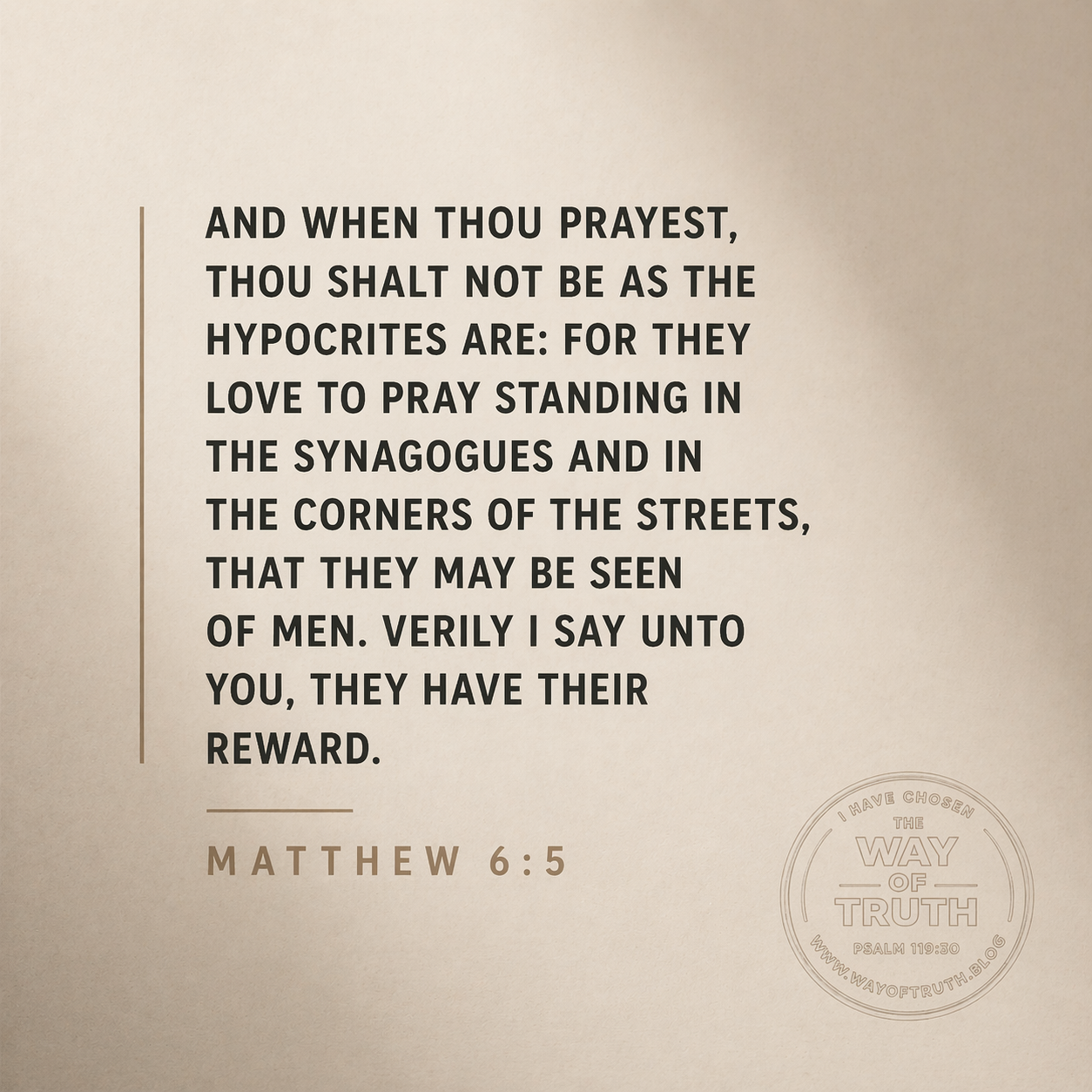
“Thou shalt not be as the hypocrites are…”
The word “hypocrites” originally referred to actors on a stage. That’s important. Jesus isn’t describing people who occasionally struggle with mixed motives. He’s describing those who turn spiritual acts into performances. They aren’t praying to God. They’re playing a role in front of people.
“Standing in the synagogues and in the corners of the streets…”
These locations matter. Synagogues were places of worship, and street corners were places of visibility. The issue is not where they prayed, but why. Public prayer itself isn’t condemned. Scripture includes many examples of public prayer. The problem is intentional positioning for maximum attention.
“That they may be seen of men.”
That phrase exposes everything. Their audience isn’t God. It’s the crowd.
And Jesus doesn’t leave room for ambiguity: “Verily I say unto you, They have their reward.”
That’s sobering. The applause, the nods, the quiet admiration of others, that’s it. That’s the full payment. There’s no additional reward from the Father because the act was never truly directed toward Him.
It’s worth slowing down here to clarify what Jesus is—and isn’t—condemning. Jesus isn’t condemning:
- Public prayer in itself
- Audible or structured prayer
- Praying in church settings
What He condemns is performative spirituality. Prayer that’s carefully crafted for human recognition rather than sincere communion with God.
A common misunderstanding is to swing too far and think all visible expressions of faith are wrong. That would contradict passages like Matthew 5:16, where believers are called to let their light shine. The difference lies in the direction of the heart. One seeks God’s glory; the other seeks personal recognition.
Some groups have used this passage to argue that all formal or corporate prayer is inherently corrupt. That interpretation doesn’t hold up under the broader witness of Scripture. Early believers prayed together (Acts 2:42), and Jesus Himself prayed publicly at times (John 11:41–42).
On the other side, modern culture often encourages curated spirituality, where even prayer can become content to share or a way to project an image. Jesus’ words cut straight through that. The issue isn’t the medium; it’s the motive.
Scripture remains consistent and self-defending here. God sees the heart (1 Samuel 16:7), and He’s not impressed by outward displays detached from inward sincerity.
Living with a Godward Focus in a Visibility-Driven World
This verse lands with surprising force in a world where nearly everything can be seen, shared, and affirmed by others. It doesn’t take much for prayer to drift from a conversation with God into something shaped by how it will be perceived.
If we’re honest, the pull is real. We want to sound thoughtful, spiritual, and composed. We want our words to land well. And somewhere along the way, it’s easy to forget who we’re actually speaking to.
Jesus calls us back to something simpler and deeper.
Prayer isn’t about impressing others. It’s about meeting with God.
That changes everything. It frees us from the pressure to perform. We don’t need polished phrases or carefully structured sentences. We don’t need to sound like someone else. God isn’t grading our vocabulary.
He’s looking at our heart.
This doesn’t mean we should avoid praying in groups or leading others in prayer. Those are good and necessary parts of the life of the church. But it does mean we should regularly check our motives. Why am I praying this way? Who am I thinking about as I speak?
One helpful test is this: would I still pray this if no one else were listening?
If the honest answer is no, that’s worth sitting with. Not in guilt, but in clarity. Jesus isn’t exposing hypocrisy to shame us. He’s exposing it so we can turn away from it.
There’s also a subtle encouragement here. The world often rewards visibility. God rewards sincerity. Those two systems don’t always overlap.
That means some of the most meaningful prayers you’ll ever pray will never be heard by anyone else. No one will applaud them. No one will quote them. But God hears them.
And that’s enough.
For the church, this passage calls us to cultivate a culture of authenticity. Not forced simplicity or artificial humility, but genuine, God-centered prayer. When we gather, our aim shouldn’t be to sound impressive. It should be to seek the Lord together.
And beyond the gathered church, this verse reminds us of our witness. A watching world doesn’t need more religious performance. It needs to see real faith. When our prayer life reflects a sincere relationship with God, it quietly points others to Him.
We glorify God not by being noticed, but by being faithful.
And part of that faithfulness is learning to pray as if God is truly the one listening. Because He is.
If Your Heart Is Searching for Something Real
Maybe you’ve seen religion that felt like a performance. Maybe you’ve even participated in it yourself. Outward actions, inward emptiness. Words that sounded right but didn’t come from a place of real connection.
Jesus isn’t calling you into that kind of life. He’s calling you into something real.
At the center of the Bible’s message is a simple but serious truth: all of us have sinned. Not just in what we do, but in who we are. Our hearts drift toward self, toward recognition, toward anything but God. Even our best efforts can be mixed with wrong motives.
And sin carries weight. The Bible is clear that the penalty for sin is death, both physical and eternal separation from God.
But God didn’t leave us there.
He sent His Son, Jesus Christ, who lived a perfectly righteous life, never once seeking His own glory apart from the Father. He went to the cross and took the penalty for sin upon Himself. He died, was buried, and rose again, defeating sin and death.
Because of what Christ has done, forgiveness is offered freely. Not earned. Not performed. Simply received.
You don’t come to God by impressing Him. You come by trusting Him.
If you’ve never turned to Christ, you can do that now. Not with polished words, but with a sincere heart. A simple turning. A recognition of your need, and a trust that Jesus is enough.
And for those who do, God promises something remarkable: full forgiveness, new life, and a restored relationship with Him.
The kind of relationship where prayer is no longer a performance but a conversation. Where you’re not trying to be seen by others but known by God. And in Christ, you are.
Reflection and Response
- When I pray, am I more aware of God’s presence or others’ perception of me?
- Are there ways I’ve subtly turned spiritual practices into performances?
- Would my prayer life look different if no one else ever heard me pray?
- How can I intentionally cultivate a more sincere, God-centered prayer life?
- In what ways can my quiet faithfulness bring glory to God and point others to Christ?