
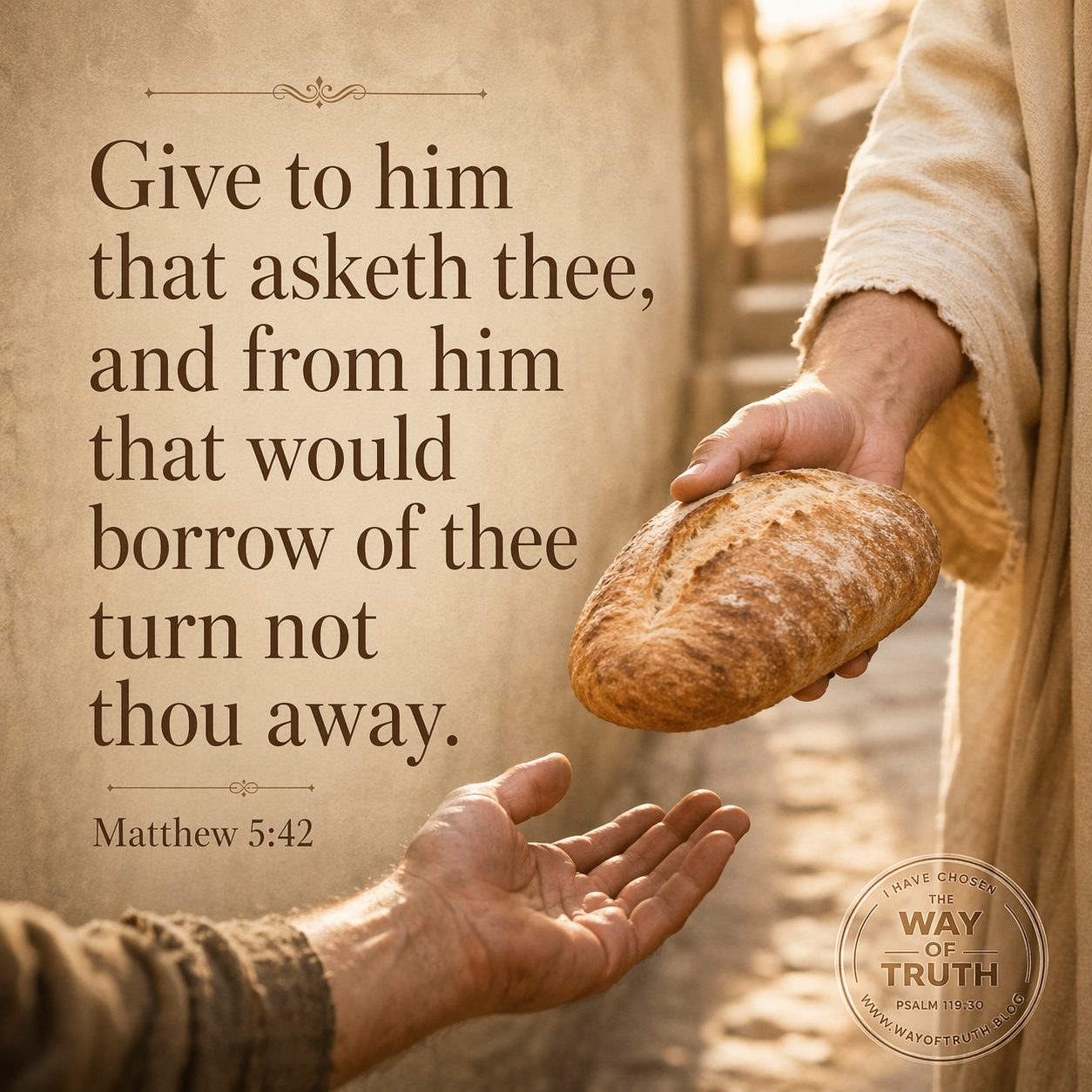
Jesus’ words in Matthew 5:42 land at the end of a series of commands that steadily dismantle our natural instincts. In the verses just before this, He calls His followers to turn the other cheek, give more than what’s demanded, and go the extra mile. This verse builds on that same theme: a heart that no longer clings tightly to rights, possessions, or self-protection.
“Give to him that asketh thee…” sounds simple, but it pushes against something deep in us. We tend to measure, evaluate, and calculate. Is this person deserving? Will I get anything back? Is this wise? Jesus isn’t ignoring wisdom, but He’s exposing our instinct to guard ourselves first and love second. His command reveals that kingdom righteousness isn’t just about avoiding wrongdoing; it’s about actively doing good, even when it costs us.
“And from him that would borrow of thee turn not thou away.” In that culture, lending wasn’t a financial strategy. It was an act of mercy. Jesus calls His followers to be people who don’t shut the door when someone is in need. The issue here isn’t enabling irresponsibility but refusing a hard-hearted indifference.
This teaching reflects the character of God Himself. Throughout Scripture, God is shown as generous, patient, and kind even toward those who don’t deserve it. Psalm 145:9 says, “The Lord is good to all: and his tender mercies are over all his works.” Jesus is calling His followers to reflect that same kind of open-handed generosity.
Some misunderstand this verse as a command to give indiscriminately in every situation without discernment. But Scripture interprets Scripture. Proverbs commends wisdom, and passages like 2 Thessalonians 3:10 address unwillingness to work. The point here isn’t reckless giving. It’s a transformed heart that leans toward generosity rather than self-protection.
Others might object that this teaching is unrealistic or impractical in the modern world. Yet that objection actually proves Jesus’ point. The standard He sets isn’t meant to feel natural. It reveals the kind of heart only God can produce.
In a world shaped by self-interest, this kind of generosity stands out. It quietly testifies that our trust isn’t in what we possess, but in the God who provides.
Living with Open Hands
If we’re honest, most of us don’t struggle with giving everything away. We struggle with giving at all when it feels inconvenient. Jesus is aiming directly at that tension.
This passage calls us to live with open hands. That doesn’t mean we abandon wisdom or responsibility. It means our default posture shifts. Instead of asking, “How little can I give?” we begin to ask, “How can I reflect the generosity of Christ here?”
Sometimes that will look like meeting a practical need. A meal, a few dollars, a helping hand. Other times it may mean giving time, attention, or patience when we’d rather move on. Not every request requires the same response, but every encounter reveals something about our heart.
There’s also a subtle challenge here for the church. Are we known as people who turn away, or people who lean in? A generous church doesn’t just preach truth. It embodies it. When believers care for one another and extend mercy beyond their walls, they reflect the heart of their Savior.
At the same time, this passage gently exposes our excuses. We may say, “I’ll help when I have more.” But generosity isn’t about abundance. It’s about trust. The widow in Luke 21 gave out of her poverty, and Jesus commended her because her giving revealed faith.
There’s freedom in this kind of living. When we loosen our grip on possessions, they lose their power over us. We’re no longer controlled by fear of loss because we trust the One who provides.
And yes, sometimes giving will feel uncomfortable. You might even get taken advantage of at times. But Jesus never promised that obedience would always be efficient or appreciated. He calls us to faithfulness, not perfect outcomes.
So, we give. Not because everyone deserves it, but because God has been generous to us.
Receiving What We Could Never Earn
If you’re reading this and you’ve never truly trusted in Jesus Christ, this passage points you to something deeper than generosity. It points you to grace.
At the heart of the gospel is this reality: we’re not naturally generous toward God. We don’t give Him the honor, obedience, or love He deserves. Scripture says we’ve all sinned, and that sin separates us from Him. The penalty isn’t just inconvenience or regret. It’s judgment. “For the wages of sin is death” (Romans 6:23).
But God didn’t turn away.
Instead of giving us what we deserve, He gave us what we could never earn. Jesus Christ, the Son of God, lived a perfectly righteous life. He never sinned. Yet He willingly went to the cross and took the punishment for sin upon Himself. He died in the place of sinners, bearing the full weight of God’s wrath.
And He didn’t stay in the grave. He rose again, victorious over sin and death.
That’s the greatest act of generosity the world has ever seen.
Now the call is simple, but it’s personal. Turn from your sin. Stop trusting in your own goodness, your own efforts, and your own reasoning. Trust in Jesus Christ alone. Believe that He died for your sins and rose again. Receive Him as your Lord and Savior.
When you do, God forgives you completely. He gives you new life, a new heart, and a new direction. The generosity Jesus commands in Matthew 5:42 begins to grow in you, not as a burden, but as a reflection of what you’ve received.
If you’ve never come to Him, you can come today. He doesn’t turn away those who come in faith.
Reflection and Response
- Where do I tend to “turn away” instead of leaning in when someone has a need? What does that reveal about my heart?
- How can I grow in practical generosity this week, not just in money but in time, attention, and compassion?
- Do I trust God enough to give freely, or do I hold back out of fear of loss or lack?
- How can our church more clearly reflect Christ’s generosity to those both inside and outside our community?
- Have I personally received the greatest gift—salvation through Jesus Christ—and if so, how is that shaping the way I give to others?