
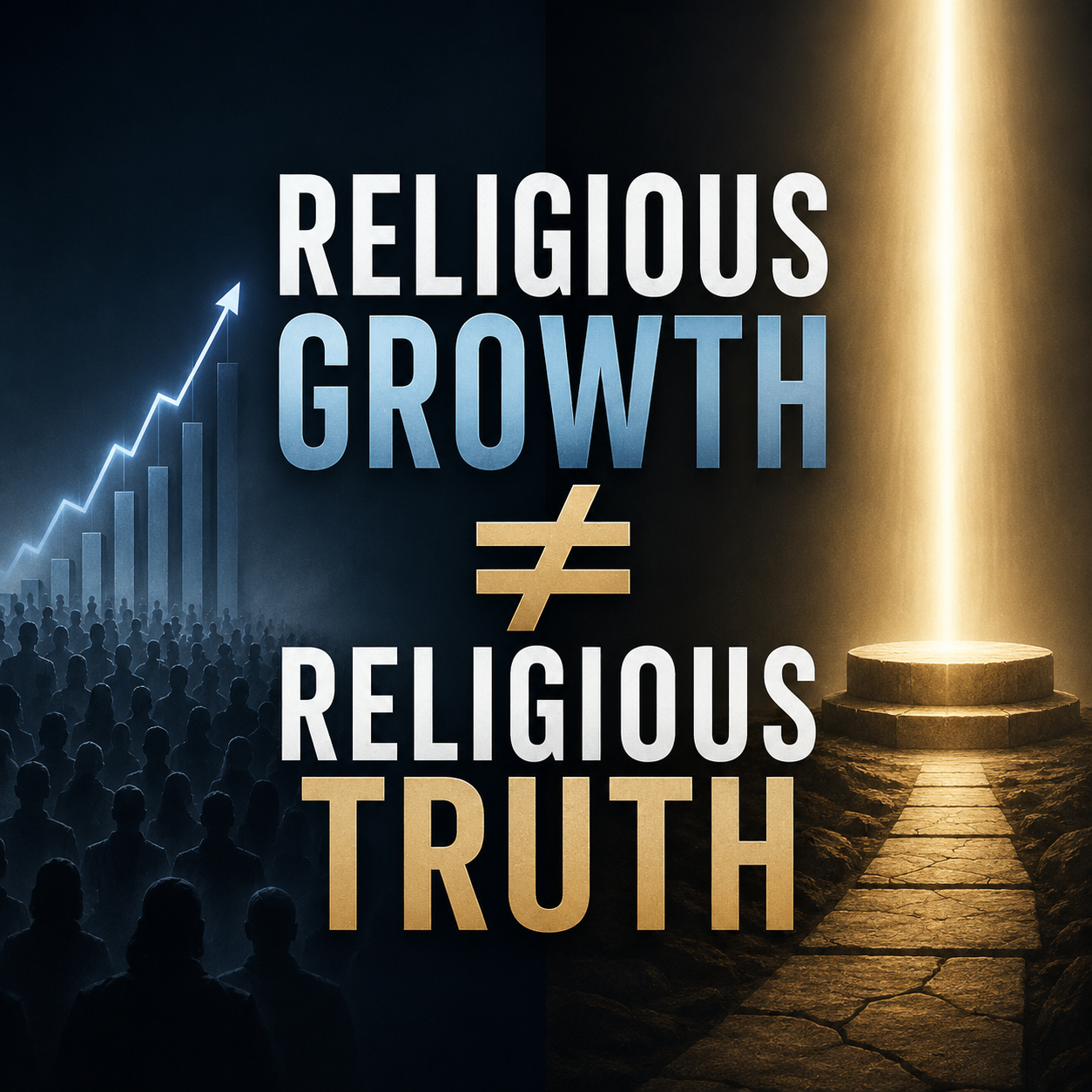
“If numerical growth is supposed to validate truth claims, then Christianity isn’t the only religion that can appeal to expansion. Islam’s rapid growth would seem to make an even stronger case.”
This claim is often raised against Christians who point to the explosive spread of early Christianity as part of the historical case for the faith. The skeptic’s point is simple: if growth proves truth, then Christianity doesn’t have a monopoly on that argument. Islam has grown rapidly, both historically and in the modern world. Therefore, the skeptic argues, Christian appeals to growth are either weak, inconsistent, or self-defeating.
There’s an important distinction, however, that must be made at the very beginning. Christians shouldn’t argue that numerical growth, by itself, proves Christianity true. Popularity doesn’t equal truth. A claim can spread widely and still be false. A belief can be held by only a minority and still be true. Truth isn’t determined by a census.
At the same time, this doesn’t mean growth is irrelevant. The rapid spread of a belief may raise historical questions worth investigating. It may call for explanation. It may tell us something about the credibility, conviction, sacrifice, social conditions, or persuasive power associated with a movement. But growth isn’t the same thing as truth. It’s a signpost, not a foundation.
Christianity’s case doesn’t rest on the mere fact that many people became Christians. It rests on the historical claims at the center of the faith, especially the death, burial, empty tomb, post-resurrection appearances, and rise of the earliest Christian movement in the face of opposition. Growth matters apologetically only when it is connected to those historical claims.
The Skeptical Claim Gets One Thing Right
The objection is correct to challenge any simplistic argument that says, “Christianity grew rapidly; therefore Christianity is true.” That would be a weak argument. If numerical expansion alone proved truth, then many religions, ideologies, political movements, and cultural trends could claim validation.
Islam has indeed grown significantly. Pew Research Center reported that Muslims were the fastest-growing major religious group globally from 2010 to 2020, increasing by 347 million people and rising from 23.9% to 25.6% of the world’s population. Christianity remained the largest religious group, but its share declined from 30.6% to 28.8% during that same period.1
Pew has also explained that modern Islamic growth is driven heavily by demographic factors, including higher fertility rates and a younger median age among Muslims compared with non-Muslims.2 For the 2015–2020 period, Pew estimated that Muslim women had an average of 2.9 children compared with 2.2 children per non-Muslim woman, and the global median age for Muslims in 2020 was 24 compared with 33 for non-Muslims.3
So, the Christian apologist should readily concede the point: Islam’s growth is real. It shouldn’t be dismissed, mocked, or ignored. But the more important question is this: what kind of growth are we talking about, and what is the growth being used to prove?
The skeptic’s argument is effective only against a crude popularity-based apologetic. It’s much less effective against the more careful Christian argument, which doesn’t say, “Christianity grew, therefore Christianity is true,” but rather, “The rise of Christianity is historically significant because of what the earliest Christians claimed, when they claimed it, where they claimed it, what they suffered for claiming it, and how difficult the movement is to explain apart from their sincere conviction that Jesus had risen from the dead.”
That’s a very different argument.
Growth Isn’t Proof, but It Can Be Evidence That Requires Explanation
Growth doesn’t automatically validate a truth claim, but it can still be part of a cumulative historical argument. A movement’s expansion may require explanation, especially when the movement begins under conditions that seem unfavorable to success.
For example, if a new movement grows because it’s backed by wealth, political power, military success, social pressure, inherited identity, or demographic birth rates, that tells us something about its expansion. But if a movement grows despite persecution, social shame, lack of political power, and a message that appears foolish or offensive to many of its hearers, that tells us something else.
The Christian argument from early growth isn’t merely that Christianity became large. It’s that Christianity grew out of a specific historical proclamation: that Jesus of Nazareth, publicly crucified under Pontius Pilate, had bodily risen from the dead. The earliest Christians didn’t merely spread a vague philosophy, a tribal identity, or a private spirituality. They proclaimed a public event.
That proclamation began in the very context where it could have been most easily challenged. Christianity arose in Jerusalem, where Jesus had been condemned and crucified. The apostles didn’t preach, “Jesus lives on in our hearts.” They preached that God had raised Him from the dead. They proclaimed this among people who could investigate the claim, dispute it, reject it, or punish them for it.
This doesn’t prove Christianity automatically. But it does mean the growth of Christianity is historically meaningful in a way that must be carefully examined. The central question is not, “How many people eventually believed?” The question is, “What best explains why the first Christians believed, preached, suffered, and multiplied in the first place?”
Islam’s and Christianity’s Growth Aren’t the Same
The skeptic’s comparison often assumes that all religious growth functions the same way. But that’s not true. The historical expansion of Islam and the early expansion of Christianity occurred under very different conditions.
Islam began in seventh-century Arabia and expanded rapidly in connection with the formation of a religious and political community. Encyclopaedia Britannica notes that Islam’s first phase of expansion was connected to Islamic conquests and empire building, and that Islam’s transformation from a small Arab ruling-class identity into the dominant faith of a vast empire occurred over a long period from 634 to 870.4
This doesn’t mean every conversion to Islam was forced, nor does it mean Islam spread only by the sword. That would be an oversimplification. Islam spread through many factors, including conquest, governance, trade, social integration, religious conviction, family life, and cultural influence. But historically, Islam’s early expansion was closely tied to political and military success in a way that early Christianity’s first expansion was not.
Christianity, by contrast, began as a persecuted minority movement centered on a crucified Messiah. Its earliest missionaries had no empire, no army, no legal privilege, and no worldly advantage comparable to later state-backed religious expansion. The Christian message was offensive to many Jews because of the claim that the crucified Jesus was Messiah, and foolish to many Gentiles because resurrection and crucifixion didn’t fit Greco-Roman ideals of wisdom, honor, and power.
Again, this doesn’t prove Christianity true by itself. But it does show that the comparison between Christianity’s early growth and Islam’s later growth isn’t as simple as the skeptical claim suggests. Different kinds of growth require different explanations.
The Christian Appeal Isn’t to “Numbers,” but to Origins
A careful Christian apologetic doesn’t rest its case on the number of Christians in the world today. It asks how Christianity began.
This is important because modern religious demographics are often shaped by birth rates, family structures, migration patterns, cultural identity, government policy, and social pressure. Those factors can explain why a religious group grows numerically without proving that its core doctrines are true.
That point applies to Christianity too. A person born into a Christian-majority nation isn’t automatically evidence that Christianity is true. A nominal Christian who inherited a label from family or culture isn’t the same as a first-century witness willing to suffer for the claim that Jesus rose from the dead.
The apologetic importance of Christianity’s early growth isn’t merely numerical. It’s testimonial and historical. The earliest Christians claimed that they had seen the risen Christ. They proclaimed this message publicly. They endured hostility for it. They worshiped Jesus within a Jewish monotheistic framework. They gathered on the first day of the week. They baptized converts in His name. They celebrated the Lord’s Supper in remembrance of His death. They treated the resurrection not as a symbolic metaphor but as the decisive act of God in history.
The question isn’t, “Did Christianity become popular?” The question is, “Why did this particular resurrection-centered movement arise at all?”
That’s where the Christian argument has force. Growth isn’t the proof. Growth is one historical effect that points us back to the cause that needs explaining.
Popularity Can Never Be the Final Test of Truth
The skeptic is right that popularity can’t be the final test of truth. Christians should agree with that wholeheartedly. In fact, Christianity itself warns against measuring truth by majority opinion.
The prophets were often outnumbered. Jesus warned that the broad way leads to destruction and the narrow way leads to life. The apostles frequently stood against religious and cultural majorities. Biblical faith has never depended on the idea that the largest crowd must be right.
Therefore, Christians should avoid triumphalistic arguments that sound like, “Christianity is true because it is big.” That’s not the biblical argument. The gospel is true whether many or few believe it. Christ is risen whether the world receives or rejects Him.
At the same time, skeptics should also avoid the opposite error. The fact that growth doesn’t prove truth doesn’t mean growth is meaningless. A movement’s rise can still be historically significant. If a belief spreads rapidly under surprising conditions, that fact may reasonably invite investigation.
For Christianity, the focus isn’t raw numbers but the nature of the earliest testimony. The apostles didn’t merely advocate ethical reform. They proclaimed that Jesus had risen bodily from the dead. If that claim is false, Christianity collapses. If that claim is true, Christianity stands, regardless of whether it has many followers or few.
Christianity isn’t validated by being popular. It’s validated by the truth of Christ’s resurrection.
Islam’s Growth May Show Sociological Strength, but Not Theological Truth
Islam’s growth may demonstrate many things: strong community identity, high fertility, youthful demographics, religious commitment, missionary zeal, cultural cohesion, or social durability. Those aren’t insignificant. But none of them proves Islam’s central theological claims.
The truth of Islam depends on whether its claims about God, Muhammad, revelation, Scripture, Jesus, sin, salvation, and final judgment are true. Those claims must be tested by evidence, coherence, historical reliability, and theological adequacy.
Likewise, Christianity must be tested by its own central claims. Did Jesus exist? Was He crucified? Was He buried? Was His tomb found empty? Did His followers sincerely believe they saw Him alive after His death? What best explains the origin of resurrection belief among first-century Jewish disciples? Are the New Testament documents historically reliable? Does Christianity offer the most coherent explanation of God, humanity, sin, redemption, and history?
Those are the real questions.
If Islam grows because of demographics, that tells us something about population patterns. If Christianity grows in some regions and declines in others, that tells us something about culture, fertility, secularization, evangelism, and religious identity. But neither trend settles the question of truth.
The Christian shouldn’t fear Islam’s growth. Nor should the Christian use Christianity’s size as a shallow substitute for evidence. The gospel doesn’t need inflated arguments. It invites historical, theological, moral, and existential examination.
The Early Christian Movement Remains Historically Distinctive
The rise of Christianity remains historically remarkable because of its origin in a crucified and risen Messiah. Crucifixion was a shameful death. It marked a person as cursed, defeated, and humiliated. Yet the earliest Christians proclaimed that this crucified Jesus was Lord, Messiah, Son of God, Savior, and Judge of the living and the dead.
That message didn’t flatter Jewish expectations of national triumph or Greco-Roman ideals of power and honor. It demanded repentance. It called people away from idols. It challenged Caesar’s ultimate authority. It placed a crucified Jew at the center of God’s redemptive plan for the whole world.
And yet the movement grew.
The apologetic point isn’t simply that it grew. The point is that it grew around a claim that should have been easy to crush if the body of Jesus were available, if the disciples had fabricated the story, or if the resurrection proclamation had no early basis.
The disciples’ transformation also matters. The New Testament presents them as fearful and confused after Jesus’ arrest and crucifixion. Yet soon afterward, they publicly proclaimed His resurrection. Skeptics may reject the New Testament’s theological interpretation, but they still need to explain the historical emergence of resurrection proclamation, early Christian worship, missionary sacrifice, and the willingness of key witnesses to suffer for their testimony.
Growth alone doesn’t prove Christianity. But Christianity’s growth, when joined to the resurrection claim and the conduct of the earliest witnesses, becomes part of a larger historical case.
A Better Christian Argument
A weak argument says:
“Christianity grew rapidly; therefore Christianity is true.”
A better argument says:
“Christianity’s early growth is historically significant because it arose from the proclamation that Jesus had risen bodily from the dead, began in the environment where that claim could be challenged, spread despite social and religious opposition, and was carried forward by witnesses who appeared sincerely convinced of what they proclaimed. This growth doesn’t prove Christianity by itself, but it’s one important piece of a cumulative case for the resurrection.”
That argument is much more careful. It doesn’t depend on popularity. It doesn’t deny the growth of other religions. It doesn’t pretend that numbers settle truth. Instead, it asks what best explains the origin and endurance of the Christian movement.
The skeptic’s objection has force against careless rhetoric, but it doesn’t defeat a serious historical apologetic.
Conclusion: Truth Isn’t Counted by Heads, but Tested by Reality
The skeptic’s objection is helpful insofar as it warns Christians not to make careless arguments from popularity. If Christians say, “Our religion grew, therefore it’s true,” they’ve opened the door for every growing religion, ideology, or movement to make the same claim.
But Christianity doesn’t ultimately rest on numerical growth. It rests on Jesus Christ: His life, His teaching, His death, His burial, His resurrection, and His continuing lordship.
Islam’s rapid growth doesn’t disprove Christianity any more than Christianity’s global size disproves Islam. Numbers alone can’t decide between competing truth claims. The real issue is evidence.
The Christian claim isn’t merely that Christianity spread. The claim is that Christianity spread because something happened: Jesus of Nazareth, crucified under Roman authority, was raised from the dead by God. If that didn’t happen, Christianity is false no matter how large it becomes. If it did happen, Christianity is true no matter how many reject it.
The question, then, isn’t which religion has the most impressive demographic chart. The question is whether Jesus Christ truly rose from the dead. Christianity stands or falls there.
- Pew Research Center, How the Global Religious Landscape Changed from 2010 to 2020 (Washington, DC: Pew Research Center, June 9, 2025), 8–9, https://www.pewresearch.org/religion/2025/06/09/how-the-global-religious-landscape-changed-from-2010-to-2020/. ↩︎
- Ibid. ↩︎
- Conrad Hackett, “Islam Was the World’s Fastest-Growing Religion from 2010 to 2020,” Pew Research Center, June 10, 2025, https://www.pewresearch.org/short-reads/2025/06/10/islam-was-the-worlds-fastest-growing-religion-from-2010-to-2020/. ↩︎
- “Islamic World: Conversion and Crystallization (634–870),” Encyclopaedia Britannica, updated March 13, 2026, https://www.britannica.com/topic/Islamic-world/Conversion-and-crystallization-634-870. ↩︎