
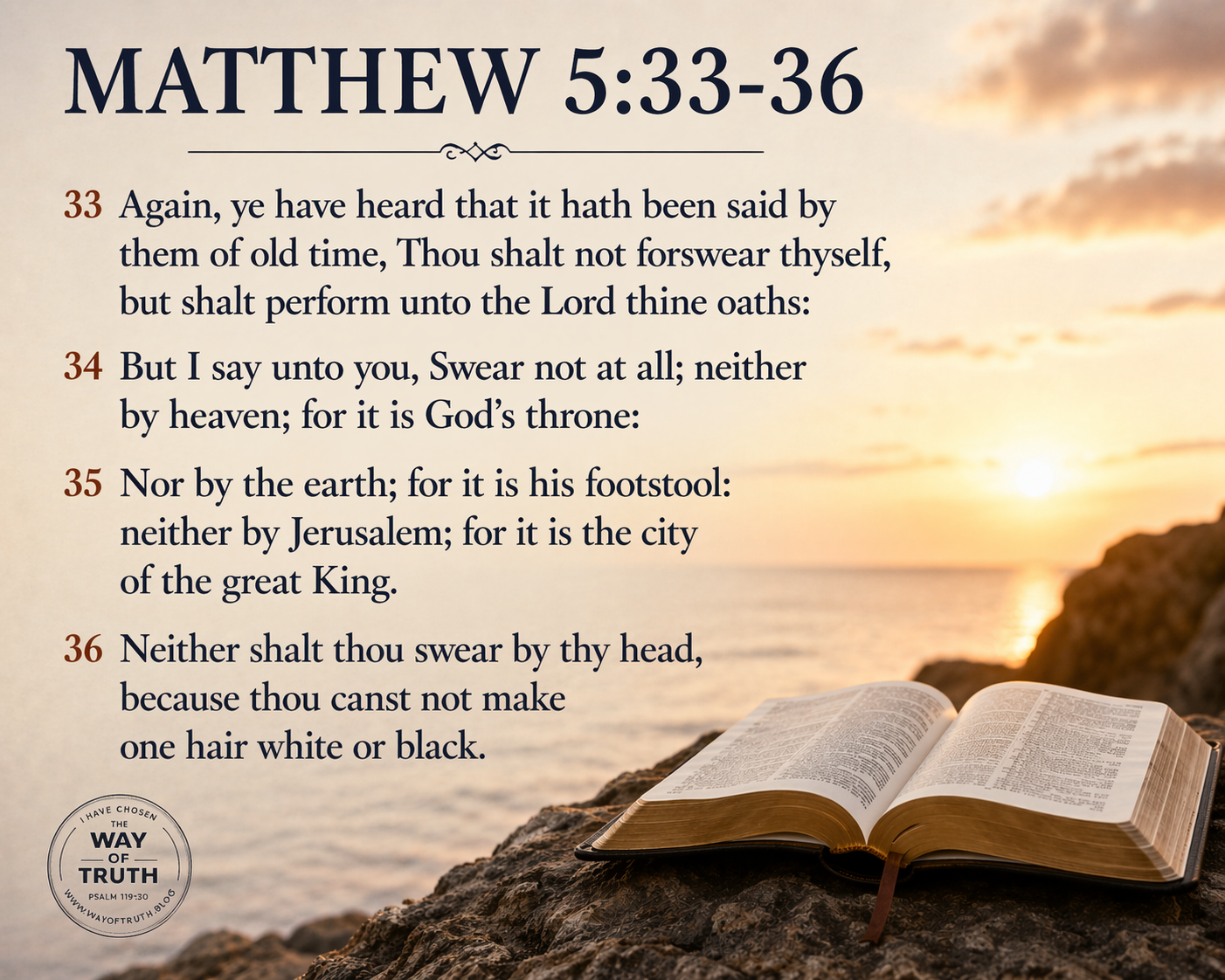
In the fourth antithesis, Jesus reminds His listeners of another familiar command: do not swear falsely, and when you make a vow, keep it. That principle comes straight from the Law and reflects God’s concern for truth and faithfulness. The problem, however, wasn’t the command itself. It was how people had come to handle it. Over time, a system developed that allowed for careful wording and selective seriousness. Some oaths were treated as binding, while others were considered less so, depending on what one swore by.
Jesus exposes the heart behind this practice. It wasn’t really about honoring God; it was about creating room to maneuver. If someone could speak in a way that sounded serious without actually binding themselves, they could maintain an appearance of integrity while avoiding full accountability. It’s the kind of thing that feels clever in the moment but collapses under honest scrutiny.
So, when Jesus says, “Swear not at all,” He’s not lowering the standard but raising it beyond external regulation. He’s addressing the deeper issue: a heart that tries to manage truth instead of simply living in it. This fits perfectly with the flow of Matthew 5. Jesus has already shown that sin isn’t merely outward behavior but inward disposition. Anger and lust aren’t just actions; they’re heart conditions. Now He shows that truthfulness isn’t just about formal vows; it’s about the integrity of everyday speech.
The standard Jesus sets is both simple and searching. He’s calling for a life where words flow from a heart aligned with truth. No loopholes, no verbal gymnastics, and no layered qualifications. Just honesty. It’s a righteousness that can’t be faked because it’s not rooted in performance but in transformation. And that kind of integrity, while straightforward, reaches into every corner of life.
Why “Casual” Oaths Don’t Exist
Jesus then dismantles the idea that some oaths are more serious than others. People in His day would swear by heaven, or by the earth, or by Jerusalem, assuming that these carried different levels of obligation. It created a kind of sliding scale of truthfulness, where one could speak with varying degrees of commitment depending on the wording.
But Jesus removes the entire foundation for that thinking. Heaven is God’s throne. The earth is His footstool. Jerusalem is the city of the great King. In other words, every reference point a person might use in an oath is already connected to God. There’s no neutral ground, no lesser category, no safe workaround. Everything ultimately belongs to Him.
This isn’t just a clever argument. It’s a theological reality. If God is sovereign over all things, then every word spoken exists within His authority. That means there’s no such thing as a “casual” oath. Even the attempt to create one reveals a misunderstanding of who God is.
Jesus goes even further by pointing to the human person. “Neither shalt thou swear by thy head,” He says, “because thou canst not make one hair white or black.” There’s a subtle irony here. We speak as though we possess authority and control, but in reality, we’re limited in ways we often overlook. We can’t even govern the smallest details of our own bodies apart from God’s providence.
This humbles the entire discussion. Oaths often function as a way of asserting credibility or control: “You can trust me because I guarantee this.” But Jesus reminds us that we’re not ultimate authorities. We’re creatures, dependent and accountable.
In a modern context, the same principle applies. We may not swear by heaven or Jerusalem, but we still use phrases to strengthen our claims: “I swear,” “I promise,” “honestly.” The instinct is the same: to reinforce words that, ideally, should already be trustworthy. Jesus gently but firmly demolishes that instinct by pointing us back to God’s all-encompassing authority.
Truthfulness Without Props
At its core, this passage isn’t primarily about banning certain phrases; it’s about restoring truth to its rightful place in human speech. Jesus isn’t condemning every form of oath in every context. Scripture elsewhere shows that oaths can be appropriate in formal or legal settings, and even God Himself uses oath language to confirm His promises. The issue here is something more ordinary and more revealing: how people speak in everyday life.
The pattern Jesus confronts is the use of verbal “props.” These are the extra phrases we add to make our words seem more reliable. When someone says, “I promise,” or “I swear I’m telling the truth,” it often suggests that their words, on their own, might not carry enough weight. It’s an attempt to reinforce credibility rather than embody it.
Jesus calls His followers away from that pattern. He points toward a life where truthfulness is so consistent that reinforcement becomes unnecessary. This doesn’t mean perfection in speech, but it does mean a settled commitment to honesty that shapes every conversation.
There’s also a deeper theological implication. Truth isn’t merely a moral principle; it’s rooted in the character of God. Scripture teaches that God cannot lie. His words are always reliable, always faithful, and always true. When Jesus calls His followers to truthful speech, He’s calling them to reflect that divine character in a human way.
This stands in contrast to both ancient and modern approaches to truth. Some systems emphasize technical precision: saying exactly the right words in the right way. Others lean toward pragmatism, where truth becomes flexible depending on circumstances. Jesus rejects both extremes. He doesn’t offer a technique for speaking; He calls for a transformed heart from which truthful speech naturally flows.
Skeptics may argue that this standard is unrealistic, that human communication is too complex for such simplicity. But that objection actually proves the point. The difficulty lies not in the clarity of the command, but in the condition of the human heart. We struggle with truth because we’re inclined toward self-preservation and self-presentation. Jesus addresses the root, not just the symptom.
Living as People Whose Words Can Be Trusted
When this teaching moves from the page into daily life, it becomes both practical and searching. Most people don’t regularly make formal oaths, but nearly everyone feels the subtle pressure to shape how they’re perceived. That pressure shows up in small ways: overcommitting, exaggerating, softening difficult truths, or adding verbal emphasis to make something sound more convincing.
Jesus calls His followers to a different way of living. He invites them into a life where words aren’t tools for managing perception but expressions of reality. This begins with a conscious awareness that every word is spoken before God. There’s no private conversation, no harmless exaggeration that falls outside His notice. That awareness doesn’t produce fear so much as it produces clarity. It reminds us that truth matters, even in the smallest details.
In the life of the Church, this kind of integrity is essential. Trust is built over time through consistent, truthful communication. When believers speak honestly, keep their commitments, and avoid manipulative language, they create an environment where unity can flourish. On the other hand, even small patterns of dishonesty can erode relationships and hinder the witness of the gospel.
There’s also a personal freedom in this way of living. When you’re committed to truth, you no longer have to remember which version of a story you told or manage impressions through carefully chosen words. You’re free to speak plainly. Your “yes” can mean yes, and your “no” can mean no, without additional explanation.
That doesn’t mean harshness or insensitivity. Truth must always be paired with love. There are times when wisdom calls for careful timing or gentle wording. But even then, the goal is never to distort reality, but to communicate it faithfully and graciously.
This passage ultimately invites self-examination. Not in a crushing or condemning way, but in a clarifying one. It asks simple but weighty questions: Are my words reliable? Do people trust what I say? Am I speaking to reflect truth, or to shape perception?
As these questions settle in, they point us back to God, whose truth is perfect and whose grace enables His people to grow in integrity.
The Perfect Truth and Saving Grace of Christ
As we consider Jesus’ words about truthfulness, it becomes clear that the issue isn’t merely what we say but who we are. Our speech reveals our hearts, and if we’re honest, we recognize that we haven’t always been truthful. We’ve all spoken carelessly, shaded the truth, or said what was convenient rather than what was right. These aren’t small matters in the sight of a holy God.
Scripture teaches that God is perfectly truthful. He never speaks falsely, never misleads, and never fails to keep His word. That means our dishonesty, in any form, stands in direct contrast to His character. The consequence of sin isn’t simply broken relationships with others, but separation from God Himself.
Yet this is where the gospel brings hope.
God, in His mercy, sent His Son, Jesus Christ, into the world. Jesus lived a life of perfect righteousness, including perfect truthfulness. Every word He spoke was pure, faithful, and aligned with the will of the Father. He never needed to reinforce His words because He is the Truth.
And yet, He went to the cross.
There, Jesus bore the penalty for our sin, including our dishonesty, our hypocrisy, and our failure to live with integrity. He took upon Himself the judgment we deserved. He died, was buried, and on the third day, He rose again, demonstrating His victory over sin and death.
Because of His finished work, forgiveness is offered freely.
If you don’t yet know Him, consider this a personal invitation. You don’t need to clean up your life or fix your speech before coming to Christ. In fact, the very awareness of your need is what draws you to Him. Turn to Him in repentance—acknowledging your sin honestly—and place your trust in Him alone for salvation.
When you do, God forgives you completely. He gives you a new heart and begins a work of transformation within you. Over time, even your words begin to change, not because you’re forcing them to, but because your heart is being renewed.
There’s grace for you in Christ. There’s forgiveness, restoration, and a new beginning grounded in truth.
Come to Him, trust in Him, and live in the freedom of His truth for His glory.
Reflection and Response
- In what specific situations do I feel the need to reinforce my words instead of simply speaking truthfully?
- Are there patterns in my speech—such as exaggeration or overcommitment—that reveal a deeper issue in my heart?
- How does recognizing that all things belong to God change the way I think about my everyday words?
- In what ways can I strengthen trust within my church and relationships through consistent honesty?
- What would it look like, practically, for my “yes” to mean yes and my “no” to mean no?