
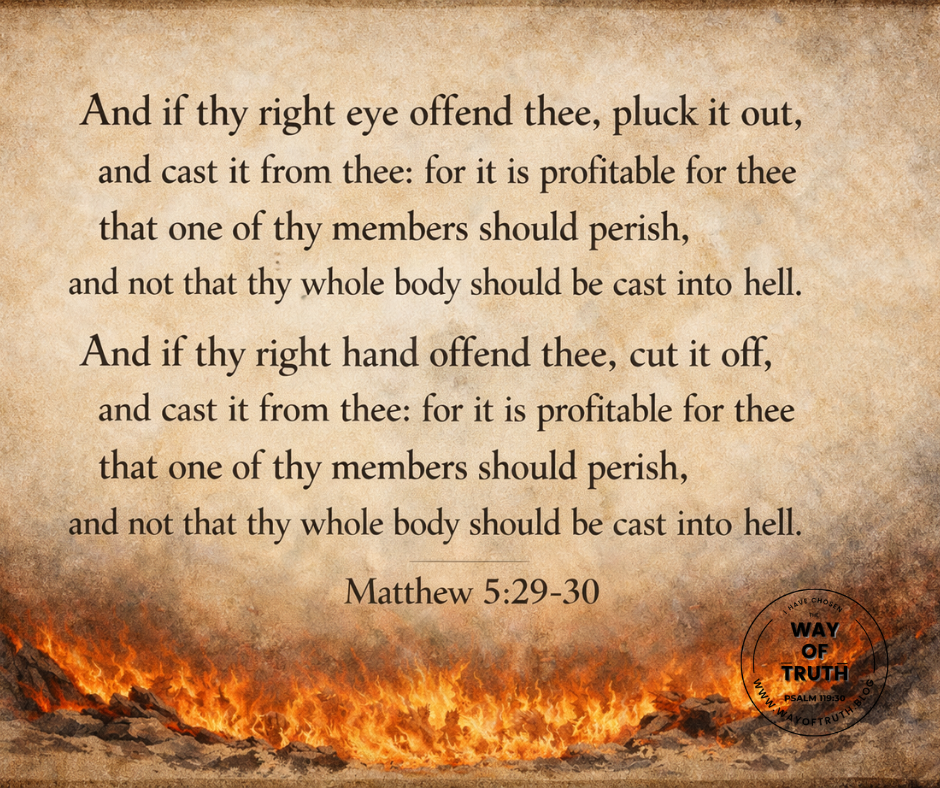
These verses land with a kind of shock that’s hard to ignore. Jesus isn’t softening anything here. He’s pressing the issue of sin with deliberate intensity, and that intensity only makes sense when you remember the flow of the passage. In Matthew 5:27–28, He has already shown that sin is not limited to outward acts but includes inward desire. Lust, anger, and envy are not “lesser” sins simply because they’re hidden. They’re violations of God’s holiness at the heart level.
Now, in verses 29–30, Jesus addresses the logical question that follows: if sin is internal and pervasive, how seriously should we treat it? His answer is unmistakable. We must deal with sin decisively, even radically.
The “right eye” and “right hand” are not random examples. In the ancient world, the right side symbolized strength, skill, and value. These represent things that are useful, precious, even necessary for daily life. In other words, Jesus isn’t talking about cutting off something trivial. He’s talking about relinquishing things we feel we can’t live without.
At the same time, we must be clear: Jesus isn’t commanding literal self-harm. Scripture consistently teaches that sin originates in the heart (Jeremiah 17:9; Mark 7:21–23). Removing a body part can’t remove a sinful nature. If taken literally, this command wouldn’t solve the problem but only mask it. The force of Jesus’ words isn’t in literal action but in moral urgency.
He’s using vivid, almost startling imagery to communicate a truth we tend to minimize: sin is deadly. It’s not a harmless indulgence or a private struggle with no real consequences. It leads to judgment. Jesus explicitly mentions hell, not as a rhetorical flourish, but as a sober reality. That alone challenges modern assumptions that treat sin as a matter of personal preference rather than eternal significance.
Some critics argue that this language is extreme or even unreasonable. But that objection often reveals a deeper issue: a diminished view of sin. If sin is truly rebellion against a holy God, then drastic measures are not excessive but appropriate. Others, on the opposite end, attempt to soften Jesus’ words into mere hyperbole with no practical demand. But the seriousness of His tone resists that reading. The imagery is figurative, but the command is real and pressing.
This passage also exposes the inadequacy of external religion. If sin must be cut off at its source, then outward conformity alone is not enough. The Pharisees focused on behavior. Jesus focuses on the heart. And in doing so, He shows that the problem runs deeper than we would like to admit. This prepares us to see our need not just for correction, but for transformation.
What Radical Obedience Looks Like Today
Once we understand what Jesus is saying, the next question becomes unavoidable: what does this actually look like in real life? It’s one thing to agree that sin is serious. It’s another to act like it is.
Jesus calls for decisive action. Not vague intentions. Not delayed efforts. Action. If something in your life consistently leads you into sin, it can’t remain untouched. That might sound obvious, but in practice, we often resist this. We prefer gradual change, minimal disruption, and comfortable compromises. Jesus doesn’t leave room for that approach.
Consider how this applies in everyday situations. For many, temptation is closely tied to accessibility. If your phone becomes a gateway to sinful habits, then “cutting it off” may mean setting strict boundaries: filters, time limits, or even removing certain apps entirely. If certain relationships pull you toward compromise, it may mean creating distance or redefining those interactions. If particular forms of entertainment shape your desires in unhealthy ways, it may mean letting them go.
And here’s the honest part: it will feel costly. Jesus doesn’t pretend otherwise. In fact, He emphasizes the loss. The language of “plucking out” and “cutting off” is intentionally severe because the sacrifice can feel that way. But He reframes the cost. It’s better to lose something now than to lose everything later.
We often underestimate how sin works. It rarely presents itself as destructive at the outset. It appears manageable, even enjoyable. It promises control. But over time, it reshapes desires, dulls conviction, and hardens the heart. What begins as something small becomes something consuming. That’s why Jesus calls for early, decisive action rather than delayed response.
There’s also a communal aspect to this. The Christian life isn’t meant to be lived in isolation. Within the church, believers are called to encourage one another toward holiness. That includes accountability, honest conversations, and mutual support. Not as a system of surveillance, but as an expression of love. When we take sin seriously together, we help one another stay anchored in truth.
And there’s a deeper freedom here. Sin always promises satisfaction but delivers bondage. Radical obedience, though costly in the moment, leads to genuine freedom. It clears the fog. It restores clarity. It aligns our lives with what’s actually good.
If we’re being candid, most of us already know where the problem areas are. The question isn’t whether we see them. The question is whether we’re willing to act.
A Word of Hope for Those Who Feel the Weight
It’s possible to read a passage like this and feel overwhelmed. The standard seems so high, the demand so absolute, that it exposes how far short we fall. If sin is this serious, and if it runs this deep, what hope is there?
That tension is intentional. Jesus isn’t merely giving moral instruction; He’s revealing the true condition of the human heart. When we see sin clearly, we begin to understand that the problem isn’t occasional failure but a deeper brokenness. We don’t just need better habits but a new nature.
But this isn’t meant to drive us into despair. It’s meant to drive us to Him.
The same Jesus who speaks these hard words is the One who moves toward sinners with compassion. He doesn’t expose sin to shame us into hiding. He exposes it so that we’ll turn and be healed. Throughout the Gospels, we see Him engaging with people who are painfully aware of their sin and have no illusions left. And He doesn’t cast them away. He calls them to repentance and offers restoration.
For believers, this means that the fight against sin isn’t fought alone. The Holy Spirit works within us, convicting, strengthening, and reshaping our desires. Growth in holiness is real, even if it’s often gradual and marked by struggle. The presence of conviction isn’t a sign of failure but evidence that God’s at work.
There’s also grace for the moments when we stumble. Taking sin seriously doesn’t mean living in constant fear of condemnation. It means living in honest awareness, quick repentance, and renewed dependence on God. The goal isn’t perfection achieved by effort, but transformation grounded in grace.
If you feel the weight of this passage, don’t ignore it. But don’t let it crush you either. Let it lead you to a deeper dependence on Christ. He’s both the standard of holiness and the source of forgiveness. And in Him, there’s both truth and mercy held together perfectly.
From Severe Warning to Saving Grace
Maybe as you read this, something feels uncomfortably close to home. You recognize that sin isn’t just an abstract idea but a reality in your own life. You see patterns you’ve excused or minimized. And if you’re honest, you know that simply trying harder hasn’t solved the problem.
That’s exactly where the message of the gospel meets you.
The Bible teaches that sin separates us from God. It’s not a minor flaw but rebellion against the One who created us and defines what’s good. Because of that, sin carries a real penalty. Jesus speaks of hell in this passage because judgment isn’t imaginary. It’s the just consequence of sin.
But God hasn’t left us without hope.
Jesus Christ came into the world and lived the life we have not lived, a life of perfect righteousness, not only in outward actions but in the deepest intentions of the heart. He fulfilled the standard that we fail to meet. Then He willingly went to the cross, where He took upon Himself the punishment that sin deserves. He bore the judgment so that sinners could be forgiven.
Three days later, He rose from the dead, demonstrating His victory over sin and death. This isn’t symbolic. It’s the foundation of the hope He offers.
And here’s the invitation: you don’t earn this forgiveness. You receive it. When you turn from your sin—honestly, without excuses—and place your trust in Jesus Christ, God forgives you completely. Not partially. Not conditionally. Completely. He gives you a new heart and begins the work of transforming your life from the inside out.
This passage calls us to take sin seriously. The gospel shows us how that’s possible. Not through self-punishment, not through moral effort alone, but through the saving work of Christ.
So come to Him as you are. Don’t wait for a better version of yourself. Trust Him now. He’s ready to forgive, ready to restore, and ready to lead you into a life that reflects His goodness.
Reflection and Response
- What specific influences in your life are consistently leading you toward sin, and what would it look like to remove them decisively?
- Are there areas where you have been managing sin rather than confronting it? Why have you hesitated to take stronger action?
- How does Jesus’ warning about hell reshape your understanding of sin’s seriousness and its consequences?
- In what ways can you invite trusted believers into your life for accountability and encouragement in pursuing holiness?
- How does the gospel give you both the motivation and the assurance needed to fight sin and live for the glory of God?