
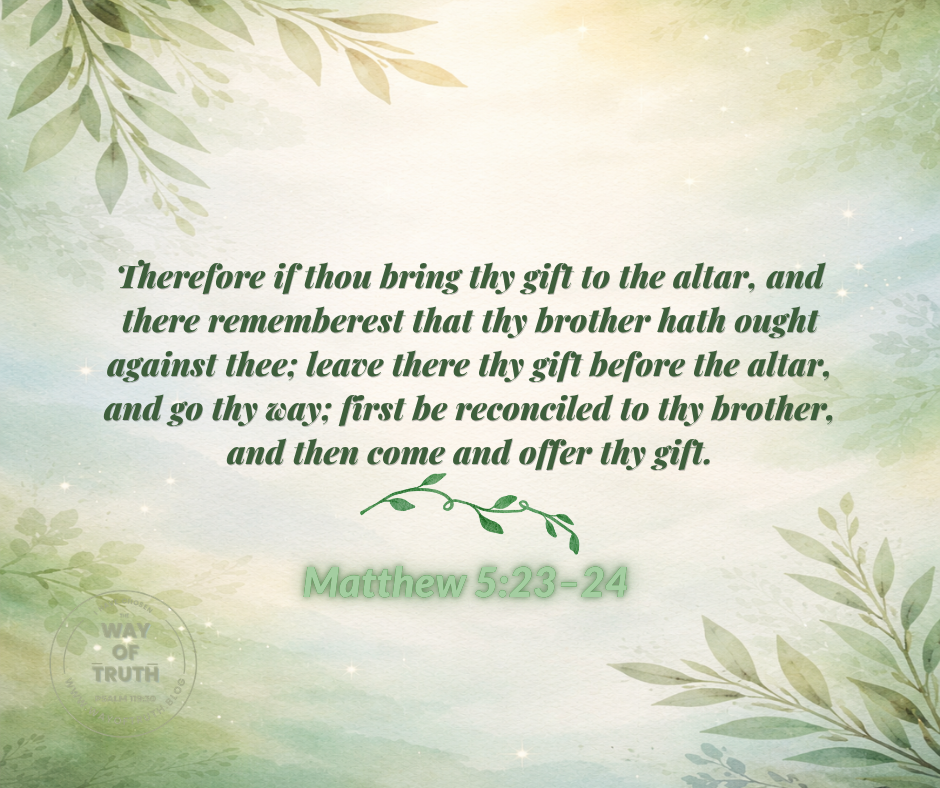
Jesus continues His teaching from the previous verses, where He exposed the seriousness of anger and contempt. Now He takes it one step further. He moves from the inner condition of the heart to outward action, and not just any action, but worship itself.
“Therefore…” ties this directly to what came before. Because anger places us under judgment, unresolved conflict isn’t a small issue we can tuck away while we go about religious duties. Jesus paints a vivid scene: a person bringing a gift to the altar, likely at the temple, engaged in what would have been considered a deeply sacred act. Everything looks right on the outside.
But then something happens. Mid-worship, the person remembers that a brother “hath ought against thee.” Notice that wording carefully. This isn’t about holding a grudge. It’s about realizing someone else has something against you. That subtle shift matters. Jesus is placing responsibility on the worshiper, not the offended party.
And what does He command? Not “finish your offering quickly” or “pray about it later.” He says, “Leave there thy gift… and go.” Worship is paused. Reconciliation takes priority.
That can feel surprising. After all, shouldn’t worship come first? Yet Jesus isn’t diminishing worship. He’s revealing what true worship actually is. If we claim to honor God while disregarding broken relationships we’ve contributed to, something is off at the root.
This also fits the broader witness of Scripture. In 1 Samuel 15:22, obedience is better than sacrifice. In Isaiah 1, God rejects offerings given alongside injustice. The consistent message is that external acts of worship can’t compensate for a heart and life that ignore God’s moral will.
Some might object, “Isn’t this unrealistic? What if reconciliation isn’t possible?” Jesus isn’t demanding control over outcomes, but responsibility for initiative. The command is to go, to seek reconciliation, to make things right as far as it depends on you.
Others may twist this passage into a kind of moralism, suggesting that reconciliation earns acceptance before God. That would miss the point entirely. Jesus isn’t teaching salvation by relational perfection. He’s exposing the kind of righteousness that reflects a heart aligned with God.
In a world that often separates “spiritual life” from everyday relationships, Jesus refuses to allow that division. Worship and reconciliation belong together. You can’t meaningfully offer one while neglecting the other.
The Urgency of Making Things Right
There’s an unmistakable urgency in this passage. Jesus doesn’t say, “Eventually get around to reconciliation.” He says, “first be reconciled.” That word “first” rearranges priorities in a way that feels almost disruptive.
Picture the scene again. You’ve traveled to the altar. You’ve prepared your offering. Everything is in place. And then you remember a strained relationship. At that moment, Jesus says, stop. Leave it. Go deal with it.
That tells us something important. God isn’t impressed by uninterrupted religious performance. He values integrity. He cares about the condition of our relationships because they reflect the condition of our hearts.
This doesn’t mean every disagreement must be resolved before we can pray or gather for worship. That would be impossible. But it does mean that when we become aware of real offense, especially where we have contributed to it, we don’t ignore it, justify it, or delay it indefinitely.
Let’s be honest. Most of us are pretty skilled at spiritual multitasking. We’ll sing, pray, read Scripture, and serve, all while quietly avoiding a difficult conversation we know we should have. Jesus gently but firmly disrupts that pattern.
There’s also humility built into this command. It’s not easy to approach someone and say, “I may have wronged you,” or even, “I know you’re upset with me, and I want to make this right.” That requires laying down pride.
And yet, that humility is exactly what reflects God’s character. Scripture consistently ties love for God to love for others. You can’t separate them without distorting both.
There’s a bit of irony here too. We often think reconciliation will “cost” us something: our pride, our comfort, maybe even our sense of being right. But unresolved conflict quietly costs far more. It drains joy, hinders prayer, and fractures fellowship.
So, Jesus isn’t giving a burdensome command. He’s pointing us toward freedom, even if the first step feels uncomfortable.
Living This Out Together
This passage lands differently when we bring it into everyday life. It’s not about ancient altars. It’s about phone calls we’ve been avoiding, conversations we’ve postponed, tensions we’ve learned to live with.
For the church, this is especially important. Our unity isn’t built on shared preferences or personalities. It’s built on Christ. That means reconciliation isn’t optional maintenance; it’s part of our witness.
When believers refuse to address conflict, it doesn’t just affect those involved. It subtly shapes the culture of the whole community. Distance becomes normal. Silence replaces honesty. Over time, that weakens the church’s ability to reflect the gospel.
On the other hand, when reconciliation is pursued, even imperfectly, it shows something different. It shows that grace isn’t just something we talk about, but something we practice.
This also calls for discernment. Not every situation will resolve neatly. Some relationships are complicated, and some people are unwilling to reconcile. Scripture acknowledges that reality. In Romans 12:18, we’re told, “If it be possible, as much as lieth in you, live peaceably with all men.”
That phrase matters. “As much as lieth in you.” Our responsibility is to take initiative, to seek peace, to act in humility. The outcome isn’t always in our control.
Still, the heart posture remains. We don’t ignore, excuse, or harden ourselves. We move toward reconciliation where we can.
Practically, this might look like:
- Initiating a conversation instead of waiting for the other person
- Owning our part without immediately defending ourselves
- Listening carefully instead of preparing our next argument
- Extending forgiveness, even when it’s costly
And yes, sometimes it means awkward conversations. The kind where you replay the opening line in your head five times before saying it. But those moments often become the doorway to restored fellowship.
Above all, this passage reminds us that our relationship with God and our relationships with others are deeply connected. We don’t earn God’s favor through reconciliation, but reconciliation reflects that we understand His grace.
And just to keep it real: if you’ve ever felt the nudge during worship like, “You really should call that person,” you’re not imagining things. You’re experiencing exactly what Jesus is describing.
If Your Heart Is Stirred Toward Something Deeper
Maybe as you read this, you’re thinking about a specific relationship. Or maybe you’re realizing that the deeper issue isn’t just conflict with others, but your relationship with God Himself.
The truth is, every one of us stands in need of reconciliation, not just with people, but with God. Scripture teaches that our sin separates us from Him. It’s not just the obvious things like anger or harsh words. It’s the deeper reality that our hearts naturally drift away from His ways.
And that separation carries a real consequence. God is holy and just, and sin can’t simply be overlooked. The penalty is death, both physical and eternal.
But here’s the good news: God didn’t leave us in that condition.
Jesus Christ came into the world and lived the perfect life we could never live. He fulfilled the very standard He teaches in passages like this one. Then He went to the cross and took upon Himself the penalty for our sin. He died in our place.
And He didn’t stay in the grave. He rose again, defeating sin and death, proving that His sacrifice was accepted.
Because of what Christ has done, reconciliation with God is possible. Not through our efforts or religious performance, but through repentance and faith. Turning from sin. Trusting in Him.
If you’ve never taken that step, you don’t have to wait for the perfect moment. You can come to Him right now. Speak honestly. Acknowledge your need. Trust that what He has done is enough.
And if you do know Him, this passage gently calls you back to live in light of that reconciliation. To extend to others what God has graciously extended to you.
Reflection and Response
- Is there a relationship in your life where you’ve been aware of tension but have delayed taking a step toward reconciliation?
- Are you more inclined to focus on your own grievances, or to consider where others may have something against you?
- How does your approach to conflict reflect your understanding of God’s grace toward you?
- What practical step can you take this week to pursue peace with someone, even if it feels uncomfortable?
- In what ways can you actively reflect God’s glory by promoting unity and sharing the message of reconciliation through Christ?