
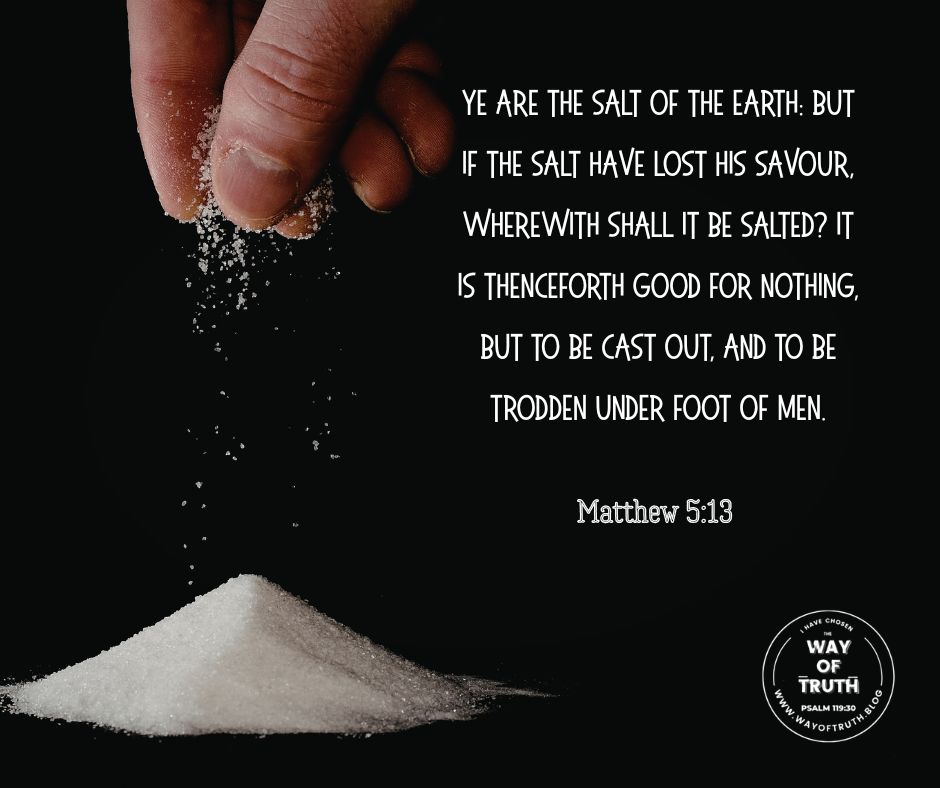
Jesus doesn’t begin with a command. He begins with a declaration: “Ye are the salt of the earth.” That matters. Before telling His followers what to do, He tells them what they are. This statement comes right after the Beatitudes, which describe the character of those who belong to His kingdom. In other words, the kind of people described in verses 3–12 are the very people who function as salt in the world.
Salt in the ancient world wasn’t just a seasoning. It preserved food from decay and added flavor. Both ideas help us understand what Jesus is saying. His people are meant to slow moral decay and bring something distinct and life-giving into a broken world. Not by force, not by political dominance, but by the quiet, steady presence of truth-shaped lives.
This also assumes something about the world itself. If salt is needed, then the world is already in a state of decay. Scripture consistently affirms this. Humanity is not neutral; it’s fallen (Romans 3:23). That’s why influence matters. Without it, things don’t stay the same. They deteriorate.
Some might object here and say Christianity is just one voice among many moral systems. But Jesus doesn’t present His followers as one option among others. He presents them as necessary. Not because of personal superiority, but because they carry truth revealed by God Himself.
So, the identity is clear: if you belong to Christ, you’re meant to have a preserving, distinct, noticeable influence. Not loud for the sake of being loud, but unmistakably different because of who you follow.
When Salt Loses Its Purpose
Jesus immediately follows the declaration with a warning: “but if the salt have lost his savour, wherewith shall it be salted?” That question isn’t meant to be answered. It’s meant to stop you.
Salt that doesn’t act like salt is useless.
Now, chemically speaking, pure salt doesn’t lose its saltiness. But in Jesus’ day, salt was often mixed with impurities. Over time, the useful part could be leached out, leaving behind something that looked like salt but had no real effect. That’s the picture.
It’s possible to appear connected to Christ and yet lose the distinctiveness that marks genuine discipleship.
This doesn’t mean a true believer can lose salvation. Scripture consistently teaches that those who are truly born again are kept by God (John 10:28). But it does mean that a profession of faith without transformation is empty. Jesus isn’t describing someone who struggles. He’s describing someone who has become indistinguishable from the world.
That kind of “salt” is described as “good for nothing.” That’s strong language, but it fits the point. If the purpose is gone, the value is gone.
You’ll sometimes hear the idea that faith is a private matter, something that shouldn’t affect how you live publicly. This verse challenges that directly. If your faith doesn’t shape your life, then what exactly is it doing?
Jesus isn’t calling for perfection, but He is calling for reality. A life connected to Him will, over time, reflect Him. Not flawlessly, but genuinely.
Living as Salt in a Decaying World
If Jesus says, “Ye are the salt of the earth,” then the question isn’t whether you have influence. It’s what kind.
Salt works quietly. It doesn’t draw attention to itself. Nobody compliments the salt directly. They just notice that something tastes right. That’s helpful. Christian influence often looks less like spotlight moments and more like consistent, faithful presence.
In your daily life, this means integrity when no one’s watching. It means telling the truth when it would be easier to soften it. It means refusing to participate in what you know dishonors God, even when it costs you socially or professionally. These aren’t dramatic acts, but they’re powerful ones. They preserve.
At the same time, salt adds flavor. There should be something compelling, even attractive, about a life shaped by Christ. Not artificial cheerfulness, but real hope. Not shallow positivity, but steady confidence in God. When others are anxious, bitter, or cynical, a believer has the opportunity to respond differently. That difference points somewhere.
For the Church, this is a collective calling. We’re not meant to withdraw from the world, but neither are we meant to blend into it. When churches lose clarity on truth in an effort to be accepted, they don’t become more effective. They become less useful. A saltless church doesn’t preserve anything.
It’s worth asking: where am I tempted to dilute what I know is true? Is it in conversations? In decisions? In priorities? It doesn’t usually happen all at once. It happens gradually, through small compromises that feel reasonable in the moment.
But the goal isn’t to retreat into isolation or to act superior. It’s to live faithfully in the places God has already put you. Your home, your workplace, your friendships. That’s where salt does its work.
And don’t miss this: salt has to be in contact with what it’s preserving. If it stays in the container, it doesn’t help anything. Faithfulness doesn’t mean distance from people. It means presence with purpose.
Above all, remember why this matters. Your life isn’t just about personal growth. It’s about God’s glory. When you live in a way that reflects His truth, you point others toward Him. That’s part of how the gospel moves forward.
From Corruption to Renewal
Maybe as you read this, you recognize something uncomfortable. Not just a lack of influence, but a deeper issue. The Bible doesn’t just say the world is decaying. It says we’re part of the problem apart from Christ.
That’s not meant to discourage you. It’s meant to be honest.
Sin isn’t just about outward actions. It’s a condition of the heart. It separates us from God, who is holy and just. And the consequence of that separation is serious. Scripture speaks of judgment, not because God is harsh, but because He’s righteous.
But the message doesn’t stop there.
God didn’t leave us in that condition. Jesus Christ entered into the very world He describes here. He lived perfectly, without sin, and then willingly went to the cross. There, He took the penalty that sin deserves. Not His own, but ours. And when He rose again, He showed that sin and death don’t have the final word.
That’s the heart of the gospel.
Through repentance and faith, a person can be forgiven and made new. Not gradually improved but truly transformed. Brought from spiritual death to life. Given a new identity and a new purpose.
That’s where being “salt” really begins. You don’t become salt by trying harder. You become salt by being made new through Christ.
So, if you’ve never trusted Him, don’t treat this as abstract theology. It’s personal. Turn from your sin. Place your trust in Jesus Christ. Not in your efforts, not in your morality, but in what He has done.
And if you do, you won’t just be changed privately. Your life will begin to carry a quiet, steady influence that points others toward the same hope you’ve found.
Reflection and Response
- In what areas of your life are you most tempted to “blend in” rather than remain distinct in your faith?
- How does your daily conduct either preserve truth or contribute to moral compromise around you?
- Are there relationships where God may be calling you to be a clearer witness of His truth and grace?
- What small, faithful choices can you make today to live more consistently as “salt”?
- How does remembering the gospel reshape your motivation to live for God’s glory and share Christ with others?