
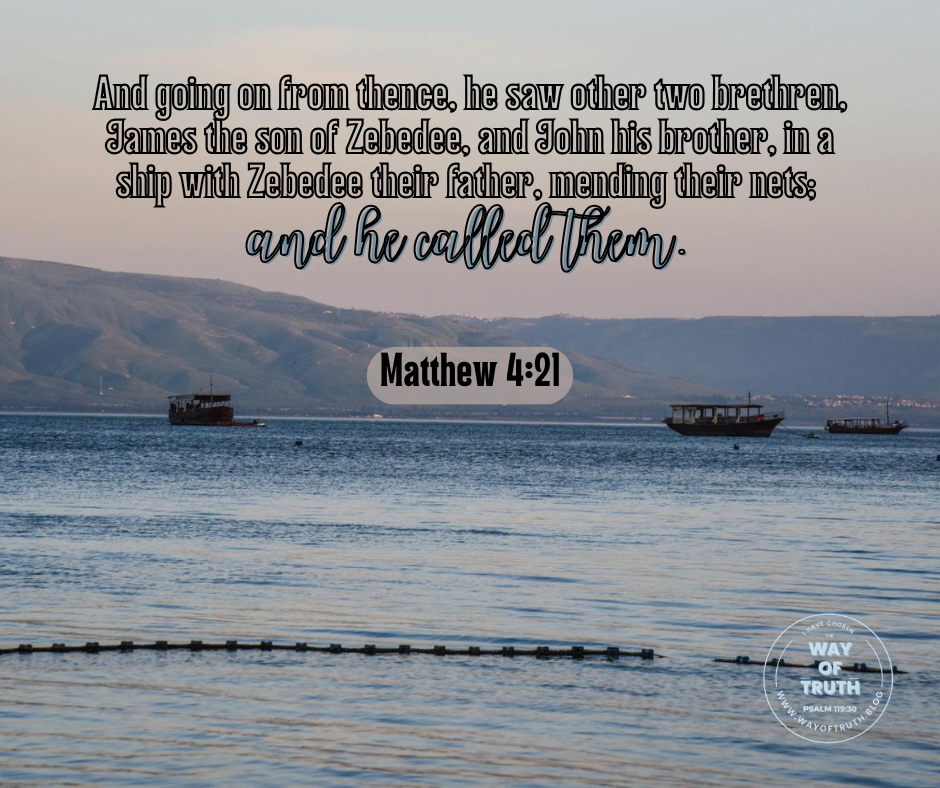
Matthew 4:21 continues the unfolding scene along the Sea of Galilee. Jesus has already called Peter and Andrew, and now He moves a little farther down the shoreline. The pattern repeats, but with a few meaningful details added.
“And going on from thence, he saw other two brethren, James the son of Zebedee, and John his brother.”
Again, Jesus notices two brothers. The gospel frequently moves through relationships that already exist. Faith often spreads along the lines of family, friendship, and shared work. The first disciples aren’t isolated individuals discovered in random places; they’re embedded within real households and communities.
Matthew then describes their situation: “in a ship with Zebedee their father, mending their nets.”
This small snapshot reveals a working family. Fishing was rarely a solitary trade. It involved teamwork, shared equipment, and the daily maintenance of tools. Nets had to be cleaned, repaired, and prepared for the next catch. If a net tore, the entire effort could fail.
James and John aren’t idle observers when Jesus arrives. They’re busy repairing what has been worn by previous work. The detail reminds us that discipleship often begins in the middle of responsibility, not outside it.
Another subtle feature appears here: their father is present.
The call of Christ is about to interrupt an ordinary family moment. That detail quietly raises the stakes. Leaving the nets is one thing. Leaving the boat with your father in it is something else entirely. The cost of following Jesus becomes more visible in this scene.
Then Matthew writes the simplest phrase in the entire verse: “and he called them.”
No extended speech. No complicated argument. Just the authority of Christ issuing a summons.
This brief phrase captures something essential about the ministry of Jesus. His authority is not merely persuasive; it’s commanding. He doesn’t only offer ideas to consider. He calls people to follow.
Some skeptics view passages like this as mythological embellishments, arguing that real people would not respond to such a sudden summons. But the Gospels consistently portray Jesus as possessing a unique moral authority that compelled attention. Even His critics acknowledged that He taught “as one having authority” (Matthew 7:29).
The power of His call didn’t come from theatrical charisma but from the truth of His identity.
Matthew 4:21 therefore shows us something deeply personal about discipleship. Jesus doesn’t simply announce a general message and wait for volunteers. He calls specific people.
James and John are not merely part of a crowd.
They are seen.
They are addressed.
They are summoned.
And their lives are about to change forever.
When the Call of Christ Interrupts Ordinary Life
The scene in Matthew 4:21 highlights something many believers experience: the call of Christ often arrives in the middle of ordinary life.
James and John are not attending a religious event. They’re not searching for spiritual direction on a mountaintop. They’re repairing fishing nets with their father. In other words, they’re doing what they normally do.
Then Jesus calls.
This pattern appears throughout Scripture. God frequently meets people in the flow of everyday responsibility. Moses encounters the burning bush while tending sheep. David is called while watching flocks. Elisha is summoned while plowing a field.
The message is clear: ordinary life is not spiritually invisible.
Your daily work, routines, and relationships are not barriers to God’s calling. They’re often the very context in which His voice becomes clear. The kingdom of God doesn’t operate only in obviously religious environments. It intersects with kitchens, offices, farms, boats, classrooms, and construction sites.
Another important detail in this verse is the presence of Zebedee, the father of James and John. Discipleship sometimes introduces tension into familiar relationships. The decision to follow Christ can reshape priorities, expectations, and long-standing plans.
This doesn’t mean Christianity dismisses family responsibility. In fact, Scripture consistently calls believers to love and care for their families. But the call of Christ ultimately takes precedence over every other loyalty. Jesus will later make this explicit when He teaches that allegiance to Him must come before even the closest human relationships (Matthew 10:37).
That truth can feel uncomfortable in a culture that treats personal autonomy as the highest value. Yet the Christian claim is that Jesus is not merely another voice competing for influence. He’s the rightful King.
When the King calls, obedience is the appropriate response.
For the church, this passage also offers encouragement. The early disciples weren’t selected from the ranks of religious elites or political leaders. They were working men who responded to the authority of Christ. Their transformation would come through years of walking with Him, learning from Him, failing, repenting, and growing.
That pattern still shapes Christian discipleship today. Following Christ doesn’t require perfect understanding or flawless character. It begins with a willingness to respond when He calls.
And it continues through a lifetime of being shaped by His presence.
The Call That Still Reaches People Today
The brief phrase “he called them” continues today through the message of the gospel.
Every person eventually encounters the same fundamental reality: humanity is separated from God because of sin. Sin isn’t simply wrong behaviors. It’s a deeper posture of independence from our Creator. We live as though we belong to ourselves rather than to the God who made us.
That separation leads to spiritual darkness and ultimately judgment.
But the story of the gospel is that God did not abandon humanity in that condition. Jesus Christ entered the world to accomplish what we could never accomplish ourselves. He lived a perfectly obedient life, fulfilling the righteousness that God requires.
Then He went to the cross.
There, Jesus bore the penalty for sin in the place of sinners. The judgment that belongs to us fell upon Him instead. Three days later, He rose from the dead, demonstrating His victory over sin, death, and the grave.
Because of Christ’s death and resurrection, forgiveness and new life are offered to all who trust Him.
This is where the call of Christ becomes personal. Just as Jesus called James and John, the gospel calls each person to respond.
That response begins with repentance and faith. Repentance means turning away from sin and self-rule. Faith means trusting Jesus Christ alone as Savior and King.
You can’t earn salvation through effort or religious performance. You receive it by trusting the One who gave His life to rescue sinners.
If you’ve never responded to Christ’s call, the invitation remains open. Turn from sin. Believe in Jesus Christ. Follow Him.
The same Savior who once walked along the Sea of Galilee still calls people today.
And those who answer discover that their lives become part of a far greater story than they ever imagined.
Reflection and Response
- What does the presence of Zebedee in this scene reveal about the cost of following Christ?
- Why do you think Jesus often called people in the middle of their everyday work?
- How does this passage challenge the idea that spiritual calling only happens in dramatic moments?
- In what ways does Christ continue to call people through the message of the gospel today?
- What might responding to Jesus’ call look like in your current season of life?