
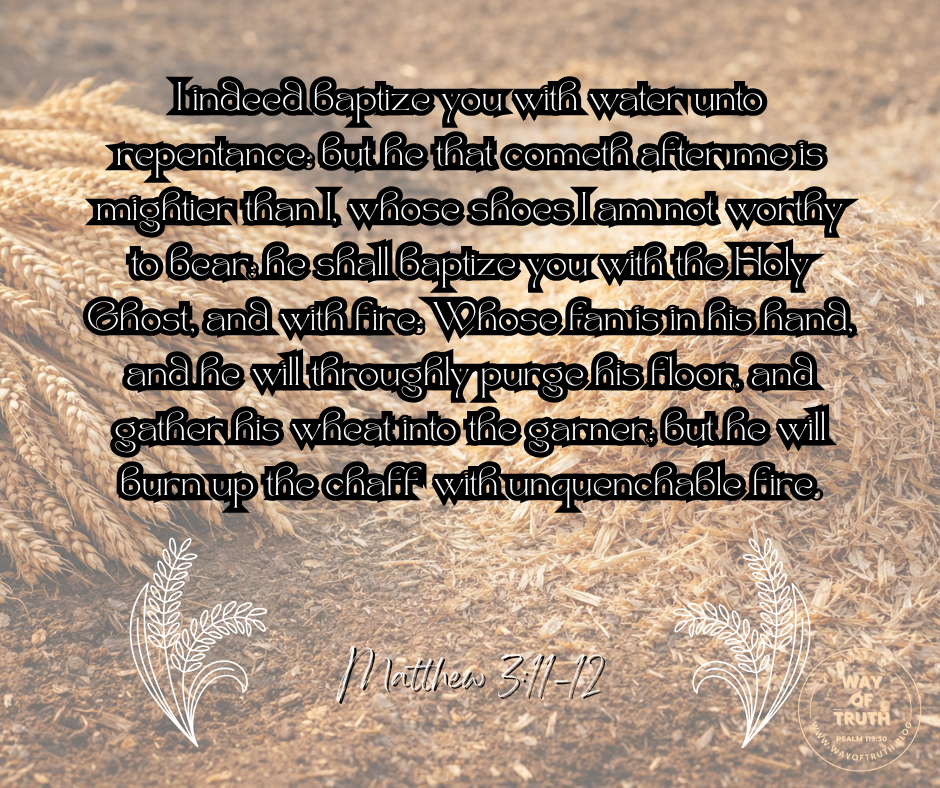
After preaching with prophetic authority and confronting religious leaders with fearless clarity, John draws attention away from himself. “He that cometh after me is mightier than I.” True ministry always points forward to Christ.
John’s humility is striking. “Whose shoes I am not worthy to bear.” In that culture, carrying sandals was the task of the lowest servant. John, though recognized as a prophet, considers himself unworthy of even that role in relation to the coming Messiah. This isn’t false modesty. It’s accurate theology. The distance between prophet and Messiah is vast.
John contrasts two baptisms. “I indeed baptize you with water unto repentance.” His baptism symbolized a change of heart. It prepared people for what was coming. But the coming One “shall baptize you with the Holy Ghost, and with fire.”
Here the scope widens. The Messiah doesn’t merely call for repentance. He effects transformation. To be baptized with the Holy Ghost speaks of inward renewal, empowerment, and the gift of God’s own presence. This anticipates Pentecost and the broader New Testament teaching that salvation includes the indwelling Spirit.
The mention of “fire” carries both purifying and judicial connotations. In the immediate context, especially with verse 12, the fire leans toward judgment. The same Messiah who gives the Spirit also executes justice. Scripture refuses to divide Christ into only gentle teacher or only severe judge. He’s both Savior and King.
John’s message guards against reducing Jesus to a moral influencer. The One coming after him is mighty. His work penetrates the soul and determines eternal destinies.
The Winnowing Fan and the Final Separation
Verse 12 intensifies the imagery. “Whose fan is in his hand.” The “fan” refers to a winnowing fork used to toss grain into the air. The heavier wheat would fall to the floor. The lighter chaff would blow away.
“He will throughly purge his floor.” This is decisive language. Thoroughly. Completely. The Messiah doesn’t conduct partial evaluations. He separates wheat from chaff with precision.
The wheat is gathered “into the garner.” That is protection, preservation, and belonging. The chaff, however, “will burn up…with unquenchable fire.” The fire isn’t momentary or symbolic inconvenience. It’s unquenchable.
These images fit the broader biblical pattern. The prophets spoke of the Day of the Lord as both salvation and judgment. Jesus will later teach in parables about separation at the end of the age. The apostles affirm final accountability.
Some modern readings attempt to soften “unquenchable fire” into temporary discipline or metaphorical discomfort. Yet the weight of Scripture supports the seriousness of eternal consequence. The same voice that promises eternal life warns of eternal judgment.
The winnowing image is especially sobering because wheat and chaff grow together on the same plant. They share space on the same floor. Outward proximity doesn’t determine final destiny. The Messiah Himself distinguishes.
This confronts complacency. It also comforts believers. The One who purges the floor is not arbitrary. He’s righteous. He knows the difference between wheat and chaff better than we do.
Living Between Water and Fire
For the church, these verses are both encouraging and clarifying.
First, they remind us that repentance is not the end. It’s preparation. John’s water baptism pointed forward. Christian life is empowered by the Holy Spirit. We don’t live by external reform alone but by inward renewal.
Second, they call us to humility. If John the Baptist considered himself unworthy to carry Christ’s sandals, how carefully should we guard against self-exaltation? Ministry, influence, and gifting are not platforms for ego. They’re opportunities to magnify the mightier One.
Third, these verses sharpen our understanding of mission. The Messiah gathers wheat. That implies evangelism. He also burns chaff. That implies urgency. We can’t preach comfort without truth, nor judgment without grace.
There’s also a personal question here: are we wheat or chaff? Wheat has substance. It has weight. It remains when tested. Chaff is light, rootless, and easily blown away. A life rooted in Christ endures scrutiny. A life built on appearance does not.
The Spirit’s work produces depth. Conviction. Love. Perseverance. Those are marks of wheat.
We live in a culture that prefers blurred lines and softened categories. John and Jesus do not. The floor will be purged. The separation will be thorough.
That reality shouldn’t make believers anxious but earnest. We serve a mighty Savior who both saves and reigns.
If You Have Not Yet Met the Mightier One
If you don’t yet know Christ, these verses present both warning and hope.
The warning is clear. There is real separation. There’s unquenchable fire. These aren’t relics of primitive religion. They’re part of the consistent teaching of Scripture. Judgment isn’t random cruelty. It’s the righteous response of a holy King to persistent sin.
But the hope is even clearer. The One who judges is also the One who baptizes with the Holy Ghost. He gives new life. He forgives sin. He gathers wheat into His garner.
Jesus Christ lived the perfect life we have not lived. He died on the cross, bearing the wrath we deserve. He rose again, conquering death. Through repentance and faith, we’re united to Him. The Spirit is given. The root changes. The destiny changes.
You can’t transform yourself into wheat by effort. You must be born again. Turn from sin. Trust in Christ alone. Ask Him to forgive you and make you new.
The fan is in His hand. But so is mercy.
Don’t delay. The mightier One has come.
Reflection and Response
- Does my life reflect the humility of John or the self-importance of my culture?
- Am I relying on external religion, or on the inward work of the Holy Spirit?
- In what ways is the Spirit producing lasting fruit in my life?
- How does the reality of final separation shape my urgency in sharing the gospel?
- Have I personally trusted in Christ, the One who gathers wheat and judges chaff?