
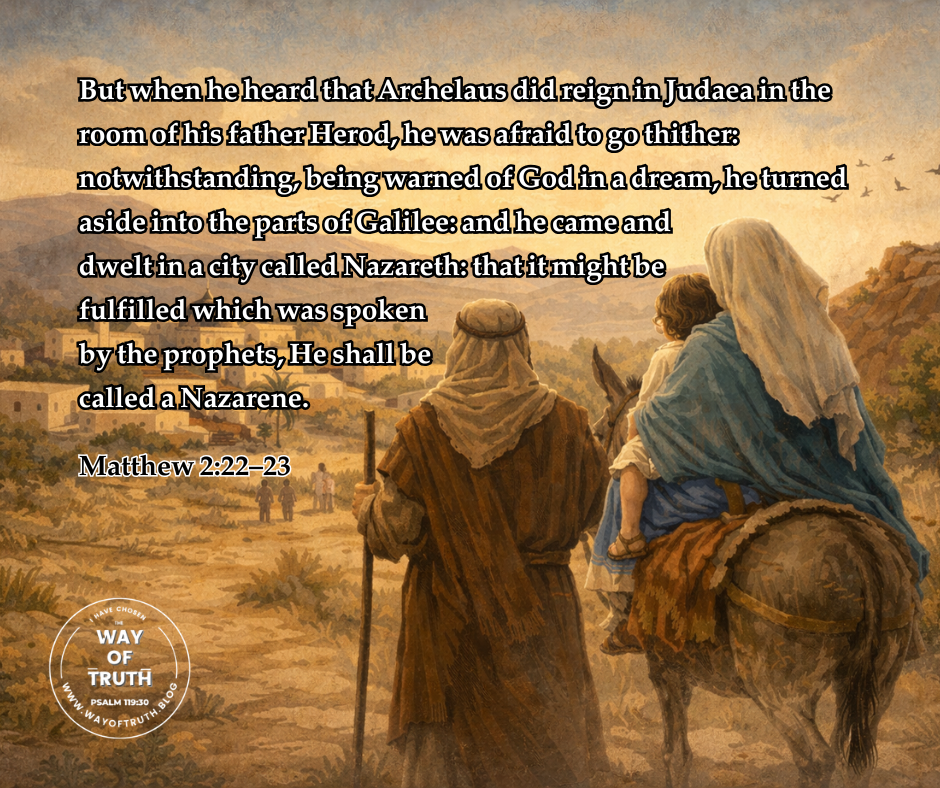
In Matthew 2:22-23, Joseph hears that Archelaus, Herod’s son, now rules in Judea. History tells us Archelaus was as unstable and cruel as his father. Joseph’s fear isn’t unbelief, but reasonable caution. The text doesn’t rebuke his concern. Instead, it records that God meets him again with direction.
“Being warned of God in a dream.” Once more, divine revelation intersects ordinary anxiety. Joseph doesn’t allow fear to dictate his path, nor does he ignore it recklessly. He waits for God’s word. The result is a redirection to Galilee.
Then comes Nazareth.
Nazareth wasn’t a celebrated city. It was small, obscure, and not associated with royal prestige. To settle there seems anticlimactic after prophetic dreams and angelic interventions. Yet Matthew says this too fulfills what was spoken by the prophets: “He shall be called a Nazarene.”
The wording is notable. Matthew doesn’t cite a single prophet by name but refers broadly to “the prophets.” This suggests not a quotation from one verse, but a thematic fulfillment. The Messiah would be despised, lowly, and regarded without honor. Nazareth carried that reputation. Later in the Gospel, Nathanael will ask, “Can there any good thing come out of Nazareth?”
Matthew isn’t forcing geography into prophecy. He’s showing that the Messiah’s humble association aligns with the prophetic portrait of the suffering, rejected Servant. The King will not grow up in Jerusalem’s courts, but in an overlooked village.
From a theological standpoint, this reinforces a consistent biblical pattern: God exalts what the world dismisses. The Messiah’s obscurity is not a detour. It’s God’s design.
Matthew 2:22–23 reminds us that divine fulfillment often unfolds in unimpressive places.
Faithfulness in the Ordinary
These verses speak to anyone who feels their setting is small or unnoticed.
Nazareth wasn’t Rome or Jerusalem. It wasn’t a center of influence. Yet it became the home of the Son of God. That alone should recalibrate how we think about significance.
Joseph’s obedience continues quietly. He doesn’t argue for a more prestigious location. He doesn’t seek visibility. He receives God’s direction and settles his family in a humble place. Faithfulness is measured by obedience, not prominence.
For believers today, this is deeply encouraging. Many serve Christ in ordinary towns, routine jobs, and unseen ministries. The world measures worth by scale and recognition. Scripture measures it by alignment with God’s will.
The Church must guard against equating spiritual success with visibility. The Messiah grew up in obscurity for decades before public ministry. God’s work is often incubated in hidden seasons.
Joseph’s fear also teaches us something practical. He didn’t deny it. He brought it under God’s guidance. There’s a difference between being ruled by fear and responding wisely to real danger. Faith isn’t reckless bravado. It’s responsive obedience.
On a personal level, consider where God has placed you. Do you see it as insignificant? Nazareth challenges that assumption. God’s purposes unfold in ordinary spaces. Holiness isn’t confined to famous platforms.
There’s also a quiet humility in the title “Nazarene.” It would later be used in mockery. Jesus of Nazareth. The label of a small town attached to the Savior of the world. Yet that humility foreshadows the cross, where the King would be publicly despised.
The path of Christ is not upward in worldly terms. It’s downward in humility, then upward in resurrection.
For the Church, this shapes our witness. We proclaim a crucified and risen Lord who embraced obscurity before glory. That message may not impress by the world’s metrics. But it reveals God’s wisdom.
The Savior from an Unlikely Place
Matthew 2:22–23 shows us something beautiful about the gospel. God’s plan doesn’t depend on impressive beginnings.
Jesus grew up in Nazareth, a town with little reputation. Yet He was the promised Messiah. His humble upbringing foreshadowed the greater humility of His ministry and death.
Humanity’s greatest problem isn’t lack of prestige, but sin. We have rebelled against God. The penalty for sin is death and separation from Him. No amount of status or success can erase our guilt.
Jesus, the Nazarene, lived without sin. He fulfilled the law perfectly. He embraced rejection and went to the cross, bearing the judgment sinners deserve. He rose again, proving that death was defeated.
The world may overlook what God exalts. The cross appeared weak. Nazareth seemed unimpressive. Yet through that weakness, God accomplished salvation.
If you don’t already know Jesus Christ as your Lord and Savior, understand that the One once dismissed as “the Nazarene” is the risen Lord. He invites you to turn from sin and trust Him. Forgiveness is offered freely. Eternal life is secured not by your reputation, but by His finished work.
And if you belong to Christ, let this passage steady you. You don’t need a grand stage to serve faithfully. The Savior who came from Nazareth sees you where you are. Walk humbly. Obey consistently. Trust deeply.
Reflection and Response
- How does Nazareth reshape your understanding of spiritual significance?
- What does Joseph’s response to fear teach you about wise obedience?
- In what “ordinary” place has God positioned you for faithful service?
- Why is humility central to Christ’s mission?
- How can you reflect the quiet faithfulness modeled in this passage?