
Matthew opens his Gospel with what many readers are tempted to skim. A list of names doesn’t feel like a dramatic way to introduce the story of Jesus. Yet Matthew knows exactly what he’s doing. He begins not with a miracle or a sermon, but with a record. This is history with purpose.
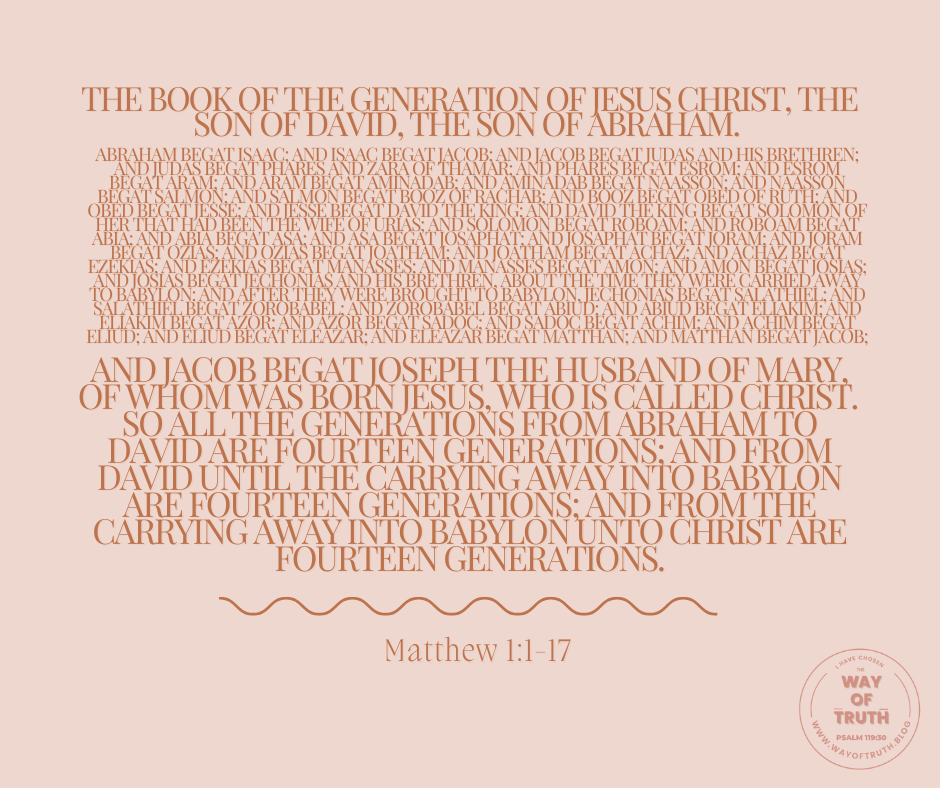
The opening line sets the tone: “The book of the generation of Jesus Christ.” That phrase echoes Old Testament genealogies and signals continuity, not novelty. Jesus doesn’t arrive out of nowhere. He stands at the culmination of a long, deliberate story. By calling Him “the son of David, the son of Abraham,” Matthew anchors Jesus in two covenant promises. From Abraham comes the promise of blessing to the nations; from David comes the promise of an enduring king. Before Jesus speaks a word or performs a sign, Matthew tells us He belongs here.
The genealogy itself is selective and structured. Matthew arranges it into three groups of fourteen generations, moving from Abraham to David, from David to the Babylonian exile, and from the exile to Christ. This isn’t careless omission; it’s theological craftsmanship. The pattern highlights key moments in Israel’s story: promise, kingdom, collapse, and restoration. History has direction. It’s going somewhere.
What’s especially striking is who appears in this list. Matthew includes women, something uncommon in ancient genealogies, and not just any women. Tamar, Rahab, Ruth, and “her that had been the wife of Urias” all carry complicated, even scandalous, stories. Some were Gentiles. Some were associated with sexual sin or social shame. Matthew doesn’t clean up the family tree. He presents it honestly. The Messiah’s lineage includes sinners, outsiders, and broken lives. That’s not an embarrassment to be hidden; it’s part of the point.
The kings, too, tell a story. David is named “the king,” but his sin is not glossed over. Solomon is identified through David’s failure with Bathsheba. Later kings range from faithful to disastrous, and the exile stands as a public reminder of judgment. Yet the genealogy doesn’t end in Babylon. It moves through the silence and obscurity until it reaches Joseph and Mary, and finally Jesus, “who is called Christ.” That phrasing matters. Jesus is not merely another link in the chain. He is its goal.
Skeptical objections often dismiss genealogies as artificial or theologically motivated rather than historical. But motivation doesn’t negate truth. Ancient genealogies regularly arranged material for meaning, and Matthew’s care here actually strengthens the case for reliability. He includes difficult names and inconvenient details that don’t serve propaganda. Cultic distortions sometimes treat Jesus as a divine figure detached from real history. Matthew insists otherwise. God entered time, family, and flesh. Redemption didn’t float down from heaven; it grew up in a family tree.
This passage quietly defends the coherence of Scripture. The same God who made promises in Genesis brings them to fulfillment in Christ. The genealogy preaches before Jesus ever does: God is faithful, history is meaningful, and grace runs through real lives.
Living as People Inside God’s Story
It’s easy to think of our own lives as small and disconnected. We see unfinished business, family messes, and personal failures, and we wonder how any of it fits into God’s purposes. Matthew 1 gently but firmly pushes back on that way of thinking.
This genealogy reminds us that God works through ordinary faithfulness over long stretches of time. Most of the people listed here never performed miracles or led revivals. They lived, married, raised children, failed, repented, and died. And God used all of it. That’s encouraging for believers who feel unseen or unimpressive. Faithfulness doesn’t have to be flashy to matter. God is writing a story that often looks quiet while it’s unfolding.
The inclusion of deeply flawed individuals also reshapes how we think about grace. The gospel doesn’t begin with moral perfection but with God’s commitment to redeem. The presence of sinners in Jesus’ lineage doesn’t excuse sin, but it does declare that sin isn’t the final word. The Church should reflect that same posture. We don’t gather because we’ve cleaned ourselves up, but because Christ has welcomed us in mercy. That should shape how congregations treat repentant sinners, struggling believers, and people who don’t yet belong.
This passage calls the Church to remember its rootedness. Christianity is not a free-floating spirituality. It’s grounded in God’s historical action and covenant faithfulness. When the Church forgets that, it drifts toward novelty and shallow identity. Matthew reminds us that we inherit a story we didn’t invent. Worship becomes deeper when we realize we’re standing in a long line of redeemed people, all pointing to Christ.
There’s also a quiet missionary note here. Abraham’s promise was never meant to stop with one family or nation. The presence of Gentiles in the genealogy signals where the Gospel is headed. The Church doesn’t proclaim a tribal savior but a Savior for the world. That should shape how we pray, give, and speak. Evangelism isn’t an optional add-on; it’s woven into the story from the beginning.
On a personal level, this passage invites humility. None of us get to choose our background, and none of us can rewrite our past. Matthew shows that God isn’t limited by either. Your family story, your regrets, and your slow growth don’t disqualify you from usefulness. God redeems, redirects, and repurposes lives for His glory.
If God can bring the Messiah through centuries of human weakness and wandering, He can certainly work through yours. The call, then, is simple but demanding: trust His faithfulness, walk in obedience today, and leave the outcome to Him.
When God Steps into Our Family Line
If you step back and look at this genealogy with fresh eyes, one truth becomes impossible to miss: God didn’t save from a distance. He stepped into the human story. He entered a family line marked by sin, sorrow, failure, and hope, and He did it on purpose.
That’s good news, because our own stories aren’t clean either. Scripture is clear that all have sinned and fallen short of God’s glory. Sin isn’t just a mistake or a bad habit; it’s rebellion that carries real guilt and real consequences. Left to ourselves, we stand under judgment, separated from the holy God who made us.
But the genealogy of Jesus tells us that God had a plan long before we ever felt the weight of that truth. Jesus Christ came as a true man, born into history, to do what we could not. He lived in perfect obedience, then willingly gave His life as a sacrifice for sinners. On the cross, He bore the penalty our sin deserved. He didn’t just sympathize with human weakness; He conquered it.
The story doesn’t end with death. God raised Jesus from the dead, declaring His victory over sin and the grave. That resurrection is God’s assurance that forgiveness is real, salvation is complete, and new life is possible.
The response Scripture calls for is not self-improvement, but repentance and faith. Turning from sin and trusting in Christ alone for salvation. That invitation is personal. It’s not about fixing your family history or proving your worth. It’s about receiving what God has already done.
If you don’t already know Jesus Christ as your Lord and Savior, you’re invited today to trust Him. You can come honestly, without pretense, bringing your sins, your fears, and your brokenness. God delights to save. He’s been doing it through flawed people for generations.
And if you do belong to Christ, this passage invites renewed gratitude. You’re part of the story now. A living testimony of God’s faithfulness, called to live for His glory and to point others to the Savior who stepped into history for them.
Reflection and Response
- How does seeing Jesus rooted in real history strengthen your trust in God’s promises?
- In what ways does this genealogy challenge how you view your own past or family story?
- How might the Church better reflect the grace shown in Christ’s family line?
- Where is God calling you to quiet faithfulness rather than dramatic results?
- Who in your life needs to hear that God welcomes sinners into His saving story?