
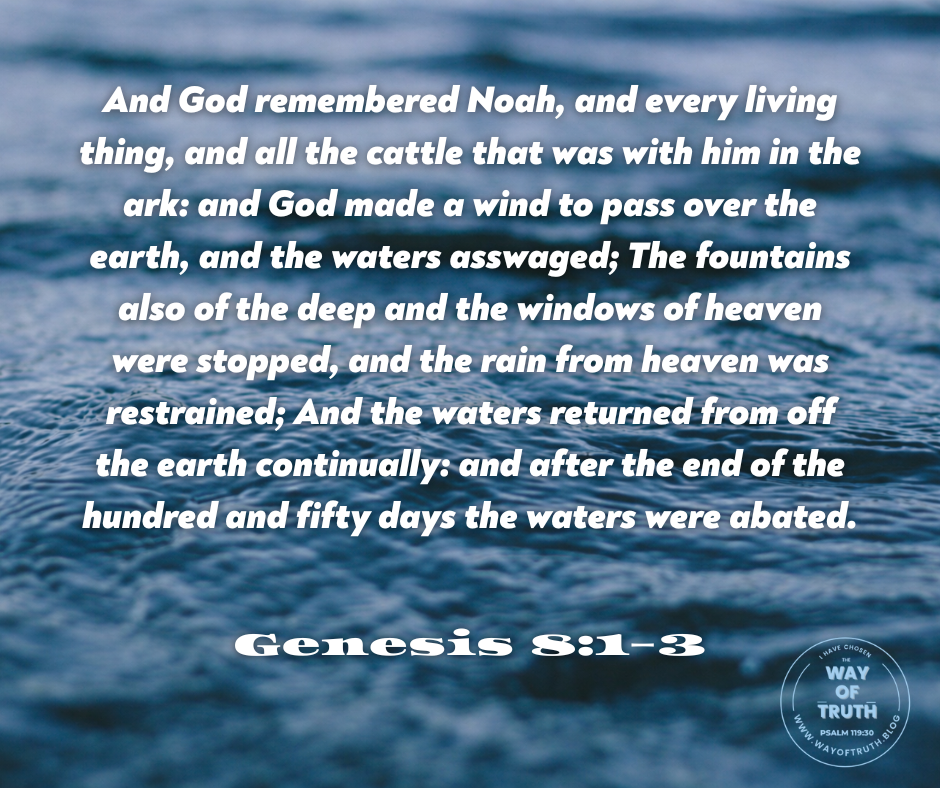
There are moments in Scripture where everything turns, not because circumstances suddenly change, but because God acts. Genesis 8:1–3 is one of those moments. The world is still flooded. The ark still drifts. Nothing looks different from the outside. Yet the most important thing has already happened: “And God remembered Noah.”
That sentence marks the quiet hinge of the Flood narrative. Judgment has reached its full measure, but it will not go one moment further than God allows. Before the waters begin to recede, before Noah sees land or steps into a renewed world, God moves. Deliverance begins not with visible relief, but with divine remembrance.
It’s worth pausing here, because this is often how God works in our lives as well. We tend to look for signs that things are improving before we believe God is near. Scripture reverses that instinct. God’s faithfulness doesn’t wait for circumstances to shift. It moves first.
The Bible’s use of the word remembered doesn’t suggest that God had forgotten Noah during the long months of rain and drifting. God does not misplace His people. To say that God remembered Noah is to say that He now acts decisively on Noah’s behalf, bringing His purpose to its next stage. Remembrance is not mental recall; it’s covenant faithfulness expressed in time.
For Noah, this meant that while he was still surrounded by water, the future had already changed. God sent a wind across the earth, restrained the rain, and stopped the fountains of the deep. Judgment didn’t collapse under its own weight. It was closed by God’s hand. The waters began to return “continually,” not violently or suddenly, but steadily and under control.
There’s something deeply comforting about that word continually. God does not rush restoration, and He does not abandon it halfway through. The waters recede because He wills them to do so, and they don’t stop receding until His purpose is complete. Noah’s rescue unfolds at God’s pace, not Noah’s.
Many believers live in this same in-between space. The storm has passed its worst point, but the ark is still floating. The pain hasn’t vanished. The answers aren’t complete. Yet Genesis 8 teaches us that waiting is not evidence of neglect. Waiting is often the environment in which trust grows.
We also learn here that God’s mercy is never detached from His authority. The same God who opened the windows of heaven now closes them. The same power that brought judgment restrains it. Mercy is not God changing His mind about holiness; it’s holiness expressed faithfully rather than destructively. God’s restraint is as intentional as His judgment.
This matters because it reminds us that hope rests not in chance, but in character. The world didn’t slowly fix itself. Noah didn’t steer the ark toward safety. God governed the entire process. And because God governed it, the outcome was never in doubt.
For the believer, this passage speaks directly to seasons when faith must rest on God’s word rather than visible progress. It teaches us to measure reality not by what we see, but by what God has promised. When God remembers, the outcome is settled even if the process is still unfolding.
Genesis 8 also quietly points us forward. Noah is preserved through judgment, but he’s not freed from sin’s presence. The world will be renewed yet still broken. That prepares us for the greater act of remembrance God accomplishes in Jesus Christ. In Christ, God does not merely restrain judgment; He bears it. The cross stands as the ultimate proof that God remembers sinners, not by overlooking justice, but by fulfilling it.
If you’re walking through a season where relief feels slow, Genesis 8:1–3 reminds you that God’s work often begins before you notice change. You may still be waiting, still praying, still trusting, but that doesn’t mean nothing is happening. God remembers His people. Always.
If you would like to explore the depth, structure, and theology of this passage further, you’re warmly invited to read the full Bible study here: From Judgment to Remembrance: A Study of Genesis 8:1–3.