
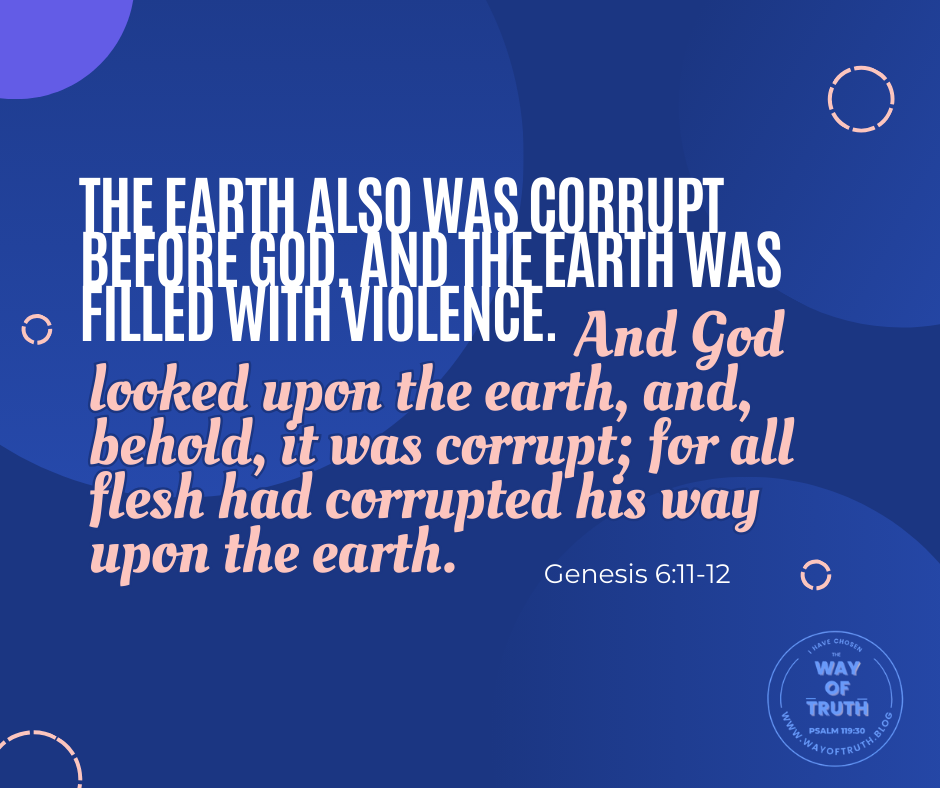
There is a weight to Genesis 6:11–12 that does not quickly lift. These verses slow us down and force us to see the world not as we wish it were, not as culture explains it away, but as God Himself evaluates it. The tragedy of Noah’s generation was not ignorance; it was indifference to God’s presence. The earth was corrupt before God. Life was lived as though He were distant, irrelevant, or safely ignored.
That phrase confronts us devotionally. We do not merely live in a world; we live before a holy God. Every thought, decision, habit, and justification unfolds in His sight. The pre-Flood world collapsed not because people lacked creativity or intelligence, but because they abandoned God’s way and replaced it with their own. Violence filled the earth when reverence for God disappeared from the heart.
This is uncomfortable—but necessary—truth. Scripture does not preserve Genesis 6 to satisfy curiosity about ancient judgment, but to awaken sober self-examination. We are often tempted to think corruption only exists “out there”: in broken systems, hostile cultures, or distant headlines. Genesis presses the question closer. Where have we grown comfortable with what God calls corrupt? Where have we excused attitudes, practices, or silences simply because they are normal?
Yet this passage is not given to drive us to despair. It’s given to drive us to God. Before judgment ever fell, God looked. He saw clearly. And in that same context, Noah found grace. God’s assessment of corruption is never separated from His purpose to redeem. He does not expose sin to shame us, but to rescue us from self-deception.
For the believer, this calls us back to a life lived consciously before God, coram Deo. Faithfulness does not begin with public heroics, but with private obedience. It grows through small, daily decisions to walk God’s way rather than drift with the current. The call is not to isolate ourselves from the world, but to resist becoming shaped by its moral logic.
There is also a quiet warning here for the Church. When violence and corruption become ordinary, God’s people must not lose their moral clarity. Silence, accommodation, and selective obedience slowly dull our witness. The Church is called to be a living contrast: a community that remembers God’s presence, honors His ways, and reflects His character in a world that has forgotten both.
And there’s a missionary note that cannot be missed. If God sees the world so clearly, then love demands that we speak truthfully. Judgment is real, but so is mercy. The same God who judged the ancient world now extends grace through Jesus Christ. To withhold that message out of fear or comfort is not compassion; it’s neglect.
Ask yourself today:
- Where in my life am I most tempted to live as though God’s evaluation were secondary?
- Are there “respectable” compromises I’ve made simply because they’re culturally normal?
- How might God be calling me to walk more deliberately in His way this week for His glory?
- Who around me needs to hear not only that the world is broken, but that Christ saves?
Genesis 6:11–12 reminds us that God sees truly, judges justly, and saves graciously. May we be found walking faithfully before Him: loving righteousness, resisting corruption, and pointing others to the grace that rescues sinners.
If you would like to explore these truths more deeply, I invite you to read the entire Bible study here: Divine Assessment on the Eve of Judgment: A Study of Genesis 6:11–12.
May the Lord use His Word to sharpen our hearts, steady our walk, and draw many to the saving grace found in Jesus Christ.